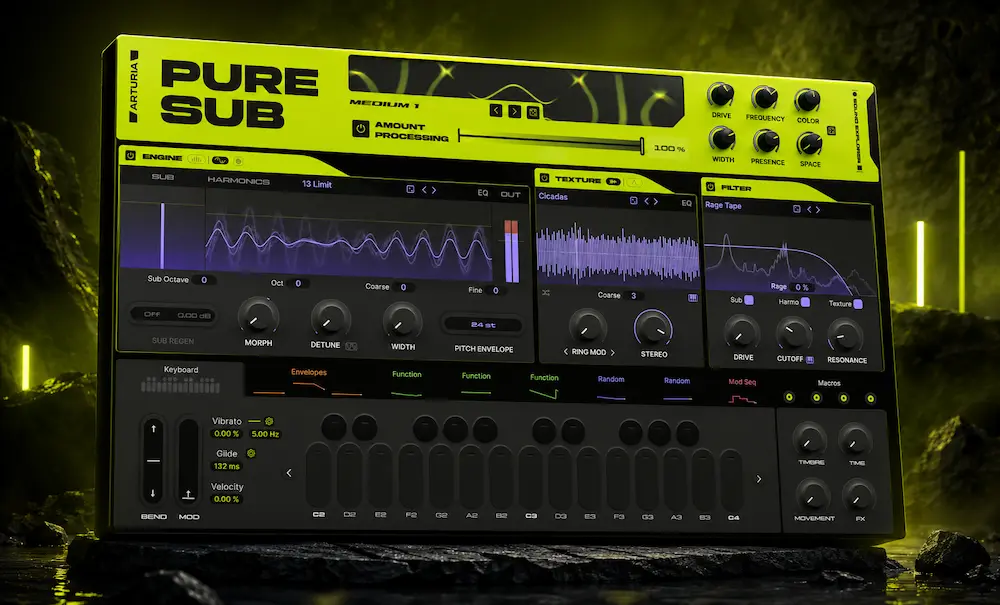
Arturia Pure SUB is a monophonic bass synthesizer and bass-design plugin built specifically for 808s, sub bass, Reese basses and other modern electronic low-end sounds. Its defining feature is the separation of the sound into three independently shaped stages: Sub, Harmonics and Texture, followed by dedicated filtering, bass processing, effects and a final Maximiser.
The most important part of the design is Sub Regen. It allows the original fundamental to be restored after filtering, distortion and other processing, giving the producer a way to push the harmonic and textural content harder without allowing the deepest part of the bass to become equally unstable.
That makes Pure SUB different from a conventional general-purpose synthesizer. The underlying technologies—oscillators, waveform shaping, filters, distortion, modulation and dynamics—are familiar, but they are organized around the specific engineering problems of modern bass production. In this review, I look at Pure SUB not only as a sound-design instrument, but also at how its architecture affects 808 production, mix translation, headroom, stereo behavior and the amount of corrective processing required later in the mix.
Why Pure SUB Separates the Fundamental From the Bass Character
 The problem with heavily processed bass is rarely the lack of low end. It is the lack of control over what happens to the low end once the sound is pushed hard enough to become audible and aggressive. The fundamental needs to remain predictable, while the harmonics can take distortion, filtering, modulation and stereo processing without dragging the entire bass signal through the same treatment.
That distinction is especially important with 808s and synthesized sub bass. A clean fundamental may have excellent low-frequency stability but little presence on smaller playback systems. Adding saturation or distortion makes the bass easier to hear by generating upper harmonics, but those harmonics are created by changing the original waveform. Process the entire signal again with compression, clipping or aggressive filtering and the lowest octave can become increasingly difficult to manage.
Pure SUB puts those functions on separate paths. The Sub layer handles the fundamental with independent level, octave and phase controls. Harmonics supplies the tonal identity through the Pressure and Reese engines, while Texture provides additional material ranging from ring modulation and AM to distortion, noise and oscillator-based sources.
The important point is not that Pure SUB has three layers. Multilayer synthesis is hardly new. The useful decision is that the layers represent different engineering roles in the bass. You can change the harmonic density without necessarily changing the fundamental level, add width to the upper content without deliberately widening the sub, and introduce aggressive texture without making the clean low-frequency foundation part of every processing decision.
In practical use, the separation becomes most noticeable when the bass is pushed beyond a clean sub. I can establish the low-frequency weight first, then increase harmonic density or texture without immediately having to rebuild the sub underneath it. The difference is less obvious on a simple sine-based bass and becomes much more useful once distortion, stereo movement and additional processing start changing the character of the upper bass. That makes Pure SUB feel less like a conventional synth with bass presets and more like a dedicated bass-construction workflow.
That makes Pure SUB less about adding another collection of oscillators and more about moving part of the bass-processing workflow upstream. Instead of generating a complex bass first and separating its problems later with EQ, parallel processing and additional tracks, the instrument gives the producer control over those components before they reach the mix.
Arturia Pure SUB Key Specifications
| Specification | Pure SUB |
|---|---|
| Instrument Type | Monophonic bass synthesizer |
| Sound Architecture | Sub, Harmonics and Texture |
| Harmonics Engines | Pressure and Reese |
| Texture | Noise Sample and Corroder with noise, AM, ring modulation and distortion shaping |
| Filter Modes | 40+ |
| Sub Processor | 33 modes with 6 shaping controls |
| FX Rack | 12 slots, 18 effects |
| Modulation | 3 envelopes, 6 flexible modulator slots, Function, Random, Envelope, Step Sequencer, Voice Modulator, modulation sidechain and 4 macros |
| Presets | 300 factory presets |
| Expression | MPE, Slide, Aftertouch, Velocity and Key Track |
| Formats | VST, VST3, AU, AAX, NKS and standalone |
Sub Regen: Keeping the Fundamental Under Control
Sub Regen is the most technically significant part of Pure SUB’s architecture. It addresses a common problem in bass sound design: the processing that makes a sub audible and aggressive can also make its fundamental less predictable.
Distortion and saturation reshape the waveform rather than simply adding level. Filtering changes the spectral balance, while modulation and effects can introduce further movement in both the waveform and its frequency content. On a bass where the fundamental carries most of the energy, those changes can become much more consequential than they are on a midrange-heavy instrument.
Pure SUB’s approach is to let the bass go through its processing chain while retaining access to the original fundamental. With Sub Regen engaged, the processed low end can be replaced with a regenerated version of that source fundamental. In practical use, this becomes most useful when the harmonic and texture stages are pushed hard enough that the processed waveform would otherwise start changing the character of the sub itself. The upper part of the bass can become more aggressive while the fundamental remains a more stable reference.
That is particularly useful for an 808. Suppose the bass needs enough saturation to produce harmonics that remain audible on smaller speakers. With a conventional synth, one common solution is to split the signal, keep a clean low-frequency layer, process the upper layer separately, and then manage the crossover and phase relationship between them. Pure SUB builds the same basic production concept into the instrument.
The advantage is therefore control, not a better-sounding sine wave. Sub Regen does not make the fundamental inherently deeper, louder or more accurate. It gives the producer a way to preserve a defined low-frequency component while shaping the material above it much more aggressively.
That distinction also defines the feature’s limitation. Sub Regen does not make the complete bass signal immune to phase or translation problems. The harmonic and texture layers can still introduce complex relationships through stereo processing, modulation, filtering and nonlinear effects. The finished patch still needs to be checked in mono and against the kick and other low-frequency elements of the mix.
For mixing engineers, that is the useful takeaway: Sub Regen is best viewed as a sound-design control mechanism, not a substitute for low-end management at the mix or mastering stage.
Hear What Professional Mastering Changes
A well-designed bass can still lose impact when it reaches the finished mix. Low-end balance, punch, stereo width, headroom and overall translation all have to work together at the final stage. If you want to hear how your own track responds to professional mastering, upload up to 35 seconds of your mix and receive a free mastering demo. No commitment is required before you hear the result.
Request your free mastering demo →
Pressure, Reese and Texture: Building the Bass Above the Fundamental
Once the fundamental is treated as a separate element, the rest of the bass can be designed for character rather than sheer low-frequency weight. Pure SUB divides that work between the Pressure and Reese Harmonics engines and the separate Texture layer.
Pressure is the main tonal-shaping engine. It provides an additive approach to waveform construction, allowing the harmonic structure to be shaped directly rather than relying only on a fixed oscillator waveform. The engine can work with multiple waveform positions that can be morphed, giving the producer a way to create movement inside the harmonic content rather than adding movement only through external modulation.
Reese takes a different approach. Its dense, detuned oscillator behavior is designed to produce the moving harmonic character associated with Reese basses. Detune, width, octave and pitch controls can therefore be used to move the bass from a relatively controlled tone toward a much wider and more animated sound.
Both harmonic engines provide a dedicated Pitch Envelope, which is particularly useful for 808 and electronic bass design. A short downward pitch movement at the beginning of a note can create impact without relying entirely on a louder transient. Because pitch movement can be shaped independently from the amplitude envelope, the initial pitch gesture can be adjusted without rebuilding the entire envelope shape.
The harmonic section also includes morph, detune, width, octave, coarse and fine tuning and EQ controls. These are relatively familiar synthesis functions, but having them inside a bass-specific harmonic stage makes it faster to move between a clean low-end foundation and a more animated upper bass.
Texture serves a different role. The Noise Sample and Corroder sources can introduce noise, distortion, ring modulation, AM and additional movement around the main bass. This material does not need to carry the fundamental, which makes it useful for adding presence and character without simply increasing sub energy.
The distinction matters in a mix. Texture is not automatically useful because it makes a patch sound larger in isolation. Its value depends on whether the added harmonic and upper-frequency information improves audibility without creating unnecessary masking, harshness or low-mid buildup around the kick and other instruments.
Pure SUB Presets: Are the Factory Sounds Useful?
Pure SUB ships with 300 factory presets, but the more important question is whether they demonstrate the architecture effectively rather than simply increasing the preset count. The library is centered on the instrument’s intended territory: sub bass, 808s, Reese-style sounds, hard basses, plucks, wobbling basses, club-oriented low end and other electronic bass designs.
That focus is useful because Pure SUB is not trying to provide a general synthesizer library covering pads, leads, keys and cinematic textures. The presets instead function as starting points for the specific production problems the instrument is designed to solve.
The intended sound range is broader than 808s alone. Arturia’s own Pure SUB material demonstrates workflows for Reese bass, house bass, dubstep wobble, punchy 808 and evolving DnB bass, which matches the instrument’s architecture: a stable sub foundation can remain relatively controlled while harmonic movement, texture and processing provide the character above it.
For a producer who normally builds bass from scratch, the presets are still valuable as demonstrations of how the Sub, Harmonics, Texture and Sub Processor stages interact. For experienced users, the more interesting patches are the ones where the harmonic and texture layers contribute presence without simply increasing the fundamental level.
The limitation is the same as the instrument itself: a large preset library does not make Pure SUB versatile outside its intended role. If you need a single synthesizer for bass, leads, pads, keys and experimental sound design, a broader instrument remains a better choice.
Built-In Processing: Useful Sound Design Tools, Not a Replacement for Your Mix Chain
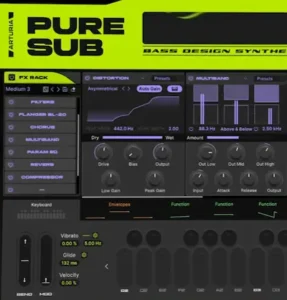
Pure SUB’s processing section is extensive: more than 40 filter modes, a 33-mode Sub Processor, a 12-slot FX Rack with 18 effects, and a final Maximiser with EQ, compression and multiband processing. The raw feature count is less interesting than where those processors sit in the signal path and how they affect the way the instrument is used.
The filter section is also important because Sub, Harmonics and Texture can be routed independently. That reinforces the central design philosophy: the deepest part of the bass does not have to receive exactly the same filtering treatment as the harmonic and textural layers. For sound design, this is often more useful than simply having a large number of filter models.
The Sub Processor comes after the three synthesis layers have been brought through the filter section, making it the main stage for reshaping the combined bass. Its six macros provide broad control over the selected processing mode, which is useful for sound design because you can move between substantially different tonal states without rebuilding a chain outside the instrument. That is a genuine workflow advantage, particularly when auditioning bass sounds against an arrangement.
The FX Rack is primarily about consolidation. Twelve slots and saveable rack presets can keep a bass patch self-contained, reducing the need to route the instrument through several external effects during sound design. The individual effects are not the reason to buy Pure SUB, though. Producers with established saturation, distortion, modulation and dynamics plugins will generally have little reason to abandon them simply because equivalent processing is available inside the synth.
The Maximiser needs more caution. Compression, EQ and multiband processing at the end of the instrument are useful for shaping a preset and judging how a bass behaves when pushed toward a finished level. They can also make an isolated patch sound substantially bigger than it will actually need to be in a mix.
That distinction matters. A bass that sounds impressive in solo is not necessarily a bass that leaves enough room for the kick, vocals and other low-frequency content. Over-processing the output can also hide problems that become obvious once the bass is routed into a real production. The same issue appears later when a mix is pushed toward release level: compression can change how the kick and bass drive the overall dynamics, while clipping and limiting can increase density at the cost of transient structure. For a closer look at how compressor timing, detector response and low-frequency interaction affect the whole stereo mix, see our guide to mix bus compressor plugins.
For a mixing-oriented workflow, the better approach is to use Pure SUB’s internal processing to establish the sound, then evaluate the result with the rest of the arrangement playing. External EQ, compression, clipping or limiting should still be used when the mix requires them. Pure SUB’s processing is best understood as part of the sound-design environment, not as a substitute for deliberate mix-bus or mastering decisions.
Using Pure SUB in a Real Mixing Workflow
 Pure SUB is a sound source, not a mixing processor, but its internal signal architecture can change how a bass part is prepared before it reaches the mix.
Consider a typical electronic bass with a strong fundamental and a heavily processed upper layer. The deepest part of the sound generally benefits from being narrow and predictable, while the harmonics can carry more width, distortion and modulation. When both are generated and processed as one signal, those decisions have to be reconstructed later with filters, parallel processing and additional routing.
Pure SUB lets the producer make those decisions at the source. The Sub layer can establish the low-frequency foundation independently, while Harmonics and Texture provide the information that makes the bass audible and gives it movement. That is particularly useful when a bass needs to remain powerful in mono but still feel large in stereo.
One practical advantage becomes obvious when the patch is checked in mono. The harmonic and texture layers can carry much more apparent width than the fundamental, so the bass can feel larger in stereo without requiring the deepest part of the signal to become equally wide. The mono check is still essential, because changes in the upper layer can alter perceived level, punch and tonal balance even when the sub itself remains controlled.
It also changes the way distortion can be approached. Instead of driving the entire bass simply to generate enough upper harmonics, the producer can push the harmonic or texture content harder while using Sub Regen to retain a more controlled fundamental. The result still needs to be judged in context, but the initial sound-design decision is considerably easier to manage.
The same principle applies to level. If the fundamental is doing most of the low-frequency work, changing the amount of harmonic distortion does not have to mean changing the sub level at the same time. That separation gives the producer more control over perceived density without constantly rebuilding the balance between the two components. Once the bass is part of the mix, more targeted dynamics control may still be required; our Parish Audio Parametric Compressor review looks at a different approach to shaping compression around specific frequency and sidechain requirements.
The practical benefit is therefore not that Pure SUB produces a universally mix-ready bass. It is that more of the important decisions can be made before the bass reaches the mixer: how much energy belongs to the fundamental, how much presence comes from harmonics, and how much width or movement belongs in the upper layers. The final relationship with the kick, headroom and stereo image still has to be solved in the mix.
808s, Reese Bass and Distorted Subs: Where Pure SUB Earns Its Keep
Pure SUB becomes most convincing when the bass has to perform two jobs at once: carry a stable fundamental and remain audible through a dense arrangement. That is the situation where its dedicated architecture saves more work than a conventional synthesizer with a larger but less focused feature set.
808s are the strongest case for Pure SUB. The instrument’s architecture maps unusually well to the way modern 808s are shaped: establish the fundamental, use a dedicated pitch envelope to control the initial pitch movement, then build enough harmonic content for the bass to remain audible once it leaves a full-range monitoring system.
That workflow also gives the producer more control over the trade-off between weight and presence. The Sub layer can carry the low-frequency foundation while Pressure adds harmonic density, and Texture or distortion can be introduced without requiring the entire sound to behave as a single processed layer. For 808s that need to remain recognizable on smaller speakers without turning the sub itself into a distorted block of low-frequency energy, that separation is genuinely useful.
Reese bass is the second strong use case. The dedicated Reese engine removes much of the initial setup associated with building a dense, detuned bass from multiple oscillators. The advantage is not that Pure SUB can create a sound that a general-purpose synthesizer cannot. It is that the instrument gets to the relevant starting point faster, with the harmonic layer already treated as a primary part of the bass rather than something that has to be constructed afterward.
Distorted subs are where Sub Regen becomes most relevant. Heavy nonlinear processing is often used to make a bass cut through a dense arrangement, but applying the same treatment to the entire signal can turn the fundamental into the least predictable part of the sound. Pure SUB’s ability to retain a regenerated fundamental while pushing the processed content harder gives the producer a cleaner way to make that trade-off.
The case is much weaker outside bass-focused electronic production. Rock, acoustic music and many conventional pop sessions rarely need a dedicated three-part bass architecture. If the job is simply to generate a clean synth bass, a broad subtractive synthesizer may be faster. If the part is an electric or acoustic bass, Pure SUB is solving a problem that does not exist in the first place.
That is ultimately the trade-off with Pure SUB: the more often your production depends on engineered electronic low end, the more valuable its specialization becomes. For producers who rarely build 808s, Reese basses or aggressively processed subs, the extra specialization is more likely to become unused functionality than a workflow advantage.
Where Pure SUB Stops Being Useful: Mixing and Mastering
Pure SUB is a sound source with integrated processing, not a replacement for the tools used to balance a finished mix. That distinction matters because its low-end architecture can make a bass easier to design, but it does not remove the problems that appear once that bass has to coexist with the rest of a production.
For a mixing engineer, the value is primarily upstream. If you are designing or replacing a bass part, Pure SUB can provide a controlled starting point and reduce the amount of external routing needed to build the sound. Once the bass is part of the arrangement, however, conventional mix tools still have the job of managing its relationship with the kick, other low-frequency instruments and the master bus. EQ, compression, clipping and limiting remain separate decisions.
That makes Pure SUB more relevant to a producer who also handles the mix than to an engineer who receives completed stems. If a client sends a finished bass stem that is too heavy below the fundamental, masks the kick or triggers the limiter disproportionately, owning the synthesizer does not solve the problem. The appropriate response is still corrective processing—or, if the production allows it, asking for a revised bass source.
The case for mastering is weaker still. A mastering engineer may process a track containing a Pure SUB bass, but the origin of that bass is largely irrelevant at the mastering stage. The useful questions are whether the low end has enough headroom, whether the stereo field is appropriate, whether the dynamics translate, and whether the bass is forcing unnecessary work from the limiter.
In other words, Pure SUB can help prevent some low-end problems before mixing and mastering. It cannot replace the engineering decisions required once those problems exist in a finished production. Before a track reaches mastering, the practical question is whether the entire mix—not just the bass—remains stable when the level is pushed. Our guide to preparing a mix for mastering goes deeper into the checks that matter before that handoff.
What Makes Arturia Pure SUB Different?
Pure SUB is not based on a revolutionary synthesis technology. Its oscillators, waveform shaping, filtering, distortion, modulation and dynamics processing all have familiar equivalents elsewhere. The meaningful difference is the way those tools are organized around a bass-specific signal path.
The instrument separates the fundamental, harmonic body and texture into dedicated stages, then provides filtering, Sub Processor, effects and dynamics around that structure. Sub Regen reinforces the same concept by allowing a clean fundamental to be recreated after processing.
That makes Pure SUB a specialist rather than a general-purpose synthesizer. A producer could recreate much of the same concept with Pigments, SubLab XL, UVI Rumble or several external processors, but doing so requires more routing and more decisions. Pure SUB’s advantage is that the architecture is already designed around the problem.
The result is workflow specialization rather than breakthrough DSP. For producers who regularly create 808s, Reese basses, distorted subs and other electronic low-end sounds, that specialization is the main reason to choose Pure SUB over a broader synthesizer.
Pure SUB vs SubLab XL, UVI Rumble and Pigments: Which Bass Synth Fits the Workflow?
Pure SUB is not automatically the better choice than every bass-oriented synthesizer. The decision depends on whether the priority is 808 production, synthesized bass design, broad sound-design capability, or simply getting a usable low-end part together quickly.
Pure SUB is monophonic. For 808s, sub bass, Reese basses and most bass-music workflows, that is a logical design choice rather than a serious limitation. It becomes more relevant if you want one instrument to cover polyphonic bass chords, pads or general-purpose melodic synthesis.
| Instrument | Primary Workflow | Low-End Architecture | Sound Design | Best For | Main Trade-Off |
|---|---|---|---|---|---|
| Arturia Pure SUB | Dedicated bass sound design | Separate Sub, Harmonics and Texture with Sub Regen | Deep bass-focused modulation and processing | 808s, Reese basses, distorted subs, UK bass | Monophonic and intentionally specialized |
| SubLab XL | 808 and sample-based bass production | Hybrid synthesis and sample-based workflow | Fast sound creation with strong 808 focus | Trap, hip-hop, drill and sample-driven bass | More focused on 808 and sample-driven workflows |
| UVI Rumble | Multi-band bass synthesis | Frequency-oriented bass architecture | Broad electronic bass sound design | Deep bass design and electronic production | Broader system with more complexity to manage |
| Arturia Pigments | General-purpose synthesis | Flexible multi-engine architecture | Much broader synthesis and modulation capability | Bass, leads, pads, sequences and full sound design | Requires more setup for a bass-specific task |
SubLab XL is the more obvious choice when the workflow revolves around 808s, samples and rapid beat production. Its combination of synthesis and sample-based layers makes it particularly well suited to producers who want to shape an existing bass source as much as generate one from scratch. Pure SUB is more interesting when the bass is being constructed as a controlled synthesis system, with the fundamental and harmonic content treated as separate design elements.
UVI Rumble is the closest architectural alternative. Its approach also divides bass generation into independently processed regions, but the organizing principle is different. Rumble is built around frequency-oriented layers with extensive oscillator and shaping options, while Pure SUB is organized around the functional roles of the fundamental, harmonic body and texture. Rumble therefore makes more sense when deep sound-design flexibility is the priority; Pure SUB makes more sense when the producer wants a narrower bass-specific workflow.
Pigments is the strongest choice for a producer who wants one synthesizer to cover bass, leads, pads, keys, sequences and experimental sound design. It is also capable of sophisticated bass construction, but its flexibility can be unnecessary when the task is specifically to build a modern sub or 808. Pure SUB trades that breadth for a more direct path to the target.
The important comparison is therefore not simply which synthesizer sounds better. Pure SUB’s advantage is workflow specialization. If you regularly create electronic bass and want the instrument itself to enforce a useful separation between the fundamental and the material above it, that specialization has practical value. If you need a broader synthesis platform, one of the alternatives is likely the better long-term investment.
Low-End Translation: What Pure SUB Cannot Solve for You
A controlled sub inside the instrument is only the starting point. Low-end translation is a mix problem, not a synthesizer feature. Pure SUB can give the producer more control over the relationship between the fundamental and its harmonics, but the finished bass still has to work at different playback levels, bandwidths and listening positions.
A bass can sound perfectly balanced on full-range headphones while carrying more energy below the useful range of the monitoring system than the mix actually needs. The opposite problem is just as common: a spectrum that looks conservative in the sub region can produce a bass that disappears on smaller speakers because there is not enough harmonic information above the fundamental to establish its pitch and character.
That is where Pure SUB’s architecture becomes useful rather than self-sufficient. Start with the fundamental at a level that leaves sensible headroom, then add harmonic content until the bass remains identifiable when the playback system contributes less low-frequency extension. After that, judge the combined signal against the kick and the rest of the arrangement rather than evaluating the bass in isolation.
Stereo information deserves the same scrutiny. The deepest part of the bass generally benefits from a stable, narrow image, while the harmonic and texture layers can carry movement and width. Pure SUB makes that separation easier to build, but it does not make every wide bass patch mix-safe. The wider the processed upper content becomes, the more important it is to check the result in mono and listen for changes in perceived level, punch and tonal balance.
There is also a direct mastering implication. Excessive fundamental energy can consume headroom without producing a proportional increase in perceived loudness. A limiter responding primarily to sub energy may reduce overall level or reshape the groove before the producer realizes what is happening. Pure SUB can help create a more disciplined source, but once the bass is printed into the mix, headroom, dynamics, stereo behavior and final translation are still engineering decisions. If the finished track still has unstable or excessive low end, the next question is no longer how the bass was synthesized but what can actually be corrected at the mastering stage; our guide to fixing bass in mastering covers that distinction in detail.
Compatibility, CPU Load and Early Reliability
Pure SUB covers the main professional DAW formats and can also run as a standalone application: VST, VST3, AU, AAX and standalone. Arturia also supports NKS, MPE and Apple Silicon, with Windows 10 or later and macOS 11 or later listed as supported platforms.
CPU performance should be judged patch by patch rather than by the synth engine alone. Pure SUB combines three sound-generation stages with filtering, modulation, the Sub Processor, a multi-effect rack and final processing, so patches using heavy distortion, modulation and effects can demand more resources than simpler sub-focused sounds. There is currently no standardized independent benchmark comparing Pure SUB directly with SubLab XL, UVI Rumble and Pigments, so assigning a fixed CPU ranking would be misleading.
Reliability has the same limitation. Pure SUB is a new instrument with no long-term stability record, and early user reports are still too limited to establish a meaningful failure rate. There is at least one KVR report of crashes in both FL Studio and Reaper, while other users have reported successful demo use. Those reports point to an issue worth watching, but they do not justify labeling the plugin broadly unstable.
For professional sessions, the practical response is simple: test the current build in the DAW, operating system and project template you actually use before making it part of a critical production. That matters more than a generic compatibility checklist, particularly when the plugin is still in its first release cycle.
Arturia Pure SUB Price and Value: Who Gets the Best ROI?
Pure SUB is currently available for $49/€49 as a limited-time launch offer, reduced from the regular $79/€79 price. The difference matters less than what the instrument is replacing in the user’s workflow. A producer buying a first dedicated bass synth is getting a fairly complete environment; a producer who already owns several capable synthesizers and bass-specific tools is mainly paying for a more focused workflow.
At the current $49/€49 offer, the specialization is easy to justify for anyone regularly producing 808s, Reese basses or heavily processed electronic low end. At the regular $79/€79 price, the existing plugin collection becomes more important. If Pigments, SubLab XL, UVI Rumble or comparable tools already cover the same jobs, Pure SUB needs to save enough time in actual production to justify adding another specialized instrument.
That is where its value proposition is strongest. Pure SUB puts synthesis, harmonic generation, modulation and bass-oriented processing into a single environment. The benefit is not simply having fewer plugins installed. It is avoiding the extra routing, layering and corrective processing that can be required when building the same fundamental-plus-harmonics workflow from a general-purpose synthesizer.
For a producer who rarely creates electronic bass, that specialization works against the purchase. A broader synthesizer will usually deliver more value across a wider range of projects. For someone whose sessions repeatedly involve 808s, Reese basses and distorted subs, the narrower design is an advantage because the instrument spends less time asking the user to configure it for the job.
The best measure of Pure SUB’s value is production frequency, not feature count. If its architecture matches a task you perform every week, $79 is a reasonable price for workflow efficiency. If that task appears only occasionally, the same $79 is better spent on a more versatile instrument or on tools that address problems further down the mixing and mastering chain.
Who Should Buy Arturia Pure SUB — and Who Should Skip It?
Pure SUB makes the most sense when bass design is a recurring part of the production workflow. Its value drops quickly when the instrument’s specific architecture is rarely used.
- Electronic and bass-music producers: The strongest fit. If your sessions regularly involve 808s, Reese basses, distorted subs or heavily processed low end, Pure SUB’s architecture is built around the problems you are already solving.
- Hip-hop and 808 producers: A particularly good match. The independent fundamental, pitch envelope and harmonic processing make it easier to shape the weight, attack and audibility of an 808 without treating the entire sound as one undifferentiated layer.
- Sound designers: Worth considering if you want a dedicated bass-design environment rather than another general-purpose synthesizer. The modulation system and processing stages provide enough depth to move well beyond factory-preset use.
- Mixing engineers: Useful only when sound creation or bass replacement is part of the job. Pure SUB can provide a controllable source, but it does not replace the processors used to fit an existing bass into a finished mix.
- Mastering engineers: Low priority. The instrument generates bass; it does not address the core problems of mastering. Unless you also create or edit electronic productions, there is little reason to add it to a mastering-focused toolkit.
- General-purpose synthesizer users: Think twice. If Pigments or another full-featured synthesizer already covers your bass work, Pure SUB is primarily a workflow specialization rather than a major expansion of your sonic capabilities.
- Rock, acoustic and traditional pop producers: Usually a skip. Unless synthesized low end is a regular requirement, a dedicated bass synth is unlikely to provide enough recurring value to justify another plugin.
Arturia Pure SUB: Pros and Cons
Pros
- Purpose-built bass architecture: The separation of fundamental, harmonics and texture reflects a real electronic-bass production workflow.
- Sub Regen: Provides a practical way to retain a controlled fundamental while processing the upper content more aggressively.
- Fast 808 workflow: Independent pitch-envelope and harmonic controls make transient and tonal shaping faster than building the same structure externally.
- Effective Reese and distorted-bass design: Dedicated synthesis and processing reduce setup time for common modern bass sounds.
- Deep modulation: Enough routing flexibility to support evolving bass patches rather than limiting the instrument to preset-based production.
- Self-contained sound design: Integrated filtering, distortion and effects can reduce external routing when building and auditioning bass sounds.
- Current launch pricing: At $49/€49, Pure SUB is particularly easy to justify for producers who regularly use 808s, Reese basses and processed electronic low end. At the regular $79/€79 price, its value depends more heavily on how often the dedicated bass workflow is actually used.
Cons
- Highly specialized: Its value drops sharply if electronic bass is only an occasional part of the production workflow.
- Not a general-purpose synth replacement: A broader instrument such as Pigments offers considerably more range for the same general category of software synthesizer.
- Limited evidence on performance: Independent CPU, latency and long-session benchmarks are still insufficient to make strong performance claims.
- New-product reliability: There is not yet enough release history to establish a long-term stability record.
- Processing can flatter presets: The built-in Maximiser can make isolated sounds appear more finished and powerful than they may need to be in a mix.
- Little direct value for mastering: It is a bass-generation tool, not a mastering utility, so its relevance to mastering-only workflows is limited.
Overall Rating
| Category | Rating |
|---|---|
| Sound Quality | 9/10 |
| Workflow | 9.5/10 |
| Low-End Control | 9.5/10 |
| Mix Translation | 8.5/10 |
| Sound Design Flexibility | 7.5/10 |
| Value for Money | 8.5/10 |
| Overall | 8.8/10 |
Sound Quality — 9/10: Pure SUB produces convincing modern electronic bass with enough harmonic density, movement and weight for 808s, Reese sounds and distorted subs. The score stops short of 10 because its strength is specialization rather than an unusually broad or groundbreaking synthesis engine.
Workflow — 9.5/10: This is one of Pure SUB’s strongest advantages. Separating the fundamental, harmonics and texture turns a common multi-stage bass-processing workflow into a much more direct sound-design process. The instrument removes setup work without pretending to replace the rest of the mix chain.
Low-End Control — 9.5/10: Sub Regen is the feature that justifies the high score. Retaining a controlled fundamental while pushing harmonic and textural processing harder is a practical engineering advantage, particularly for aggressive 808 and electronic bass designs. It improves control rather than simply adding more low-end weight.
Mix Translation — 8.5/10: Pure SUB’s architecture makes it easier to keep the fundamental controlled while adding harmonic and stereo information above it. That is a useful starting point for translation, but the instrument cannot solve kick interaction, headroom, mono compatibility or final dynamics on its own. The score reflects how well the architecture supports those decisions rather than suggesting that every preset is automatically mix-ready.
Sound Design Flexibility — 7.5/10: There is substantial modulation, filtering, processing and texture capability, but Pure SUB is intentionally constrained by its bass-focused architecture. A broader synthesizer such as Pigments offers significantly more range when the production extends beyond electronic low-end design.
Value for Money — 8.5/10: At the current $49/€49 launch price, Pure SUB offers strong value for producers who regularly build 808s, Reese basses and processed electronic low end. At the regular $79/€79 price, the specialization becomes harder to justify unless dedicated bass design is a recurring part of the workflow. For occasional bass work, a more versatile synthesizer can cover a wider range of projects.
Overall — 8.8/10: Pure SUB earns its score through focused engineering rather than feature count or revolutionary synthesis. Its separation of fundamental, harmonic content and texture makes difficult low-end design faster and more controllable, while its specialized nature keeps it from competing with full-range synthesizers on versatility.
Arturia Pure SUB Verdict: A Specialized Bass Tool That Gets the Workflow Right
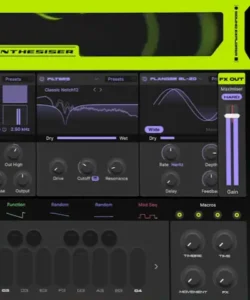 Pure SUB’s strongest argument is not its filter count, effects rack or preset library. It is the decision to build the instrument around a problem that bass producers repeatedly solve with external routing: keeping the fundamental controlled while shaping the harmonic and textural content independently.
That is a meaningful workflow improvement, but it is not a breakthrough in synthesis. The underlying tools are familiar, and a capable producer could build comparable signal paths with Pigments, SubLab XL, UVI Rumble or a combination of a synthesizer and external processing. Pure SUB’s advantage is that the relevant architecture is already there when the job is specifically to create modern electronic bass.
That makes it particularly convincing for 808s, Reese basses and aggressively processed subs. It is considerably less compelling as a general-purpose synthesizer and has little reason to be part of a mastering-focused setup. Producers who already have a mature collection of bass instruments should buy it only if its workflow is faster enough to matter in their actual sessions.
The current $49/€49 launch offer makes Pure SUB particularly easy to justify for producers who regularly build 808s, Reese basses and aggressively processed electronic low end. At the regular $79/€79 price, the decision depends more heavily on how often its specialized workflow saves time in real production. If that use case is occasional, a broader synthesizer may offer better long-term value.
Final verdict: Pure SUB is a strong specialist instrument, not a must-have studio standard. Its value comes from making bass architecture easier to control, not from introducing sounds or DSP techniques that could not be achieved elsewhere. For producers who repeatedly build modern electronic low end, that focused workflow is enough to make Pure SUB worth owning.
Find Out What Your Mix Is Actually Missing
A powerful low end, clear midrange and competitive level are not separate goals. The final master has to balance them without sacrificing punch, depth or musical impact. Sometimes the difference is a few precise processing decisions; sometimes it is knowing what not to change. That is where an experienced mastering engineer can make a measurable difference beyond what another plugin can provide.
Don’t judge your mix only by meters or plugin chains. Upload up to 35 seconds and hear your own track with a free professional mastering demo. You can compare the original and mastered versions before deciding whether a full mastering session is worth it for your release.
Get your free mastering demo →
Arturia Pure SUB FAQ
Can Arturia Pure SUB be used in FL Studio, Ableton Live, and other major DAWs?
Yes. Pure SUB is available in VST, VST3, AU and AAX formats, covering the major Windows and macOS DAW workflows. Because early reports include some isolated compatibility issues, a new installation should still be tested in the specific DAW and project template used for critical work.
Does Pure SUB support Apple Silicon and MPE?
Yes. Arturia supports Apple Silicon on macOS, and Pure SUB includes full MPE support with Slide. NKS support is also included for compatible controller workflows.
Should the sub layer in Pure SUB be kept in mono?
Not as an absolute rule, but the deepest part of a bass generally benefits from a stable, narrow image. Pure SUB’s separate harmonic and texture layers make it easier to keep spatial movement above the fundamental rather than applying the same stereo treatment to the entire bass signal.
Can Pure SUB create a mix-ready bass without external plugins?
It can produce a finished-sounding bass patch on its own, but “mix-ready” still depends on the arrangement. The built-in processing is useful for sound design, while EQ, dynamics and level control may still need to be handled externally once the bass is competing with the kick and other instruments.
Is Arturia Pure SUB CPU-heavy?
There is not enough independent benchmark data to give Pure SUB a meaningful CPU ranking against SubLab XL, UVI Rumble or Pigments. In practice, the load should be evaluated with the actual patch: heavy distortion, modulation, filtering and effects can create a very different CPU footprint from a simple sub-focused sound. For a critical production system, testing the current build in the target DAW is more useful than relying on a generic CPU figure.
Is Pure SUB a good choice for a producer who already owns Pigments?
Only if bass production is frequent enough for the specialized workflow to save meaningful time. Pigments is substantially broader, while Pure SUB provides a more constrained environment built specifically around modern electronic bass.
Is Pure SUB useful for bass sound design beyond 808s?
Yes. The Reese engine, harmonic processing, Texture section and modulation system make it suitable for distorted subs, Reese-style basses, bass-house sounds, DnB, dubstep and other electronic bass designs. Its strongest advantage remains workflow rather than access to an otherwise impossible sound.
Is Pure SUB a good mastering tool?
No. Its mastering relevance is indirect. A mastering engineer may need to manage a Pure SUB-generated bass in a finished mix, but the synthesizer itself is not a substitute for mastering EQ, dynamics, clipping, limiting or stereo-control tools.
Is Arturia Pure SUB worth buying if I already have SubLab XL or UVI Rumble?
Only if Pure SUB’s fundamental/harmonics/texture workflow fits your production better. The three instruments overlap, so buying all of them is difficult to justify unless each serves a distinct role in the studio.
How much does Arturia Pure SUB cost?
Pure SUB is currently available for $49/€49 during Arturia’s limited-time launch offer, reduced from the regular $79/€79 price. The offer is currently scheduled to run through September 15, 2026. The regular price is easier to justify when 808s, Reese basses and dedicated electronic bass design are recurring parts of the production workflow.
Is Arturia Pure SUB worth $79 at the regular price?
For producers who regularly build 808s, Reese basses and distorted electronic low end, $79 is reasonable. For occasional bass work, a general-purpose synthesizer or an existing bass instrument will usually provide better value.

Yurii Ariefiev evaluates audio production tools from an engineering perspective, with particular attention to bass design, low-end control, dynamics, stereo behavior and how processing choices translate into real mixes.
At AREFYEV STUDIO, instruments and plugins are judged by what happens beyond the interface: how a sound holds together in a mix, how much headroom it consumes, how reliably it translates across playback systems, and what those decisions mean for the final mastering stage.
☕ Buy me a coffee