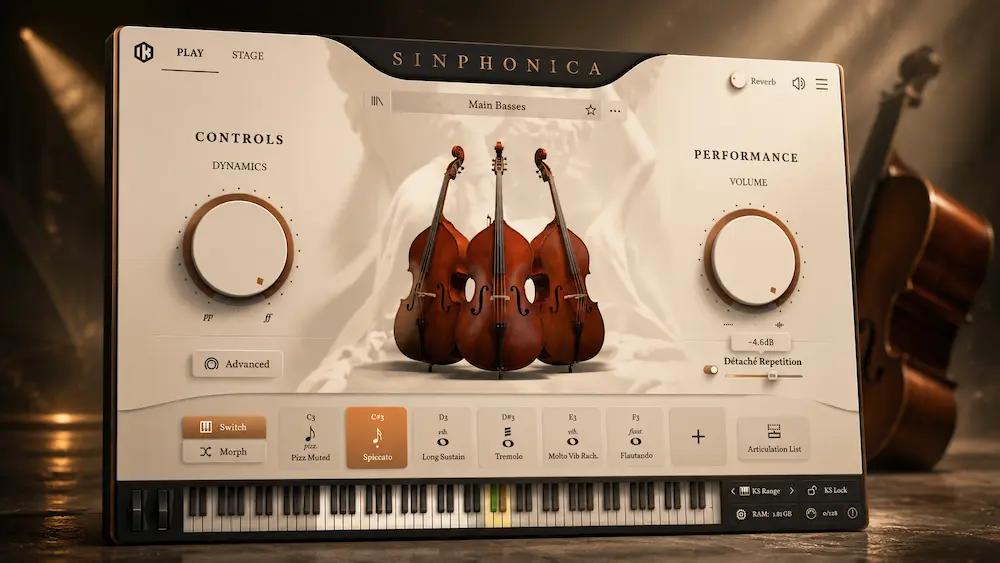
IK Multimedia enters an already mature orchestral-library market with Sinphonica Maestosa Strings. The library is built around a 60-player Italian string orchestra, but its more interesting proposition is the way performance, articulation and spatial controls are combined inside the instrument. For producers and engineers, that makes workflow and mix behavior more relevant than the headline sample count.
Maestosa Strings is the first instrument in IK Multimedia’s new Sinphonica platform. It combines a 60-player Italian string orchestra recorded at Milan’s Officine Meccaniche Studios with more than 40 articulations, five True Legato styles, eight microphone perspectives, Articulation Morphing and PALCO Virtual Stage Positioning. The complete library requires 133.1 GB of storage, with 16 GB of RAM and 250 GB of available disk space listed as minimum requirements. The release is scheduled for October 8, 2026, according to IK Multimedia’s current release information.
That makes the performance architecture more important than the sample count. For composers and producers, the practical test is how much programming, articulation switching and spatial shaping can be handled inside Sinphonica before the session turns into a conventional mixing job. That is where Maestosa Strings has the strongest case to make.
How we assess Maestosa before release: This review separates documented features from engineering assessment. At the pre-release stage, the evaluation focuses on the instrument’s performance architecture, articulation workflow, microphone routing, spatial implications, system requirements and likely behavior in a professional mix. Claims about CPU load, large-template stability, phase coherence and final sound quality are deliberately not presented as measured results until the released version can be tested in a real session.
In This Review
- Sinphonica Maestosa Strings at a Glance
- Why Sinphonica Takes a Different Approach
- Orchestral Workflow and Performance Control
- Features vs Real-World Evidence
- Storage, RAM and Template Overhead
- Comparison with Other Orchestral Libraries
- Who Should Use Maestosa Strings
- Mixing and Mastering
- Price, ROI and Platform Risk
- Verdict
- FAQ
Sinphonica Maestosa Strings at a Glance
| Specification | Maestosa Strings |
|---|---|
| Instrument Type | 60-player symphonic string orchestra |
| String Sections | Violins I, Violins II, Violas, Cellos and Double Basses |
| Articulations | More than 40 in the complete collection, with long, short and performance articulations |
| True Legato | 5 styles: Slur, Glissando, Portamento Slow, Portamento Fast and Runs |
| Dynamic Layers | Up to 5, depending on articulation |
| Round Robins | Up to 6, depending on articulation |
| Microphone Perspectives | 8 |
| Spatial System | PALCO Virtual Stage Positioning |
| Performance Control | Articulation Morphing, custom articulation mapping and Dynamic Curve |
| Production Tools | EQ, stereo imaging and multiple reverb environments |
| Cinematic Content | Cinematic textures and ensemble patches |
| Storage | 133.1 GB for the complete collection |
| Minimum RAM | 16 GB |
| Plug-in Formats | AU, VST3 and AAX, depending on operating system |
| Release | October 8, 2026 |
The specification sheet shows where Maestosa sits technically: a large sampled string library with an unusually strong emphasis on performance management and spatial control. For a working engineer, the relevant question is how those systems affect articulation editing, source balance, stereo placement and the amount of processing required after the instrument reaches the DAW.
Why Sinphonica Takes a Different Approach to Orchestral Production
 The high-end orchestral library market is already saturated with strong recordings. Spitfire Audio, Vienna Symphonic Library, Orchestral Tools, EastWest and Cinematic Studio Series all offer deeply sampled strings with extensive articulations and detailed microphone setups. Another well-recorded string section, by itself, is not a compelling reason to change libraries.
The harder problem is workflow. Orchestral programming can become an exercise in managing keyswitches, MIDI controllers, articulation changes, multiple instrument instances and spatial processing rather than shaping the performance itself. A library may sound excellent in isolation and still be slow to work with once a full arrangement is on the screen.
That is the area Sinphonica is trying to address. Maestosa combines articulation control, multiple legato behaviors, articulation morphing and microphone-based spatial positioning within the instrument instead of leaving every decision to the DAW mixer. The practical appeal is simpler: if articulation, dynamics and placement can be handled inside the instrument, there may be less MIDI cleanup and less corrective work once the parts reach the mix.
Whether that approach is actually faster or more convincing than established libraries is the more important question—and one that can only be answered by working with the instrument in a real scoring or production session.
Hear What Professional Mastering Does to Your Mix
A detailed orchestral mix can still lose impact through excessive density, uncontrolled dynamics, or an unstable stereo image. If you want to hear how your own track translates after professional processing, upload up to 35 seconds of your mix and receive a free mastering demo. You can compare the result directly and decide whether the additional clarity, depth, punch, and balance are worth taking the track further.
Request your free mastering demo →
What Maestosa Strings Changes in the Orchestral Workflow
A 60-Player Ensemble Built for Full-Scale Writing
Maestosa Strings covers five orchestral sections: 16 First Violins, 14 Second Violins, 12 Violas, 10 Cellos and 8 Double Basses. The sections are available individually or as part of the complete collection.
The important detail is the section balance, not the 60-player headline. The library is built around a conventional large string-orchestra layout, which makes it a natural fit for full ensemble writing, cinematic scoring and hybrid productions where the strings need to occupy a substantial part of the arrangement. It is less specifically aimed at intimate chamber textures, where smaller ensembles and closer room perspectives tend to be more appropriate.
Buying individual sections also changes the economics of the library. A composer working primarily with violins and cellos can start with those sections rather than committing to the full 133.1 GB installation, then expand later if the Sinphonica workflow proves useful.
Five Legato Behaviors for Different Musical Phrases
Sinphonica includes five True Legato styles: Slur, Glissando, Portamento Slow, Portamento Fast and Runs.
For orchestral programming, transition behavior is often more important than the quality of a single sustained note. A convincing sustain can still sound synthetic when every interval uses the same transition. Different legato behaviors give the composer more control over how a line moves between notes, particularly when switching between lyrical passages, audible slides and faster runs.
True Legato itself is established sample-library technology. The practical advantage here is having several transition behaviors available within the same instrument, reducing the need to build separate tracks or manually construct every change in articulation.
Articulation Morphing Moves More Performance Control Into the Instrument
Articulation Morphing is only one part of Maestosa’s performance architecture. The Sinphonica Player also provides customizable articulation mapping and Dynamic Curve control, allowing the composer to define how articulations are accessed and how the instrument responds across the performance.
This matters because orchestral programming is rarely limited to choosing the correct articulation. The more important problem is controlling the transition between playing techniques without interrupting the musical line. A custom articulation map can reduce unnecessary keyswitch movement, while Dynamic Curve provides another layer of control over how expressive changes are shaped.
Articulation Morphing then extends that workflow by allowing transitions between playing techniques to be shaped through MIDI control rather than treated as isolated articulation states. The practical advantage is therefore cumulative: mapping determines how the performance is organized, Dynamic Curve influences its response, and Morphing helps connect different playing techniques within the phrase.
Sinphonica also moves part of the finishing process into the instrument itself. Integrated EQ, stereo imaging and multiple reverb environments can be used before the signal reaches the DAW’s conventional mix chain. That does not make external processing unnecessary, but it gives the composer more control over the source before mixing begins.
The important distinction is that these tools should be evaluated as a workflow system rather than as a list of isolated features. If they reduce articulation editing and corrective processing, they have practical value. If they simply reproduce functions already handled efficiently by an existing orchestral template, their advantage is mainly convenience.
That same source-first principle is explored from a different angle in our Arcane Strings review, where player variation, pitch movement and uneven timing are treated as part of the recorded performance rather than something added later with processing.
Eight Microphone Perspectives and PALCO Put Spatial Decisions Upstream
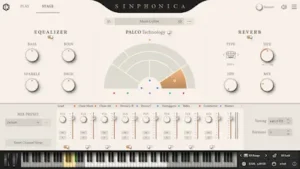
Maestosa provides eight microphone perspectives: Spot Lead, Close Main, Close Alternative, Decca Stereo L/R, Decca Center, Outriggers, Sides and Conductor. PALCO Virtual Stage Positioning is designed to work with those perspectives to control the perceived placement of the sections within the orchestral stage.
This is more significant to mixing than another built-in EQ or reverb. Microphone perspective determines how much direct sound, room information, width and depth are already present in the source. Those decisions affect the mix before any conventional processing is inserted.
From a mixing perspective, the important distinction is what arrives at the DAW before any corrective processing. A close microphone perspective can keep a section forward and defined, while a more room-heavy perspective can push it back without relying on reverb to create the same impression. PALCO adds another variable: section placement can be changed before EQ, compression or bus processing has to compensate for an unsuitable stereo position.
It does not eliminate the need for a mix engineer. In fact, the opposite can be true: more spatial control creates more opportunities to build an incoherent stereo image if perspectives are combined without regard to phase, depth and section balance. That is why PALCO should be treated as part of the orchestral arrangement, not as a substitute for the mix.
How Sinphonica Maestosa Strings Improves Orchestral Workflow
The strongest part of the design is workflow rather than headline realism. Articulation mapping, Morphing, Dynamic Curve, legato behavior and stage positioning are all aimed at reducing the number of separate decisions that normally have to be managed in an orchestral template.
Orchestral sessions become inefficient when the musical task is buried under technical maintenance: keyswitch changes, MIDI CC automation, separate articulations, additional instrument instances and repeated mixer adjustments for depth and width. None of those tasks is particularly difficult, but they accumulate quickly across a large template.
Maestosa addresses part of that problem by keeping articulation behavior, legato options, morphing and spatial positioning closer to the performance itself. The benefit is most obvious during composition and programming, when decisions need to be made quickly and revised repeatedly.
That distinction matters. A fast sketch is not the same thing as a finished production. The same trade-off appears in other performance-oriented instruments: our Electric Neon Deluxe review examines a workflow that reaches usable recorded guitar parts quickly by giving up some freedom to program an entirely new performance. Maestosa takes a different route, keeping more of the orchestral performance under MIDI control while trying to reduce the amount of manual articulation and spatial editing required.
What matters in practice is whether those controls shorten the path from a MIDI phrase to a usable orchestral performance. That is the workflow claim worth testing after release. If they do, the time savings are meaningful. If they merely move familiar sample-library functions into a cleaner interface, the advantage is mostly convenience.
Sinphonica Maestosa Strings: Features vs Real-World Evidence
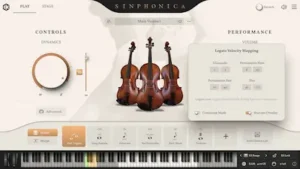 The production credentials are strong: 60 Italian string players, recording at Officine Meccaniche Studios and a reported seven-year development period. They tell us how the library was made, not how it will perform against established alternatives. For that comparison, the useful evidence will be articulation transitions, dynamic response, repeated-note behavior, stereo depth and how quickly a finished section can be made to sit in a mix.
The same principle applies to sample depth. Maestosa uses up to five dynamic layers and up to six round robins, depending on the articulation. That should help reduce repetitive playback and provide more variation between performances, but sample count is only one part of the equation. Recording quality, editing, velocity-layer transitions, round-robin behavior and the design of note-to-note transitions ultimately determine whether a sampled performance holds up under scrutiny.
For a professional user, the useful test is what happens across an actual phrase. Do dynamic changes remain smooth? Do repeated notes retain believable variation without becoming obviously processed? Do transitions between articulations preserve the timing and energy of the performance? Those questions cannot be answered from a specification sheet.
PALCO deserves the same scrutiny. Its virtual stage positioning is based on impulse-response technology, which is a technically credible way to model spatial relationships. But the presence of an IR-based positioning system does not automatically guarantee a coherent orchestral image. With multiple sections and microphone perspectives active, phase relationships, stereo stability, depth and localization become the relevant measurements.
That is where independent testing matters. Until Maestosa has been evaluated in full sessions with matched microphone configurations and competing libraries, claims about superior realism, spatial accuracy or efficiency should be treated as potential advantages rather than established results.
Sinphonica Maestosa Strings: Storage, RAM and Template Overhead
The complete Maestosa Strings collection requires 133.1 GB of storage, while IK lists 16 GB of RAM and 250 GB of available disk space as minimum requirements.
A 133 GB orchestral library is not unusual by current scoring standards, but the size still matters in a working studio. Sample libraries of this scale belong on a fast dedicated SSD, and the real constraint is rarely the raw disk capacity. It is how comfortably the system can stream and manage multiple sections once a full scoring template is loaded.
The 16 GB RAM requirement needs similar context. It is a minimum specification, not a realistic target for a large orchestral template running Maestosa alongside other sample-based instruments, multiple microphone perspectives and a modern DAW session. Professional users should treat the published requirement as the entry point for running the instrument, not as a guarantee of comfortable large-template performance.
Until the released version has been stress-tested in real sessions, there is no reliable basis for quoting instance counts, memory consumption under different microphone configurations, loading times or disk-streaming performance. Those measurements will matter more to professional composers than the headline library size.
Sinphonica Maestosa Strings vs Other Orchestral Libraries
| Library / Platform | Core Strength | Sinphonica’s Distinctive Angle | Why the Alternative Still Makes Sense |
|---|---|---|---|
| Sinphonica Maestosa Strings | Integrated string performance and spatial control | Articulation Morphing, five True Legato styles, eight microphone perspectives and PALCO | New platform with limited long-term production history |
| Spitfire Audio | Broad orchestral catalog and established scoring ecosystem | Integrated articulation and stage-positioning approach | Large range of specialized libraries and mature professional workflows |
| Vienna Symphonic Library | Detailed orchestral sampling and extensive performance control | More centralized performance and spatial workflow | Deep articulation coverage and a long-established scoring environment |
| Orchestral Tools | Orchestral libraries built around carefully captured acoustic spaces | PALCO provides an additional approach to virtual stage positioning | Strong room-based workflows and an extensive orchestral catalog |
| Cinematic Studio Series | Focused cinematic orchestral sound and streamlined programming | More extensive spatial and articulation-control architecture | Established sound, recognizable character and proven scoring workflows |
| Miroslav Philharmonik 2 | Broad orchestral coverage at a low entry price | Newer performance and spatial-control architecture | Much lower cost and a practical option for general-purpose orchestral sounds |
The useful comparison is not sample count. It is how much work each library requires between writing the MIDI performance and delivering a controllable orchestral track. Sinphonica’s advantage is its attempt to keep articulation, performance behavior and spatial positioning inside one environment. Established libraries retain the advantage of proven sounds, mature templates and years of real-world use.
For a composer starting a new orchestral template, that makes Sinphonica worth evaluating on workflow rather than specifications alone. For an existing studio already invested in a mature library ecosystem, switching only makes sense if Maestosa produces a measurable improvement in programming speed, spatial control or the final mix.
Who Maestosa Strings Is Actually For
Film, game and trailer composers are the clearest fit. These workflows demand convincing section performances, fast articulation changes and enough control over depth and placement to make the orchestra sit inside a larger production. Maestosa’s combination of legato options, articulation control and multiple microphone perspectives is directly relevant to that workload, particularly when the finished score has to survive the additional constraints of film delivery and final mastering.
For composers working specifically on screen music, the downstream requirements are different from those of a standalone music release. Our guide to mastering for film scoring covers those delivery and translation considerations in greater detail.
Hybrid composers, trailer producers and sound designers are another strong match. Maestosa is not limited to conventional orchestral writing. Cinematic textures, evolving orchestral material and ensemble patches extend the library beyond traditional string accompaniment into trailer cues, hybrid scoring, transitions, tension beds and orchestral sound design. This is where the combination of sampled strings and performance-oriented control becomes more useful than a conventional articulation-only library: the same instrument can move from a recognizable symphonic section into a more processed cinematic texture without leaving the Sinphonica environment.
Pop and electronic producers can benefit, but selectively. If strings are a recurring part of the production, having a full section available with integrated performance and spatial controls can be useful. If orchestral parts appear only occasionally, the size and price of the library make a smaller string solution easier to justify.
Mixing engineers are more likely to encounter Maestosa than need to purchase it. The eight microphone perspectives and PALCO positioning can materially change the stereo image, depth and direct-to-room balance delivered to the mix. Engineers working on client sessions should understand those controls, particularly when an orchestral balance has already been built inside the instrument.
Mastering engineers are not a primary target. Maestosa sits at the composition and production stage, so buying it specifically for mastering work makes little sense. Its relevance to mastering is downstream: large string arrangements can carry substantial dynamics, dense midrange information and complex stereo content, all of which eventually affect mix translation and mastering headroom.
For beginners and occasional users, the calculation is different. Maestosa makes the most sense when orchestral production is a regular part of the workload. If it is used a few times per year, the library’s storage footprint and professional feature set are difficult to justify.
How Maestosa Strings Affects the Mix and Master
The decisions made inside an orchestral instrument become part of the mix before any channel processing is applied. With Maestosa, microphone perspective and virtual stage placement can determine how much direct sound, room information, stereo width and depth the string sections bring into the session.
That matters in dense productions. A wide orchestral image may sound impressive on its own but leave less room for vocals, synths or other stereo-heavy elements. A predominantly close perspective can provide definition but reduce perceived depth, while a heavier reliance on room-oriented perspectives can push the strings farther back and soften their presence. These are mix decisions, not simply instrument settings.
PALCO is therefore best treated as part of the arrangement. Establishing the relative position of the string sections before they reach the DAW can reduce the need for corrective panning and ambience later, but it also means spatial decisions are being committed earlier in the production chain. The engineer still needs to check mono compatibility, stereo stability and the relationship between sections once the full arrangement is playing.
The same applies to dynamics. Large string arrangements can carry substantial level variation, particularly when natural-sounding crescendos and expressive articulations are preserved. In a hybrid mix, that dynamic movement can interact with bus compression, automation and available headroom in ways that are not obvious while programming the strings in isolation. If those problems survive into the final mix, they become much harder to correct at the mastering stage, which is why identifying the actual cause matters more than trying to process the symptom; see our guide to common mastering problems and why they happen for the downstream perspective.
For mastering, the implication is straightforward: Maestosa does not require a special mastering process. What matters is whether the upstream orchestral balance leaves enough headroom, maintains a coherent stereo image and translates across monitoring systems. That makes the final mix preparation particularly important before the track leaves the production stage; the principles covered in how to prepare a mix for mastering apply just as much to dense orchestral productions as they do to more conventional mixes.
What Independent Testing Still Needs to Establish
Several important questions about Maestosa Strings cannot be answered from the current pre-release material. The published specifications describe the library and its system requirements, but they do not establish how the instrument behaves under the load of a real scoring template.
The missing data includes CPU consumption per instance, RAM usage with different microphone configurations, library loading times, disk-streaming behavior, offline render performance and stability during long sessions. Phase coherence between microphone perspectives also deserves close examination, particularly when multiple perspectives are combined across several string sections.
Sound quality needs the same treatment. A useful comparison would put Maestosa against established string libraries at matched dynamics, articulations and microphone perspectives, then examine note transitions, repeated-note variation, stereo depth and the behavior of the library in a complete arrangement rather than in isolated demos.
Early KVR discussion already shows two different reactions to the announcement. Some users have responded positively to the demonstrated dynamic range and interface, while others have questioned IK’s move toward a large sample-based orchestral platform compared with its earlier physical-modeling work in MODO. These comments are useful as early community reactions, but they should not be treated as independent evidence of sound quality.
That distinction is worth keeping clear. Sinphonica is not a new physical-modeling system for orchestral synthesis. Its foundation is sampled orchestral performance, supplemented by dedicated performance controls and spatial-processing technology. Its success will therefore depend less on whether the underlying method sounds novel and more on how convincingly those layers work together in a professional session.
What I would test after release: I would compare the same short string phrases at matched dynamics and microphone perspectives, then check legato transitions, repeated-note variation, stereo width, mono compatibility and the amount of corrective processing required to place the sections in a dense mix. A second pass would measure RAM and CPU behavior with multiple sections loaded rather than relying on the published minimum system requirements.
Sinphonica Maestosa Strings: Price, ROI and Platform Risk
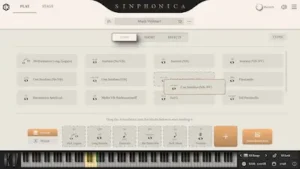 Maestosa Strings is priced at $399.99 during the introductory pre-order period, compared with a regular price of $499.99. Individual sections are also available: Violins I and Cellos cost $199.99 each, while Violins II, Violas and Double Basses cost $149.99 each. Registered Miroslav Philharmonik 2 owners can reduce the complete-collection pre-order price to $299.99.
At $399.99 during pre-order, Maestosa sits in the price range where buyers are likely to compare it against established professional string libraries rather than entry-level orchestral instruments. The more useful question is whether Maestosa saves enough production time or delivers enough control to justify replacing—or supplementing—an existing library. A 133.1 GB footprint and a 60-player ensemble sound substantial on paper, but neither is a useful measure of return on investment.
The strongest case for the purchase will come from workflow. If Articulation Morphing, the legato system and PALCO reduce MIDI editing and corrective spatial processing in real sessions, the introductory price becomes easier to justify. If the final production still requires the same amount of programming and mixing as competing libraries, the additional workflow architecture has considerably less financial value.
The individual-section pricing also makes the decision less binary. A composer who primarily needs violins or cellos can buy only the relevant section and expand later rather than paying for the entire collection upfront. That makes Sinphonica easier to evaluate without committing to the full library on day one.
There is a second consideration: Sinphonica is being introduced as a platform rather than a one-off string library. IK has described Maestosa Strings as the first chapter of the Sinphonica ecosystem, with further orchestral instruments planned. If those future releases share the same architecture and integrate well with Maestosa, the platform could become substantially more useful over time.
That future value should not be included in the purchase calculation yet. The additional instruments are a potential benefit, not a reason to assume the ecosystem will become a long-term studio standard. For buyers making a decision today, Maestosa has to justify its price on the quality and workflow of the string library already being offered.
Pre-Release Overall Rating
| Category | Rating |
|---|---|
| Sound Design Potential | 8.5/10 |
| Workflow | 9.5/10 |
| Production Control | 9.5/10 |
| Mix Integration | 9/10 |
| System Footprint | 8/10 |
| Value for Money | 8.5/10 |
| Overall | 8.8/10 |
Editorial note: This rating reflects a pre-release assessment based on the published feature set, workflow architecture and production implications. It is not a substitute for hands-on testing of the released instrument. Sound quality, CPU efficiency, large-template stability and phase behavior should be reassessed after release.
Sound Design Potential — 8.5/10: The recording scale, articulation coverage, dynamic layers and multiple microphone perspectives give Maestosa substantial sonic range. This is an assessment of the available sound-shaping architecture, not a final judgment on realism, because the released instrument has not yet been independently compared against competing libraries.
Workflow — 9.5/10: This is the strongest part of the instrument. Articulation Morphing, multiple legato behaviors and centralized performance controls directly target the repetitive MIDI editing that slows down large orchestral sessions. The architecture is built around reducing intervention rather than simply increasing the feature count.
Production Control — 9.5/10: Maestosa puts an unusually large amount of performance and spatial decision-making inside the instrument. Five True Legato styles, articulation control, eight microphone perspectives and PALCO give the composer substantial control before the signal reaches the DAW mixer.
Mix Integration — 9/10: The microphone perspectives and PALCO positioning can establish direct sound, depth, width and section placement before conventional mix processing begins. The high score reflects the usefulness of that architecture, while the need to verify phase coherence and stereo stability prevents a perfect rating.
System Footprint — 8/10: The 133.1 GB installation is a significant commitment, although it is not unusual for a current orchestral library. The rating reflects the storage and template overhead that can already be inferred from the published specifications; CPU load, streaming behavior and large-session stability remain unmeasured.
Value for Money — 8.5/10: The introductory price is easier to justify for composers who regularly produce orchestral or hybrid music and can benefit from the integrated workflow. The score is lower than the workflow ratings because the long-term value of the wider Sinphonica platform remains prospective rather than proven.
Maestosa Strings earns its strongest marks for workflow, performance control and spatial integration rather than for introducing a fundamentally new sampling technology. From an engineering perspective, its most convincing proposition is the potential to move more decisions upstream into the instrument while reducing repetitive programming and corrective mix work. The main reservation is not the feature set but the lack of independent large-template testing before release.
Sinphonica Maestosa Strings: Pros and Cons
| Pros | Cons |
|---|---|
| Strong performance-oriented workflow | Large 133.1 GB storage requirement |
| Five True Legato styles and 40+ articulations | Professional template performance is not yet independently verified |
| Articulation Morphing, custom mapping and Dynamic Curve | New platform without a long production track record |
| Eight microphone perspectives and PALCO stage positioning | Multiple spatial options can increase mix complexity |
| Integrated EQ, stereo imaging and reverb tools | Less compelling for users who only need strings occasionally |
| Individual sections can be purchased separately | Long-term value of the wider Sinphonica ecosystem is still unproven |
Sinphonica Maestosa Strings Review Verdict: Is It Worth It?
Sinphonica Maestosa Strings does not reinvent orchestral sampling. Its foundation is a large, professionally recorded string ensemble with the same fundamental building blocks used by other serious orchestral libraries: sampled articulations, dynamic layers, round robins and multiple microphone perspectives.
Its stronger proposition is what happens around those recordings. Five True Legato styles, Articulation Morphing, custom articulation control, eight microphone perspectives and PALCO bring performance and spatial decisions into the instrument rather than leaving all of that work to the DAW and mix stage.
That makes Maestosa more compelling as a production instrument than as a collection of samples. The potential benefit is not another incremental increase in sample depth; it is getting from MIDI performance to a controllable orchestral track with less technical intervention.
For composers working regularly in film, games, trailers or hybrid production, that is a meaningful proposition. Producers who use strings only occasionally have less reason to absorb the price and 133.1 GB storage requirement. Mixing engineers may find the architecture useful when working with client sessions, but mastering engineers have little reason to purchase the instrument themselves.
The main uncertainty is still real-world performance. Until the released version has been tested in scoring sessions, CPU and RAM efficiency, large-template stability, loading behavior and phase coherence across microphone perspectives remain unverified.
Bottom line: Sinphonica Maestosa Strings looks strongest as a workflow-focused orchestral library rather than a fundamental change in sample-based synthesis. At the $399.99 pre-order price, it makes the most sense for composers who regularly program strings and value integrated articulation and spatial control. Owners of established libraries such as Spitfire, VSL or Orchestral Tools have a stronger reason to wait for independent comparisons. The key buying question is not whether Maestosa has enough features, but whether its workflow saves enough editing and mix preparation to justify adding another large library to the template.
Your Mix Is the Final Test
A good production can still lose impact at the final stage: transients may soften, the stereo image can become less defined, or the overall balance may not translate the way it sounded in the studio. These problems are easier to judge on the finished mix than from meters or plugin settings alone.
Hear the difference on your own track before making a commitment. Upload up to 35 seconds of your mix and receive a free mastering demo prepared by a real mastering engineer. Compare the original and mastered versions and decide whether your production is ready for release.
Get your free mastering demo →
FAQ: Sinphonica Maestosa Strings for Producers and Composers
Is Sinphonica Maestosa Strings a Kontakt library?
No. Maestosa Strings runs inside IK Multimedia’s own Sinphonica instrument rather than Native Instruments Kontakt. Supported plugin formats include AU, VST3 and AAX on compatible 64-bit systems.
Can you buy individual Maestosa Strings sections instead of the full orchestra?
Yes. First Violins, Second Violins, Violas, Cellos and Double Basses are available as individual instruments. This is useful for composers who only need specific sections and do not want to install the complete 133.1 GB collection.
How much RAM does Sinphonica Maestosa Strings need for a professional template?
IK lists 16 GB of RAM as the minimum requirement, but that should not be treated as a recommendation for a large scoring template. Actual memory usage will depend on the number of loaded sections, articulations, microphone perspectives and other sample libraries in the session. Independent large-template testing is still needed.
Does PALCO replace panning and reverb in an orchestral mix?
No. PALCO is part of the instrument’s spatial-positioning system. It can establish section placement and depth before the signal reaches the DAW, but final orchestral mixing may still require panning, EQ, reverb, automation and dynamics processing.
Is Maestosa Strings suitable for hybrid orchestral music?
Yes. The combination of full string sections, multiple articulations, legato behaviors and cinematic textures makes it suitable for productions that combine orchestral material with synths, electronic drums and sound design. Its usefulness depends on how central strings are to the production.
Is Sinphonica useful if I already own Spitfire, VSL or another professional string library?
Potentially, but not simply because Maestosa has more features. Existing-library owners should compare articulation programming, legato transitions, spatial control and the time required to reach a finished mix. If the current library already handles those tasks efficiently, the case for switching is much weaker.
Is Sinphonica Maestosa Strings useful for mixing engineers?
Yes, mainly when working on sessions created with the instrument. The microphone perspectives and PALCO positioning can determine the amount of direct sound, room information, stereo width and depth reaching the mix. Engineers should treat those settings as part of the source rather than assuming they can be completely rebuilt later.
Does Maestosa Strings need special mastering treatment?
No. There is no Sinphonica-specific mastering process. The relevant mastering concerns are the same ones found in other dense orchestral productions: dynamic range, low-frequency headroom, stereo coherence and overall mix translation.
Is Sinphonica Maestosa Strings worth the $399.99 introductory price?
It is easier to justify for composers who regularly produce orchestral or hybrid music. Occasional users have less reason to absorb the cost and storage requirement. The strongest justification is workflow efficiency rather than the size of the sample library itself.
Should you pre-order Sinphonica Maestosa Strings?
For composers who already need a new professional string library, the introductory price makes the pre-order easier to justify. For existing-library owners, there is less urgency: the main unresolved questions are sound quality against established alternatives, large-template performance and whether the workflow actually reduces production time. Those are the areas worth waiting for independent testing to answer.

Yurii Ariefiev evaluates audio instruments and production tools from the perspective of real-world mixing and mastering, with particular attention to dynamics, stereo imaging, workflow and translation beyond the monitoring environment.
For orchestral instruments, that means looking beyond sample count and feature lists: articulation behavior, spatial decisions, mix headroom and the way a virtual performance affects the final production all matter before mastering begins.
☕ Buy me a coffee