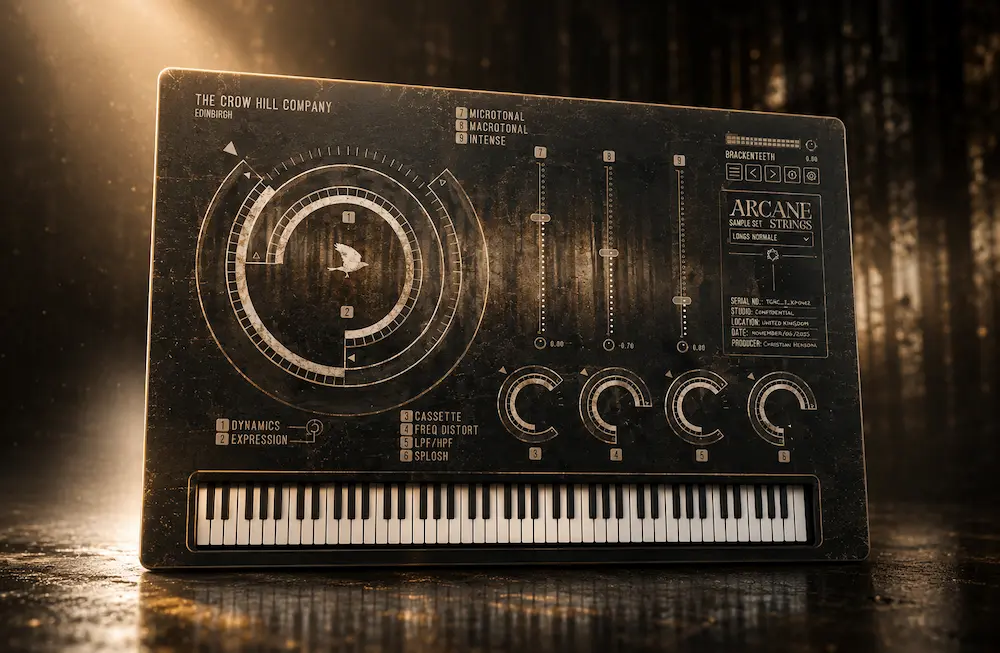
Arcane Strings is worth buying if you need deliberately imperfect, unstable, and aggressive string performances that conventional orchestral libraries do not provide efficiently. It is not a replacement for a full cinematic string library. Instead, The Crow Hill Company has built it as a specialist character instrument for basses, cellos, and violas, with pitch variation, uneven timing, individual player behavior, and deliberately rough performances embedded into the source material.
In this Arcane Strings review, I evaluate the library from a professional production and mixing perspective rather than simply repeating its feature list. The important questions are how convincing its ensemble behavior is in a mix, how useful the three Microtonal, Macrotonal, and Intense partials actually are, whether the unusual articulations save production time, and whether the library justifies another place in an established orchestral template.
My independent rating: 8.6/10. Arcane Strings earns its score through its distinctive source character, performance variation, and useful control over ensemble instability. Its main limitations are equally clear: narrow orchestral coverage, additional template overhead, and the fact that its deliberately unstable sound can create more mixing work when an arrangement becomes dense.
At the current Early Access price, Arcane Strings is easiest to justify for composers working regularly with drama, thriller, horror, hybrid scoring, and experimental orchestral textures. For users looking for a first or general-purpose string library, the value proposition is considerably weaker.
In This Review
Arcane Strings Review: Quick Verdict
| Question | My Verdict |
|---|---|
| Is Arcane Strings good? | Yes, if you want deliberately unstable and characterful low strings rather than conventional orchestral realism. |
| Is Arcane Strings a full string library? | No. It focuses on basses, cellos, and violas and works best as a specialist layer or character instrument. |
| What makes it different? | Player-to-player pitch, timing, attack, and tonal variation is preserved in the source performances instead of being added later with processing. |
| Is it useful for mixing? | Yes. Its source-level variation can reduce the need for artificial detuning, timing offsets, and saturation, although the resulting low-mid density still requires careful mixing. |
| Is it worth buying? | Yes for composers who repeatedly need this character; no as a first or general-purpose string library. |
| Independent rating | 8.6/10 |
My Testing Focus
I did not evaluate Arcane Strings by listening to isolated presets alone. The important test was how its pitch variation, uneven attacks, and partial balance behaved once the instrument was placed alongside a cleaner string source and a dense arrangement. That is where the library’s main advantage—and its main limitation—becomes much easier to hear.
Why Imperfect Strings Can Sound More Convincing in a Mix
 The problem Arcane Strings targets is familiar to anyone who has programmed orchestral samples for a dense production: a technically sophisticated string library can still sound generic. Individual notes may be beautifully recorded, but the section often behaves too uniformly. Attacks line up, pitch centers are unusually stable, dynamics respond predictably, and the players tend to disappear into a single composite voice.
A real string section is less orderly. Players enter within slightly different time windows, vibrato develops at different rates, bow pressure changes from player to player, and intonation shifts continuously around the nominal pitch. Those differences are not random noise. They create the small variations in timing, pitch, dynamics, and tone that help the ear identify a group of instruments as a physical ensemble rather than a single repeated sample.
Arcane Strings builds those variations into the performances instead of trying to correct them afterward. That is the core of the instrument’s approach: the character comes from the source material, not from a humanize control added at the end of the signal chain.
The choice of instrumentation reinforces that approach. Arcane Strings focuses on basses, cellos, and violas, giving it a naturally darker and denser register than a conventional full-range string library. In a mix, that makes its instability particularly useful for low-string ostinatos, sustained tension beds, hybrid orchestral layers, and aggressive cinematic textures. It can function on its own, but its more compelling role is often as a character layer beneath a cleaner orchestral library, where the controlled section provides definition and Arcane Strings supplies movement, weight, and irregularity.
How Arcane Strings Changes the Way You Build a String Part
The important difference in Arcane Strings is not the number of articulations. It is where the instrument puts the control over ensemble character. Instead of giving you a clean string performance and asking you to create instability with MIDI editing and mix processing, it builds different degrees of pitch separation, performance variation, and aggression into the source material.
The instrument combines four dynamic layers, up to seven round robins, 19 articulations, and three mixable performance layers. The Crow Hill Company also reports roughly 40 minutes of recorded material for each pitch centre. That amount of source material is intended to give sustained and evolving performances more variation than a short repeating sample would provide.
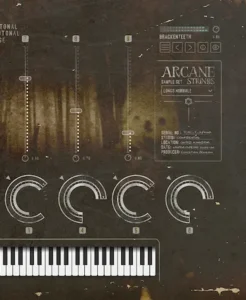
The three-partial architecture is the more significant production feature. These are not simply three microphone positions offering different balances of the same performance. They represent different approaches to how the ensemble itself behaves:
- Microtonal keeps the players relatively close in pitch, making the ensemble more controlled and easier to place within a conventional arrangement.
- Macrotonal exposes more of the pitch differences between players, increasing the sense of individual voices within the section.
- Intense pushes the sound toward a close, compressed, more aggressive presentation, functioning as a character layer rather than a neutral orchestral signal.
That makes the partials useful as a compositional and mixing control. Moving from Microtonal toward Macrotonal does not simply make the strings “wider” or “dirtier”; it changes how tightly the individual performances lock together. Bringing in Intense adds another layer of density and aggression without requiring a separate distorted string source.
With a conventional library, some of this behavior can be approximated by layering patches, introducing small pitch and timing offsets, applying saturation, and compressing the result. The difference is that those techniques are being used to imitate performance variation after the recording has already been made. Arcane Strings starts with that variation embedded in the performances themselves, which can make the result easier to reach and harder to reproduce exactly with generic processing. The same source-first principle matters in other specialist instruments: our Best Service Arabic Oud review looks at how articulation depth, player-specific technique, and sampled performance behavior affect realism before the signal ever reaches the mix.
Where Arcane Strings Actually Saves Production Time
Arcane Strings is not a workflow-automation instrument. It does not reduce MIDI editing, manage articulations for you, or replace the mixing decisions that follow the performance. Its advantage is earlier in the chain: it can eliminate some of the corrective processing normally used to make a conventional string library sound less sterile.
Take a low-string part that is technically well played but too clean for a dark trailer cue. With a conventional library, the usual workaround is to duplicate the performance, introduce small timing or pitch offsets, add saturation or distortion, compress one layer harder than the other, and then manage the additional low-mid buildup those layers create.
Arcane Strings approaches the same problem at the performance level. The pitch separation, uneven attacks, and individual player behavior are already part of the recorded material, while the three partials provide control over how much of that variation remains in the finished sound.
In practice, the time saving comes from not having to build the imperfection yourself. You are starting with it already present in the performance, then deciding how much of it the arrangement can tolerate. That matters when the string texture is being shaped as part of the composition rather than treated as a finished orchestral stem.
There is a trade-off. Source-level irregularity can make the result harder to control once the arrangement becomes dense. A conventional library gives the mixer more uniform material to shape; Arcane Strings gives the mixer more character to manage. The workflow is therefore faster when the desired sound is inherently unstable, but not necessarily faster when the production ultimately requires tight ensemble definition.
Why the Three Partials Matter More Than the Built-In Effects
 Arcane Strings includes effects for cassette-style coloration, frequency distortion, filtering, and reverb. They are useful for shaping the instrument quickly, but none of them is particularly difficult to reproduce with standard mixing plugins. The more distinctive part of the design is the three-partial system, because it changes the behavior of the ensemble rather than simply processing its output.
Blending Microtonal and Macrotonal material gives the producer control over how tightly the players lock together. A predominantly Microtonal balance can keep a sustained phrase relatively stable, while introducing Macrotonal material brings more of the individual pitch movement between players into the foreground. The result can retain a clear harmonic center without sounding like one perfectly aligned sample repeated across the keyboard.
The Intense partial serves a different function. Its closer, more compressed character adds density and aggression without requiring the producer to build a second string layer and process it separately. That makes it particularly useful when a cue needs to become more abrasive without changing the underlying musical part.
More importantly, the partials can be automated as part of the arrangement. A section can begin with tighter pitch cohesion, open into greater player separation as the tension develops, and bring in the Intense layer at a transition or climax. The MIDI performance does not have to change; the character of the ensemble does.
That is a more meaningful production control than another collection of saturation or reverb presets. The effects change the signal after the performance. The partials change how the performance itself is perceived.
What “Microtonal” Actually Means in Arcane Strings
“Microtonal” can be misleading if it suggests a conventional instrument built around alternative tuning systems. That is not the useful way to think about Arcane Strings. Here, the more important idea is reduced pitch coherence between players: instead of forcing the section toward one perfectly aligned pitch center, the performance preserves more of the natural variation between individual instruments.
In a sustained low-string section, those small pitch differences can produce audible beating and a denser harmonic texture. The voices no longer reinforce one another as a single perfectly aligned source; their slightly different frequencies interact over time. That can make a sustained chord feel broader and more physically present without relying on stereo widening.
The effect is particularly useful underneath a conventional string layer. A cleaner library can retain the harmonic definition while Arcane Strings contributes the small pitch and timing variations that keep the combined section from sounding overly uniform.
There is a limit, though. Increase the Macrotonal character too far and the same variation that creates depth can begin to weaken the perceived pitch center. In a sparse cue that may be desirable. In a dense arrangement, it can compete with bass instruments, synths, guitars, or other sustained material and make the low end feel less settled.
That trade-off is central to the instrument. Arcane Strings gives the engineer control over how much pitch disagreement remains audible; it does not make that decision for you. The useful range is therefore not “in tune versus out of tune,” but how much ensemble variation the arrangement can carry before character turns into instability.
Where Arcane Strings Works Best: Layering It Into an Existing String Template
Arcane Strings makes the most sense when it is treated as a second voice rather than the foundation of the orchestral template. A conventional string library can handle the harmonic information, articulation changes, and predictable ensemble response; Arcane Strings can be brought in selectively when that clean layer starts to sound too uniform.
A practical approach is to keep the primary string part relatively controlled and introduce Arcane Strings at a lower level, then adjust its contribution by section. The Macrotonal material can add subtle pitch separation to sustained notes, while the Intense partial can be pushed forward only where the arrangement needs more density or aggression.
This is particularly effective at transitions. Instead of writing a completely different string performance for a build or climax, the composer can keep the underlying MIDI part intact and automate the character layer around it. The harmonic content remains stable while the perceived size and instability of the ensemble increase.
There is also a mixing advantage to keeping Arcane Strings secondary. If the unconventional layer becomes too prominent, it can pull the pitch center apart or add unnecessary low-mid density. Used as a controlled layer, its irregularities remain audible without forcing the entire arrangement to adopt them. That kind of balance is part of preparing a mix for mastering: the goal is not to remove the character, but to make sure the mix reaches the mastering stage with enough control to preserve it.
That makes Arcane Strings a specialist character layer rather than a universal replacement for a conventional string library. Its strongest contribution is not coverage; it is giving an established orchestral template another way to move, thicken, and destabilize a part without rebuilding the arrangement.
How Arcane Strings Changes the Mixing — and Eventually the Mastering — Problem
Arcane Strings has a much stronger connection to mixing than to mastering because its character is created at the source. The combination of pitch variation, uneven attacks, dense low-string voicings, and the more aggressive Intense material can produce a larger and more complex signal than a tightly controlled orchestral patch. That same source-level behavior can be an advantage with other sampled ensembles: our Temple Drums of India review examines how recorded ensemble interaction, transient density, room energy, and low-frequency weight can shape the mix before conventional processing begins. That distinction becomes particularly relevant in film score mastering, where preserving depth and orchestral contrast matters as much as achieving a technically controlled final master.
That complexity can work in the arrangement, but it also changes what the mixer has to manage. Sustained basses, cellos, and violas can accumulate quickly in the low mids, while increased pitch separation can make a sustained chord feel less settled. Add guitars, synths, brass, percussion, or a sub-heavy score and the character that sounded impressive in isolation can become masking in context.
This is why Arcane Strings is better treated as an expressive acoustic source than as a static cinematic pad. The right level is often determined by the full arrangement rather than by how impressive the patch sounds soloed. Automation, voicing, arrangement density, and frequency management can matter more than simply choosing the most aggressive layer available.
The mastering implications are secondary. Arcane Strings does not provide any mastering functionality and does not replace a compressor, EQ, limiter, or other mastering processor. Its relevance to mastering is that an arrangement built around deliberately unstable and dense string material may leave less room for corrective processing at the end of the chain.
If the low mids are already congested or the upper mids are overly aggressive before mastering, the mastering engineer has limited options that will preserve the intended character while also improving translation. This is where mastering problems often reveal themselves as mix problems rather than failures of the final processing chain. The solution is usually upstream: rebalance the string layer, change the arrangement, or control the problematic material in the mix rather than expecting the final limiter or EQ to repair it.
Arcane Strings Articulations: What You Actually Get
Arcane Strings includes 19 articulations spanning sustained and short performances, strikes, plucks, oscillations, breaths, tremolo-style material, and other performance gestures. Strike articulations can use up to seven round robins, giving repeated short notes more variation than a single-cycle sampled attack.
The important distinction is that the articulation set is built around texture and dramatic function, not comprehensive orchestral coverage. There is little point judging it by how completely it can replace the articulation menu of a traditional scoring library.
Some of the more unusual material is better understood as sound-design source than as conventional orchestral playing. A short, uneven attack can provide a useful punctuation point in a thriller cue, while oscillations, Breaths, and Gasps can introduce movement that feels less mechanically tied to the DAW grid.
That makes the library particularly effective for transitions, tension beds, suspense cues, and hybrid scoring, where a string part does not always need to behave like a section playing a clearly defined orchestral phrase. The articulations are most valuable when they provide a sound or gesture that would otherwise require additional layering and processing.
For conventional pop, rock, or orchestral production, the same design can be limiting. If the requirement is a clean, repeatable articulation with precise ensemble definition, a general-purpose string library will usually be the more efficient choice.
Arcane Strings Articulations: What You Actually Get
Arcane Strings includes 19 articulations and playing styles. The important point is that this is not a conventional orchestral articulation menu. Several of the sounds are designed as texture, movement, impact, or sound-design material rather than as standard orchestral techniques.
| Articulation | Production Role |
|---|---|
| Rust Longs | Dark sustained material with a rough, threatening low-register character. |
| Ashen Longs | Sul tasto-inspired sustained texture with a dry, unconventional ensemble character. |
| Icebreaker Longs | Heavily processed harmonic material suited to darker and more synthetic textures. |
| Stormbreaker Longs | Highly unstable harmonic material with pronounced pitch irregularity. |
| Strikes | Short aggressive attacks with up to seven round robins and deliberately retained post-attack detail. |
| Plucks | Wooden, percussive string attacks useful for punctuation and hybrid scoring. |
| Oscillations | Host-synchronized rhythmic textures that become more defined as the dynamics increase. |
| Breaths | Loose ensemble movement created by players performing independently rather than as a tightly synchronized section. |
| Storm Trems | Free tremolo textures ranging from restrained rumble to aggressive movement. |
| Arcane Shorts | Slow, characterful attacks that can function more like cinematic punctuation than conventional shorts. |
| Gasps | Long, unstable drone-like textures with aleatoric movement and sudden changes. |
The remaining variations within these playing styles are controlled through the instrument’s performance structure, dynamic layers, key switches, and partials. This is why the raw number of articulations is less important than how those articulations behave when the arrangement becomes active.
Where the Sampling Concept Is Innovative — and Where It Isn’t
The Crow Hill Company’s claim that Arcane Strings “rips up the sampling rule book” needs some qualification. There is no need to frame Arcane Strings as a new synthesis or DSP technology. Its interesting idea is much simpler: the imperfections normally removed during a polished string recording are deliberately kept and turned into part of the playable instrument. Its technical distinction is primarily in how the source performances were recorded, selected, and exposed to the user.
The unusual part is the decision to preserve player-to-player variation that a conventional string library would normally try to minimize. Pitch differences, uneven timing, individual attacks, and deliberately rough performances become part of the playable instrument rather than artifacts to be edited out during production.
I would call this an innovation in sampling and instrument design, not in DSP. The useful part of the idea is in the recordings themselves: a compressor or detuner can imitate some of the behavior, but it cannot recreate the interaction between the particular players captured for the library.
The built-in effects are a different story. Tape-style degradation, distortion, filtering, and reverb are established production techniques and are not compelling reasons to buy the instrument on their own. Their practical value is convenience: they let the producer push an already unconventional source further without opening another chain of processing.
Arcane Strings is therefore best understood as a sampling and performance-design experiment with practical production value, rather than a new audio-processing technology. That is a narrower claim, but it is also the one the product can actually support.
The Hardest Question: Do You Already Have the Tools to Get There?
 The strongest argument against Arcane Strings is not its sound quality. It is redundancy. An experienced composer with a large orchestral template may already have enough instruments and processing tools to create a convincing approximation of the same production role.
A conventional low-string library can be layered, detuned slightly, shifted by a few milliseconds, saturated, distorted, or compressed to introduce more movement and aggression. None of those techniques reproduces Arcane Strings exactly, because they start with different performances, but they can solve the underlying problem: making an overly polished string part feel less static.
That makes the purchase frequency-dependent. If you regularly find yourself processing clean orchestral strings to make them rougher, wider, less synchronized, or more aggressive, Arcane Strings can shorten that path by putting those characteristics into the source material. If that requirement appears only occasionally, another specialized library is difficult to justify on workflow grounds alone.
There is also a template-management cost. Every additional sample library means more disk space, RAM usage, browser clutter, updates, and another instrument to maintain in a scoring template. For a professional composer, those costs are small individually but significant when multiplied across dozens of libraries.
The sensible buying question is therefore not “Does Arcane Strings sound different?” It clearly does. The question is “Does it give me a sound I repeatedly need and cannot reach efficiently with the tools already in my template?” If the answer is no, the library is a specialist luxury rather than a production necessity.
Arcane Strings vs. Spitfire, Glass Strings and Other String Libraries
The real buying decision is not whether Arcane Strings sounds different. It does. The question is whether that difference is large enough to justify another library when you already own Spitfire, Glass Strings, Heavyocity, or a similar cinematic string collection.
| Library / Approach | Best For | Character | Control | Choose It When… |
|---|---|---|---|---|
| Arcane Strings | Character layers, tension, dark scoring, hybrid production | Raw, unstable, microtonal, aggressive | High control over ensemble behavior through partials | You want performance variation built into the source |
| The Crow Hill Company Glass Strings | General cinematic string work | More controlled and conventional | Broader everyday usability | You need a primary string library rather than a specialist layer |
| Spitfire Audio cinematic strings | Traditional film, TV, and orchestral scoring | Polished, detailed, controlled | Broad articulation and ensemble control | You need comprehensive orchestral coverage |
| Heavyocity hybrid strings | Trailers, hybrid scoring, sound design | Processed and production-ready | More designed and effect-oriented | You want finished cinematic textures rather than raw ensemble variation |
| Existing string library + processing | Custom sound design | Depends on source and processing | Maximum engineering control | You only occasionally need Arcane Strings-type character |
For me, the useful difference is practical rather than theoretical. Arcane Strings starts with a performance that is already uneven, while a conventional library starts clean and leaves the engineer to create that movement afterward. If the production needs instability, the former can get there faster; if the production needs precision, the cleaner source is easier to control.
System Requirements and Template Load
Arcane Strings supports AU, VST2, VST3, and AAX formats on Windows 10–11 and macOS 12 through macOS 15.x, with support for both Apple Silicon and Intel Macs. The published requirements specify at least 16 GB of RAM, an internet connection for installation and activation, and 6 GB of available storage. The developer also specifies SSD storage for installations on external drives.
The 16 GB RAM requirement is not unusual for a current sample library, but it matters in a scoring template where Arcane Strings is sharing memory with multiple orchestral instruments. The practical issue is not whether a single instance will run. It is how the library behaves once several instruments, articulations, and sample-heavy plugins are loaded alongside it.
There are not yet enough independent measurements to make reliable claims about CPU consumption, RAM usage under load, latency, render time, or performance in large templates. Those figures should be treated as unverified until tested under controlled conditions rather than inferred from the system requirements.
For most users, the more relevant consideration is therefore sample streaming and template memory rather than raw DSP load. Arcane Strings is a sample-based instrument, so the impact of adding it to a large scoring session is more likely to show up in RAM and disk-streaming requirements than in the kind of sustained processor load associated with complex software instruments or mastering processors.
Arcane Strings Price and Value: Is It Worth Buying?
At the time of this review, Arcane Strings is available through an Early Access offer running until September 1, 2026. The published Early Access price is £109 / $149, with the regular price rising to approximately £149 / $199 after the introductory period.
The Early Access price makes the buying decision relatively easy for composers who already know they need this type of sound. Arcane Strings is not competing primarily on the number of articulations or the breadth of its orchestral coverage. Its value comes from providing a specific source character that can otherwise require layering, detuning, timing offsets, saturation, distortion, and additional mix management.
At the regular price, the decision becomes more demanding. If you only occasionally need rough or unstable strings, your existing library plus processing can probably cover enough of the same territory to make another sample instrument unnecessary. If you regularly work on thriller, horror, drama, hybrid, experimental, or tension-heavy scoring, the time saved by having that character available at the source makes the purchase easier to justify.
My verdict: Arcane Strings is good value for its intended specialist audience, but it is not a good value as a first or general-purpose string library.
Who Arcane Strings Is Actually For
Film, television, and game composers are the clearest target. The library’s combination of unstable ensemble behavior, low-string weight, unusual articulations, and aggressive textures fits scoring situations where a conventional orchestral patch sounds too clean or predictable. It is particularly well suited to drama, suspense, psychological scoring, horror, and hybrid cues.
Hybrid and electronic producers can also get substantial mileage from it when the strings are being used as sound-design material rather than as a conventional orchestral section. The deliberately uneven performances can sit naturally alongside synths, processed drums, distortion, and other non-acoustic elements.
Professional studios and composers with established orchestral templates are more likely to justify the purchase than users building their first string collection. In an existing template, Arcane Strings can fill a specific role: a character layer that is available immediately when a clean orchestral source needs more movement, density, or aggression.
Mixing engineers may find it useful when producing their own music or scoring work, but it should not be confused with a mixing tool. Its value is in the source material it provides, not in processing the rest of the session.
Mastering engineers have little direct reason to own it. The instrument can influence the material that eventually reaches mastering, but it provides no mastering workflow advantage.
Bedroom producers and beatmakers fall into the conditional category. Arcane Strings can work well in darker, cinematic, and experimental production, but it is too specialized to make sense as a first or only string library. If the goal is broad orchestral coverage, the money is better spent on a more versatile instrument.
The dividing line is simple: buy Arcane Strings if you repeatedly need character that your existing string libraries do not provide efficiently. If that need is occasional, it is better treated as a specialty purchase than a core production tool.
Arcane Strings: What I Would Actually Use It For
Arcane Strings makes the most sense to me in situations where the string part already works musically but still feels too clean. I would reach for it as a character layer for a dark score, a transition, a sustained tension bed, or a hybrid arrangement where conventional strings need more physical movement.
I would not choose it first for a traditional orchestral cue that depends on precise ensemble definition. In that situation, the irregular pitch and timing behavior become something the mix has to accommodate rather than an advantage.
The most useful role is therefore fairly specific: keep a conventional string library responsible for definition, and use Arcane Strings when the production needs texture, instability, or aggression that the cleaner source does not provide efficiently.
Overall Rating
| Category | Rating |
|---|---|
| Sound Character | 9.5/10 |
| Performance Realism | 9.2/10 |
| Workflow & Control | 8.8/10 |
| Mix Integration | 8.7/10 |
| Articulation Utility | 8/10 |
| Template Efficiency | 7.8/10 |
| Value for Money | 8.5/10 |
| Overall | 8.6/10 |
Sound Character — 9.5/10. Arcane Strings has a genuinely distinctive sonic identity. The preserved pitch drift, uneven attacks, player-to-player variation, and darker low-string register create character that is difficult to reproduce exactly with a conventional library and generic processing.
Performance Realism — 9.2/10. The strongest aspect of the library is the way its imperfections behave like characteristics of a real ensemble rather than random effects. The variation in pitch, timing, dynamics, and attack helps avoid the overly synchronized quality common to sampled strings.
Workflow & Control — 8.8/10. The three-partial architecture provides meaningful control over ensemble cohesion, pitch separation, density, and aggression. It does not automate the entire scoring workflow, but it can remove several corrective steps that would otherwise be required to create similar character from a cleaner source.
Mix Integration — 8.7/10. Arcane Strings can add depth, movement, and density without relying entirely on post-processing, making it particularly effective as a character layer. The limitation is that its low-mid weight and pitch variation require discipline in dense arrangements; the same qualities that make it interesting can also create masking and reduce pitch stability.
Articulation Utility — 8/10. The 19 articulations provide useful material for tension, transitions, hybrid scoring, and sound design, but this is not a comprehensive orchestral palette. Its specialist focus is a strength for cinematic character work and a limitation for users expecting a complete string template.
Template Efficiency — 7.8/10. The library can save processing and layering work when its specific sound is needed, but it still adds another sample-based instrument, storage requirement, RAM demand, and template-management overhead. Its efficiency therefore depends heavily on how often its particular character is actually used.
Value for Money — 8.5/10. The Early Access price makes the library easier to justify for composers who regularly need deliberately imperfect and aggressive string material. At the regular price, the purchase becomes more dependent on usage frequency because a general-purpose string library offers considerably broader coverage.
From an engineering perspective, Arcane Strings earns its score because it solves a specific production problem at the source rather than simply adding another processed string sound. Its strongest advantages are character, ensemble variation, and controllable instability; its main limitations are narrow orchestral coverage, template overhead, and the additional mix management that comes with deliberately imperfect material. It is a strong specialist instrument, but its value depends on whether that specialization matches the productions you actually make.
Verdict: A Specialist String Library That Earns Its Place in the Right Template
Arcane Strings makes a convincing case for itself as a specialist instrument, not as a replacement for a conventional orchestral library. Its deliberately unstable performances give composers access to pitch variation, uneven ensemble behavior, and aggressive low-string character without having to manufacture all of those qualities through additional layers and processing.
The technology is less revolutionary than the launch language suggests. There is no new synthesis architecture or breakthrough DSP here. The real innovation is the decision to preserve performance characteristics that conventional sampling workflows tend to suppress and then make those characteristics controllable inside the instrument.
That distinction is enough to make Arcane Strings useful, but not enough to make it essential. If your template already covers conventional cinematic strings and you rarely need deliberately unstable material, there is little reason to add another specialized library. If you regularly find yourself detuning, offsetting, distorting, and layering string parts to make them less polished, Arcane Strings addresses a real production problem at the source.
The buying decision is therefore straightforward: Arcane Strings is worth it for composers who need its specific character repeatedly, and unnecessary for anyone looking for a general-purpose string library. Its strongest role is as a controlled source of imperfection that can be layered into an established template when conventional strings have become too predictable.
Your Mix Should Survive the Final Stage
A dense production can sound impressive in the session and still lose impact once it reaches the final master. The job of mastering is not to make everything louder or brighter. It is to control what needs controlling, preserve the character that works, and make the finished track translate without collapsing when the playback system changes.
If you want to hear what an experienced mastering engineer can do with your existing mix, upload up to 35 seconds and receive a free mastering demo. Compare it directly with your mix before deciding whether further mastering work is justified.
Get your free mastering demo →
FAQ: Arcane Strings in Real-World Production
Is Arcane Strings a full orchestral string library?
No. It focuses on basses, cellos, and violas and is designed as a character-focused instrument rather than a complete orchestral template. It works best alongside a more comprehensive string library.
Can Arcane Strings replace Spitfire or other cinematic string libraries?
Not as a general replacement. Conventional cinematic libraries offer broader articulation coverage and more predictable ensemble behavior. Arcane Strings is the better choice when the goal is deliberately unstable, aggressive, or unconventional string character.
What makes Arcane Strings different from a normal string library?
Its performances deliberately retain more player-to-player variation in pitch, timing, attacks, and tone. The instrument then gives the user control over different degrees of that variation through its three-partial architecture.
Does Arcane Strings work in Pro Tools and other major DAWs?
Yes. The published specifications include AAX, VST2, VST3, and AU formats, covering Pro Tools and the major macOS and Windows DAW platforms.
How much RAM does Arcane Strings need?
The published minimum is 16 GB of RAM. That is manageable for a modern system, but the requirement becomes more relevant in large scoring templates where multiple sample libraries are loaded simultaneously.
Is Arcane Strings CPU intensive?
There is not enough independent benchmark data to provide a reliable CPU figure. Because it is primarily a sample-based instrument, RAM capacity and disk streaming are likely to be more important considerations in large templates than sustained DSP load, although actual performance depends on the session and system.
Can you create a similar sound with an existing string library?
To a degree. Pitch offsets, MIDI timing variation, layering, saturation, distortion, and compression can produce a similar type of instability. They will not reproduce the exact performances captured in Arcane Strings, but they can solve some of the same production problems.
Is Arcane Strings worth buying if I already own several orchestral libraries?
Only if you repeatedly need the specific character it provides. If you already own strong string libraries and rarely need unstable or aggressive textures, the additional template space, RAM, and maintenance are difficult to justify.
Is Arcane Strings worth $199?
It can be for composers who regularly need deliberately imperfect string material and would otherwise spend time building that character through layering and processing. It is a poor value as a first string library because more versatile options cover a much wider range of scoring situations.
Is Arcane Strings a Kontakt library?
No. Arcane Strings is a standalone virtual instrument rather than a Kontakt library. The published formats are AU, VST2, VST3, and AAX, covering major macOS and Windows DAWs including Pro Tools through AAX support.
Does Arcane Strings work in Logic Pro?
The library supports AU on macOS, so it is compatible with DAWs that support Audio Units. However, articulation and keyswitch workflows can depend on the DAW’s MIDI and articulation-management system, so the basic plug-in compatibility should not be confused with identical articulation workflows across every DAW.
Is Arcane Strings good for horror music?
Yes. Its unstable pitch behavior, aggressive low strings, unusual short articulations, Gasps, Breaths, and Storm Trems make it particularly suitable for horror, psychological thriller, suspense, dark fantasy, and other tension-focused scoring. It is not limited to horror, however; the same instability can work as a character layer in hybrid and experimental production.

Yurii Ariefiev evaluates sample libraries and virtual instruments from a production-engineering perspective, with particular attention to performance variation, articulation behavior, source character, and how sampled instruments respond inside real arrangements and mixes.
For character instruments such as Arcane Strings, the important question is not simply how realistic the samples sound in isolation. The analysis focuses on whether pitch variation, ensemble behavior, dynamics, and articulation choices create useful musical results—and whether that character remains controllable once the instrument is layered into a dense mix.
☕ Buy me a coffee