Mastering often comes down to making targeted adjustments without disturbing the balance and character of the mix. A vocal may need a subtle reduction in presence, a bright stereo element may require tonal control, or the center of the mix may need more definition relative to the sides. Conventional stereo processing can affect both the center and sides of the signal, including elements that do not need correction.
Mid-Side (M/S) processing provides a way to address this limitation by separating a stereo signal into its Mid and Side components. The Mid channel contains the information shared by the left and right channels, while the Side channel represents their differences. This allows equalization, compression, and other compatible processes to target these components independently.
The value of M/S processing is not simply its ability to increase stereo width. In mastering, its more useful application is selective control: adjusting the tonal balance, dynamics, or level of the center or sides without applying the same processing indiscriminately to the entire stereo signal. The key is to identify which component contains the problem and make the smallest adjustment that addresses it.
Why Use Mid-Side Processing in Mastering?
A linked stereo processor typically applies the same processing behavior to both left and right channels. This is appropriate for many mastering tasks, but it offers limited selectivity when an unwanted characteristic is more prominent in the center or sides of the stereo image.
Consider a mix in which the lead vocal has excessive upper-midrange energy, while the guitars, keyboards, and stereo ambience are already tonally balanced. A conventional stereo EQ cut will affect all of these elements according to their contribution to the left and right channels. It cannot isolate the vocal simply because the vocal is positioned in the center.
Mid-Side processing provides a different kind of selectivity. Processing the Mid component independently allows an engineer to adjust the shared information in the stereo signal without applying the same correction to the Side component. This can be useful when a tonal or dynamic issue is concentrated in the center, although it does not isolate individual instruments or guarantee that only the vocal will be affected.
The same principle applies to the Side component. If excessive brightness, harshness, or unstable dynamics are more prominent in the stereo-difference signal, targeted Side processing can address those characteristics while leaving the Mid component unchanged.
In mastering, this distinction matters because even a small correction can alter the perceived balance, depth, and width of a finished mix. M/S processing provides another level of control, but it should be used selectively: the goal is to correct a specific issue without creating unintended changes to the stereo image or tonal relationships.
Understanding Mid and Side in a Mastering Context
Mid-Side processing converts a conventional left-right stereo signal into two components based on the sum and difference of its channels:
- Mid: Represents the sum of the left and right channels. It contains signals that are common to both channels, including much of the centrally placed material, as well as any other content with a correlated contribution to left and right.
- Side: Represents the difference between the left and right channels. It contains information that differs between the channels, including interchannel level and phase differences that contribute to stereo separation, ambience, and spatial effects.
Using a normalized Mid-Side matrix, the encoding equations are:
- Mid: (Left + Right) / 2
- Side: (Left – Right) / 2
The decoder reconstructs the original stereo channels:
- Left: Mid + Side
- Right: Mid – Side
Some processors use an unnormalized sum-and-difference convention and apply gain compensation elsewhere in the signal path. The underlying encoding principle is the same, but internal signal levels may differ.
Mid and Side are not separate instrument groups, and they should not be confused with the left-to-right placement of individual sources, which is a separate aspect of the stereo field explained in our guide to stereo imaging and instrument placement. A centered lead vocal will typically contribute strongly to the Mid component, but it may also contain Side information if stereo effects, reverb, or other processing create differences between the left and right channels. Likewise, a hard-panned guitar contributes to both components rather than existing exclusively in the Side signal.
In a mastering workflow, the practical advantage is the ability to process these components independently and then reconstruct the left-right stereo signal. This provides control over shared and differential content without requiring the same processing to be applied to both components.
Refine Your Stereo Balance with Professional Mastering
Mid-Side processing can help address tonal imbalances, control dynamics, and refine the relationship between the center and sides of a mix. But achieving a coherent stereo master requires more than isolated adjustments: clarity, punch, depth, and mono compatibility must work together without compromising the original character of the production. Hear how your mix could translate through a professional mastering process. Upload up to 40 seconds of your track and get a free mastering demo.
Get Your Free Mastering Demo →
Mid-Side EQ: Correcting Tonal Problems Without Changing the Entire Mix
 One of the most useful applications of M/S processing in mastering is independent equalization of the Mid and Side components. It allows an engineer to address tonal imbalances in the shared or differential content of a stereo signal rather than applying the same EQ curve to both channels.
This approach is most effective when the unwanted energy is concentrated more strongly in one component. It does not isolate individual instruments, but it can provide a more targeted correction than conventional stereo equalization.
One additional consideration is the phase response of the EQ. When the Mid and Side paths use different filters, their phase responses can alter the relationship between the components after decoding. Depending on the filter settings, this may affect frequency-dependent stereo positioning or image stability. Linear-phase EQ can avoid the same frequency-dependent phase rotation, but may introduce pre-ringing and additional latency. Neither filter type should be treated as a universal default: evaluate the decoded stereo signal and check mono compatibility.
Controlling Vocal Presence in the Mid Channel
Lead vocals are commonly mixed near the center and therefore contribute strongly to the Mid component. If a vocal sounds overly forward or aggressive, a conventional stereo EQ cut will also affect other elements that share its frequency range, including the kick, snare, bass, and centrally positioned instruments.
A reduction in the Mid component’s upper-midrange energy can help moderate this presentation while leaving the Side component’s EQ unchanged. However, the adjustment affects all material contributing to the Mid signal within that frequency range—not just the vocal.
The result depends on the arrangement and the stereo processing already present in the mix. A vocal with stereo reverb, widening, or modulation may also contribute significant Side information, so a Mid-only correction will not necessarily address every aspect of its tonal character.
Frequency selection and gain reduction should be determined by the specific problem. There is no universal upper-midrange frequency or amount of attenuation that works for every vocal master.
Reducing Harshness in the Side Channel
Excessive high-frequency energy in the Side component can make a stereo mix sound bright, diffuse, or spatially distracting. Possible contributors include wide backing vocals, stereo percussion, cymbals, layered guitars, and reverberant effects.
If the harshness is concentrated in the Side signal, a carefully chosen high-frequency reduction can control some of that energy without applying the same tonal change to the Mid component. This may help preserve the presence of centrally positioned elements while refining the spectral balance of the stereo image.
The distinction is important: Side EQ does not selectively process only reverberation or panned instruments. It affects all content represented in the Side component within the selected frequency range, and can therefore change both the perceived brightness and spatial character of the mix. If the harshness appears only after limiting or saturation, however, the underlying cause may be dynamic or harmonic rather than a simple frequency imbalance; our guide to diagnosing harsh highs in mastering explores these different causes.
Managing Low-Mid Energy in the Stereo Sides
Wide guitars, stereo keyboards, room microphones, and layered recordings can contribute substantial low-midrange energy to the Side component. When this energy builds up, it may make the stereo image feel less defined or compete with the central elements for space.
A restrained low-midrange adjustment on the Side signal can reduce excessive energy in the stereo-difference component while leaving the Mid component’s EQ unchanged. Depending on the material, this may make the overall presentation feel more focused without applying a broad low-mid cut to the entire mix.
However, reducing low frequencies in the Side component should not be treated as a default mastering practice. Stereo bass, room information, and other intentionally wide sources may contribute useful content in this range. The decision should be based on whether that energy creates an actual problem, not on the assumption that low-frequency information belongs exclusively in the center.
Mid-Side Compression: Independent Dynamic Control
Mid-Side compression allows an engineer to apply different dynamic control to the shared and differential components of a stereo signal. Rather than feeding the complete left-right signal to a single stereo compressor, the Mid and Side components can be processed through separate compression stages, each with its own detector behavior and gain-reduction settings.
This changes how the compressor responds to the program material. A transient that triggers substantial gain reduction in the Mid component does not have to produce the same reduction in the Side component, and vice versa. The resulting difference in dynamic behavior can be useful, but it also changes the relationship between the center and the stereo sides.
Controlling Central Transients
Kick drums, snares, and other prominent transient sources often contribute strongly to the Mid component. If these transients create excessive peaks or make the center feel disproportionately aggressive, Mid-only compression can provide targeted dynamic control.
Because the Side component is not subjected to the same gain reduction, stereo ambience and other differential content can retain more of their original dynamics. The extent of this separation depends on how the sources are distributed between the two components: Mid compression still affects every signal contributing to the Mid channel, not just the kick or snare.
In mastering, the goal is usually to control specific peaks without flattening the transient structure. Excessive gain reduction can soften attacks, change the perceived punch of the rhythm section, and shift the apparent balance between the center and sides. Attack, release, ratio, and threshold settings should be evaluated in the context of the full mix rather than adjusted in isolation.
Controlling Dynamic Peaks in the Stereo Sides
The Side component may contain wide percussion, reverberation, backing vocals, stereo instruments, and other elements with substantial dynamic variation. Occasional peaks in this signal can make the stereo image fluctuate or cause certain effects and supporting elements to become momentarily distracting.
Side-only compression can reduce these variations while leaving the Mid component outside the same gain-reduction process. This can be useful when the central balance is already stable but the stereo-difference content becomes disproportionately prominent at certain moments.
However, reducing Side dynamics also changes the movement and apparent width of the stereo image. Heavy or poorly timed compression may suppress ambience, make reverberation less expressive, or cause the spatial presentation to feel less open. The result should therefore be judged in the decoded stereo signal, not only by monitoring the Mid and Side components separately.
Mid and Side compression offer independent control at the processing stage, but their effects are ultimately heard together. Any change in the relative dynamics of these components can alter the perceived position, width, and stability of elements across the stereo image.
Mid-Side De-Essing: Selective Control of Sibilance
 M/S processing can also be useful when sibilant energy is distributed unevenly between the center and sides of a stereo mix. This is particularly relevant when lead and backing vocals have different stereo positions or use different amounts of spatial processing.
For example, a centered lead vocal may already have a balanced high-frequency response, while wide backing vocals produce excessive sibilance that becomes distracting in the stereo image. Depending on its detector design and stereo-linking behavior, a conventional stereo de-esser may react to sibilant energy in one or both channels and apply gain reduction across the linked signal, potentially reducing high-frequency detail in elements that do not need additional control.
Placing a de-esser in the Side processing path can help reduce sibilant energy represented in the Side component while leaving the Mid component outside that gain-reduction process. This can be useful when the backing vocals or their spatial effects contribute disproportionately to the unwanted sibilance.
The reverse approach is also possible. If a centered lead vocal is the main source of excessive sibilance, Mid-only de-essing may provide more targeted control while leaving the Side component unaffected by the same detector and gain reduction.
Neither approach isolates individual vocal tracks. The de-esser responds to the frequency content and detector behavior of the entire component being processed, so other material with similar high-frequency energy may also trigger gain reduction. M/S de-essing is therefore best treated as a corrective option for spatially concentrated sibilance, not as a substitute for track-level de-essing and vocal control during mixing.
When Mid-Side Processing Is Not the Right Solution
M/S processing adds another level of control to stereo mastering, but it is not inherently more precise or appropriate than conventional stereo processing. Its usefulness depends on where the problem occurs and how the signal is distributed between the Mid and Side components.
Before introducing separate processing stages, identify the source of the issue. What appears to be a Side-related tonal or spatial problem may originate from a particular instrument, an arrangement choice, or an interaction between several elements. M/S processing can address the resulting stereo information, but it cannot isolate the original source in a finished stereo file.
Several situations call for a different approach:
- The problem affects both components equally. If the entire stereo program requires the same tonal or dynamic adjustment, conventional stereo processing is usually more direct and avoids unnecessary M/S encoding and decoding.
- The stereo balance is already working. If the mix translates well and its spatial presentation is intentional, additional M/S processing may introduce changes without solving an actual problem.
- The issue originates from an individual track. When the multitrack session is available, correcting the source during mixing is generally more selective than processing the combined stereo signal. M/S processing cannot replace access to the original tracks.
- Independent dynamics processing destabilizes the stereo image. Different gain-reduction behavior in the Mid and Side components can change perceived width, depth, and spatial balance, particularly when compression is excessive or reacts inconsistently to the arrangement.
- The improvement does not survive level-matched comparison. A louder processed signal can appear more impressive even when the tonal or spatial change is not beneficial. Compare the processed and unprocessed versions at comparable loudness before deciding whether the adjustment is justified.
M/S processing should be introduced only when it addresses an identifiable issue or produces a meaningful improvement in the decoded stereo signal. Additional control is useful only when it leads to a better mastering decision.
Building an External Mid-Side Processing Chain
A dedicated M/S utility can encode a stereo signal into separate Mid and Side channels, allowing each component to pass through its own chain of external processing plugins before the signal is decoded back to stereo.
A typical signal path follows this sequence:
- Encode the stereo signal. Convert the incoming Left/Right signal into Mid and Side components.
- Process the Mid component. Apply the required equalization, compression, de-essing, or other processing to the Mid signal.
- Process the Side component. Use a separate plugin chain if the stereo-difference information requires different treatment.
- Decode the processed signal. Reconstruct the Left/Right stereo output from the processed Mid and Side components.
- Evaluate the result. Compare the decoded output with the original stereo signal at matched loudness, checking both tonal balance and spatial stability.
This configuration allows the two components to follow different processing paths, with independent plugin selections, settings, and signal-chain order. For example, the Mid path might use a subtle equalizer followed by a compressor, while the Side path uses a separate EQ and de-esser. The processed components are then decoded into the final stereo signal. The order of these processors also matters because each stage changes the signal received by the next; our guide to the mastering chain examines how these interactions influence the final result.
Routing accuracy is critical. The encoder must deliver the Mid and Side signals to the correct processing paths, and the decoder must receive them in the expected channel order. Reversed assignments, unintended channel summing, or inconsistent routing can alter the reconstructed stereo image. The exact routing procedure depends on the DAW and the channel-handling capabilities of the plugins involved.
Using AREFYEV ADUAL for Mid-Side Processing in Mastering
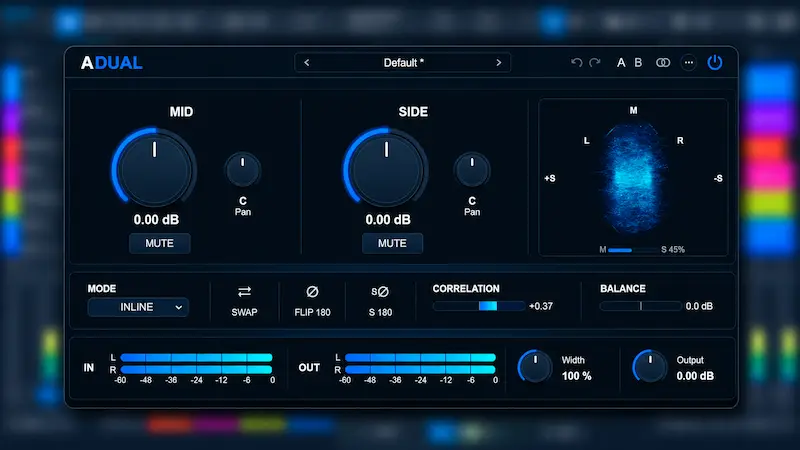
 AREFYEV ADUAL is a free Mid-Side utility for mixing and mastering. It provides independent Mid and Side gain control, M/S encoding and decoding, component isolation, polarity controls, and real-time stereo metering. The current v1.0.0 release supports Windows 10/11 (64-bit) and is available in VST3, CLAP, and Standalone formats; macOS, AU, and AAX versions are not currently available.
ADUAL does not include built-in equalizers, compressors, or de-essers. Its role in an external processing setup is to handle M/S encoding and decoding, allowing compatible third-party plugins to process the two components independently.
Using ENCODE and DECODE with External Plugins
ADUAL offers three operating modes: INLINE, ENCODE, and DECODE. ENCODE and DECODE are the relevant modes when building an external M/S processing chain.
- ENCODE: Converts the incoming stereo signal into Mid and Side components. The Mid signal is assigned to Channel 0, and the Side signal to Channel 1.
- DECODE: Reconstructs a conventional stereo signal from a processed Mid/Side pair. The Mid signal must arrive on Channel 0 and the Side signal on Channel 1.
- INLINE: Processes the stereo signal within ADUAL and returns a stereo output. It provides access to independent Mid and Side gain, panning, muting, and polarity controls without requiring a separate external processing chain.
A typical external processing configuration can be organized as follows:
Stereo Master
     |
     v
ADUAL - ENCODE
     |
     +----------------------+
     |                      |
     v                      v
   MID CHAIN              SIDE CHAIN
     |                      |
  Equalizer              Equalizer
     |                      |
  Compressor              De-Esser
     |                      |
     +----------------------+
                |
                v
         ADUAL - DECODE
                |
                v
        Final Stereo Master
This arrangement gives the Mid and Side components separate processing paths without requiring an equalizer or compressor with its own integrated M/S routing. The DAW must support the necessary channel routing and preserve the channel assignments throughout the signal path.
Independent Mid and Side Gain Control
ADUAL provides dedicated MID GAIN and SIDE GAIN controls for adjusting the relative levels of the two components. These controls can be used to change the balance between shared and differential information before evaluating the reconstructed stereo signal.
Increasing the Mid level can make the central presentation more prominent, while increasing the Side level can emphasize the stereo-difference information and change the perceived width. Reducing either component produces the corresponding shift in balance. These adjustments should be judged in the decoded stereo signal, since changing the relative Mid and Side levels can affect tonal balance and spatial perception simultaneously. For a broader look at how center stability and spatial relationships shape perceived width, see our guide to stereo width in mixing.
Isolating Mid and Side Components
The MID MUTE and SIDE MUTE controls allow either component to be removed temporarily for focused monitoring.
This is useful when checking an external processing chain. Monitoring the Mid component alone helps reveal changes to the shared signal, while isolating the Side component can make excessive brightness, resonances, or unwanted spatial effects easier to identify.
However, isolated monitoring is only one part of the evaluation. A Mid or Side component may sound unbalanced or incomplete on its own while contributing appropriately to the reconstructed stereo mix. Final decisions should always be made with both components playing together.
Monitoring Polarity and Stereo Behavior
ADUAL provides dedicated polarity controls for examining and modifying the relationship between the Mid and Side components. S 180 reverses the polarity of the Side component, while FLIP 180 reverses the polarity of both components.
Its monitoring section includes a vectorscope, correlation meter, and stereo balance meter. These displays provide complementary information about stereo behavior, helping identify changes in channel relationships, correlation, and left-right balance after external processing.
The A/B snapshot system allows alternative settings to be compared, while Undo/Redo makes it possible to review and reverse parameter changes during the adjustment process.
For a complete overview of its operating modes, controls, and supported formats, see the AREFYEV ADUAL product page.
A Practical Mid-Side Mastering Workflow
An effective M/S workflow starts with a clearly identified problem, not with the decision to process the Mid or Side component simply because the option is available. The objective is to make a targeted correction, understand its effect on the stereo signal, and retain it only if the decoded master benefits.
1. Identify the Problem Before Processing
Listen to the unprocessed master and determine whether the unwanted tonal, dynamic, or spatial characteristic is more prominent in the Mid component, the Side component, or both. Use isolated monitoring when necessary, but do not rely on meters alone: correlation and vectorscope readings provide useful information about signal behavior, not a verdict on sound quality.
2. Choose the Appropriate Processing Method
Match the processing method to the problem. Equalization addresses frequency balance, compression controls dynamic variation, de-essing reduces excessive sibilant energy, and gain adjustment changes the relative level of the Mid and Side components. Avoid introducing additional processing stages when a simpler stereo adjustment would achieve the same result.
3. Process One Component at a Time
Begin with the component most closely associated with the issue. Adjusting the Mid and Side paths separately makes it easier to identify which change produces a useful result and which introduces unwanted side effects. Once the individual adjustments are understood, evaluate their combined effect.
4. Keep Adjustments Controlled
Use the smallest amount of processing that produces a meaningful improvement. Broad EQ changes, excessive compression, or large level differences between Mid and Side can alter the tonal balance, transient response, and perceived stereo width of the master. Pay particular attention to changes that become apparent only after decoding.
5. Compare Processed and Original Versions
Use level-matched A/B comparisons to determine whether the processing provides a genuine improvement rather than simply changing the apparent loudness. Check vocal balance, transient definition, tonal consistency, and the relationship between central and lateral information. If the processed version does not offer a clear advantage, reconsider the adjustment.
6. Evaluate the Decoded Stereo Master
Make the final decision while monitoring the complete decoded stereo signal. Isolated Mid and Side listening can help identify problems, but neither component represents the finished listening experience on its own. Check the master in stereo and mono, using the mono-compatibility checks and phase-diagnostic methods covered in our related guide, and across the playback systems relevant to the intended release. Confirm that the processing has not introduced unwanted tonal changes, unstable spatial balance, or reduced mono compatibility.
Mid-Side Processing Is About Precision, Not Complexity
Mid-Side processing gives mastering engineers another way to address tonal, dynamic, and spatial issues in a stereo mix. Its main advantage is the ability to treat the shared and differential components independently rather than applying identical processing across the entire stereo signal.
Separate equalization, compression, and de-essing can be useful when an unwanted characteristic is concentrated more strongly in the Mid or Side component. However, this selectivity does not extend to individual instruments: every element contributing to the processed component can be affected. The result must therefore be judged in the context of the complete mix.
Effective M/S processing depends on identifying the actual problem, choosing an appropriate technique, and avoiding unnecessary changes to the stereo image. More control does not automatically mean a better master, and conventional stereo processing remains the more appropriate choice for many corrections.
Tools such as AREFYEV ADUAL provide the encoding, decoding, independent component controls, and monitoring functions needed to build an external M/S processing workflow. The actual tonal and dynamic processing can then be handled by compatible third-party plugins.
The most successful M/S adjustment is not necessarily the one that produces the most obvious change. It is the one that corrects an identifiable problem while preserving the balance, coherence, and intended spatial character of the original mix.
Hear What Your Mix Gains from Professional Mastering
Mid-Side processing gives you precise control over the relationship between the center and sides of a mix, but every adjustment also affects the reconstructed stereo image. A tighter Mid, smoother Side signal, or wider stereo presentation is only an improvement if the complete master retains its punch, tonal balance, spatial coherence, and mono compatibility. The most reliable way to judge the result is to hear your own mix before and after professional mastering—not just rely on meters or isolated processing decisions. Upload up to 40 seconds of your mix and receive a free mastering demo prepared by a real mastering engineer. Compare both versions and hear what professional mastering can actually bring to your track.
Upload Your Mix and Get a Free Mastering Demo →

Yurii Ariefiev approaches Mid-Side processing as a question of signal relationships rather than a shortcut for widening a mix. In stereo mastering, changes to the sum and difference components can influence center stability, interchannel correlation, and mono compatibility at the same time. Evaluating these interactions in the reconstructed stereo signal is essential to making technically controlled decisions.
Found this article useful?
If you found it useful, you can support independent audio research with a coffee. ☕
Buy me a coffee