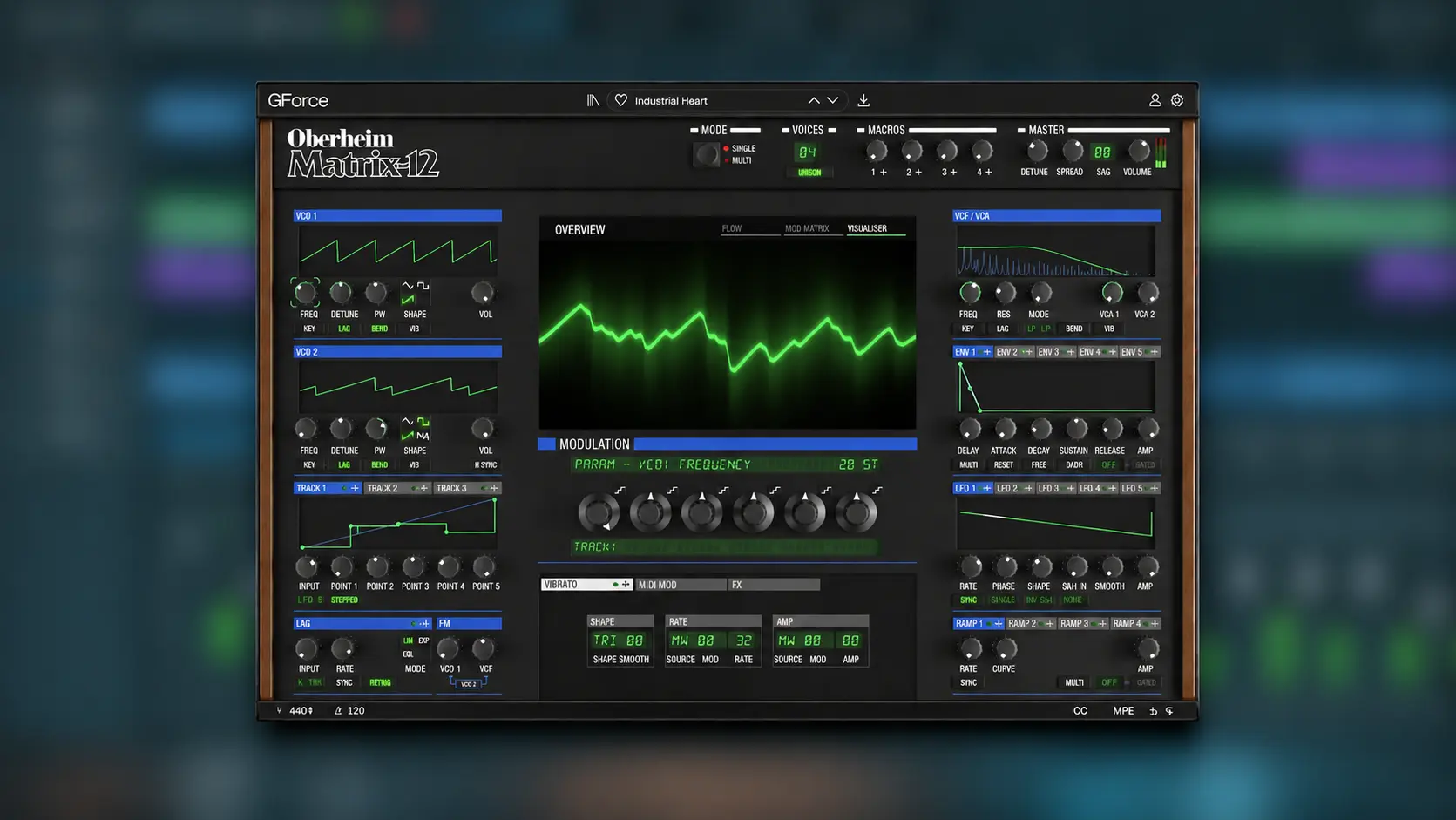
The GForce Oberheim Matrix-12 is a virtual analog synthesizer plugin developed by GForce Software in collaboration with Oberheim and Marcus Ryle, one of the original Matrix-12 designers. It recreates the hardware synthesizer’s architecture with a redesigned interface that makes its extensive modulation system easier to navigate. The main attraction is the combination of the original instrument’s deep sound-design capabilities with visual tools and performance features suited to modern production workflows.
Synthesis Architecture and Main Features
The plugin retains the original Matrix-12’s 12-voice architecture, with two modeled voltage-controlled oscillators per voice. Both offer triangle, sawtooth, and pulse waveforms. The second oscillator also adds noise and hard sync, while frequency modulation provides another option for shaping oscillator tones. The filter section includes 15 modes, covering low-pass, high-pass, band-pass, notch, phase, and combined configurations. Each voice also has two VCAs in series.
The more distinctive part of the architecture is its modulation system. Each voice includes five envelopes, five LFOs, four ramps, and three trackers, alongside additional modulation processors. Each parameter can have up to six bipolar modulation assignments. Quantization, per-note randomization, and drag-and-drop routing provide further control over modulation behavior.
GForce has redesigned the programming interface around three views. Flow visualizes signal and modulation paths, Mod Matrix provides a sortable, editable modulation grid, and Visualiser displays envelopes, filter curves, tracker data, and other modulation behavior. These tools make complex routing easier to inspect and manage than on the original hardware.
Modulation, Multi Mode, and Performance Control
The modulation interface is one of the plugin’s main strengths. Flow, Mod Matrix, and Visualiser give users different ways to inspect signal paths, edit modulation assignments, and monitor how parameters respond. This makes the Matrix-12’s complex routing easier to navigate without reducing its depth.
Single Mode uses all 12 voices as one polyphonic instrument, with unison, detune, and stereo spread controls. Multi Mode supports up to six overlapping keyboard zones, each with its own timbre, voice allocation, MIDI channel, and micro-arpeggiator. This allows users to build layered parts and more complex performance setups within a single plugin instance.
The instrument also supports MPE, including polyphonic pressure, velocity, release velocity, and per-patch timbre curves. Four global macros provide additional control over multiple parameters. These features make the Matrix-12 a more expressive performance instrument, particularly when paired with an MPE-compatible controller.
Practical Value and Limitations
The Matrix-12 is aimed at sound designers, synthesizer enthusiasts, and producers who need detailed control over evolving or expressive sounds. Its modulation system is useful when simpler synthesizers offer too few routing options. Multi Mode adds another practical advantage, allowing users to build layered parts within one instrument rather than managing several separate instances.
In its independent review, Bonedo awarded the plugin five out of five stars, highlighting its interface, sound-design capabilities, MPE implementation, and preset selection. The review also noted that the instrument remains complex despite the improved workflow. The redesigned interface makes the architecture easier to navigate, but it does not eliminate the learning curve of a deeply programmable synthesizer.
The effects section is relatively focused, offering stereo delay and matrix reverb rather than an extensive range of built-in processing. Users who want a broader effects suite will need additional plugins. CPU performance and the behavior of large Multi Mode setups have not been independently benchmarked, so there is not enough evidence to make firm claims about their resource demands.
Arturia Matrix-12 V is the closest alternative. Both plugins are based on the same hardware synthesizer and offer extensive modulation capabilities. Arturia includes insert effects, while GForce’s version centers on its Flow, Mod Matrix, and Visualiser interfaces. Bonedo preferred the GForce version in its comparison, but this reflects the reviewer’s assessment rather than establishing an objectively superior sound.
Price and Availability
GForce Oberheim Matrix-12 is available as a downloadable instrument for macOS and Windows. It runs as a standalone application and supports AU, AAX, VST, and VST3 plugin formats. The regular price is $119.99, with an introductory price of $83.99 available through December 5, 2026. A 14-day trial is also available for users who want to evaluate the instrument before purchasing.
Final Verdict
GForce Oberheim Matrix-12 is a strong choice for producers who need extensive modulation options, flexible voice architecture, and detailed sound-design control. Its Flow, Mod Matrix, and Visualiser interfaces make complex routing easier to manage, while Multi Mode and MPE support add useful options for layered arrangements and expressive performance.
The main trade-off is the time required to learn the instrument. It is not the best fit for users who want quick results from presets or a straightforward analog-style synthesizer. However, producers willing to explore its architecture will find a deeply programmable instrument with substantial sound-design flexibility. At the introductory price, it is worth considering for anyone specifically looking for the capabilities of the original Matrix-12.