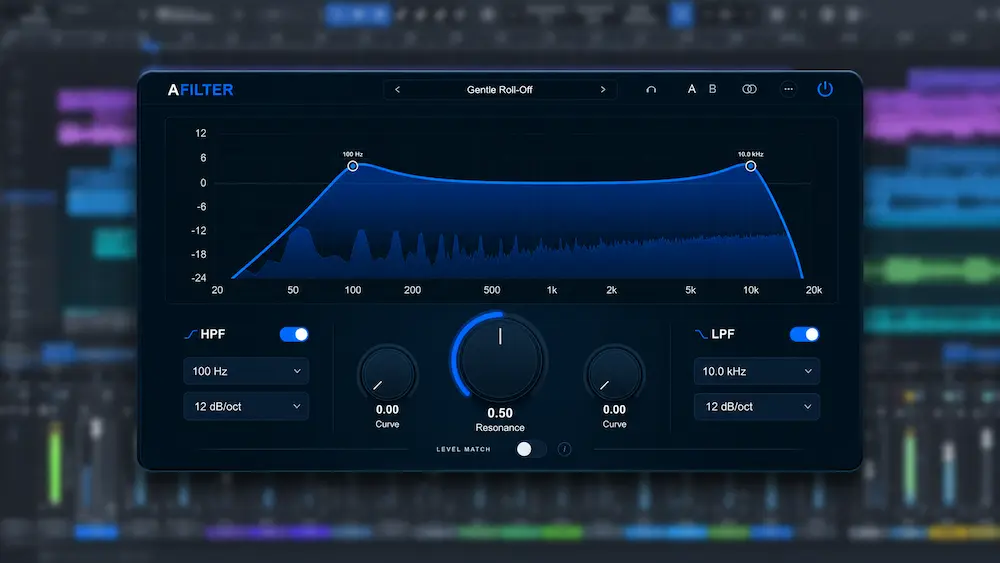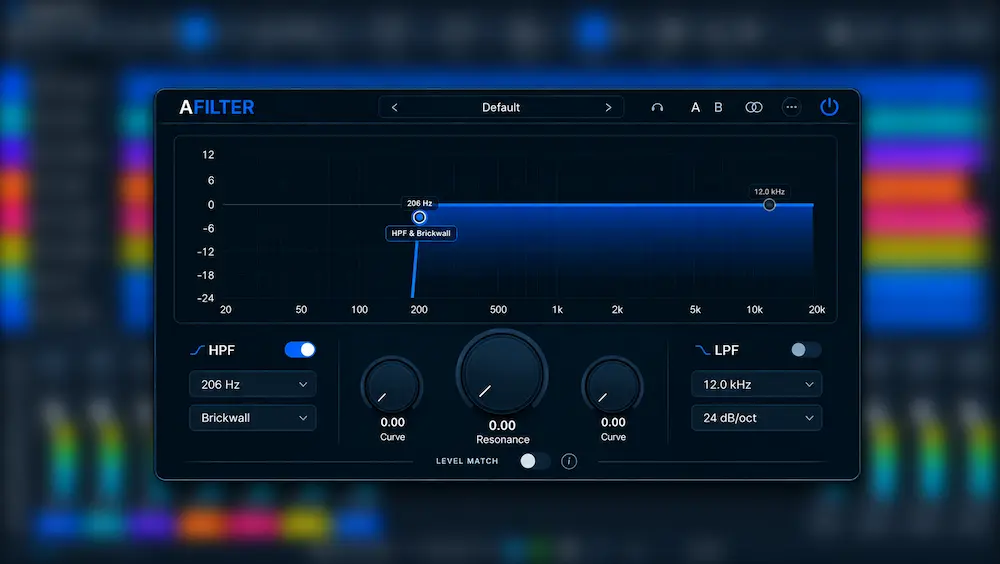
A Brickwall filter is an extremely steep high-pass or low-pass filter designed to separate the passband from the stopband over a narrow transition region. Compared with conventional filters, which attenuate frequencies progressively beyond the cutoff, a Brickwall filter provides much stronger attenuation over a smaller frequency range.
In audio production, this response can be useful for suppressing subsonic rumble, reducing unwanted high-frequency content, or restricting a signal to a defined frequency range. The trade-off is that increasingly steep filtering can affect more than frequency amplitude: depending on the filter design, it may introduce phase rotation, ringing, latency, or changes in transient response.
A filter’s frequency response curve alone does not reveal these consequences. Its implementation, cutoff frequency, phase characteristics, and interaction with other signals all matter when deciding whether Brickwall filtering is appropriate.
What Is a Brickwall Filter?
 A Brickwall filter is a high-pass or low-pass filter with an exceptionally steep transition between its passband and stopband. Frequencies within the passband remain largely unaffected, while frequencies beyond the cutoff region are progressively attenuated at a much higher rate than with conventional filter slopes.
The name describes the shape of an idealized frequency response. Rather than rolling off gradually, the response drops almost vertically at the cutoff, resembling a wall. This is a theoretical model, not a perfectly achievable response in a practical audio filter.
An ideal brickwall filter would pass all frequencies on one side of the cutoff without attenuation and completely eliminate those on the other. Real filters cannot produce this instantaneous transition. They require a finite transition band, and the achievable response depends on the filter architecture and design parameters.
In practical audio applications, the term *Brickwall* therefore refers to an extremely steep filtering response rather than a mathematically perfect boundary between passband and stopband.
A Brickwall filter can operate in either direction:
- Brickwall high-pass filter: Strongly attenuates frequencies below the cutoff region while retaining higher-frequency content.
- Brickwall low-pass filter: Strongly attenuates frequencies above the cutoff region while retaining lower-frequency content.
Both approaches provide more aggressive frequency separation than conventional filter slopes. Whether that precision is useful depends on the unwanted content, the signal’s frequency distribution, and the side effects introduced by the filter design.
How Does a Brickwall Filter Work?
A conventional audio filter attenuates frequencies progressively beyond its cutoff frequency. The rate of attenuation is defined by the filter slope, typically expressed in decibels per octave (dB/oct).
A Brickwall filter uses a much steeper response, producing stronger attenuation across a narrower frequency range. This creates a more abrupt transition between the passband and stopband.
Consider a low-pass filter with a cutoff frequency of 10 kHz. A 12 dB/oct filter gradually attenuates frequencies above the cutoff, while a 48 dB/oct filter reduces them much more rapidly. A Brickwall mode can produce an even steeper transition, although its exact response depends on the filter’s implementation.
The same principle applies to high-pass filtering. A Brickwall HPF strongly attenuates frequencies below the cutoff, creating a narrower transition into the passband than a conventional filter.
The cutoff frequency is not an exact dividing line between unaffected and eliminated frequencies. Content near the cutoff can still be attenuated, and the amount of reduction depends on the filter’s actual frequency response.
Passband, Stopband, and Transition Band
Three regions define the behavior of a Brickwall filter:
- Passband: The frequency range intended to pass with minimal attenuation.
- Stopband: The frequency range where the filter provides substantial attenuation.
- Transition band: The range between the passband and stopband, where the response changes from relatively flat to strongly attenuated.
A Brickwall filter is designed to make this transition band extremely narrow while providing the required attenuation in the stopband.
In digital signal processing, the achievable response depends on several factors, including filter order, coefficient design, sampling rate, and the selected magnitude and phase characteristics. Different filter architectures can produce different phase and time-domain behavior, even when their frequency response curves look similar.
Get a More Controlled, Balanced Master
Aggressive filtering can solve specific frequency problems, but the final master also depends on how the entire mix works together. Low-end definition, transient detail, tonal balance, and stereo coherence all need to be considered without introducing unnecessary changes to the sound. Submit your mix for a free mastering demo: upload up to 40 seconds of audio and hear how a dedicated mastering approach may translate to your track.
Request Your Free Mastering Demo →
Brickwall High-Pass vs Low-Pass Filters
Brickwall high-pass and low-pass filters follow the same steep-filtering principle but attenuate opposite ends of the frequency spectrum.
A Brickwall high-pass filter attenuates frequencies below its cutoff region. It can be useful for reducing subsonic energy, mechanical rumble, and other unwanted low-frequency content that does not contribute to the intended sound.
A Brickwall low-pass filter attenuates frequencies above its cutoff region. It can help reduce high-frequency noise, unwanted upper harmonics, or spectral content beyond the useful range of a recording.
| Characteristic | Brickwall HPF | Brickwall LPF |
|---|---|---|
| Attenuated range | Below the cutoff region | Above the cutoff region |
| Passband | Frequencies above the transition band | Frequencies below the transition band |
| Typical corrective use | Subsonic rumble and unwanted low-frequency noise | High-frequency noise and unwanted upper-spectrum content |
| Potential application | Reducing excessive low-frequency energy in a recording | Reducing unwanted high-frequency content in a source |
A high-pass and a low-pass filter can also be combined to restrict a signal to a specific frequency band. This approach is useful when isolating a range for processing or analysis. The resulting band depends on both cutoff settings and the filters’ transition characteristics.
The distinction between high-pass and low-pass filtering is the direction of attenuation, not the steepness of the slope. Brickwall describes how sharply the response transitions from the passband toward the stopband.
Brickwall Filters vs Standard Filter Slopes
The main difference between conventional filter slopes and Brickwall filtering is how quickly the response transitions from the passband to the stopband.
A 12 dB/oct filter has a relatively gradual roll-off. A 24 dB/oct filter attenuates frequencies more rapidly, while 48 dB/oct produces a substantially steeper response. A 96 dB/oct slope is steeper still, allowing strong attenuation over a narrower frequency range. Brickwall filtering aims to make this transition even sharper, although the exact response depends on the implementation.
The following table compares common filter slopes and their typical applications:
| Filter Slope | Response | Typical Use |
|---|---|---|
| 12 dB/oct | Gradual attenuation | Subtle tonal shaping and routine cleanup |
| 24 dB/oct | Steeper attenuation | General-purpose corrective filtering |
| 36 dB/oct | Very steep attenuation | More aggressive frequency control |
| 48 dB/oct | Very steep attenuation | Strong suppression beyond the cutoff region |
| 96 dB/oct | Extremely steep attenuation | Applications requiring a narrow transition band |
| Brickwall mode | Extremely sharp cutoff approximation | Highly selective frequency attenuation |
These slope values describe the attenuation rate in decibels per octave; they do not define a complete filter design. Filters with the same nominal slope can differ in resonance, phase response, and time-domain behavior.
Brickwall mode should not be treated as a universal synonym for a specific slope, such as 96 dB/oct. It describes an extremely steep filtering response, while the actual attenuation characteristics depend on the plugin or hardware implementation.
For a broader explanation of high-pass and low-pass filter behavior and slope characteristics, see our guide to high-pass and low-pass filters.
Where Are Brickwall Filters Used in Audio Production?
Brickwall filtering is useful when unwanted frequency content needs to be attenuated aggressively over a narrow transition band. Its practical applications depend on the source material, the frequency range being targeted, and the intended processing result.
1. Removing Subsonic Noise
Low-frequency rumble can result from microphone handling, stand vibrations, ventilation systems, mechanical equipment, or environmental noise. Some of this energy may fall below the useful frequency range of the recorded source.
A Brickwall high-pass filter can strongly attenuate unwanted subsonic content while maintaining a relatively narrow transition band. This can be useful when a recording contains substantial low-frequency noise but its essential tonal information begins considerably higher.
The cutoff frequency must be selected carefully. Aggressive high-pass filtering can also attenuate fundamental frequencies, low-frequency resonance, and other useful components of the recording. The goal is to remove unwanted energy without compromising the source’s tonal balance.
2. Controlling High-Frequency Noise
Recordings can contain hiss, electrical noise, amplifier noise, and other unwanted high-frequency content. A Brickwall low-pass filter can strongly attenuate frequencies above a selected cutoff region.
This approach may be useful when the source does not require the full upper-frequency spectrum. For example, a sound effect or a deliberately bandwidth-limited recording may benefit from substantial high-frequency attenuation.
However, filtering is less appropriate when the unwanted noise overlaps with important harmonics, cymbal detail, vocal articulation, or transient information. In these situations, a more targeted EQ or a dedicated noise-reduction process, such as the one discussed in our Acon Digital Restoration Suite 3 review, may produce better results.
Harshness in a master is not always caused by excessive high-frequency energy. It can also result from transient behavior or added harmonics, as explained in our guide to diagnosing and controlling harsh highs in mastering.
3. Isolating a Frequency Range
A high-pass and low-pass filter can be combined to isolate a specific frequency range. This technique is useful for analyzing selected parts of a recording, creating sound-design effects, or preparing audio for further processing.
For example, a sound designer might isolate the midrange to emphasize a particular texture or apply aggressive filtering to create a deliberately restricted sound.
This type of processing is not necessarily corrective. It can be a creative choice intended to change the spectral character of a source.
4. Digital Signal Processing and Anti-Aliasing
Steep low-pass filtering also plays an important role in digital audio systems. Before an analog signal is converted into digital samples, frequencies above the system’s usable bandwidth must be sufficiently attenuated to prevent aliasing.
If frequency components above the Nyquist frequency are not adequately attenuated before sampling, they can fold back into the audible frequency range and appear as unwanted artifacts in the digital signal.
Anti-aliasing filters are designed to provide the required attenuation near the upper limit of the sampling system. Modern analog-to-digital converters use carefully engineered filter designs to manage the transition between the passband and stopband.
This application is related to the principle of Brickwall filtering, but it is not equivalent to inserting an extremely steep EQ filter into a mix. Converter filters are designed for specific sampling requirements, with carefully controlled passband response, stopband attenuation, phase characteristics, and latency.
5. Specialized Mixing and Mastering Tasks
During mixing and mastering, Brickwall filters can be useful for attenuating unwanted frequency content that cannot be controlled sufficiently with more gradual filter slopes.
Applications may include reducing low-frequency rumble, attenuating unwanted ultrasonic content, or applying a deliberately narrow bandwidth limitation for a specific processing purpose.
However, applying a Brickwall filter to an entire mix requires particular care. The filter affects all signal components within its transition and stopband regions, including elements that contribute to the overall frequency balance of the mix.
A steep filter should address an identifiable technical or creative requirement rather than be used simply because it provides stronger attenuation.
Brickwall Filter Artifacts and Limitations
An extremely steep frequency response can provide strong attenuation, but it also involves engineering trade-offs. The most important considerations include phase response, ringing, transient behavior, and the interaction between filtered signals.
Phase Shift and Phase Response
A filter changes more than the amplitude of individual frequencies. It also affects their phase relationships.
In conventional minimum-phase filter designs, steeper responses generally involve more pronounced phase rotation around the cutoff region. This can change the relationship between a filtered signal and other signals containing similar frequency components.
The effect is particularly relevant when processing multiple microphones, parallel signal paths, or sources that are subsequently summed together. Changes in phase relationships can affect how these signals combine, potentially altering their frequency balance.
Linear-phase filters behave differently. They are designed to maintain a consistent phase relationship across frequencies, but this approach introduces other trade-offs, including latency and the potential for pre-ringing around transients.
A steep magnitude response alone does not reveal how a filter behaves in the phase domain. Its implementation and phase characteristics must also be considered.
Pre-Ringing and Post-Ringing
Ringing is another potential consequence of certain steep filter designs.
Linear-phase FIR filters typically have symmetrical impulse responses. Depending on the filter design, this can produce oscillations before and after the main impulse peak, commonly described as pre-ringing and post-ringing.
Pre-ringing is particularly important because it occurs before the main transient. Depending on its level, duration, and frequency, it can affect the perception of sharp transients such as drum hits, percussion, and other short-duration sounds.
Minimum-phase IIR filters have different time-domain characteristics. Their impulse responses are not symmetrical around the main peak, so they do not produce the same pre-ringing behavior associated with linear-phase FIR designs. However, they introduce frequency-dependent phase shifts and can exhibit ringing after an impulse.
Neither architecture is universally better. The appropriate choice depends on the application, source material, and acceptable trade-offs.
Transient and Tonal Changes
Very steep filtering can affect the relationship between transient and sustained components of a signal. A filter may provide a precise magnitude response while still changing the audible character of the source.
For example, aggressive low-pass filtering can reduce high-frequency transient detail, while steep high-pass filtering can alter low-frequency weight and the waveform shape of a recording.
These effects are not determined by slope alone. Filter topology, phase response, cutoff frequency, resonance, and source material all contribute to the final result.
Latency and Processing Requirements
Some digital filter designs require additional processing resources and introduce latency. This is particularly relevant to certain linear-phase FIR implementations, where filter length and design requirements can affect processing delay.
The amount of latency and processing load depends on the implementation. It should not be assumed that every Brickwall filter introduces the same delay or computational overhead.
In real-time applications, such as live monitoring and low-latency recording, these factors can influence which filter design is practical.
An Ideal Brickwall Response Is Not Achievable
A mathematically ideal Brickwall filter would have an infinitely steep transition between the passband and stopband. A practical filter can only approximate this response.
As the desired transition becomes narrower, the filter design must account for increasingly demanding requirements involving magnitude response, phase behavior, and time-domain characteristics.
This is why a real-world Brickwall mode should be understood as an extremely steep filtering option, not a perfect frequency separator that operates without side effects.
When Should You Use a Brickwall Filter?
A Brickwall filter is most useful when a specific frequency range requires strong attenuation over a narrow transition band and a conventional filter slope does not provide sufficient control.
Before choosing an extremely steep filter, identify the unwanted content and determine whether it can be attenuated without compromising important musical information.
Consider using a Brickwall filter when:
- A recording contains substantial subsonic rumble that requires strong attenuation.
- High-frequency noise exists outside the useful bandwidth of the source.
- A narrow transition band is necessary for a specific filtering task.
- You need to isolate a frequency range for sound design or analysis.
- A conventional filter slope cannot provide the required stopband attenuation.
A gentler filter is often more appropriate for subtle tonal shaping, natural low-frequency cleanup, or gradual control of excessive brightness.
For example, a vocal recording may contain unwanted low-frequency noise, but that does not automatically justify an extremely steep high-pass filter. A moderate slope may provide sufficient attenuation while preserving the natural body and fundamental frequencies of the voice.
The same principle applies to mastering. Applying a steep filter to an entire mix can alter its tonal balance and phase relationships across multiple instruments simultaneously. Compare the filtered and unfiltered signals at matched playback levels to evaluate the actual effect of the processing.
The objective is not to achieve the steepest possible response. It is to obtain the required attenuation while minimizing unwanted changes to the signal.
Brickwall Filtering with AFILTER
When a mixing or mastering task requires aggressive frequency attenuation, control over the filter slope makes it easier to compare different approaches and choose the appropriate response.
AFILTER is a free audio filter plugin developed by AREFYEV STUDIO. It features independent high-pass and low-pass sections, allowing users to control both ends of the frequency spectrum within a single plugin.
The available slope options are 12, 24, 36, 48, and 96 dB/oct, alongside a dedicated Brickwall mode for extremely steep filtering.
This range of options allows users to compare gradual roll-off with more aggressive attenuation and determine which response best suits the source material.
AFILTER also includes several tools for evaluating filtering decisions:
- Independent HPF and LPF: Adjust low-frequency and high-frequency attenuation separately.
- Multiple slope options: Choose from gradual to extremely steep filter responses.
- Brickwall mode: Apply an extremely steep filtering response for specialized processing tasks.
- Adjustable Resonance: Control the response around the cutoff frequency.
- Delta monitoring: Listen to the difference signal to identify which audio content is affected by the filtering.
- Level Match: Compare processed and unprocessed signals at matched levels to reduce loudness-related bias.
For example, if a recording contains unwanted low-frequency rumble, start with a moderate HPF slope and adjust the cutoff until the problematic energy is sufficiently attenuated. If the selected slope does not provide enough rejection, compare the result with Brickwall mode.
Use Delta monitoring to hear what the filter removes or changes. Then compare the processed and unprocessed signals with Level Match enabled. This helps distinguish actual tonal changes from differences in playback level.
AFILTER is available in VST3 and CLAP formats, with an optional standalone application for 64-bit Windows.
If you need a dedicated tool for high-pass, low-pass, and extremely steep Brickwall filtering, explore AFILTER and its free Brickwall mode.
Frequently Asked Questions About Brickwall Filters
Is a Brickwall Filter Completely Vertical?
No. A perfectly vertical frequency response is an idealized theoretical model. Real-world filters have a finite transition band, even when their attenuation is extremely steep. The term Brickwall describes practical filters that approximate this sharp cutoff behavior.
What Is a Brickwall High-Pass Filter?
A Brickwall high-pass filter strongly attenuates frequencies below its cutoff region while allowing higher frequencies to pass. It can be used to reduce subsonic rumble, unwanted low-frequency noise, and other content that does not contribute meaningfully to the recording.
What Is a Brickwall Low-Pass Filter?
A Brickwall low-pass filter strongly attenuates frequencies above its cutoff region while allowing lower frequencies to pass. It can be useful for controlling high-frequency noise or restricting the bandwidth of a sound.
Does a Brickwall Filter Cause Phase Shift?
It depends on the filter design. Minimum-phase implementations produce frequency-dependent phase rotation, while linear-phase designs aim to maintain consistent phase relationships across frequencies but can introduce latency and pre-ringing. The magnitude response alone is not enough to determine a filter’s phase behavior.
Can a Brickwall Filter Cause Ringing?
Yes. Some steep digital filter designs can produce ringing in their time-domain response. Linear-phase FIR filters can exhibit both pre-ringing and post-ringing, while minimum-phase designs have different phase and transient characteristics. The nature and audibility of these effects depend on the implementation and source material.
Is a Brickwall Filter Better Than a 24 or 48 dB/Octave Filter?
Not necessarily. A Brickwall filter provides a much sharper transition, but stronger attenuation is not automatically better. A moderate slope may preserve more natural tonal and transient characteristics while providing sufficient control. Choose the filter according to the actual processing requirement.
Can I Use a Brickwall Filter During Mastering?
Yes, but it should be used selectively. A Brickwall filter can help attenuate unwanted subsonic or high-frequency content in a master, but aggressive filtering can affect the entire mix. Evaluate its impact on tonal balance, phase relationships, and transient detail before committing to the processing.
Final Thoughts: Is Brickwall Filtering Necessary?
A Brickwall filter provides extremely steep frequency attenuation when a narrow transition between the passband and stopband is required. It can be useful for reducing unwanted low-frequency rumble, controlling excessive high-frequency content, isolating frequency ranges, and handling specialized audio processing tasks.
However, a perfectly vertical brickwall response exists only as a theoretical model. Practical filters can only approximate it, and their implementation involves trade-offs related to phase response, ringing, latency, and transient behavior.
For everyday mixing tasks, conventional filter slopes are often sufficient. Brickwall filtering becomes useful when a specific application requires stronger attenuation over a narrower frequency range than a conventional filter can provide.
The best approach is to select the filter according to the source material and the intended result, then evaluate its impact through careful listening. A steeper response is simply another processing option, not a guarantee of better sound.

Evaluating steep audio filters requires more than checking how quickly frequencies are attenuated beyond the cutoff. The interaction between magnitude response, phase behavior, and transient response determines whether a filter solves a technical problem or introduces unwanted changes. These considerations are particularly important when processing complex material, where low-frequency control and high-frequency attenuation can affect the overall tonal balance.
Enjoyed this review?
If you found it useful, you can support independent audio research with a coffee. ☕
Buy me a coffee