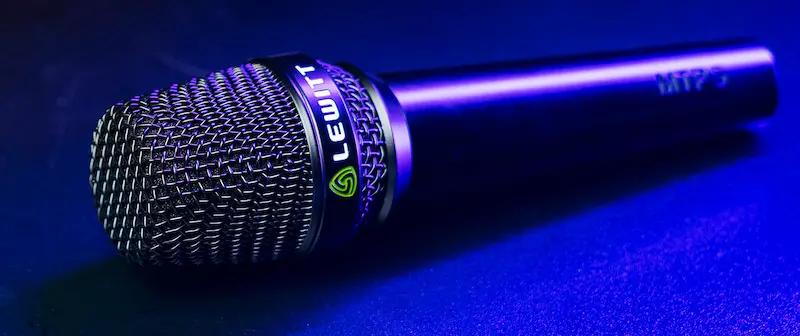
Lewitt MTP 5: A Budget Live Vocal Mic Engineered for Real-World Stage Control
Lewitt has introduced the MTP 5, a dynamic live vocal microphone designed to compete in one of the most saturated segments of the pro audio market: affordable stage mics. Instead of relying on branding or legacy positioning, the company is clearly targeting practical performance factors — vocal intelligibility, feedback rejection, and mechanical durability.
This release isn’t positioned as a “flagship disruptor.” It’s a tactical product: built for working musicians, small venues, touring acts, and engineers who need predictable results without overpaying. The MTP 5 aims to solve the most common live sound problems rather than reinvent the category.
Sound Signature: Controlled Presence Without Harshness
At the core of the MTP 5 is a carefully shaped frequency response designed for live vocal clarity. The mic emphasizes upper-mid presence — the critical range where vocal intelligibility lives — while avoiding the brittle high-end that plagues many entry-level dynamic microphones.
This tuning approach serves a specific purpose: helping vocals cut through dense arrangements without sounding aggressive. In live environments, especially in rock, pop, and electronic setups, the vocal needs to sit forward in the mix without requiring excessive EQ boosting.
Unlike cheaper alternatives that artificially hype the high frequencies, the MTP 5 maintains a smoother top-end response. This directly reduces perceived sibilance (“S” and “SH” harshness), which means less reliance on de-essing and corrective EQ at the console.
The low-end is also intentionally restrained. Excessive proximity effect or uncontrolled low frequencies can muddy the mix and reduce vocal definition. Lewitt’s tuning keeps the low-mid range tight, allowing vocals to remain focused even in challenging acoustic environments.
Feedback Rejection and Polar Pattern Optimization
Feedback is one of the most critical failure points in live sound. The MTP 5 addresses this through a cardioid polar pattern combined with optimized off-axis rejection. In practical terms, this means the microphone prioritizes the source (the vocalist) while minimizing bleed from monitors, drums, and backline amps.
What matters here is not just the polar pattern itself, but how consistent it remains across the frequency spectrum. Poorly designed microphones often exhibit uneven off-axis coloration, which leads to unpredictable feedback behavior. Lewitt appears to have engineered a more stable off-axis response, improving gain-before-feedback.
Another notable feature is the integrated metal ring around the grille. This is not cosmetic — it’s a functional solution to a common user error: cupping the microphone. When performers cover the grille, they alter the polar pattern, increase low-frequency buildup, and dramatically raise feedback risk. The MTP 5 physically limits this behavior.
This kind of design indicates a focus on real-world usage rather than lab-only performance metrics.
Mechanical Isolation and Handling Noise Reduction
Handling noise is often underestimated, but in live scenarios it can significantly degrade signal quality. Every movement, grip adjustment, or impact transfers mechanical vibrations into the capsule.
The MTP 5 uses a rubber-mounted capsule suspension system to reduce these artifacts. This internal shock absorption helps isolate the capsule from physical movement, resulting in a cleaner signal path.
For front-of-house engineers, this translates to less low-frequency rumble and fewer corrective filters. For performers, it means greater freedom of movement without compromising sound quality.
Build Quality and Touring Durability
Live microphones are tools, not studio ornaments. They are dropped, transported, exposed to humidity, and used under inconsistent conditions. Lewitt has addressed this with a rugged metal body, reinforced grille, and durable mesh construction.
This positions the MTP 5 as a reliable option for touring musicians and rental inventories. Longevity is not just a convenience — it directly impacts cost efficiency over time.
In this price category, build quality is often where compromises are made. The MTP 5 appears to prioritize structural integrity alongside acoustic performance, which is a critical combination for live applications.
Practical Features and Use Cases
The microphone ships with a clip, transport bag, and windscreen — a standard but necessary комплект for immediate deployment. Lewitt also offers a variant with an on/off switch, which can be useful in rehearsal environments, small venues, or situations without dedicated engineering control.
From a workflow perspective, the MTP 5 is designed for minimal setup friction. It does not require extensive EQ shaping or gain staging adjustments to achieve usable results, which is a key advantage in fast-paced live environments.
Market Positioning and Competitive Context
The sub-$150 live microphone market is dominated by legacy models and established industry standards. Lewitt’s strategy with the MTP 5 is not to compete on brand recognition, but on performance-to-price ratio.
Compared to typical entry-level dynamic microphones, the MTP 5 offers a more refined high-frequency response, improved feedback control, and better mechanical isolation. These are not marketing differentiators — they are operational advantages that affect real-world performance.
This makes the MTP 5 particularly relevant for independent artists, touring bands, and small production teams that require consistency without premium pricing.
From Live Capture to Final Production
While the MTP 5 is optimized for live use, it can also be used for rehearsals, demo recordings, and streaming setups. However, capturing a clean signal is only the first step in achieving a professional result.
Live recordings often require detailed post-processing to reach commercial standards. This includes corrective EQ, dynamic control, stereo imaging, and final mastering tailored to modern distribution platforms.
For artists working with live material, a structured mixing and mastering process becomes critical. A properly treated recording can translate a raw performance into a competitive release-ready track without losing its live energy.
Conclusion
The Lewitt MTP 5 is a pragmatic tool designed for real-world performance conditions. It does not rely on hype — its value lies in control: controlled sibilance, controlled feedback behavior, controlled handling noise, and controlled tonal balance.
In a crowded market, this level of engineering focus at an accessible price point positions the MTP 5 as a serious contender for live vocal applications. For engineers and performers alike, it offers a predictable, stable, and efficient solution where it matters most — on stage.