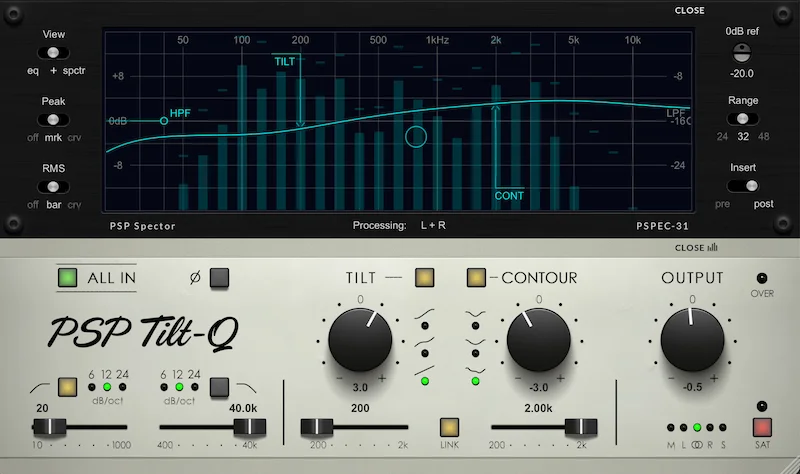
PSPaudioware Launch Tilt-Q — A Musical Tilt EQ for Fast Mix Balance and Mastering Control
PSPaudioware has released Tilt-Q, a new equalizer plugin built around the concept of tilt EQ processing — a technique designed for broad tonal shaping rather than surgical frequency correction. Instead of stacking multiple EQ bands and making micro-adjustments, Tilt-Q focuses on quickly rebalancing the relationship between low and high frequencies in a mix.
This approach is not new in high-end analog workflows, but in digital production it has often been underutilized or poorly implemented. Tilt-Q brings that philosophy into a modern plugin format, combining speed, precision, and musical behavior in a way that fits both mixing and mastering environments.
What a Tilt EQ Actually Does — and Why It Matters
A tilt equalizer works by pivoting the frequency spectrum around a defined center point. Boosting the high frequencies simultaneously reduces the lows, and vice versa. This creates a natural rebalancing effect without introducing the typical buildup or harshness that often comes from traditional EQ moves.
In practical terms, this means fewer decisions and faster results. Instead of asking “which band should I adjust?”, the engineer focuses on overall tonal direction. This is particularly valuable when dealing with full mixes, stems, or buses where maintaining cohesion is critical.
Tilt-Q is designed specifically for these macro-level adjustments. It allows you to fix dull, overly dark, or excessively bright mixes in seconds — without compromising phase integrity or musicality.
Signal Flow and Core Processing Structure
The plugin starts with high-pass and low-pass filters, allowing users to clean up unnecessary frequency extremes before applying tonal shaping. Each filter includes adjustable cutoff frequency and selectable slopes of 6, 12, or 24 dB per octave.
This stage alone can significantly improve clarity by removing subsonic rumble or excessive top-end noise, setting a cleaner foundation for further processing.
The main processing section is built around two primary controls:
Tilt — the core parameter that defines the spectral balance. It determines how much low-end is reduced or enhanced relative to the high frequencies.
Contour — a loudness-style EQ curve that enhances both ends of the spectrum while shaping the midrange. This is particularly effective for adding perceived depth and polish.
Both controls feature adjustable center frequencies, which is a critical detail. Instead of applying a generic tilt, users can anchor the processing around a specific frequency range, making the tool adaptable to different genres and material types.
Three Processing Characters — Not Just Cosmetic Variations
Tilt-Q includes three selectable curve behaviors for both Tilt and Contour sections. These are not subtle differences — they significantly affect how the EQ interacts with the signal:
— Classic mode delivers a balanced, neutral response suitable for mastering;
— Edge-focused mode enhances lows and highs more aggressively, creating a modern, forward sound;
— Mid-centric mode preserves midrange integrity while allowing controlled adjustments around it.
This flexibility allows Tilt-Q to function across multiple stages of production without requiring additional EQ plugins.
Mid/Side Processing and Stereo Control
One of the most important features in modern production is stereo manipulation, and Tilt-Q provides full control with support for Left, Right, Mid, and Side processing.
This opens up advanced workflows such as brightening only the side channels to increase perceived width, or tightening the center to improve vocal clarity and mono compatibility.
In mastering scenarios, this level of control is essential for achieving depth and spatial balance without introducing phase issues or compromising translation.
Internal Processing Quality and DSP Design
Tilt-Q operates with 64-bit double-precision internal processing, ensuring extremely high accuracy and minimal cumulative error. This is especially relevant when the plugin is used in mastering chains, where even subtle degradation can become audible.
The plugin also features automatic oversampling (referred to as FAT double sampling) when operating below 50kHz sample rates. This reduces aliasing artifacts and results in smoother filter behavior.
An additional highlight is the SAT module — a second-generation output saturation stage. This provides subtle harmonic enhancement and soft clipping characteristics, allowing engineers to add density and cohesion without introducing harsh distortion.
Built-in Spectrum Analyzer for Visual Feedback
Tilt-Q includes the PSP Spector PSPEC-31 analyzer, offering a 31-band spectral display. Users can switch between bar and curve visualization modes, enabling real-time monitoring of tonal changes.
This is more than just a visual aid. It provides immediate confirmation of decisions, helping engineers avoid over-processing and maintain balance throughout the workflow.
Real-World Use Cases in Mixing and Mastering
The strength of Tilt-Q lies in its efficiency. It is designed for scenarios where speed and musicality matter more than surgical precision.
In mixing, it can be used early in the chain to establish a coherent tonal direction before detailed processing begins. This reduces decision fatigue and improves consistency across sessions.
In mastering, Tilt-Q becomes a finishing tool — ideal for subtle adjustments that enhance clarity, depth, and translation without disrupting the integrity of the mix.
However, it is important to understand its limitations. Tilt-Q is not intended for removing resonances or fixing problematic frequencies. It operates at a macro level, and should be combined with precise EQ tools when necessary.
In professional workflows, this type of processing is typically part of a broader system that includes corrective EQ, compression, and harmonic shaping. If achieving a competitive, release-ready sound is the goal, relying solely on quick tools is rarely enough — a structured approach to mixing and mastering online ensures that tonal balance is built correctly from the ground up.
Compatibility and System Requirements
Tilt-Q is available for Windows (Windows 7 and above) and macOS (10.15 or higher). It supports VST, VST3, AU, and AAX formats, making it compatible with all major DAWs including Pro Tools, Logic Pro, Cubase, and Ableton Live.
Pricing and Market Position
The plugin is currently offered at an introductory price of $49, discounted from its regular price of $69. This positions Tilt-Q as a mid-tier tool — accessible enough for independent producers, but powerful enough for professional use.
Rather than replacing traditional EQs, Tilt-Q complements them by offering a faster, more intuitive way to shape tonal balance at a macro level. It fills a gap between utility plugins and full-featured mastering processors, delivering results with minimal effort and maximum musicality.