Transport Vintage Tape — Not a Tape Emulator, But a Controlled Saturation Engine
The release of Transport Vintage Tape by Iconic Instruments doesn’t follow the traditional tape plugin formula. It doesn’t aim to recreate a specific machine. It doesn’t focus on analog nostalgia. Instead, it redefines what a tape-style processor can be inside a modern digital workflow.
This is not about “warmth.” This is about control.
transport vintage tape sits in a gray area between tape emulation and multiband saturation, and that positioning changes how it behaves in real sessions.
What Actually Changed in This Release
Most tape plugins are built around limitations. You push signal into a nonlinear model, and it responds in a predictable way: compression, harmonic saturation, transient softening.
Transport Vintage Tape flips that logic.
Instead of forcing the entire signal through one behavior model, it lets you shape what enters saturation in the first place.
This is the critical shift: pre-saturation control.
It means you’re no longer reacting to the plugin — you’re designing how it behaves.
Core Processing Architecture
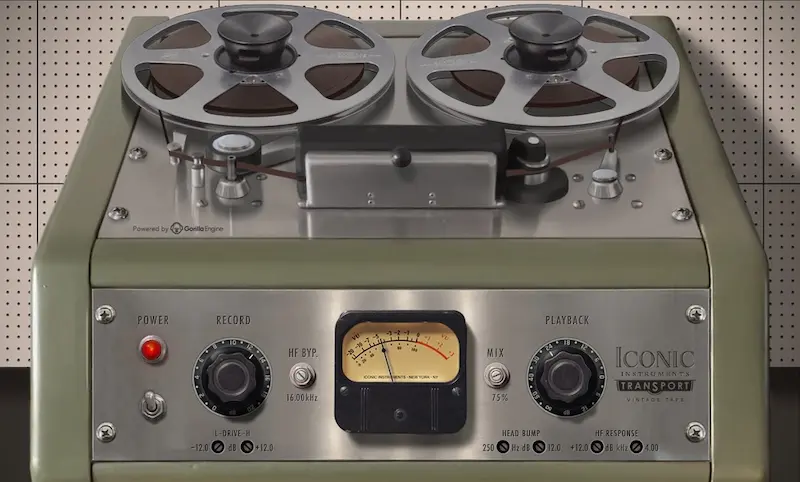
Record Level defines the intensity of the effect. At low levels, you get subtle compression and harmonic enrichment. Push it harder, and transport vintage tape moves into distortion territory that traditional tape plugins rarely reach.
High Drive / Low Drive introduce frequency-dependent saturation control. This is effectively a simplified multiband system without crossovers. You decide how much of the low end and high end actually hits the nonlinear stage.
HF Bypass is one of the most practical features. It removes high-frequency content from saturation entirely, preserving transient clarity and top-end detail.
Head Bump is not just a flavor control. It’s a tunable low-frequency boost (50–250 Hz, up to +12 dB), allowing you to shape weight and resonance directly inside the plugin.
HF Response adds a flexible shelving EQ (±12 dB, 4–10 kHz), letting you compensate or exaggerate top-end behavior.
The result is a system where transport vintage tape behaves less like hardware and more like a configurable processing module.
Where It Sits in the Market
There are two dominant categories in this space.
Traditional tape emulations: UAD Studer A800, Waves J37, Softube Tape. These focus on realism and nonlinear behavior modeling.
Flexible saturation tools: FabFilter Saturn, Soundtoys Decapitator. These prioritize control and creative shaping.
Transport vintage tape doesn’t fully belong to either group.
Compared to Studer A800, it lacks depth and analog realism. You won’t get the same subtle compression curves or machine-specific behavior.
Compared to Waves J37, it offers more flexibility but less inherent musicality.
Against FabFilter Saturn, it’s simpler and faster to dial in, but less powerful in complex routing scenarios.
This positions transport vintage tape as a hybrid: faster than Saturn, more flexible than classic tape plugins, but not a replacement for either.
Real-World Use Cases
Low-End Control
The Head Bump parameter allows you to build low-frequency weight without relying on external EQ. This is especially useful on kick and bass buses.
Transient Preservation
Using HF Bypass, you can saturate the body of a sound while keeping attacks clean. This is critical for drums and percussive elements.
Creative Distortion
Unlike traditional tape plugins, transport vintage tape can be pushed into aggressive distortion. This makes it viable for sound design and modern genres like trap and EDM.
Mix Bus Glue (with caution)
At low settings, it can add cohesion. But the margin for error is narrow — push too far and the mix collapses.
In professional workflows, tools like this are rarely used in isolation. They sit inside a broader processing chain where balance, dynamics, and tonal integrity are controlled globally. That’s why it’s common to combine creative saturation with structured workflows like professional mixing and mastering services, where each stage is optimized rather than stacked blindly.
Where It Delivers
transport vintage tape performs best in:
— electronic music production
— hip-hop and trap
— dense digital mixes
— sound design environments
Whenever precision and controlled aggression are required, it outperforms traditional tape plugins.
Where It Falls Apart
Overprocessing Risk
Too many controls create a false sense of precision. It’s easy to overdo saturation and destroy balance.
Top-End Degradation
Even with HF Bypass, improper settings can reduce clarity and smear high frequencies.
Lack of True Tape Behavior
There’s no detailed modeling of wow/flutter, hysteresis, or inter-channel interaction. This limits realism.
For mastering, these limitations become critical.
Hard Limitations You Can’t Ignore
Transport vintage tape is not a replacement for:
— high-end tape emulations
— advanced multiband saturation systems
— analog hardware processing
It’s a specialized tool. Treat it as one.
Final Assessment
Transport vintage tape is not about recreating analog gear. It’s about reshaping how saturation is applied.
Its strength is control. Its weakness is authenticity.
If you understand gain staging, frequency balance, and nonlinear processing, it becomes a powerful addition. If not, it will degrade your mix faster than it improves it.