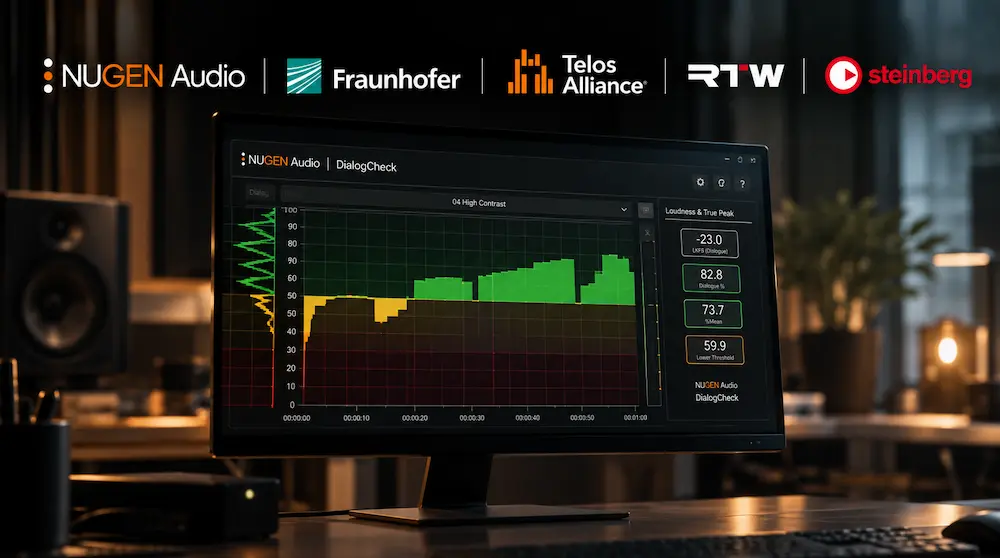
NUGEN Audio, RTW, Steinberg and Telos Alliance have introduced the LMMG Dialog Intelligibility Implementation Agreement, a common specification for implementing Fraunhofer IDMT’s LEAP dialogue-intelligibility technology across professional audio products.
LEAP is designed to assess how easily speech can be understood in a programme by estimating the listening effort required to follow dialogue. Unlike loudness or level measurements, it targets the intelligibility of speech in the context of the surrounding audio.
The agreement defines how participating manufacturers should process, scale and present LEAP measurements, with the goal of making a reading from one manufacturer’s system directly comparable with a reading from another.
What Is LEAP and What Does It Measure?
Developed by Fraunhofer IDMT, LEAP is designed to measure perceived dialogue intelligibility by estimating the listening effort required to understand speech. It does not treat speech level or programme loudness as a direct proxy for intelligibility.
That matters because dialogue can sit at an apparently appropriate level and still be difficult to follow. The problem often comes from what surrounds the voice rather than from the voice level itself.
Music, ambience, sound effects, reverberation and background noise can all mask speech. A mix can therefore meet its loudness target while dialogue remains hard to understand, particularly when competing material occupies the same spectral and temporal space as the voice.
LEAP provides a separate measurement for this aspect of the programme, giving engineers a way to assess dialogue intelligibility alongside conventional level and loudness measurements.
Why Loudness Alone Does Not Tell You If Dialogue Is Intelligible
Loudness and dialogue intelligibility measure different things. A loudness meter tells you how loud a programme is perceived over the measurement window; it does not tell you how easily the listener can extract speech from the mix.
That distinction becomes obvious when dialogue competes with music, sound effects, ambience or reverb. Raising the dialogue level may help, but it can also be the wrong fix. If the voice is being masked by competing material, the underlying problem may be the arrangement, spectral balance, dynamics or timing of the surrounding elements rather than the dialogue level itself.
Dialogue intelligibility therefore makes sense as a separate measurement alongside loudness, peak level and other established audio metrics. It addresses a question those meters cannot answer directly: how much effort does the listener need to understand what is being said?
LMMG Sets a Common Standard for LEAP Measurements
The LEAP Meter Manufacturers Group (LMMG) brings NUGEN Audio, RTW, Steinberg and Telos Alliance together with Fraunhofer IDMT to define how LEAP-based dialogue intelligibility measurements should be implemented across professional audio products.
The reason for the agreement is practical. Using the same underlying measurement technology does not automatically guarantee identical results between products. Differences in signal processing, downmixing, smoothing and scaling can affect the displayed measurement and make readings from different systems difficult to compare.
The LMMG Dialog Intelligibility Implementation Agreement sets common rules for these parts of the measurement chain. It establishes Dialogue Intelligibility as the standard terminology and DIU (Dialogue Intelligibility Unit) as the user-facing measurement unit, with results mapped to a common 0–100 scale.
The specification also defines reference thresholds and colour ranges, signal-processing and downmixing requirements, smoothing behaviour, and the treatment of non-dialogue content.
The practical goal is interoperability: a DIU reading should have the same meaning whether the measurement comes from a NUGEN Audio, RTW, Steinberg or Telos Alliance implementation of LEAP.
What Is DIU?
DIU (Dialogue Intelligibility Unit) is the measurement unit used to report LEAP-based dialogue intelligibility results under the LMMG specification.
The scale runs from 0 to 100 DIU, with higher values representing better dialogue intelligibility and lower estimated listening effort. The point is to give engineers a consistent reference when comparing dialogue performance across systems and production stages.
DIU is not a replacement for LUFS or other loudness measurements. They describe different properties of the programme: loudness measurements quantify the perceived level of the overall signal, while DIU is intended to indicate how easily the dialogue can be understood within that signal.
That makes DIU a complementary measurement for production and QC rather than another way of expressing loudness.
Dialogue Intelligibility Across the Production Chain
The value of a common measurement becomes clearer when the same programme moves between different production systems.
A broadcast may be monitored on one manufacturer’s hardware, mixed or refined in post-production with another company’s software, and then passed through a separate QC system before delivery. If each implementation handles the measurement differently, identical programme material can produce different readings at different stages.
The LMMG agreement is designed to minimise those differences by defining common rules for LEAP-based measurement. A programme can therefore be monitored, processed and checked using tools from different manufacturers while retaining the same measurement scale and interpretation.
That makes dialogue intelligibility more practical as part of a production workflow rather than simply another analysis feature on an individual meter.
Where LEAP Fits in Professional Audio Workflows
LEAP-based dialogue intelligibility measurement is aimed at workflows where speech needs to remain intelligible from production through final delivery. That includes live production, broadcast monitoring, post-production, quality control and content verification.
The use cases extend across television, streaming, podcasts, documentaries, news and other speech-led formats. In these productions, dialogue competes with music, effects, ambience and other programme elements, making level alone an unreliable indicator of how clearly the speech will be understood.
For engineers, the practical value is in identifying potential intelligibility problems before the programme reaches the audience, and doing so with a measurement that can be carried through different stages of the production and QC chain.
Give Your Mix the Clarity It Needs to Translate
Dialogue intelligibility depends on how clearly the important elements survive the full programme mix, not simply on hitting a loudness target. A mastering pass can help evaluate the balance, dynamics, depth and detail of your mix across playback systems. Try our free mastering demo by uploading up to 40 seconds of your mix: Upload your mix for a free mastering demo →
LEAP Demonstrated at IBC 2026
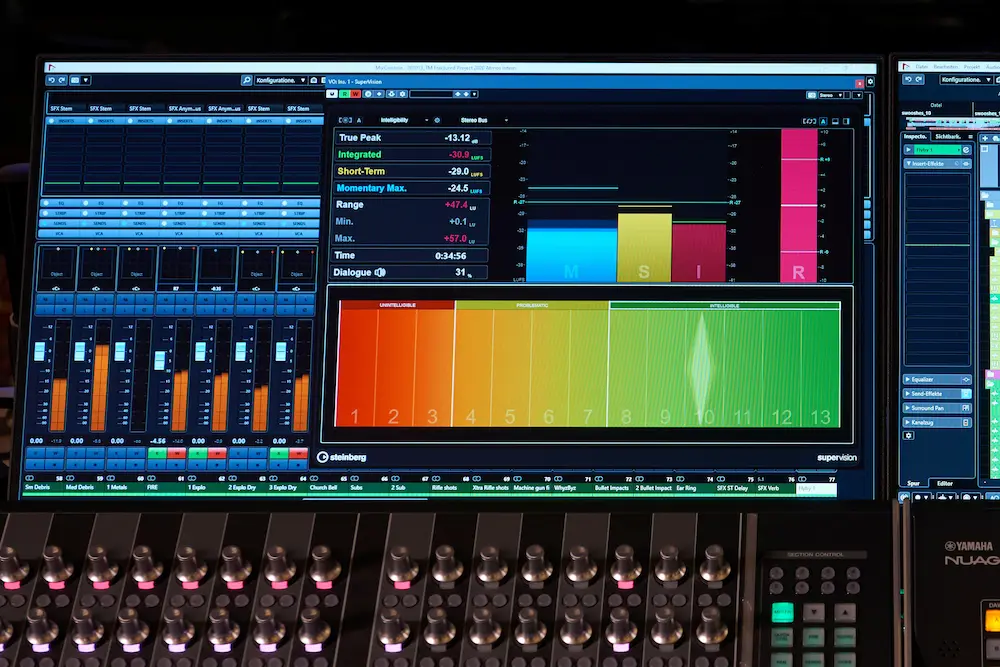
The LMMG agreement is being demonstrated at IBC 2026 in Amsterdam, where NUGEN Audio, RTW, Steinberg and Telos Alliance are showing dialogue intelligibility measurement in their respective products and workflows.
NUGEN Audio is demonstrating the technology at stand P27. RTW is at Hall 8, 8.D44 with Amptec, Steinberg at Hall 8, 8.D25 with Yamaha, and Telos Alliance at Hall 8, 8.D37.
Fraunhofer IDMT is also involved in Crystal Clear: Boosting Speech Intelligibility in Media, part of the IBC 2026 Accelerator Media Innovation Programme. Crystal Clear is a separate initiative from the LMMG agreement, but both projects address the same broader engineering problem: making speech intelligibility measurable rather than relying solely on subjective assessment.
What LEAP Adds to the Engineer’s Metering Toolkit
The LMMG agreement is not another loudness standard. It addresses a different part of the signal: how easily dialogue can be understood within the programme mix.
Engineers already have established measurements for loudness, peak level, dynamics and spectral balance. Dialogue intelligibility is harder to reduce to a single number because it depends on the interaction between speech and everything around it — music, effects, ambience, noise and reverberation.
A LEAP-based measurement can therefore serve as another diagnostic reference alongside conventional metering. It can help flag sections where dialogue may require excessive listening effort, even when the programme meets its loudness and level targets.
That does not make DIU a substitute for critical listening or engineering judgement. Its practical value is in providing a repeatable measurement that can be compared across versions, systems and production stages.
Where Dialogue Intelligibility Measurement Goes Next
The current LMMG agreement provides a common specification for real-time dialogue intelligibility measurement. The more interesting next step is moving from a live meter reading to metrics that describe the intelligibility of an entire programme or finished asset.
That could make dialogue intelligibility useful in automated QC, where a completed programme could be assessed for intelligibility alongside loudness compliance and other delivery requirements. For broadcasters, streaming platforms and post-production facilities, an integrated metric could make it easier to identify problematic sections before delivery.
Whether DIU becomes a widely adopted delivery metric will depend on how broadly manufacturers implement the specification and how the industry validates it in real-world production. For now, the LMMG agreement establishes a common measurement language that allows LEAP-based systems from different manufacturers to be compared on the same scale.

Yurii Ariefiev approaches dialogue intelligibility measurement from an audio-engineering perspective, with particular attention to how speech interacts with competing programme material. In this context, LEAP and DIU are most useful as objective references alongside conventional metering, helping separate intelligibility from simple level or loudness measurements.
Enjoyed this review?
If you found it useful, you can support independent audio research with a coffee.
☕ Buy me a coffee