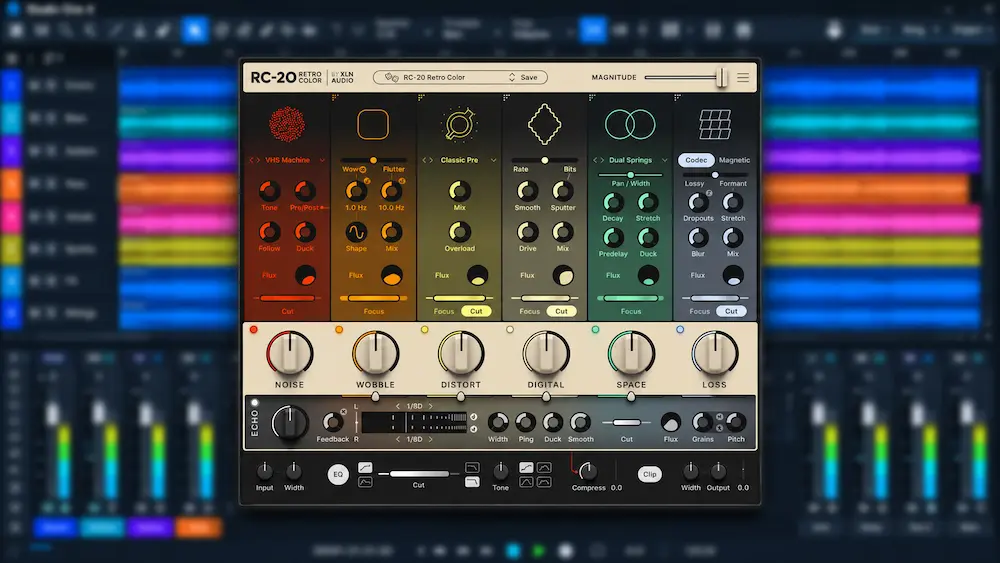
RC-20 Retro Color is designed to add the imperfections and character often missing from clean digital recordings: noise, pitch instability, saturation, signal degradation, and spatial effects. Version 2 builds on that foundation with feedback-based Echo processing, granular textures, new digital artifacts, and greater control over the signal path. Rather than replacing the original concept, XLN Audio has expanded its creative capabilities and made the processing chain more flexible.
The most significant addition is Echo, which routes successive delay repeats through RC-20’s effects. This allows modulation, distortion, and degradation to accumulate across the feedback path instead of applying the same treatment to every repeat. Grains and Codec extend the plugin’s sound-design range, while module reordering, additional filtering, tempo synchronization, and improved preset management provide more control over how effects interact.
This review examines the documented changes, their implications for production workflows, and RC-20 v2’s position among competing lo-fi effects plugins. The distinction between documented features and verified performance is important: the available release information describes the new processing capabilities, but does not establish v2-specific CPU usage, latency, detailed signal behavior, or the sonic performance of its new algorithms through independent testing. These aspects therefore remain open technical questions rather than grounds for a definitive performance verdict.
What Is New in RC-20 Retro Color v2?
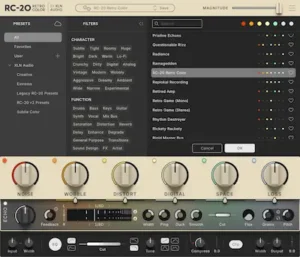
 RC-20 v2 retains the six-module concept of the original plugin, but its processing architecture has been updated. The original Magnetic module is replaced by Loss, which combines tape-related degradation and dropouts with the new Codec processing. Noise, Wobble, Distort, Digital, Space, and Loss provide the plugin’s expanded range of noise generation, pitch modulation, saturation, digital degradation, reverb, and signal manipulation.
The most significant additions and changes include:
- Echo: a feedback delay that routes successive repeats through RC-20’s effects, allowing modulation, distortion, and degradation to build across the feedback path.
- Grains: granular processing that transforms Echo tails into more diffuse, evolving textures.
- Codec: digital degradation effects featuring artifacts associated with lossy compression, packet dropouts, formant shifts, and blurred signal detail.
- Expanded distortion and reverb: additional tape and classic preamp coloration, four-track cassette distortion, and 32 new reverb types.
- Additional processing controls: warp modulation, Digital Sputter and Drive, Space ducking, and a Noise pre/post blend.
- Reorderable modules: Wobble, Distort, Digital, Space, and Loss can now be rearranged to change the order in which their processing affects the signal.
- More detailed control and workflow: Focus/Cut filters for selected modules, tempo synchronization for supported effects, Loudness Match, preset tags and collections, snapshots, undo history, and module locking.
These changes serve two distinct purposes. Echo, Grains, Codec, and the expanded processing options increase the range of textures RC-20 can generate. Module reordering, filtering, synchronization, and preset-management improvements provide greater control over how those effects interact and how settings are recalled. The distinction matters: adding processing options expands the sound palette, but improving routing and session management makes that expanded palette more practical to use in complex production sessions.
Echo: The Most Significant New Creative Feature
A conventional delay generates repetitions of an input signal. Those repeats can be filtered, saturated, modulated, or routed through additional effects, but creating more complex interactions often requires a separate delay plugin and additional signal routing. RC-20 v2 takes a more integrated approach with its new Echo feature.
Echo’s feedback path can route successive repeats through RC-20’s processing. As the signal feeds back, each repetition can acquire further modulation, distortion, and degradation. This turns the delay into an active part of the sound-design process rather than simply repeating the original performance.
The Echo section also provides controls for shaping how the feedback effect behaves. Sweetwater’s published v2 feature description lists per-module Echo amount controls, along with Width, Ping/Pong, Duck, Flux, and tempo synchronization. These options matter because they allow the delay repeats to interact with selected processing stages while providing additional control over stereo placement, rhythmic timing, and feedback behavior. Their exact sonic response and practical limits still require direct evaluation.
The practical difference is most apparent when working with isolated sounds. A vocal phrase, percussion hit, or synthesizer note can develop into a sequence of increasingly unstable and degraded repetitions. Instead of building a separate effects chain around a conventional delay, producers can create these interactions within RC-20’s existing processing environment.
This approach is particularly useful for:
- Vocal production: creating progressively degraded repeats, unstable tails, and lo-fi transitions from short phrases or individual words.
- Drum programming: turning a single percussion hit into a sequence of repetitions with accumulating distortion or modulation.
- Synth sound design: introducing evolving movement and progressive degradation into sustained tones, melodic phrases, and one-shot sounds.
- Transitions and effects: developing changing textures from isolated audio without building an extensive auxiliary effects chain.
The main advantage is integration: Echo can interact with RC-20’s other processing stages instead of operating as an isolated delay effect. However, this flexibility also introduces a potential gain staging challenge. When feedback interacts with multiple stages of distortion, modulation, and degradation, the resulting signal may become increasingly dense or unpredictable. The available documentation establishes the routing concept, but does not provide enough detail to assess the internal gain structure or behavior at extreme feedback settings. Those aspects require practical testing.
Creative Effects Shape the Sound. Mastering Defines the Final Balance.
Lo-fi processing, saturation, modulation, and feedback effects can add character and movement to individual tracks, but their impact on the full mix needs to be evaluated in context. Frequency buildup, transient definition, stereo balance, and low-end consistency all influence how well a production translates beyond the studio. If your mix is ready for its final stage, AREFYEV STUDIO offers a free mastering demo so you can hear how professional mastering may affect its overall balance, clarity, dynamics, and translation. Upload up to 40 seconds of your mix for an initial assessment.
Get Your Free Mastering Demo →
Grains: Turning Delay Tails into Textures
Grains extends RC-20 v2’s Echo concept into granular sound design. According to the release information, it transforms delay tails into granular and ambient textures. Rather than emphasizing clearly separated repeats, this processing breaks sustained audio into smaller fragments, producing a more diffuse and evolving result.
This makes Grains particularly relevant to sound design when a conventional delay or reverb does not provide enough textural movement. A short synthesizer note, vocal fragment, or processed percussion sound can become the source material for a more extended atmospheric layer.
Potential applications include:
- Creating atmospheric layers from short melodic phrases.
- Extending vocal or percussion material into transitional effects.
- Adding granular movement and variation to sustained synthesizer sounds.
- Transforming familiar audio material into less recognizable textures.
However, the inclusion of granular processing does not make RC-20 a dedicated granular instrument. The documented Grains feature is associated with the Echo processing environment, and the available release information does not establish how extensively its parameters can be controlled compared with specialized granular processors. Producers who need detailed grain-position editing, extensive sample manipulation, or complex granular modulation should assess those requirements separately before treating RC-20 as a replacement for a dedicated granular tool.
Codec: A More Digital Form of Degradation
RC-20’s original identity is closely associated with tape noise, pitch instability, saturation, and other forms of analog-inspired coloration. Codec broadens this palette by introducing digital artifacts associated with degraded signal transmission and lossy audio processing.
The documented effects include artifacts associated with lossy network compression, packet dropouts, formant shifts, and blurred signal detail. These effects offer a different type of coloration from conventional tape or vinyl processing. Depending on the settings and source material, digital degradation can introduce a sense of instability, signal damage, reduced definition, or deliberately compromised audio quality.
Potential applications include:
- Adding degraded digital character to vocal samples and spoken-word recordings.
- Creating unstable textures from synthesizers and electronic instruments.
- Introducing digital artifacts into transitions and sound effects.
- Contrasting clean source material with deliberately degraded layers.
There is an important technical distinction: Codec should be understood as a creative degradation effect, not as a verified, technically accurate simulation of specific network protocols or audio codecs. The release information identifies the types of artifacts it can produce but does not disclose enough detail to assess its underlying algorithms, specific codec models, or behavior at different sample rates and bit depths.
For producers, the relevant question is therefore not whether Codec accurately reproduces a particular transmission system. It is whether its controls provide useful and predictable digital coloration when applied to real source material. That can only be established through practical evaluation.
Expanded Processing and More Flexible Signal Routing
Beyond its three headline additions, RC-20 v2 expands several areas of the original processing environment. The documented update includes new tape and classic preamp coloration, four-track cassette distortion, 32 additional reverb types, warp modulation, Digital Sputter and Drive, Space ducking, and a Noise pre/post blend.
Not every addition will be equally relevant to every producer. Their practical value depends on how often a session calls for different types of coloration and how much flexibility is needed without building separate processing chains.
The expanded distortion options provide additional sources of saturation and degradation. The new reverb types broaden the range of ambience available in the Space module, while Space ducking adds another option for controlling the effect’s level in relation to the source signal. The Noise pre/post blend provides greater control over how noise interacts with the processing chain.
One of the more significant structural changes is module reordering. RC-20 v2 allows users to rearrange Wobble, Distort, Digital, Space, and Loss. This matters because the order of processing stages can substantially affect the resulting sound.
For example, distortion applied before digital degradation can produce a different result from distortion applied afterward. Similarly, modulation before a spatial effect can create a different interaction from modulation placed later in the chain. Reordering gives producers more control over these relationships within RC-20, without requiring external routing.
There is one important limitation: Noise is not included in the documented reordering capability. It would therefore be inaccurate to describe all six modules as freely reorderable.
Focus/Cut Filters, Tempo Sync, and Loudness Match
 RC-20 v2 also introduces several workflow controls that improve how users shape and evaluate effects, rather than adding entirely new processing categories.
Focus/Cut filters are available for Noise, Wobble, Distort, and Loss. They provide additional control over the frequency content affected by these modules. This is useful when an effect contributes the desired character to one part of a sound but creates unwanted coloration elsewhere. For example, a producer may want to add distortion to the midrange of a drum loop while keeping its low-frequency foundation less affected—a decision that also depends on the overall frequency balance of the mix.
Tempo synchronization is available for selected modulation effects, Magnetic tape flutter, and Echo delay. Synchronizing these processes to the project tempo can make rhythmic movement easier to coordinate with an arrangement. This is particularly useful when modulation or delay becomes part of a repeating musical pattern rather than an isolated sound-design effect.
Loudness Match is designed to make comparisons between processed and unprocessed signals at more comparable perceived levels. This addresses a common problem in effect evaluation: a louder signal can seem more impressive even when the processing itself has not improved its tonal balance, dynamics, or overall contribution to the mix.
Loudness matching should not be confused with mastering loudness control, peak limiting, or delivery normalization. It is a comparison aid, not a substitute for proper gain staging or final mix and mastering measurements. The available documentation does not specify the matching algorithm or its measurement method, so its precision and behavior should not be assumed without practical testing.
Workflow Improvements: Presets, Snapshots, Undo, and Oversampling
Managing a creative multi-effect can become increasingly demanding when a session contains multiple instances and detailed processing settings. RC-20 v2 addresses this with a set of workflow improvements designed to make preset management, sound exploration, and parameter editing more convenient.
- Preset tags and search filters make it easier to locate sounds by category and other preset attributes.
- Custom collections and preset sharing provide additional options for organizing and exchanging settings.
- Undo history allows users to revisit earlier editing decisions.
- Module locking keeps selected processing stages unchanged while other parts of a preset are modified or explored.
- Snapshots allow different settings to be stored and compared.
- Oversampling is available as an additional processing option.
- Master compression adds another stage to RC-20’s processing environment.
- Modifier-key control allows multiple controls to be adjusted simultaneously.
Module locking is particularly useful when exploring presets. A producer might find a combination of Noise and Wobble that works well but want to audition different distortion or spatial settings. Locking the preferred modules helps preserve that part of the sound while other settings are changed.
Snapshots and undo history address a related aspect of creative work: comparing variations without losing earlier decisions. These functions can make detailed sound design easier to manage, particularly when several versions of an effect setting need to be evaluated before choosing one for the session.
Oversampling deserves separate consideration because RC-20 includes distortion and other nonlinear processing. Oversampling can help reduce aliasing in nonlinear signal processing, but its presence alone does not establish how effectively it is implemented in RC-20 v2. The available information does not specify which processing stages use oversampling, its available modes, or the associated CPU cost. Those details require independent evaluation.
How RC-20 Retro Color v2 Fits into a Mixing Workflow
RC-20 is best understood as a creative multi-effect rather than a corrective mixing processor. Its role is to introduce character, movement, instability, and deliberate signal degradation. It is not intended to replace equalization, transparent compression, dedicated dynamics processors, audio restoration tools, or dedicated mastering processors.
Drums and Percussion
Drum loops and individual percussion tracks are natural applications for RC-20’s processing approach. Noise can add texture, Wobble can introduce pitch instability, Distort can alter harmonic content, and Digital or Loss can create more pronounced forms of degradation. Echo expands these possibilities by turning individual hits into evolving rhythmic or textural effects.
The main consideration is low-frequency stability. Excessive modulation, distortion, or degradation can alter the character and consistency of kick and bass elements. Focus/Cut controls may help limit the frequency content affected by selected modules, but the processed signal still needs to be evaluated in the context of the full arrangement.
Vocals and Vocal Samples
RC-20 can add character to vocal layers, ad-libs, samples, and background textures. Echo can generate progressively degraded repetitions, while Codec introduces digital artifacts that differ from conventional tape-style coloration.
On a lead vocal, the important question is not simply whether the effect sounds interesting in isolation. The processing must also preserve intelligibility and maintain the vocal’s intended position in the mix—two essential considerations in effective vocal mixing. Heavy degradation may work well on a parallel layer, an ad-lib, or a transition, while being less suitable for the main vocal path.
Synthesizers, Keys, and Electronic Sound Design
Synthesizers and sampled instruments provide a broad range of source material for RC-20. Grains can transform Echo tails into more extended textures, Echo can create evolving repetitions, and the expanded distortion and modulation options can introduce movement and variation into otherwise static sounds.
For electronic producers, the main advantage is access to several types of creative processing within one plugin. However, RC-20 should not be mistaken for a full granular synthesizer or a dedicated modulation system. Its strength lies in combining character effects, not replacing broader hybrid sound-design instruments that combine sampling, synthesis, and granular processing.
Bass and Full Mixes
RC-20 can also be applied to bass and broader mix elements, but these uses require careful judgment. Modulation and degradation can add character, yet they may also affect low-frequency consistency or make a dense mix more difficult to control.
On a full mix, RC-20 is better treated as a deliberate creative effect than as a routine mastering processor. Any processing that changes tonal balance, stereo image, transient behavior, or noise floor should be evaluated against the intended mix and delivery requirements. Loudness Match can help make level comparisons more consistent, but it does not establish that the processed version is technically or musically superior.
RC-20 Retro Color v2 vs. v1: Is the Upgrade Meaningful?
For existing RC-20 users, the main question is whether the new processing capabilities and workflow improvements justify upgrading. Version 1 already provides the plugin’s six-module approach to creative sound processing. Version 2 builds on that foundation with new sound-design options, expanded processing, and greater control over the signal chain.
| Area | RC-20 v1 | RC-20 v2 |
|---|---|---|
| Core modules | Noise, Wobble, Distort, Digital, Space, Magnetic | Noise, Wobble, Distort, Digital, Space, Loss |
| Magnetic / Loss processing | Magnetic tape wear, flutter, and dropouts | Loss retains tape-related degradation and adds Codec processing |
| Echo | No equivalent documented integrated feedback feature | Feedback delay with repeats routed through RC-20 effects |
| Granular processing | No documented Grains feature | Grains transforms Echo tails into granular textures |
| Digital degradation | Original Digital module | Expanded digital processing, including Codec effects |
| Signal routing | Original module arrangement | Reordering for Wobble, Distort, Digital, Space, and Loss |
| Filtering | Original controls | Additional Focus/Cut filters for selected modules |
| Tempo synchronization | Original synchronization capabilities | Sync options for selected modulation effects, Magnetic tape flutter, and Echo delay |
| Workflow | Original preset and control workflow | Preset tags, collections, snapshots, undo history, and module locking |
XLN Audio’s release information states that projects created with v1 can be opened in v2. The update also includes v1 factory and artist presets, while existing user presets can be imported. These compatibility provisions matter for producers with established sessions and custom preset libraries.
However, project compatibility does not necessarily mean bit-identical processing. The available information does not establish that a v1 project will produce exactly the same audio when opened and rendered in v2. Engineers responsible for critical session recalls should retain access to the original plugin version and compare renders before replacing it in archived projects.
The upgrade is most relevant to users who want integrated feedback processing, granular textures, expanded digital degradation, or more flexible effects routing. Producers who rely mainly on the original six modules and rarely need these additional capabilities may have less reason to upgrade immediately. The decision ultimately depends on whether the new features solve actual production needs rather than simply expanding the feature list.
RC-20 Retro Color v2 Alternatives
RC-20 v2 is not the only option for producers looking for lo-fi processing. Several plugins cover overlapping territory, but their approaches differ in focus, flexibility, and the types of coloration they provide.
| Plugin | Main approach | Where it makes sense |
|---|---|---|
| XLN Audio RC-20 Retro Color v2 | Multi-module character processing with noise, modulation, distortion, degradation, spatial effects, Echo, and Grains | Producers who want several types of coloration and sound design in one plugin |
| Baby Audio Super VHS | Six controls focused on VHS-inspired coloration and instability | Users who prefer a simpler, more immediate lo-fi effect |
| Aberrant DSP SketchCassette II | Cassette-oriented processing with tape profiles, saturation, hiss, dropouts, and wow/flutter | Producers specifically looking for cassette-style degradation |
| iZotope Vinyl | Vinyl-inspired dust, scratches, warp, and mechanical noise | Users who need a free, focused vinyl-effect tool |
| Chow Tape Model | Open-source reel-to-reel tape emulation | Users interested in tape-style processing rather than an all-in-one lo-fi multi-effect |
Baby Audio Super VHS takes a more focused approach, with six controls covering different aspects of VHS-inspired coloration. It is worth considering when the goal is to add a recognizable lo-fi character quickly, without the broader processing environment and routing options found in RC-20.
Aberrant DSP SketchCassette II is more specifically oriented toward cassette character. Its feature set includes multiple tape profiles, saturation, hiss, dropouts, and wow/flutter. It is a relevant alternative when cassette-style degradation is the main requirement rather than a wider collection of lo-fi effects.
iZotope Vinyl is a free option for vinyl-style effects, including dust, scratches, warp, and mechanical noise. Its scope is considerably narrower than RC-20’s, but it may be sufficient when the objective is simply to introduce vinyl-inspired character without investing in a more comprehensive multi-effect.
Chow Tape Model offers an open-source approach to reel-to-reel tape emulation. It is not a direct replacement for RC-20’s multi-effect architecture, but it provides a more specialized option for producers interested in tape-style processing.
These plugins are not interchangeable. RC-20 v2’s main advantage is the combination of multiple character-processing categories, including its integrated Echo and Grains features. A dedicated cassette or tape processor may be more appropriate when a specific type of degradation is the priority. A free vinyl effect may be entirely adequate for a narrower task. The better choice depends on the sound required, the level of control needed, and whether an all-in-one workflow offers practical value.
Price and Upgrade Value
The standard listed prices are $129 for the full version and $39 for the upgrade from v1. At the time of this review, Plugin Boutique lists promotional prices of $99 for the full version and $19 for the upgrade. Retail prices and promotional offers may vary by region and sales channel.
For new buyers, the main consideration is whether RC-20’s combination of effects offers enough practical value compared with purchasing specialized plugins or building similar processing chains from tools they already own. Its appeal lies in bringing multiple types of character processing into one environment, rather than providing a single specialized effect.
For existing v1 users, the listed $39 upgrade price makes the decision more straightforward, provided the new Echo, Grains, Codec, signal-routing options, and workflow improvements are relevant to their production needs. Producers who mainly use RC-20 for occasional noise, pitch instability, or saturation may have little reason to upgrade immediately.
There is also a documentation limitation to consider. At the time of release, the manufacturer’s publicly available product documentation and release notes did not provide a complete, independently verifiable v2 technical specification. The retailer listing provides pricing and an advertised feature overview, but v2-specific trial availability and complete licensing terms should be confirmed before purchase.
Compatibility and Technical Considerations
RC-20 Retro Color v2 is listed for macOS 10.13 or later (64-bit) and Windows 10 or 11 (64-bit), with support for VST3, AU, and AAX. The published compatibility list includes Ableton Live 10 or later, Logic Pro 10 or later, Pro Tools 11 or later (excluding Pro Tools First), Cubase 10 or later, FL Studio 20 or later, Reaper 5 or later, Reason 10.3 or later, Cakewalk by BandLab, and MOTU Digital Performer 10 or later. Confirm the latest host and operating-system requirements with XLN Audio before updating.
Several technical questions also remain unanswered by the available release information:
- How does v2’s CPU usage compare with the original version?
- What latency, if any, is introduced by the new Echo and Grains processing?
- How effectively does oversampling reduce aliasing in nonlinear processing stages?
- How does Codec respond to different source material and sample rates?
- Does the updated processing maintain consistent stereo behavior across the modules?
- Do v1 and v2 produce identical renders when projects are opened without changing their settings?
These questions matter to engineers working with large sessions, demanding real-time processing requirements, or precise project recall. Without independent measurements and controlled comparisons, claims about lower CPU usage, improved audio quality, negligible latency, or completely transparent backward compatibility would be premature.
Overall Rating
This is a feature-based editorial assessment of RC-20 v2’s documented processing capabilities and workflow, not a hands-on evaluation of its sonic performance or measured technical behavior.
| Category | Rating |
|---|---|
| Creative Processing Range | 8.8/10 |
| Feedback & Texture Generation | 8.7/10 |
| Signal-Chain Flexibility | 8.5/10 |
| Frequency & Timing Control | 8.2/10 |
| Preset & Session Management | 8.6/10 |
| Overall | 8.6/10 |
The combination of noise, modulation, distortion, digital degradation, spatial effects, and expanded processing options gives RC-20 a broad creative palette without requiring multiple separate effects.
Echo and its feedback-based processing provide a particularly useful extension of the original concept, while Grains adds another route to evolving textures; however, the available documentation does not establish the depth of granular control compared with dedicated processors.
Reordering five processing modules allows more deliberate signal-chain design, although Noise remains outside this capability, limiting complete routing freedom.
Focus/Cut filters and tempo synchronization offer useful frequency and timing adjustments, but their availability is limited to selected modules and effects rather than providing universal control across the entire plugin.
Preset tags, collections, snapshots, undo history, and module locking make experimentation and session recall more manageable, although the available information does not establish v2-specific CPU performance, latency, or exact compatibility of rendered audio with version 1.
RC-20 Retro Color v2 is a versatile creative multi-effect for producers who regularly build lo-fi coloration, degraded repetitions, and evolving textures from existing audio. Its strongest advantage is the integration of several processing approaches within one environment, supported by more flexible routing and preset management. The main compromise is that some capabilities remain specialized or limited, while important technical performance details still require independent verification.
Final Verdict: Who Should Consider RC-20 Retro Color v2?
 RC-20 Retro Color v2 is a substantial expansion of an established creative effects plugin. Echo is the most significant addition: its feedback path can route successive repetitions through RC-20’s processing, allowing modulation, distortion, and degradation to accumulate across repeats. Grains extends this approach into granular textures, while Codec adds another category of digital degradation.
The routing and workflow improvements also contribute to the update. Module reordering, Focus/Cut filters, tempo synchronization, snapshots, undo history, and module locking provide more ways to shape effects and manage settings without leaving the plugin.
However, RC-20 is not an essential purchase for every studio. Its primary role remains creative coloration rather than corrective mixing or mastering. Producers who need transparent processing, detailed audio restoration, a dedicated granular instrument, or specialized tape emulation may be better served by tools designed specifically for those applications.
RC-20 Retro Color v2 is most relevant to:
- Hip-hop and beat producers who regularly work with lo-fi textures and degraded samples.
- Electronic music producers who need evolving textures, feedback effects, and digital artifacts.
- Sound designers creating transitions and unconventional effects from existing audio.
- Mixing engineers applying creative processing to individual tracks, parallel layers, and selected buses.
- Existing RC-20 users who will make practical use of Echo, Grains, Codec, and the expanded routing options.
It is less compelling for:
- Engineers primarily looking for transparent corrective processing.
- Producers who need only a basic vinyl or cassette effect.
- Users whose existing specialized plugins already cover the new capabilities.
- Studios that cannot accept uncertainty around CPU usage, latency, or exact project recall.
The strongest argument for v2 is not simply the larger feature set. Echo and Grains extend RC-20’s original character-processing concept into more complex, evolving sound design, while the routing and workflow improvements provide greater control over how those effects are combined and managed. For producers who regularly use these techniques, the update is worth serious consideration. For others, the original version or a more specialized alternative may remain sufficient.
Your Mix Needs More Than Creative Effects. Hear What Professional Mastering Changes.
RC-20 Retro Color v2 can add feedback-driven textures, granular movement, saturation, and digital degradation to individual tracks, but these creative decisions also affect the balance of the finished production. A mix that sounds exciting with layers of processing may still need careful attention to low-end consistency, transient definition, tonal balance, stereo image, and overall dynamics. Adding another effect is not necessarily the answer. The more useful next step is to hear your actual mix before and after professional mastering and judge what changes in context. AREFYEV STUDIO offers a free mastering demo prepared by a real mastering engineer. Upload up to 40 seconds of your mix and compare the original with the mastered version before deciding how to proceed.
Upload Your Mix and Get a Free Mastering Demo →
Frequently Asked Questions
Is RC-20 Retro Color v2 a completely new plugin?
No. It is a major update to the established RC-20 Retro Color plugin. It retains the six-module format, but replaces the original Magnetic module with Loss. It also adds Echo, Grains, Codec processing, expanded effects, and workflow improvements.
What is the biggest difference between RC-20 v1 and v2?
Echo’s integrated feedback processing is one of the most significant changes. Successive repeats can pass through RC-20’s effects, allowing modulation, distortion, and degradation to accumulate across the feedback path. Grains and Codec further expand the plugin’s sound-design capabilities.
Can RC-20 Retro Color v2 be used on vocals?
Yes. Its noise, modulation, distortion, digital degradation, and Echo processing can be applied to vocal tracks, samples, ad-libs, and parallel layers. Processing should be controlled carefully when vocal intelligibility is a priority.
Is RC-20 Retro Color v2 suitable for mastering?
RC-20 is primarily a creative multi-effect, not a corrective mastering processor. It can be used deliberately for coloration or sound design on a full mix, but its noise, modulation, distortion, and degradation effects may compromise tonal balance or signal consistency. Any use on a master bus requires careful level-matched comparison and monitoring.
Does RC-20 v2 support projects and presets from version 1?
XLN Audio’s release information states that v1 projects can be opened in v2, that v1 factory and artist presets are included, and that existing user presets can be imported. This does not establish that every v1 project will produce identical audio renders in the new version.
How much does RC-20 Retro Color v2 cost?
At release, Sweetwater listed the full version at $129 and the upgrade for existing v1 owners at $39. Retailer prices may vary by region and sales channel.
What are the main alternatives to RC-20?
Baby Audio Super VHS offers a more focused VHS-style effect, Aberrant DSP SketchCassette II concentrates on cassette degradation, iZotope Vinyl provides free vinyl-style processing, and Chow Tape Model focuses on reel-to-reel tape emulation. The most suitable alternative depends on the type of coloration and processing control required.
Does RC-20 Retro Color v2 use a lot of CPU?
The available release documentation does not establish a reliable v2-specific CPU benchmark. Performance should be evaluated in the intended DAW, taking the project’s sample rate, buffer settings, and processing configuration into account.
Is there a free trial of RC-20 Retro Color v2?
XLN Audio’s existing RC-20 product information advertises a 10-day trial for the original product. The available documentation does not independently confirm whether the current trial includes every v2 feature. Check the trial terms with XLN Audio before relying on them.

Evaluating creative multi-effects requires more than judging the character of an individual sound. Signal-chain interaction, transient preservation, frequency buildup, and level consistency all influence whether distortion, modulation, and degradation remain useful within a production. From an engineering perspective, the key is understanding how these processes affect the source and whether their combined result serves the intended musical role.
Enjoyed this review?
If you found it useful, you can support independent audio research with a coffee. ☕
Buy me a coffee