
Masking in Mixing: Why Important Sounds Disappear Inside a Busy Mix
Some mixes seem perfectly organized on screen, yet something important keeps slipping away. The hook doesn't stay with the listener. A melodic phrase loses its impact. An instrument that sounded obvious in solo suddenly feels difficult to notice once everything plays together. Nothing is muted, distorted, or missing—but the song becomes harder to follow.
That phenomenon is known as masking in mixing. The sound hasn't disappeared from the recording. Instead, another musical event has become easier for the brain to recognize, making the original part feel less obvious even though it remains fully audible.
Once you understand why masking occurs, it's much easier to recognize it inside a real mix—and far less likely you'll mistake it for a simple EQ or level problem.
What Masking Actually Means During Mixing
 Masking is often misunderstood because every instrument remains physically present in the session. Solo a guitar, and it's easy to hear. Solo the piano, and every note is still there. Press play on the full arrangement, however, and one of those parts suddenly seems to retreat into the background. Nothing has been removed from the recording. The listener simply begins treating one musical event as more important than another.
This happens because hearing is selective rather than objective. The brain doesn't process every sound with equal priority. Instead, it continuously filters incoming information, searching for the musical events that appear most significant at any given moment. That process happens automatically and within fractions of a second. As attention settles on one element, another may become noticeably harder to distinguish even though both remain equally present in the mix.
Auditory masking begins when two or more musical ideas compete for recognition at the same moment. Every instrument is still playing, but our perception naturally gives priority to whichever sound appears more important. As a result, another part becomes harder to notice even though nothing has been removed from the mix.
Masking doesn't belong to a single instrument. It exists between instruments. That's why engineers evaluate interactions rather than individual tracks. A piano isn't masking by itself. Neither is a guitar. Masking appears only when multiple musical events begin competing for the listener's attention at the same time.
This is one reason the professional mixing process focuses on how sounds interact rather than how individual tracks perform in isolation. Mixing is ultimately about shaping how musical elements interact as a complete performance. Masking is one of the clearest examples of why those interactions matter: the listener isn't hearing isolated sounds—they're experiencing a single musical picture built from many competing moments.
Why Two Audible Instruments Can Still Hide One Another
One of the easiest mistakes people make when thinking about masking is assuming that every sound remains equally noticeable simply because every track is still present. Nothing has vanished from the recording. Every waveform is still present, every note is still playing, and every instrument still occupies its place in the arrangement. Yet listeners often describe the same experience: "I know there's another part in there, but I can't quite make it out." That difference between physical presence and human perception sits at the heart of masking.
Imagine listening in the car. You remember the guitar riff after the song ends but barely recall the keyboard phrase that played underneath it. Nothing disappeared from the mix. One musical idea simply became easier for the brain to retain than the other. The same thing happens when a powerful guitar chord and a short piano phrase arrive together. Both remain audible, but the stronger event naturally captures attention, making the piano feel less significant even though it never leaves the mix.
Timing plays an equally important role. A brief, energetic attack can draw attention away from a sustained instrument that continues ringing underneath it. Likewise, two sounds that begin almost simultaneously may compete for recognition, causing one musical idea to dominate the moment while the other becomes surprisingly difficult to follow. Relative loudness also contributes to this process, but not in a simple "louder wins" relationship. A slightly quieter element can still command attention if it carries more distinctive musical information or reaches the listener at a more noticeable instant.
For this reason, masking should never be confused with audio disappearing. Every element may remain fully measurable inside the session while becoming far less recognizable to the human ear. The recording hasn't changed—only the way the listener organizes what they're hearing has changed.
Masking can occur even when two instruments don't occupy exactly the same frequency range. Timing, rhythmic emphasis, dynamics, and musical importance all influence which sound the listener notices first. Frequency overlap is only one possible contributor—not the definition of masking itself.
It's equally important not to confuse masking with overall tonal balance. Although both affect the listening experience, they describe different aspects of a mix. If you're interested in how the overall spectral character of a production shapes its presentation, our guide to frequency balance in a mix explores that subject separately. Masking focuses on something different: why competing musical events become difficult to distinguish even when every part is still present.
If masking eventually creates a mix that feels cloudy or difficult to separate, our guide on fixing a muddy mix explores that listening outcome in greater detail.
Recurring Masking Patterns Engineers Notice Before Any Processing Begins
 After working on hundreds of productions, certain masking patterns begin to repeat themselves regardless of genre, recording quality, or production style. One project may involve a modern pop arrangement, another a dense metal mix, and the next an acoustic singer-songwriter session. The instruments change, but the listening experience often doesn't. Similar moments keep appearing where important musical ideas lose definition as the arrangement becomes more active.
A common example occurs when the lead element feels engaging during quieter sections but gradually becomes harder to follow as additional instruments enter. Another involves rhythm parts becoming so dominant that melodic phrases no longer leave a lasting impression. We've also encountered mixes where every individual track sounds convincing in isolation, yet the chorus fails to feel memorable because several equally important musical events compete for the listener's attention at exactly the same time.
Dense arrangements reveal these situations especially well. Extra layers don't automatically make a production sound bigger. In many sessions they simply increase the number of sounds asking the brain to process them simultaneously. The result isn't necessarily a technical fault. Instead, the listener expends more effort trying to separate musical ideas, and the song feels less immediate despite containing plenty of detail.
For that reason, our evaluation process begins long before any processing decisions are considered. We first listen for recurring perceptual conflicts—moments where musical information starts competing for recognition instead of supporting the arrangement as a whole. Identifying those patterns early provides valuable context for every decision that follows. Recognition comes before correction.
Many of these situations eventually present themselves as broader mixing problems, but understanding the underlying perceptual conflict makes them much easier to diagnose. It's also one of the reasons professional mixing begins with careful listening rather than immediately reaching for processing tools. Experienced engineers spend time understanding how the arrangement behaves before deciding whether anything actually needs to change.
| Typical Situation | What the Listener Experiences | Relationship Between Sounds |
|---|---|---|
| Lead melody enters a busy chorus | The melody becomes harder to follow. | Several prominent musical events compete for attention at once. |
| Rhythm instruments grow more active | Groove becomes obvious while melodic details fade. | Rhythmic information dominates the listener's perception. |
| Multiple signature hooks appear together | No single hook feels memorable. | Important musical ideas compete instead of reinforcing one another. |
| Arrangement gains additional layers | The mix feels busy rather than clearer. | The listener has more simultaneous information to separate. |
| Sustained parts continue beneath new musical events | Earlier elements seem less noticeable without actually disappearing. | New arrivals naturally become the primary focus of attention. |
Signs You May Be Hearing Masking
- Important parts sound clear in solo but become difficult to follow in the full mix.
- Adding instruments makes the arrangement feel busier rather than more exciting.
- The chorus contains more energy yet fewer memorable musical ideas.
- Different listeners focus on different instruments during the same section.
- The mix feels crowded even though every track is clearly audible.
What Masking Is Not
- Not every frequency overlap is problematic.
- Not every muddy mix is caused by masking.
- Not every disappearing instrument needs EQ.
- Masking is a perceptual phenomenon before it becomes a technical one.
Clear recordings can still compete with themselves
Many masking issues aren't caused by poor recordings—they develop when multiple musical ideas compete for the listener's attention at the same time. Before considering any processing, our studio evaluates how instruments interact throughout the arrangement, helping preserve the parts that matter most and ensuring important musical moments remain recognizable from the first verse to the final chorus.
Experienced evaluation. Thoughtful decisions. Mixing built around musical perception.
Why Masking Is Often Misdiagnosed As Other Mixing Problems
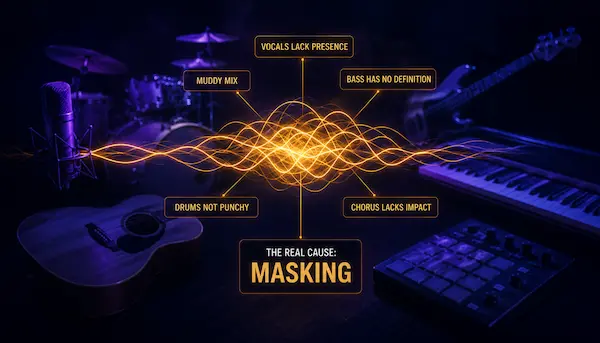 One of the reasons masking is so easy to overlook is that listeners rarely describe it directly. They don't say, "I'm hearing perceptual competition between musical elements." Instead, they point to the result. The mix feels unclear. The chorus doesn't have the impact they expected. Certain parts seem to fade away whenever the arrangement becomes more active. Those observations are completely valid—but they describe the symptom rather than the underlying reason.
During professional mix evaluations, we regularly encounter projects where clients describe completely different symptoms even though they originate from the same perceptual conflict. A client may believe the vocals are getting lost, while another assumes the bass lacks definition. Someone else hears drums that don't feel as present as they did during production. In many cases, those impressions are real. What's less obvious is that several seemingly unrelated issues can originate from the same listening experience: multiple musical elements competing for recognition at the same moment.
This distinction matters because similar outcomes don't always share the same cause. A mix that feels crowded isn't automatically suffering from the same problem as one where an important melodic phrase becomes difficult to notice. Likewise, a section that appears less energetic doesn't necessarily indicate that any individual instrument is performing poorly. Sometimes the listener simply has too many equally prominent musical events to organize comfortably, making individual ideas less memorable even though every track remains intact.
That's why we treat masking as a perceptual condition rather than a standalone mix defect. It often sits beneath problems that listeners describe in more familiar language. Understanding that relationship makes diagnosis more accurate before any technical decisions are considered.
If your production consistently feels cloudy or difficult to follow, our guide on how to fix a muddy mix explores that specific symptom in detail. Likewise, if the primary concern is keeping the lead performance consistently recognizable throughout a song, our article on making vocals stand out in a mix focuses on that challenge directly. Those topics address individual listening outcomes, while masking explains one of the perceptual mechanisms that can contribute to them.
How Listener Attention Changes Which Sounds Remain Noticeable
Listening to music isn't a passive process. The brain is constantly deciding where to focus, shifting attention from one musical event to another as the arrangement develops. That focus can change from one second to the next without the listener being aware of it. A guitar phrase that feels obvious during a sparse verse may become surprisingly difficult to notice once additional instruments enter, even though its level never changes. The recording stays exactly the same. Only our attention shifts.
This is why masking feels so inconsistent. It isn't fixed to a particular instrument or section of a song. As arrangements evolve, new rhythmic accents appear, melodic ideas overlap, and fresh textures enter the mix. Each new event slightly changes the way existing sounds are interpreted. An instrument that was easy to recognize a moment ago can become far less noticeable simply because attention has shifted toward a different musical event.
We've evaluated projects where artists requested louder vocals, brighter guitars, or stronger drums, only to discover that none of those elements were actually missing. The underlying issue was that several important musical elements were competing for attention at exactly the same moment. The musical information remains complete from beginning to end. What changes is the context surrounding it. Attention naturally shifts as the arrangement becomes denser, causing some musical ideas to stand out while others become less immediately recognizable.
Context plays a larger role than many musicians expect. The same keyboard line can feel expressive in one section and almost invisible in another without any edits being made. Likewise, a sustained guitar chord may seem rich and obvious until a new rhythmic pattern enters and immediately draws attention elsewhere. Perception is dynamic because music itself is dynamic. The ear is constantly reevaluating what deserves attention as the song unfolds.
Once masking has been identified, it's much easier to judge whether the arrangement actually needs technical changes or simply clearer musical priorities. That broader subject is explored separately in our guide on how to balance instruments in a mix, which focuses on the musical relationships that follow after perceptual conflicts have been identified.
Why Experienced Engineers Look For Masking Instead Of Guessing At Solutions
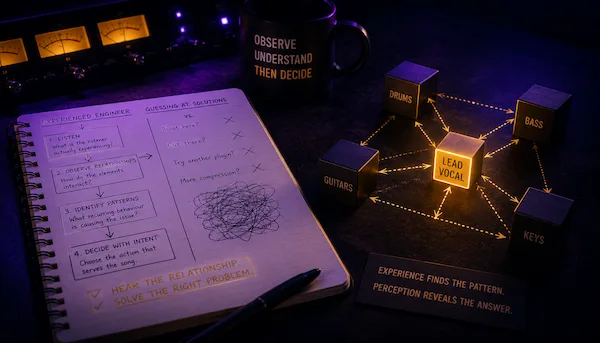 Experience doesn't give engineers better hearing. It gives them a larger library of listening patterns built across hundreds of completed mixes.
After working on hundreds of mixes, recurring relationships become surprisingly easy to identify. Certain musical combinations repeatedly produce the same listening experience, even when the genre, instrumentation, and production style are completely different. That's why professional evaluation begins with observation rather than immediate intervention.
In our studio, the first question is rarely, "What should we change?" It's usually, "What is the listener actually experiencing?" Those are very different conversations. If a musical idea seems difficult to follow, we don't assume that a particular track is responsible. Instead, we examine how surrounding elements influence the way that idea is perceived within the arrangement. Looking at tracks individually often hides the real issue. Listening to the relationships between them usually reveals it.
This approach prevents unnecessary decisions. We've reviewed projects that had already gone through multiple rounds of EQ, compression, automation, and level adjustments before arriving at our studio, only to discover that the original perceptual conflict remained unchanged. Once the relationship causing the masking becomes obvious, it's often clear why earlier adjustments produced little improvement. The perceived problem wasn't isolated to a single instrument in the first place.
Pattern recognition also prevents unnecessary revisions because engineers spend less time guessing and more time confirming what the mix is actually communicating. Instead of reacting differently to every session, experienced engineers develop a structured listening process that helps separate perception from assumption. That doesn't mean every mix behaves the same way. It means similar listening patterns are recognized before conclusions are drawn, allowing decisions to be based on observation instead of instinct alone.
This philosophy is reflected throughout our mixing checklist, where careful evaluation comes before any technical action. Comparing a project against well-chosen reference tracks also provides valuable perspective, making it easier to distinguish between genuine perceptual conflicts and differences that simply belong to the artistic character of the mix.
Masking Is About Perception, Not Missing Audio
Perhaps the most important thing to remember about masking is that it isn't defined by what's present inside a session—it's defined by what reaches the listener. Two mixes can contain exactly the same musical information, yet communicate very different experiences. One feels effortless to follow. The other requires concentration, even though every instrument is technically audible. The difference isn't missing audio. It's how that audio is perceived.
Listeners don't experience individual waveforms, mixer channels, or track counts. They experience complete songs—melodies, emotions, movement, and memorable moments. They remember a melody that stayed with them, a rhythm that felt natural, or a chorus that immediately made sense. If important musical ideas become difficult to recognize because other sounds continuously compete for attention, the emotional message of the arrangement becomes harder to follow regardless of how well each track was recorded.
This is why masking deserves to be understood as a listening phenomenon rather than simply another mixing term. It reminds us that musical communication depends on recognition as much as it depends on sound quality. Every instrument can remain fully intact while becoming less meaningful if the listener struggles to distinguish its role within the arrangement. In other words, a complete recording doesn't automatically become a clear musical experience.
Across commercial releases, independent productions, and client projects alike, the clearest mixes rarely succeed because they contain more musical information. They succeed because listeners can recognize the information that's already there. Musical ideas support one another instead of competing for recognition, allowing listeners to stay connected to the performance without consciously working to separate individual elements.
Ultimately, clarity begins when competing sounds stop competing for perception. Once musical ideas no longer compete for recognition, listeners spend less effort decoding the arrangement and more time engaging with the performance itself.
About AREFYEV Studio
At AREFYEV Studio, every mix is evaluated by experienced engineers before any processing decisions are made. Rather than assuming that every clarity issue requires technical correction, we manually assess how musical elements interact throughout the arrangement, identifying recurring perceptual conflicts that can affect the listener's experience. This approach helps preserve the artistic intent of each production while avoiding unnecessary adjustments that may improve one element at the expense of another. Every evaluation is completed before mix revisions are proposed, allowing recommendations to be based on listening rather than assumption. Our focus is simple: ensure important musical ideas remain recognizable, natural, and emotionally engaging from the first note to the final chorus.
When listeners stop noticing important musical ideas, the mix stops telling the whole story
If essential parts seem to disappear as the arrangement grows, making individual tracks louder is rarely the real answer. At AREFYEV Studio, we evaluate how musical elements interact from the listener's perspective, identifying perceptual conflicts before recommending any processing. The objective isn't to make every instrument demand attention—it's to help every important musical idea remain naturally recognizable throughout the song.
Manual evaluation. Thoughtful mix decisions. Professional results trusted by artists worldwide.
Frequently Asked Questions
What is masking in mixing?
Masking in mixing occurs when one musical element becomes difficult to perceive because another sound attracts more of the listener's attention. The hidden sound is still present in the recording, but its musical role becomes less recognizable within the full arrangement.
Is masking the same as frequency overlap?
No. Frequency overlap can contribute to masking, but the two concepts are not identical. Masking is a perceptual phenomenon that depends on how listeners interpret competing musical information, not simply on where sounds exist within the frequency spectrum.
Can masking happen even when nothing clips?
Yes. A mix can have plenty of headroom and still suffer from masking. Since masking is related to human perception rather than technical distortion, important musical details may become difficult to distinguish even when the recording itself remains clean.
Why does one instrument disappear during the chorus?
As more musical elements enter the arrangement, the listener's attention naturally shifts between competing sounds. An instrument that was easy to notice during the verse may feel less obvious in the chorus, even though its level and performance remain unchanged.
Can masking be identified before applying processing?
Absolutely. Professional engineers typically evaluate masking during the initial listening stage. Recognizing recurring perceptual conflicts before making technical decisions leads to more accurate assessments and helps avoid unnecessary processing that may not address the underlying issue.