
How To Balance Instruments In A Mix: Building Musical Hierarchy That Listeners Naturally Follow
Learning how to balance instruments in a mix isn't about pushing every fader until the session looks symmetrical. A balanced mix doesn't give every instrument the same amount of attention—it gives each one the right role at the right moment. Some elements naturally lead the song, others support it, and some are there simply to create movement, emotion, or context. When those relationships become clear, listeners rarely think about the mix itself. They simply stay connected to the music.
One of the most common misconceptions is that balance is measured by volume alone. In reality, listeners don't experience songs one track at a time. They hear the interaction between musical ideas. If every instrument competes equally for attention, the arrangement starts to feel crowded, even when nothing appears technically wrong. Good balance creates direction. It quietly tells the ear where to focus without making that guidance feel obvious.
What Instrument Balance Actually Means
 When engineers talk about instrument balance, they are rarely talking about individual track levels in isolation. They're describing the relationships between musical parts.
The ear instinctively assigns different levels of importance to those contributions, even before the listener consciously notices them.
A lead vocal carries the message. A kick drum establishes momentum. Rhythm guitars may create energy without ever demanding attention. Pads can shape emotion while remaining almost unnoticed. Balance begins when each element supports its intended role instead of competing for equal prominence.
This is why a well-balanced mix isn't built around equality. It's built around hierarchy. Some musical ideas deserve to lead, while others exist to reinforce them. If every instrument insists on being heard with the same intensity, the listener is forced to decide what matters instead of being guided through the performance. The result often feels confusing rather than exciting. Making an important part easier to perceive is very different from simply making it louder.
The primary musical focus also changes as a song unfolds. The instrument that defines the opening verse may become secondary once the chorus arrives. A melodic hook can briefly take control before giving way to the vocal again. Background textures that feel almost invisible in one section may become essential during a transition. Good balance adapts as the song's focus evolves because the story of the song is constantly moving forward.
Think of balance as visual composition in photography. Every object may be visible, but the eye is still guided toward one subject before exploring the rest of the frame. Instrument balance works the same way. The listener first connects with the main musical idea before naturally taking in everything supporting it.
This principle sits at the core of professional mixing decisions and explains why mixing is ultimately about shaping musical communication rather than treating every recorded part equally. Once musical relationships become clear, balance stops feeling like a technical adjustment and becomes one of the strongest storytelling tools available inside a mix.
Why Musical Hierarchy Matters More Than Equal Levels
Every mix asks the listener a simple question: What should I pay attention to first? The answer doesn't come from chance. It comes from musical hierarchy. Rather than treating every instrument as equally important, a well-balanced mix establishes clear priorities that guide the listener naturally from one musical idea to the next. Without that hierarchy, even a great performance can feel unfocused because every part seems to ask for attention at the same time.
Most songs naturally contain different musical roles. There are elements that lead the experience, others that reinforce it, parts that provide a stable foundation, textures that add emotion without demanding attention, and transitions that prepare the ear for what's coming next. None of these roles are more valuable than the others, but they are not meant to occupy the same level of importance. A supporting instrument succeeds precisely because it supports rather than competes.
Listeners rarely analyze these relationships consciously. Instead, the brain continuously organizes incoming information, instinctively following whatever appears to be the most significant musical event. When priorities are obvious, the song feels effortless to follow. Melodies remain memorable, rhythmic movement feels intentional, and emotional moments arrive naturally. When every instrument is presented with equal authority, however, the opposite often happens. Nothing truly disappears, yet nothing clearly stands out either.
This is why equal loudness is often mistaken for good balance. On paper, every track may seem equally represented, but music isn't experienced as a spreadsheet of levels. The ear constantly compares sounds, searching for direction. If multiple instruments appear equally important, the listener must decide where to focus instead of being guided by the mix itself. That additional mental effort subtly reduces clarity, even though each individual part remains perfectly audible.
Building a clear hierarchy is one of the earliest decisions made during a professional mix because every later adjustment depends on it. Professional engineers decide which musical ideas deserve the listener's attention first, while supporting elements remain exactly where the arrangement needs them. That hierarchy reinforces the emotional direction of every section. This decision-making process sits at the heart of how professional mixing works, where defining priorities is often more influential than any technical adjustment made later in the session.
Why Raising Every Instrument Never Creates A Better Mix
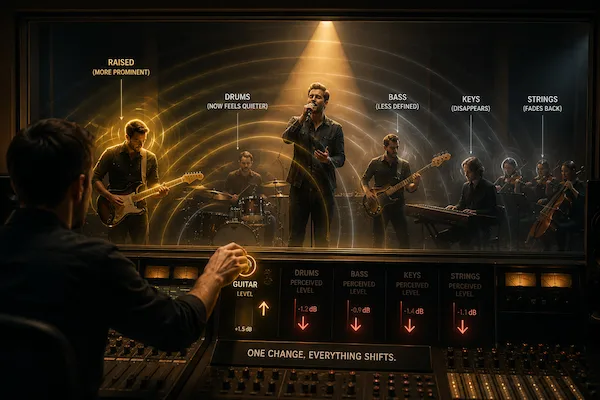 One of the most familiar moments during mix revisions sounds something like this: "Can we bring up the guitars?" A new version goes out, and the next reply arrives: "Now the drums feel too quiet." After the drums are adjusted, the bass suddenly seems less defined. Then the keyboards appear to disappear. Before long, nearly every track has been turned up, yet the mix feels no bigger, clearer, or more exciting than it did at the start.
This cycle happens because balance is never absolute. Every change immediately alters the relationship between everything else. Making one instrument more prominent doesn't simply affect that single track—it changes the way every surrounding element is perceived. What felt perfectly supportive a moment ago may now seem distant. Something that previously blended into the background can suddenly become distracting. The ear is constantly comparing sounds rather than evaluating them one by one.
The brain performs that comparison almost instantly. Listeners don't ask themselves whether the piano is at the correct level or whether the rhythm guitar sits exactly where it should. Instead, they experience the entire musical picture at once. If one element suddenly becomes more dominant, the brain instantly reassesses every other relationship in the mix. This is why solving one perceived problem by increasing volume often creates two or three new ones elsewhere.
Professional revisions frequently involve moving instruments in both directions. Sometimes an important musical idea becomes clearer not because it was pushed forward, but because another element stepped back. Those decisions aren't about making the mix quieter or louder overall. They're about restoring perspective. Once the hierarchy becomes easier to follow, important musical moments stand out without feeling exaggerated or artificially pushed forward.
Perhaps the biggest mindset shift is realizing that listeners never judge tracks independently. They judge contrast, context, and relationships. A guitar can feel powerful in one mix while sitting at a lower level than it would in another simply because the surrounding instruments support its role more effectively. When those relationships break down, the result often feels busy, unfocused, or strangely disconnected—qualities that are commonly associated with an amateur-sounding mix, even when every individual instrument appears loud enough on its own.
| Musical Role | Primary Purpose | How Listeners Naturally Perceive It |
|---|---|---|
| Lead | Carries the main musical message or emotional focus. | Immediately attracts attention and becomes the primary point of focus. |
| Support | Strengthens the lead without competing for dominance. | Feels present and important, but naturally follows the lead element. |
| Foundation | Provides stability, groove, and musical grounding. | Creates a sense of confidence and continuity without demanding constant attention. |
| Texture | Adds atmosphere, emotion, and depth to the arrangement. | Often noticed subconsciously, enriching the listening experience rather than leading it. |
| Transitions | Guide movement between musical sections and prepare upcoming moments. | Briefly attract attention before naturally handing focus back to the next important musical idea. |
A Simple Way To Evaluate Instrument Balance
If you're unsure whether your mix feels balanced, avoid changing multiple instruments at once. Instead, listen through one complete section and ask yourself these four questions:
- Can you immediately identify the song's main musical focus?
- Do supporting instruments reinforce that idea instead of competing with it?
- Does your attention move naturally as the arrangement develops?
- After the section ends, can you clearly remember the part the song wanted you to remember?
Great Mixes Begin With Clear Musical Priorities
Many mixes don't struggle because they lack technical processing. They struggle because too many musical ideas compete for the listener's attention at the same time. Our studio evaluates the relationships between instruments, identifies where musical hierarchy becomes unclear, and builds a mix that naturally guides listeners through every section of the song without forcing individual elements forward.
Musical balance. Clear communication. Professional mixes built for confident release.
How Listener Attention Moves Throughout A Song
 A balanced mix is never frozen in place. The moment a song begins, the listener's attention starts moving, following the emotional flow of the performance rather than staying locked onto a single instrument. That's why balance is dynamic. It responds to the changing purpose of each section instead of maintaining identical relationships from the first note to the last.
Take a typical verse. The goal is often intimacy and storytelling, so the ear immediately locks onto the element carrying that message while the surrounding instruments create support without drawing unnecessary attention. As the music approaches a pre-chorus, the emotional direction begins to shift. Certain parts become more noticeable, tension gradually builds, and the listener starts anticipating what comes next. By the time the chorus arrives, priorities have changed again. The song usually asks for a broader emotional statement, meaning different instruments may temporarily become more significant than they were only a few seconds earlier.
The same principle continues throughout the rest of the arrangement. A bridge often introduces contrast by redirecting attention toward new musical ideas before returning to familiar themes. During an outro, the focus may slowly drift away from the main performance toward the overall atmosphere as the song reaches its conclusion. None of these changes require every instrument to become louder or quieter by default. What changes is the listener's perception of which musical idea deserves to lead at that particular moment.
This constant movement explains why successful mixes rarely feel repetitive, even when the instrumentation remains largely unchanged. The relationships between instruments continue to evolve as the music develops. Most people never consciously notice those shifts, yet the ear follows them almost effortlessly. The result feels natural because the mix keeps reinforcing the emotional direction already established by the song.
One observation appears repeatedly during professional mix revisions: when the musical focus evolves smoothly from section to section, listeners often describe the record as feeling more engaging without immediately identifying why. They simply stay connected to the performance. That changing sense of attention also contributes to perceived musical impact, a concept explored further in our article on how a mix creates stronger perceived punch through changing musical focus. Here, however, the goal is different. Instrument balance is about guiding attention smoothly from one musical idea to the next instead of asking every important moment to compete at the same time.
Quick Self-Check
If most listeners remember the vocal, hook, or main melody while still noticing the groove, your instrument balance is probably working.
If different people describe completely different instruments as the "main focus," the musical hierarchy may not be clear enough.
If every instrument feels equally important, the mix often needs stronger prioritization—not simply different levels.
Why Balance Starts With Musical Purpose Instead Of Processing
One of the biggest differences between an experienced mix engineer and someone still developing their workflow isn't found in the tools they use—it's found in the questions they ask before making a single decision. The first question is rarely, "How should this instrument sound?" It's much simpler: What should the listener notice right now? Until that answer is clear, changing the mix rarely produces consistent results because there is no musical direction behind those choices.
Every successful mix begins by identifying the song's primary focus. Which part carries the emotion of the verse? What musical idea should define the chorus? Which instrument supports the rhythm without distracting from it? These decisions establish a roadmap for the entire session. Once the musical roles are understood, every later adjustment has a clear purpose: reinforcing the story the song is already trying to tell instead of trying to discover it later through technical adjustments.
In professional sessions, it's surprisingly common for a mix to feel dramatically clearer after revisiting those priorities instead of introducing new processing. A client may describe the song as crowded, unfocused, or lacking direction, yet the real issue often turns out to be uncertainty about what deserves the listener's attention. When that hierarchy becomes obvious, the mix starts communicating more effectively even before any detailed refinement takes place.
This approach also explains why two songs built from similar instruments can require completely different balance decisions. The objective isn't to satisfy a universal formula. It's to serve the musical intention of that specific performance. A songwriter's intimate acoustic ballad asks listeners to focus differently than an energetic rock anthem or a modern pop production. The balance follows the purpose, not the genre alone.
For that reason, evaluation always comes before refinement. Professional engineers spend time understanding how the music communicates before deciding how individual elements should support it. That philosophy also forms the foundation of our professional mixing checklist, where identifying the song's primary focus is treated as an essential step before moving on to detailed mix decisions. When the purpose is clear from the beginning, every later choice becomes easier to justify—and the finished mix feels intentional rather than accidental.
Professional engineers don't begin by asking how loud an instrument should be. They first decide what the song needs listeners to notice, then build every balance decision around that objective.
Common Balance Decisions Seen During Professional Mix Revisions
 After working on hundreds of mix revisions, certain patterns emerge across projects regardless of genre.
The wording changes from project to project, but the underlying issue is often the same.
Clients may describe a mix as "busy," "flat," or "hard to follow," yet the recordings themselves are rarely the problem.
More often, the musical relationships have drifted away from what the song is trying to communicate.
In many cases, clients initially describe technical problems, but careful listening reveals that the recording itself is rarely the issue. The real challenge is usually deciding what deserves attention first. Small balance changes often solve problems that clients initially expect to require EQ, compression, or automation.
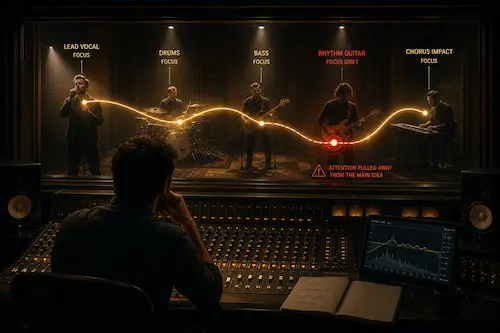
One of the most common situations occurs when the lead element slowly loses authority as additional layers enter the arrangement. Everything sounds individually acceptable, but the listener no longer knows what deserves attention first. In other cases, supporting instruments become unexpectedly dominant. A part that was meant to reinforce the groove or emotion begins pulling focus away from the main musical idea simply because the balance no longer reflects its intended role.
Background textures create another recurring challenge. Atmospheres, doubled parts, subtle melodic lines, or rhythmic accents can add richness when they remain supportive. Left unchecked, however, they gradually compete with the material they were meant to enhance. Nothing feels obviously wrong in isolation, yet the overall presentation becomes mentally tiring because too many details ask the listener to process them at once.
Transitions between song sections reveal another pattern. A verse may feel controlled and engaging, but the movement into the chorus suddenly loses direction. The emotional shift exists in the performance, yet the mix doesn't reinforce it clearly enough. We've also seen countless revisions where the hook technically remains present throughout the song, but listeners struggle to remember it afterwards because another musical element repeatedly distracts from it during the moments that matter most.
Interestingly, these situations are often resolved without introducing additional processing. The session itself may remain largely unchanged. Instead, the improvement comes from re-establishing the musical hierarchy so each element supports the overall narrative while reinforcing the same musical direction. Once those relationships become clearer, comments like "it feels more open," "the chorus finally works," or "everything makes sense now" often appear—even though no dramatic technical overhaul has taken place.
This ability to recognize patterns instead of reacting to individual symptoms is one of the qualities that separates experienced engineers from those relying solely on fixed workflows. Knowing why listeners lose focus is usually more valuable than immediately searching for another technical solution. It's also one of the reasons artists evaluating the best mixing engineer often discover that consistent decision-making has a greater impact on the final result than the size of a studio or the number of tools available.
Why Instrument Balance Shapes Every Other Mixing Decision
Instrument balance isn't simply one step in the mixing process—it establishes the reference point for every decision that follows. Before asking whether a song feels clear, spacious, cohesive, or impactful, it's worth asking a simpler question: Are the musical priorities already clear? If the answer is no, every later judgment becomes less reliable because it's based on relationships that haven't been properly defined yet.
Professional mixes assign different levels of importance to different instruments because every part serves a different musical purpose. Clear hierarchy allows attention to move smoothly from one musical idea to the next.
This is why experienced engineers rarely treat balance as an isolated task. They understand that musical hierarchy influences how every other aspect of the mix will be perceived. If the relationships between instruments remain unclear, later refinements often become inconsistent because the reference itself keeps shifting. The mix may appear to improve after one adjustment, only to feel less convincing after the next, simply because the underlying priorities were never fully established.
Once instrument balance becomes stable, evaluating the rest of the mix becomes far more objective. Questions about musical organization begin to make sense because the listener already knows what deserves attention first. Spatial presentation becomes easier to assess because important musical elements occupy well-defined roles. The overall cohesion of the production also becomes more apparent because every decision now supports the same musical direction instead of competing with it.
For that reason, balance acts as the foundation rather than the finishing touch. It gives context to every later decision without replacing it. Readers interested in how these relationships influence overall clarity can continue with our guide to frequency balance in a mix. If the goal is understanding how musical roles affect the perception of space, our article on stereo width in mixing explores that topic separately. And once the musical hierarchy is already working, the mix can be evaluated as a complete production through thoughtful mix bus processing. Each of those subjects builds upon instrument balance—but none of them can replace it.
Why Artists Trust AREFYEV Studio For Professional Mixing
AREFYEV Studio is an independent online mixing and mastering studio working with artists, producers, composers, and record labels worldwide. Every mix is reviewed manually by experienced engineers who prioritize musical communication over automated processing. Every project begins with careful listening to determine how the song communicates its main musical ideas. From there, we build a clear instrument hierarchy that supports the performance from beginning to end instead of relying on fixed formulas or automated processing. This engineer-led approach allows every important musical idea to reach the listener with clarity, consistency, and purpose. Many balance decisions are made before any detailed processing begins because understanding the musical intention usually solves more problems than immediately adjusting individual tracks.
When Every Musical Idea Has Its Place, The Entire Song Feels Stronger
A technically clean mix can still leave listeners feeling lost if they never know where to focus. Professional mixing isn't about making every instrument equally noticeable—it's about defining clear musical priorities so each important moment feels clear and intentional throughout the song. Our studio builds mixes that stay organized, emotionally engaging, and easy to follow from the opening note to the final fade.
Clear musical hierarchy. Confident translation. Mixes engineered to keep listeners engaged from start to finish.
Frequently Asked Questions
What is instrument balance in a mix?
Instrument balance is the relationship between musical elements rather than their absolute volume. A well-balanced mix allows listeners to instinctively recognize which parts should lead, which should support, and how each instrument contributes to the song without every track competing for equal attention.
Should every instrument be equally loud?
No. Equal loudness rarely creates a balanced mix because different instruments serve different musical purposes. Lead elements naturally require greater listener focus, while supporting parts provide context, movement, or emotion without dominating the performance.
How do professionals decide which instrument should stand out?
Professional engineers first identify the song's primary musical focus before making balance decisions. Instead of asking which instrument should be louder, they determine which musical idea listeners should notice first. Balance decisions are then made to reinforce that hierarchy throughout the song.
Can good balance fix a weak mix?
Good balance can dramatically improve clarity, focus, and emotional communication, but it cannot solve every problem. Poor performances, weak arrangements, or recording issues remain separate challenges. Balance helps present strong musical ideas more effectively—it cannot create them from scratch.
Does balance change during different parts of a song?
Yes. The song's primary focus naturally changes between verses, choruses, bridges, and outros. As the emotional focus shifts, the relationships between instruments should evolve as well, allowing attention to move naturally from one musical idea to the next.
Why does my mix still feel confusing even when nothing clips?
Clipping and balance are different issues. A mix can remain technically clean while still feeling difficult to follow if too many instruments compete for attention at the same time. When musical hierarchy is unclear, listeners often struggle to identify the most important ideas, making the entire mix feel less engaging.