Why Organ Plugins Ruin Your Mix — and Where Transistor Organ EKX Actually Fits
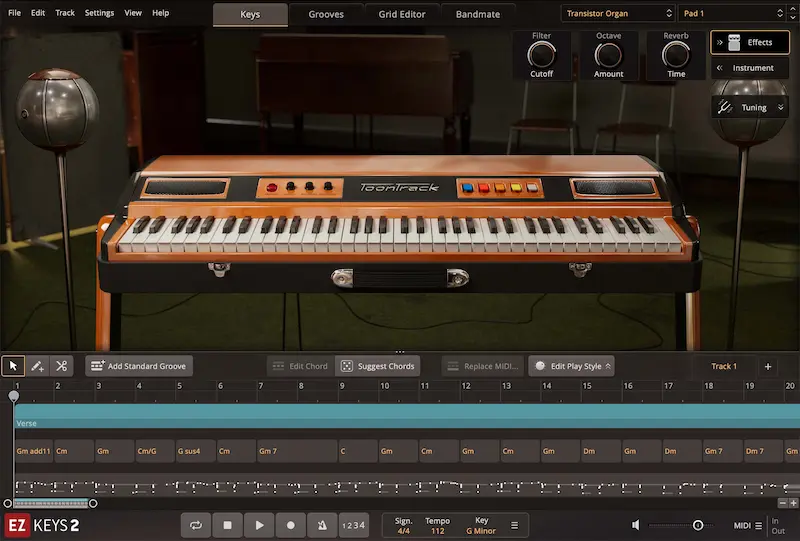
Transistor Organ EKX is being marketed as a fast, mix-ready organ solution for modern production. But that positioning hides a more important reality: tools like this don’t just speed up workflow — they reshape your mix decisions before you even start mixing.
This isn’t a product review. This is a production-level breakdown of why preset-driven organ plugins create problems — and how Transistor Organ EKX fits into that ecosystem.
The Real Problem: Organ Sounds That Don’t Translate in a Mix
Search behavior in the US tells the story:
- “organ not cutting through mix”
- “why organ sounds muddy”
- “organ clashing with guitars”
These aren’t beginner issues. These are structural problems caused by how modern virtual instruments are designed.
Transistor Organ EKX sits right in the middle of this problem.
What You’re Actually Buying
This is not a traditional instrument.
With Transistor Organ EKX, you’re getting:
- pre-EQ’d tonal profiles
- built-in compression curves
- harmonic coloration baked into presets
- fixed dynamic response
In other words: the sound is already decided before it hits your mix bus.
You’re not shaping tone. You’re inheriting it.
Why This Breaks Mix Balance
Most transistor-style organ presets share the same spectral issue:
- dominant midrange energy (400 Hz – 1.5 kHz)
- reduced transient articulation
- compressed harmonic density
Now place that into a real session:
- guitars already occupy midrange
- vocals sit in the same band
- synths layer above and below
Result:
- masking
- loss of clarity
- collapsed depth
This is why producers search for “muddy mix fix” — but the issue starts earlier.
Speed vs Control: The Core Trade-Off
The entire value proposition of Transistor Organ EKX is speed:
- load a preset
- drop in MIDI
- get instant musical output
That workflow works — but it removes critical control:
- no precise envelope shaping
- limited tonal isolation
- restricted dynamic flexibility
For entry-level users, that’s convenience.
For engineers, that’s a constraint.
Where It Fits in a Modern Production Pipeline
Used correctly, Transistor Organ EKX is not a final-stage tool.
It belongs in:
- idea generation
- songwriting sessions
- quick client demos
It does NOT belong in:
- final arrangement decisions
- dense mix environments
- critical tonal layering
If you treat it like a finished sound, it will limit your mix before it even starts.
Comparison: Real Instruments vs Preset Systems
To understand the difference, look at alternative tools:
- Arturia Vox Continental V — full parameter control, authentic modeling
- Arturia Farfisa V — flexible vintage tone shaping
- Native Instruments Vintage Organs — detailed multi-instrument library
- AIR Velvet — broader sonic control across styles
These tools let you build a sound around your mix.
Transistor Organ EKX forces your mix to adapt to the sound.
What Happens During Mixing
Once a preset-heavy organ enters the mix stage, engineers typically face:
- EQ cuts that don’t resolve masking
- compressed dynamics that limit movement
- lack of separation in stereo field
At this stage, fixing the issue becomes inefficient.
This is why experienced engineers prioritize source quality. If the tonal balance is compromised early, even professional mixing and mastering services can only partially recover clarity.
User Feedback Reflects the Divide
“Great for quick ideas — everything sounds finished immediately.”
“Hard to control. Doesn’t sit well in complex mixes.”
“Useful for demos, but I replace it in final production.”
The pattern is consistent: speed vs precision.
Strengths
- instant usability
- fast workflow for songwriting
- genre flexibility
Limitations
- lack of deep parameter control
- midrange-heavy presets
- mix translation issues
- dependency on EZKeys 2
Final Position
Transistor Organ EKX is not a mixing tool. It’s a drafting tool.
If you understand that, it becomes useful.
If you don’t, it becomes the reason your mix feels crowded, undefined, and hard to fix.
The mistake isn’t using it.
The mistake is trusting it too far into your production chain.