
What Is Mixing? Why Great Recordings Still Need To Work Together
Mixing is the process of balancing, organizing, and combining recorded tracks into a finished song that listeners experience as a single musical performance. A vocal may be recorded perfectly. The drums may sound powerful. The guitars may have exactly the right tone. Yet when those tracks are played together, the result is not automatically a finished listening experience. Listeners experience songs as complete musical experiences, not as individual tracks played separately.
In simple terms, audio mixing is the process of balancing, organizing, and combining recorded tracks so they function as one song. The objective is not making every track equally noticeable. It is helping every part support the song itself. Instead of hearing separate vocals, drums, guitars, and instruments, the song feels like one connected performance rather than a collection of separate recordings.
This is why great recordings alone are rarely enough. We regularly hear sessions containing talented performances and high-quality production that still feel confusing, unfocused, or incomplete. A vocal may struggle to hold attention. Instruments may fight for the same listener focus. In other sessions, every part sounds impressive individually while the song itself never develops a clear center of gravity. Nothing is technically wrong, yet the song still feels incomplete.
Mixing exists to solve that problem. It transforms individual tracks into a cohesive song by helping every element support the musical idea rather than compete against it. Mixing is not simply about making sounds louder or cleaner. At its best, mixing creates a musical experience that feels natural, intentional, and emotionally convincing from beginning to end.
Once that mix is complete, the project moves to the next stage of production. If you're unfamiliar with what audio mastering is, mastering begins after the mix already works as a unified piece of music. Mixing comes first because a song must become a complete musical experience before anything else can be built upon it.
Why Recording A Song Is Not The Same As Finishing A Song
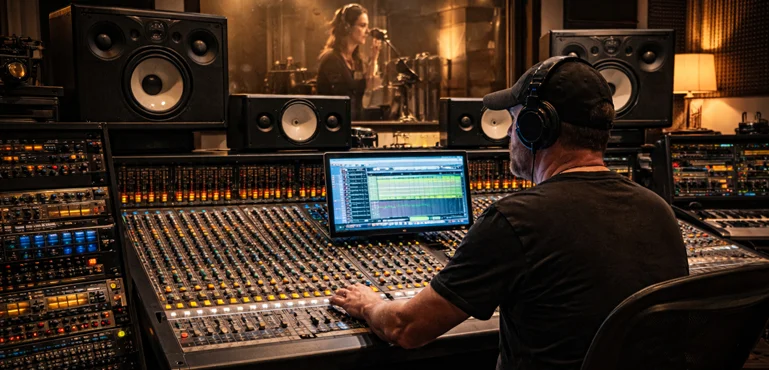 One of the most common misunderstandings in music production is the belief that a song is nearly finished once all the parts have been recorded. It is easy to see why. The vocal sounds great. The drums are powerful. The guitars have the right tone. The bass sits exactly where the producer wanted it. Every individual element seems ready for release.
Then everything plays together.
Suddenly the song feels different. The vocal that sounded impressive on its own struggles to hold attention. The drums dominate certain sections while disappearing in others. Instruments that sounded strong individually begin competing for the listener's focus. Nothing is necessarily wrong with the recordings themselves. The problem is that great recordings and a great mix are not the same thing.
Recording, production, and mixing each solve different challenges. Recording captures performances. Production shapes the creative direction of the song. Mixing focuses on relationships. It determines how all of those recorded elements interact once they occupy the same listening space.
Modern songs are often built from multitrack sessions containing dozens or even hundreds of individual recordings. Lead vocals, backing vocals, drums, bass, guitars, keyboards, effects, and production layers all exist separately before they become a finished mix. This is why the process is often described as multitrack mixing. Every recorded part remains independent until those tracks are organized into a single musical presentation.
Large contemporary sessions can contain 80, 100, or even more individual tracks. The challenge is rarely creating enough material. The challenge is helping that material behave like a single piece of music.
This is why artists are often surprised when a professionally recorded session still sounds unfinished. The problem is rarely the quality of the recordings themselves. More often, the individual parts have never been organized into a listening experience that feels intentional from beginning to end.
We see this regularly when reviewing projects before they move into professional mixing. A singer may have delivered an excellent performance, yet important lyrics become difficult to follow once guitars, keyboards, and drums enter the arrangement. In other sessions, the rhythm section feels powerful in isolation but overwhelms everything else when the full song plays. Sometimes every instrument sounds impressive on its own, yet the listener struggles to identify what deserves attention first.
For that reason, listening to individual tracks rarely predicts how a finished song will feel. Listeners never experience a project one recording at a time. They experience the entire arrangement simultaneously. Their reaction comes from how effectively those elements support one another rather than how good each track sounds by itself.
A successful mix creates cooperation where there was previously competition. Instead of fighting for attention, the elements begin serving a common musical purpose. That transition often marks the point where a collection of recordings finally starts feeling like a finished song.
The exact approach differs from project to project, but the underlying objective remains the same: helping the music feel like one complete performance. The goal is not to improve individual recordings independently. What matters most is helping the entire song function as one coherent listening experience.
What Actually Happens During Mixing
Although every song is mixed differently, the purpose of mixing remains remarkably consistent: helping separate recordings function as one coherent overall experience. Nothing jumps out as distracting. Nothing seems difficult to follow. The song simply makes sense. That reaction is not accidental. It comes from hundreds of small decisions designed to help the music communicate clearly rather than force the listener to work for basic understanding.
At its core, mixing is about connections. Every element inside a song is competing for attention to some degree. The vocal wants to tell the story. The drums want to drive the rhythm. The bass wants to support the foundation. The guitars, keyboards, strings, or other instruments all contribute their own role. When those relationships are not organized properly, the listener begins experiencing friction instead of immersion.
In practical terms, a mix engineer works with a multitrack session containing separate recordings that must work together as one piece of music.
One of the first goals of mixing is balancing levels. Not because every track should be equally loud, but because every important musical idea should have the opportunity to be heard. A lead vocal buried beneath instruments can make a song feel confusing. A rhythm section that dominates everything else can make arrangements feel one-dimensional. Even excellent performances lose impact when the listener struggles to understand where attention should go.
Imagine hearing a song for the first time and struggling to understand the chorus because the vocal keeps disappearing behind the instruments. Most listeners will not describe this as a mixing problem. They will simply lose interest and move on.
Space is equally important. Every element occupies part of the listener's mental picture of the song. When too many sounds appear to exist in the same place, the arrangement begins feeling crowded. Listeners may not consciously identify the cause, but they often describe the result using phrases like "busy," "messy," or "hard to follow." Effective mixing helps organize that space so different parts of the arrangement can coexist without constantly fighting for attention.
Listeners do not only perceive volume. They also perceive location. Part of mixing involves organizing where different sounds appear within the stereo field so the arrangement feels open, intentional, and easy to navigate. When everything appears to come from the same place, the song often feels smaller and more crowded than it actually is.
Focus becomes the next challenge. Most successful songs guide the listener naturally through the experience. During one section, the vocal may become the center of attention. In another, a riff, melody, rhythm, or instrumental hook may take over. Mixing helps establish those priorities. Instead of presenting every element with equal importance all the time, it creates a hierarchy that supports the musical intention.
This is one reason listeners often describe a great mix as feeling effortless. The music communicates clearly because the relationships between elements have been organized intentionally. People are free to enjoy the performance rather than constantly sorting through competing information.
The specific technical decisions behind that process vary from project to project. If you're interested in how engineers structure those decisions inside a session, our guide to the mixing chain explores how different processing stages contribute to the overall result. The larger objective, however, remains the same: helping every part of a song support the listening experience instead of competing against it.
Before Mixing vs After Mixing
Many people hear the result of professional mixing without fully understanding what changed. The performances are the same. The arrangement is the same. The recordings are the same. No new song was written. Yet the listener impression often feels dramatically different. That difference comes from how the individual elements interact once they begin working together instead of competing for attention. The table below illustrates the shift that typically happens when a collection of recordings becomes a finished mix.
| Before Mixing | After Mixing |
|---|---|
| Separate recordings | Unified song |
| Competing elements | Balanced relationships |
| Unclear focus | Clear musical direction |
| Inconsistent energy | Controlled experience |
| Distracting conflicts | Musical cohesion |
| Raw session | Finished mix |
Why Listeners Hear Songs Differently Than Producers
One of the biggest challenges in mixing has nothing to do with equipment, software, or musical ability. It comes from familiarity. By the time a song reaches the mixing stage, the producer may have listened to it hundreds of times. Every vocal phrase, drum fill, guitar layer, and arrangement detail has become deeply familiar. That familiarity creates a strange problem: the closer someone gets to a project, the harder it can become to hear it the way a listener will.
Listeners arrive with a completely different perspective. They do not know how much effort went into recording the vocals. They do not know which guitar layer took three days to perfect. They have no emotional attachment to a particular drum sound or production decision. They hear the song once and form an impression almost immediately.
A producer often hears the individual parts. A listener hears the result.
That difference matters more than many artists realize. We regularly encounter projects where the creator believes the lead vocal is clearly present because they already know every lyric. A first-time listener, however, may struggle to understand important lines. In other cases, producers become attached to subtle background elements that feel essential after months of work, while listeners barely notice them during normal playback. Familiarity fills in information automatically. The audience does not have that advantage.
Repeated listening can also hide balance problems. A producer may gradually adapt to an instrument that has become too dominant, a section that feels crowded, or an arrangement that lacks a clear focal point. Because the brain becomes accustomed to those characteristics over time, they stop attracting attention. Fresh ears often reveal them within seconds.
This is one reason professional mixing requires more than technical knowledge. It requires the ability to step outside the creator's perspective and evaluate the song from the listener's point of view. The goal is not to satisfy the person who has already heard the track 500 times. The goal is to create an experience that works for someone hearing it for the very first time.
Reference listening exists for a similar reason. Comparing a project against trusted material helps restore perspective when familiarity begins distorting judgment. Our guide to reference tracks for mixing explores how engineers use outside material to maintain objectivity throughout the mixing process.
Many successful mixing decisions are surprisingly simple. They happen when someone finally notices a problem that had become invisible through repetition. In that sense, mixing is often about recovering the listener's perspective before the audience ever hears the song.
Sometimes the song is better than the mix reveals
A strong performance, great production, and quality recordings do not automatically create a clear listening experience. We evaluate how the elements work together, identify what may be competing for attention, and help determine whether the mix is communicating the song as effectively as it should before release.
Professional feedback. Clear expectations. Real-world mixing experience.
The Difference Between Mixing, Production, And Mastering
 These three terms are often used together, sometimes even interchangeably. In practice, they refer to different stages of the music creation process. Understanding those differences helps explain why a song can be well-produced, professionally recorded, and still require mixing before it feels complete.
Production is the stage where the musical idea takes shape. This can include songwriting decisions, arrangement choices, sound selection, instrumentation, and creative direction. A producer may help determine how a chorus should build, which instruments support the vocal, or whether a section should feel intimate or explosive. Production creates the material that listeners will eventually hear.
Mixing begins once that material exists. Instead of asking what should be in the song, mixing asks how those elements should work together. The focus shifts from creation to organization. A producer might decide that a song needs layered guitars, stacked vocals, and multiple keyboard parts. A mixing engineer's responsibility is helping those elements coexist in a way that feels clear, balanced, and intentional when the listener hears the finished record.
This distinction is important because adding more elements does not automatically improve a song. In many sessions, the challenge is not a lack of ideas. It is helping existing ideas support one another instead of competing for attention. Mixing exists to manage those relationships and shape them into a coherent listening experience.
Mastering happens after mixing and addresses a different stage of the production journey.
For a deeper explanation of where the line between these stages is drawn, our guide on mixing vs mastering explores the differences in greater detail.
Where Mixing Fits In The Music Production Process
Many artists encounter the terms recording, production, mixing, and mastering long before they fully understand how those stages relate to one another. Although every project follows its own path, the overall structure remains remarkably consistent. Each stage solves a different problem, and mixing occupies a very specific role between creating material and preparing a finished song.
| Stage | Primary Goal |
|---|---|
| Recording | Capture performances |
| Production | Shape creative direction |
| Mixing | Organize recorded elements |
| Mastering | Prepare finished mix |
Why Some Songs Feel Finished And Others Do Not
Most listeners will never say, "This song needs better mixing." In fact, many people cannot identify mixing as a separate stage of production at all. What they do notice is a feeling. Some songs immediately sound complete, confident, and easy to follow. Others feel unfinished even when the performances are excellent and every instrument can technically be heard.
That difference is something we encounter regularly when reviewing projects before mixing. One common situation looks like this: nothing appears to be missing, yet nothing truly stands out either. The vocal is audible. The drums are audible. The guitars, bass, keyboards, and supporting elements are all present. Still, the listener finishes the song without a clear sense of what mattered most. The music communicates information, but it lacks direction.
In some projects, artists are convinced the vocal is leading the song until outside listeners consistently mention a guitar layer, synth part, or drum groove first. Those reactions often reveal attention conflicts that became invisible during months of production.
We see this frequently during mix reviews. Artists are often surprised when outside listeners focus on completely different elements than the ones originally intended to carry the song. Those reactions often reveal relationship problems inside the mix long before anyone identifies a technical cause.
Another example appears when strong performances fail to create a strong overall impression. A vocalist may deliver an emotional performance. The instrumental arrangement may be carefully crafted. The musicians may perform at a high level. Yet when everything plays together, the listener's attention constantly shifts between competing elements. Instead of being guided through the song, they are forced to decide where to focus moment by moment.
This is often where the feeling of "unfinished" begins. Not because individual tracks are weak, but because the relationships between them remain unresolved.
Think about how people experience music in the real world. Most listeners hear a song while driving, working, exercising, or doing something else entirely. They are not analyzing individual instruments. They are reacting to the overall experience. If the arrangement feels cohesive, they stay engaged. If multiple elements appear equally important all the time, attention gradually drifts away.
We frequently hear sessions where instruments seem to compete for the same role. Several parts are trying to lead simultaneously. A rhythm element draws attention away from a vocal phrase. A supporting instrument behaves like a featured instrument. The listener may never consciously identify the conflict, but they often describe the song as busy, crowded, unfocused, or difficult to connect with.
Finished-sounding records rarely achieve that feeling because every element is equally prominent. They achieve it because the relationships between elements feel intentional. People naturally understand what the song wants them to focus on. The music creates a sense of purpose without requiring effort to follow.
Well-executed mixing rarely attracts attention to itself. Listeners do not stop to admire balance, focus, or cohesion. They simply enjoy the song. When those relationships are missing, however, the effect becomes obvious very quickly. Many of the characteristics people associate with unfinished music can be traced back to the same underlying issue: the elements have not fully learned how to work together yet.
Our mixing problems guide explores many of the symptoms that appear when those relationships begin breaking down, but the larger principle remains simple. A finished song is rarely defined by individual tracks. It is defined by how effectively those tracks function as a unified musical experience.
Why Independent Artists Across The United States Still Invest In Professional Mixing
 For many years, professional mixing was associated with large studios and major music cities.
Today, artists can collaborate with experienced engineers from virtually anywhere, making professional mixing accessible to projects of every size.
For many years, professional mixing was associated with large studios and major music cities.
Today, artists can collaborate with experienced engineers from virtually anywhere, making professional mixing accessible to projects of every size.
This shift has changed the way modern music is created. Songwriters build projects from home studios. Producers collaborate remotely with artists in different states. Bands record parts in multiple locations. Self-released projects that once depended on local resources now have access to the same level of professional evaluation available to larger productions.
What has not changed is the value of perspective.
Many independent artists are highly capable of recording, producing, and arranging their own music. In fact, some of the strongest projects we encounter come from creators who handle most stages of production themselves. The challenge often appears later. After spending weeks or months inside the same project, objectivity becomes difficult. Decisions that feel obvious to the creator may not feel obvious to first-time listeners.
This is one reason professional mixing remains relevant in every corner of the country. Professional mixing is rarely about gaining access to equipment or software alone. Those tools are widely available. The greater value often comes from having someone evaluate how the entire song functions as a musical experience rather than as a collection of individual production decisions.
Independent artists, producers, songwriters, and self-released musicians face the same reality as larger commercial projects: listeners judge the finished song, not the circumstances behind its creation. Whether a track was recorded in a world-class facility or a carefully built home studio, the audience responds to clarity, focus, balance, and cohesion.
As remote collaboration continues becoming the industry standard, access to experienced mixing support is no longer restricted by location. Our guide on hiring a mixing engineer in the USA explores how artists across the country connect with professional mixing services regardless of where they create their music.
What A Mixing Engineer Really Listens For
Many people assume mixing decisions are driven mainly by technology. In reality, much of the work begins with understanding how the song is likely to be experienced by a listener. While technical issues certainly matter, they are rarely the first thing that attracts attention. The initial question is usually much simpler:
What is the listener going to notice?
That perspective changes everything.
When we review a mix, we are not listening to isolated tracks one at a time. We are listening to the interactions between them. Does the vocal naturally hold attention when it needs to? Does the rhythm section support the song without distracting from it? Do important musical moments arrive with enough impact? Is there a clear sense of direction from beginning to end?
These questions often reveal more than any technical measurement. In commercial projects, we often encounter situations where artists spend hours discussing individual sounds while listeners react to entirely different aspects of the song. A producer may focus on a guitar tone, while first-time listeners immediately comment on vocal clarity or the energy of the chorus. Those differences in perception frequently reveal where attention inside the mix is actually going.
We occasionally review sessions where artists ask about a specific technical concern, only to discover that first-time listeners are reacting to something entirely different. Those moments often reveal the gap between creator expectations and audience perception.
For example, a vocal can be perfectly audible yet still feel disconnected from the song. A guitar part can sound excellent on its own but constantly pull attention away from the lead performance. A powerful drum arrangement can dominate so much of the listener's focus that other important musical ideas become harder to follow. None of those situations are necessarily caused by poor recordings. More often, they stem from relationships that have not been fully organized.
Attention is one of the most valuable resources in music. Every song asks listeners to focus on something. Sometimes it is a vocal phrase. Sometimes it is a melody, a groove, or a particular emotional moment. If several elements demand equal attention simultaneously, most people experience confusion rather than engagement. One of the most important responsibilities of a mixing engineer is helping establish a clear hierarchy of importance throughout the song.
Balance works in a similar way. Many people think of balance as a volume issue, but from the listener's perspective it is really an attention issue. The question is not whether every element can be heard. The question is whether every element is contributing appropriately to the overall experience. A balanced mix feels natural because the listener is rarely forced to decide what deserves attention next.
This is why mixing decisions are frequently guided by perception rather than technology. Creating technically correct audio is only part of the equation. What matters is understanding how real listeners are likely to experience the song when they encounter it for the first time.
Successful mixing often begins with identifying where listener attention naturally goes before deciding where it should go. Our guide on what makes a great mixing engineer explores why listening skills and judgment often matter far more than the tools available inside a studio.
When Individual Tracks Finally Start Working As One Song
A great recording session can produce excellent performances. A talented producer can create compelling arrangements. Skilled musicians can deliver strong takes. Yet listeners never experience those elements separately. They experience the final relationship between them.
That relationship is what mixing exists to shape.
Throughout this page, we have looked at a simple reality that often surprises newer artists: songs do not become cohesive automatically. A vocal can be beautifully recorded and still struggle to connect with the listener. Drums can sound powerful while distracting from other important elements. Every instrument can be technically audible while the song itself feels difficult to follow.
The difference between a collection of tracks and a finished mix is rarely found in any single recording. It emerges from balance, focus, and the way individual parts support a common musical goal. When those relationships are working properly, listeners rarely stop to think about production decisions. They simply engage with the music.
This is why mixing remains one of the most important stages in modern music production. It helps transform separate performances into a unified overall impression. Instead of competing for attention, the elements begin reinforcing one another. The song gains direction. The song becomes easier to follow. The music becomes easier to connect with emotionally.
In our experience, the strongest mixes are not necessarily the most complex. They are the ones where every decision supports the song rather than competing with it. Whether the project contains a handful of tracks or a large multitrack session, the goal remains remarkably consistent: helping the listener focus on the music instead of the mechanics behind it.
If you're considering professional mixing and mastering services, understanding the role of mixing is often the first step toward evaluating what your project may actually need. For artists planning upcoming releases, our mixing and mastering cost calculator can also help estimate project budgets before production moves forward.
At its core, mixing is not about individual tracks. It is about what happens when those tracks stop competing and begin working together as a single musical experience.
A great song deserves more than a collection of tracks
Strong performances, quality recordings, and creative production are only part of the equation. The final challenge is turning those separate elements into a mix that feels focused, balanced, and engaging from the first listen. Our engineers evaluate projects of every size, from singles to full albums, helping artists move toward a finished record with confidence.
Meet production deadlines with a clear mixing plan and experienced engineering support.
Frequently Asked Questions About Mixing
What is mixing in music?
Mixing is the process of combining and organizing individual recordings so they function as a cohesive song. It helps vocals, instruments, and musical elements work together as a unified listening experience rather than a collection of separate tracks.
Why is mixing important?
A song can contain excellent performances and high-quality recordings but still feel confusing or unfinished. Mixing helps create balance, focus, and cohesion so listeners can connect with the music naturally. It allows the song to communicate clearly instead of forcing elements to compete for attention.
What does a mixing engineer do?
A mixing engineer evaluates the interactions between all elements in a song. Their role is to help vocals, instruments, and musical ideas work together in a way that supports the listener's experience. The focus is not simply on individual sounds but on how the entire record functions as a complete piece of music.
What happens during mixing?
Mixing involves organizing the relationship between tracks inside a session. The engineer works to create balance, establish focus, manage competing elements, and help the arrangement communicate effectively. The goal is to transform a collection of recordings into a finished listening experience.
What is the difference between recording and mixing?
Recording captures performances. Mixing organizes those performances once they have been recorded. A great recording session can produce excellent tracks, but those tracks still need to work together before they become a finished song. Mixing focuses on that transition.
What is the difference between mixing and mastering?
Mixing focuses on how individual tracks work together inside a song. Mastering begins only after the mix is finished and serves a different purpose within the production process. The two stages solve different problems and should not be viewed as interchangeable.
Can a song sound professional without mixing?
In most cases, professional-sounding releases depend on effective mixing. Even strong recordings can feel unfocused, crowded, or inconsistent if the relationships between elements have not been organized. Mixing helps transform raw recordings into a clear musical experience.
How do I know when my song is ready for mixing?
A song is typically ready for mixing once recording and production decisions are complete. The performances, arrangement, and creative direction should already be established. At that point, the focus shifts from creating material to helping all recorded elements function together as a finished song.