BOOM Library TRANSFORCE Review: Is This Advanced Transient Shaper Worth $139?
Most transient shapers are fast until the problem becomes frequency-dependent. Add attack to a kick and the click may improve while the low-frequency peak gets harder to manage. Shorten a snare and the mix gains space, but the drum can lose the decay that gives it size. Put EQ or saturation after the transient shaper and the entire signal still passes through the same processing.
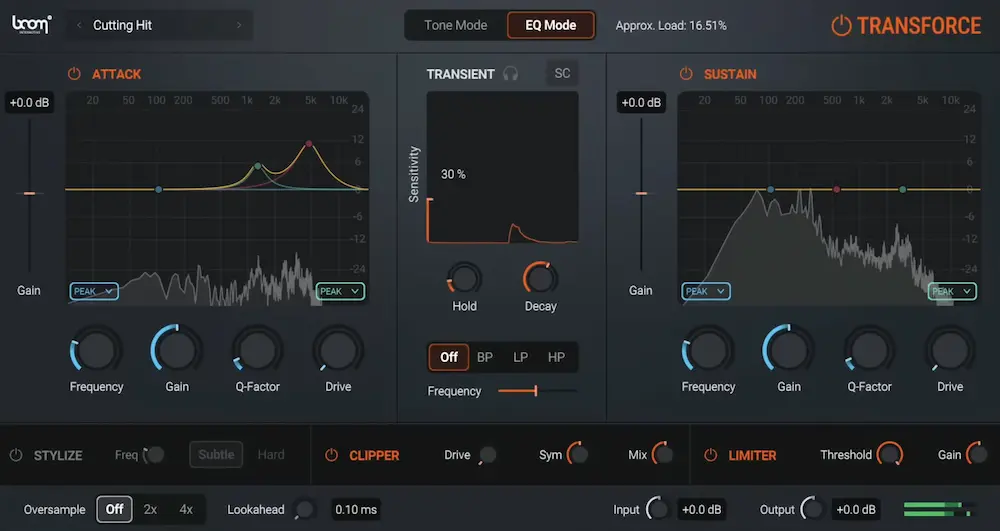
This BOOM Library TRANSFORCE review examines a different approach. TRANSFORCE separates attack and sustain into independent processing paths, then gives each side its own three-band parametric EQ and per-band saturation. Spectral control adds another layer by separating tonal resonance from broadband content, while transient detection, Stylize processing, clipping, limiting, look-ahead, and up to 4x oversampling push the plugin well beyond basic envelope shaping.
The real test is not whether TRANSFORCE offers more control. It is whether that control solves problems faster or more precisely than a conventional transient shaper followed by EQ, saturation, and peak management. At $139, TRANSFORCE has to compete not only with other transient plugins, but with the processing chains experienced engineers already know how to build.
In This Review
BOOM Library TRANSFORCE Review: Quick Verdict
TRANSFORCE is one of the most advanced transient shaper plugins currently available for sound design and complex source processing. Its main advantage is the ability to process attack and sustain independently with separate EQ, per-band saturation, and tonal-versus-broadband spectral control. This makes it significantly more flexible than a conventional two-knob transient shaper.
The plugin is best suited to sound designers, post-production engineers, and producers working with complex drums, impacts, percussion, and layered transient material. At $139, it is difficult to justify for basic attack or sustain correction, but the price makes more sense when its integrated workflow replaces several processors and parallel routing stages.
Our rating: 8.9/10. The strongest alternatives are Wavesfactory Quantum for creative attack-and-sustain separation, Sonnox Oxford Envolution for focused frequency-dependent envelope control, and Oeksound Spiff for adaptive spectral transient processing.
TRANSFORCE Specifications and Key Features
| Specification | Details |
|---|---|
| Developer | BOOM Library |
| Plugin Type | Advanced transient shaper and sound-design processor |
| Core Processing | Independent attack and sustain processing |
| EQ | Three-band parametric EQ for attack and sustain |
| Saturation | Independent per-band saturation |
| Spectral Processing | Separation of tonal resonance and broadband content |
| Additional Processing | Stylize, clipping, limiting, external triggering, and look-ahead |
| Oversampling | Up to 4x |
| Formats | VST3, AU, AAX Native, and AudioSuite |
| Compatibility | Windows and macOS with native Apple Silicon support |
| Other Support | NKS-ready |
| Authorization | iLok required |
| AAX DSP | Not supported |
| Price | $139 |
Why TRANSFORCE Goes Beyond Conventional Transient Shaping
 Conventional transient shapers remain useful because they reduce envelope control to a fast decision: more or less attack, more or less sustain. That works when the problem affects the source broadly. It becomes less precise when different parts of the envelope need different tonal treatment.
A snare may need more upper-mid crack without additional low-frequency impact. A kick can need a cleaner front edge and more density in the tail. With a metallic hit, the abrasive noise burst may be the problem while the resonant decay is the part worth preserving. These are not simply attack and sustain problems. They are changes in frequency content and signal character that occur at different points in time.
That distinction exposes the limit of the standard two-knob design. A conventional transient shaper changes the amplitude envelope, but it does not inherently distinguish low-frequency energy from upper-mid attack, or broadband noise from tonal resonance. Adding EQ or saturation afterward increases control, yet both the transient and the decay still pass through the same downstream processing.
TRANSFORCE is built around a more granular signal model. Attack and sustain are treated as separate processing targets, allowing tonal balance and saturation to be changed on one side without applying the same decision to the other. Its spectral processing adds a second distinction between tonal and broadband content. The result is control across time, frequency, and signal character rather than envelope level alone.
This matters in modern drum production, where sample layering, clipping, saturation, and frequency-selective dynamics can leave little room for broad corrections. Increasing the full attack of a kick may improve definition in solo while creating a larger low-frequency peak against the bass. Reducing a snare’s sustain may open space in the arrangement but remove the low-mid decay that gives the drum its size.
TRANSFORCE is therefore most relevant when the front and back of a sound need different treatment, not merely different levels. That is the technical gap it is designed to fill.
How TRANSFORCE Processes Attack and Sustain Separately
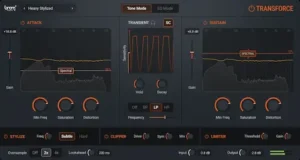
TRANSFORCE changes the workflow by moving tonal decisions inside the envelope split. Instead of shaping the transient first and correcting the result afterward, the engineer can decide which part of the sound should receive EQ or saturation before the two regions are recombined.
On a kick drum, this makes it possible to add definition to the attack without brightening the decay or increasing the harmonic density of the low-end tail. The opposite approach can be just as useful: leave the front edge largely intact, then add weight or saturation to the sustain so the kick carries more energy between hits without producing a larger initial peak.
The distinction becomes more useful on layered snares. The crack, shell tone, ring, and room component can overlap in frequency while occupying different parts of the envelope. A harder attack does not necessarily require a brighter or more aggressive decay. Likewise, adding body to the sustain should not have to soften or saturate the initial hit. Separate processing makes those decisions independent.
Percussion loops expose a different problem. Broad attack enhancement tends to favor the loudest events and can bring forward clicks, shaker edges, and other high-frequency detail that was already prominent. Processing the attack path selectively allows rhythmic articulation to increase without simply exaggerating every short-duration event in the loop.
There is also a less obvious use case: reducing peak level without making a source feel softer. If the initial transient contains excessive low-frequency energy, EQ on the attack path can remove energy that consumes headroom but contributes little to perceived definition. The result can sit more comfortably against bass or downstream limiting without requiring the entire kick or percussion hit to be filtered.
Sound design pushes the architecture further. An impact may need a harder initial event but a darker decay. A mechanical sound can require more midrange articulation at the front while its resonant tail remains untouched. Footsteps, layered cinematic hits, and creature effects often depend on a short event for definition and a longer component for material, scale, or environment. Processing those regions independently is more direct than repeatedly correcting one after changing the other.
This is where TRANSFORCE earns its complexity. The benefit is not simply having separate attack and sustain controls; it is being able to make tonal and nonlinear processing decisions at the point in the envelope where they are actually needed.
How TRANSFORCE Spectral Separation Works
Independent attack and sustain processing is not unique to TRANSFORCE. The more unusual part of its architecture is the ability to separate tonal resonance from broadband content within those regions.
That distinction matters because frequency overlap does not imply the same processing requirement. A metallic ring and the noise burst that excites it can occupy much of the same spectrum while serving completely different roles. Static EQ reduces both. Dynamic EQ can respond to level changes in a selected band, but its detector still does not inherently distinguish sustained resonance from broadband energy at the same frequencies.
TRANSFORCE adds signal character to the existing time-and-frequency split. A useful example is a metal impact with an abrasive leading edge and a resonant tail worth preserving. Reducing the entire attack can weaken the sense of impact, while cutting the offending frequency range may also strip tone from the decay. Separating the broadband component from the tonal content allows the noisy edge to be treated without applying the same decision to the resonance.
The same principle extends into music production. Guitar pick noise can overlap with useful upper-mid articulation. A snare’s crack and ring may occupy similar bands but need opposite treatment. Resonant synth attacks and bright percussion can contain broadband edges that become aggressive before the tonal body itself becomes a problem. In these cases, envelope control and EQ alone describe only part of the signal.
This is the feature that gives TRANSFORCE its clearest technical identity, but it should not become the default solution to every sharp transient. Spectral separation is valuable when desirable and undesirable components overlap in frequency but differ in character. If a small attack adjustment or narrow EQ move already solves the source, adding another layer of signal separation only slows the decision down.
Per-Band EQ and Saturation Turn the Envelope Split Into a Processing System
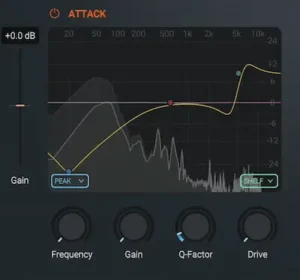 Separating attack from sustain only becomes genuinely useful when each region can be shaped after the split. TRANSFORCE gives both sides a three-band parametric EQ with independent drive per band, allowing frequency balance and harmonic density to change over the course of a single sound.
The EQ stage is useful for problems that exist only during one part of the envelope. A snare attack can carry too much low-mid energy even when the body is correctly balanced. A kick tail may need more upper-bass weight without adding energy to the initial peak. Bright percussion can require less high-frequency sustain while retaining the short edge that keeps the pattern intelligible. These moves would normally require additional dynamic processing or a more elaborate parallel setup.
Per-band saturation is the more consequential feature. Broadband drive changes every part of the selected attack or sustain path, including frequency ranges that may already be dense enough. Driving only the band that needs more harmonic content can increase audibility without turning the complete event into a louder or more distorted version of itself.
That matters on low-frequency material. Adding harmonics to the sustain of a kick can improve translation on smaller playback systems while leaving the initial peak comparatively clean. On a snare or percussion hit, controlled drive in the midrange can increase apparent presence without adding the same saturation to the low end or extending high-frequency roughness through the decay.
The practical advantage is not that TRANSFORCE replaces EQ, saturation, clipping, and limiting as individual processor types. It is that those stages operate inside the same attack-and-sustain structure. In a conventional insert chain, each processor receives the result of the previous one and may react differently as gain and peak shape change. Here, tonal and nonlinear processing can be applied before the separated regions are recombined, reducing the need to build parallel routing simply to keep one part of the envelope out of a processor.
This architecture still demands restraint. The shortest signal path is often the right one, and a source that only needs a minor envelope correction does not become better because every available stage is active. TRANSFORCE makes the most sense when the EQ or saturation requirement is specific to one temporal region and difficult to reproduce cleanly with a simpler chain.
Stylize, Clipping, and Limiting Complete the Transient Chain
The processing after the attack-and-sustain stages shows that TRANSFORCE is designed to take a sound beyond envelope correction. Stylize, clipping, and limiting address what happens after the transient structure has been changed: perceived weight, peak density, and final output control.
Stylize is the least conventional of the three. Rather than functioning as another EQ stage, it changes the timing relationship between frequencies around a selected target area. In practice, that makes it more relevant to reshaping the body and apparent weight of designed sounds, impacts, and heavily processed drums than to transparent transient correction. Its value has to be judged in the full mix or sound-design context, because changes that make an isolated hit feel larger do not automatically improve its relationship with bass, ambience, or layered material.
The clipper solves a more familiar problem. Increasing attack energy can create peaks that consume headroom faster than they improve perceived impact. Controlled clipping can reduce that excursion while adding density, allowing the sound to remain assertive without passing the entire peak downstream. The symmetry control extends the stage beyond simple peak containment by changing how positive and negative waveform excursions are clipped, which can alter the harmonic result.
The limiter serves as the final containment stage rather than another tone-shaping tool. EQ boosts, saturation, transient enhancement, and clipping can all change peak behavior, sometimes substantially. Keeping a limiter inside the same processing environment makes output control easier, particularly on sound-design assets or aggressive drum material that must leave the chain within a predictable ceiling.
These modules are most useful when they complete a deliberate chain. If the limiter is repeatedly suppressing peaks created by excessive attack enhancement, or the clipper is being driven only to compensate for earlier gain decisions, the processing is working against itself. The strongest workflow is to shape the envelope first, use clipping only where peak density needs to change, and treat limiting as final control rather than a repair stage.
None of this turns TRANSFORCE into a dedicated mastering processor. Its more credible mastering relevance is upstream: controlling peak structure at the source or stem level can preserve the relationship between punch, headroom, and final loudness before the mix reaches the mastering chain.
TRANSFORCE Workflow, Use Cases, and Limitations
TRANSFORCE is most useful for sound design, complex drum processing, impacts, percussion, mechanical effects, footsteps, layered cinematic assets, and other sources where the attack and decay need different tonal treatment. It can also solve specific mixing problems on kicks, snares, guitars, and transient-heavy stems, but it is rarely the fastest choice for simple broadband envelope correction.
That does not make a conventional transient shaper obsolete. If a kick only needs slightly more attack or a room microphone needs a shorter decay, a simpler processor will usually reach the result faster. Familiar tools also have a practical advantage in large mixing sessions: fewer parameters make decisions easier to repeat across many channels.
The calculation changes when the requirements conflict. An attack may need more presence and less low-frequency energy at the same time. A sustain region may need additional weight without more upper-mid aggression. Broadband noise may need reduction while the tonal resonance remains intact. These are the cases where TRANSFORCE can replace a more elaborate combination of envelope shaping, parallel routing, EQ, saturation, and peak control.
Its main limitation is therefore not sound quality but decision overhead. Dividing a source by time, frequency, and signal character creates more control points, and every active stage makes the processing harder to diagnose. In a busy session, that can matter more than the theoretical flexibility of the plugin. TRANSFORCE is better suited to selected problem sources than to automatic use across every drum or effects channel.
Look-ahead introduces a separate workflow trade-off. More anticipation can improve detection of very fast events, but it also increases latency. That is largely irrelevant during offline sound-design work and more consequential during tracking, live input, or any session where low-latency monitoring matters. The useful setting is the one appropriate to the task, not simply the highest available value.
Oversampling should be treated the same way. Its strongest case is nonlinear processing, particularly when saturation or clipping is being driven hard. Running every instance at 4x throughout a large session increases CPU load whether or not the audible result justifies it. A more efficient approach is to work at a practical setting, then increase oversampling on the instances where aggressive nonlinear processing makes the difference relevant.
The plugin is easiest to justify when its extra dimensions remove the need for a more complicated external chain. When they do not, the simpler tool remains the better workflow.
TRANSFORCE vs Quantum, Envolution, Spiff, and Trinity Shaper
TRANSFORCE sits in a narrower competitive field than a typical transient shaper plugin. The closest alternatives are processors that separate temporal regions, work selectively across the frequency spectrum, or treat transient content as something more complex than a global attack-and-sustain envelope.
| Plugin | Processing Model | Best Suited To | Key Strength | Trade-Off |
|---|---|---|---|---|
| BOOM Library TRANSFORCE | Separate attack and sustain paths with EQ, per-band saturation, spectral separation, clipping, and limiting | Sound design, complex drums, impacts, layered percussion, transient-heavy material | Combines temporal, spectral, tonal, and peak processing in one workflow | Excessive for straightforward envelope correction |
| Wavesfactory Quantum | Attack and sustain separation with independent effects processing | Creative transformation and extensive processing of separated signal regions | Broad freedom after the attack/sustain split | Less focused on dedicated transient shaping and peak management |
| Sonnox Oxford Envolution | Frequency-dependent transient and sustain shaping | Drums, room control, ambience, and corrective mixing work | Fast, precise envelope control within a focused engineering workflow | Less integrated sound-design and nonlinear processing |
| Oeksound Spiff | Adaptive spectral processing of transient content | Pick attack, harsh drum detail, mouth noise, and frequency-specific transient problems | Highly selective control of transient energy across the spectrum | Not a complete attack-and-sustain processing environment |
| Three-Body Technology Trinity Shaper | Separate control over attack, body, and release | Detailed envelope shaping in music production | More granular temporal control than a conventional two-stage transient shaper | Does not target the same tonal-versus-broadband workflow as TRANSFORCE |
The closest conceptual comparison is Wavesfactory Quantum because both plugins begin by separating attack from sustain. The difference is what happens next. Quantum opens the separated regions to a broad effects workflow, making it particularly strong for creative reconstruction. TRANSFORCE is more specialized: its processing is organized around reshaping impact, body, resonance, harmonic density, and the peaks created by those changes.
Oxford Envolution is the stronger alternative when the task is conventional mixing rather than sound reconstruction. Frequency-dependent control over transients and sustain covers many drum, room, and ambience problems with less operational overhead. TRANSFORCE becomes easier to justify when EQ, saturation, spectral character, and peak control need to differ between temporal regions.
Spiff approaches the problem from another direction. Its strength is adaptive spectral control of transient content, which can make it faster for narrow problems such as aggressive pick attack, sharp drum detail, or other short events concentrated in particular frequency areas. TRANSFORCE is broader but less specialized: it makes more sense when the transient problem is tied to the relationship between attack, sustain, resonance, and final peak structure.
Trinity Shaper is relevant for users who need more temporal detail than a standard attack-and-sustain model provides. Its attack, body, and release structure is useful when the middle of the envelope needs independent control. TRANSFORCE divides the problem differently, prioritizing separate processing paths and the distinction between tonal and broadband content rather than adding another envelope stage.
The practical choice comes down to the structure of the problem. For fast frequency-dependent envelope control, Envolution is the more direct tool. For adaptive spectral transient work, Spiff is more specialized. Quantum offers greater freedom for creative processing after separation, while Trinity Shaper provides a more detailed temporal model. TRANSFORCE makes the strongest case when one source needs several of these decisions at once and keeping them inside a single attack-and-sustain workflow is more efficient than building the equivalent chain manually.
How TRANSFORCE Affects Headroom, Loudness, and Mix Translation
 Transient shaping is usually discussed in terms of punch. In a finished production, it is equally a question of headroom. A short peak can consume several decibels of level without producing a comparable increase in perceived loudness, leaving downstream compression, clipping, and limiting to remove energy that may never have improved the mix. That relationship between peak control and perceived level becomes especially important when loudness and clipping are evaluated at the mastering stage.
This is where TRANSFORCE can be more useful than simply increasing attack. EQ and saturation can make the front of a sound more audible without relying entirely on a larger peak. Sustain processing can add perceived weight without increasing the initial spike, while clipping can reduce peak excursion after the transient structure has been shaped. The relevant result is not the most dramatic waveform change; it is a source that retains impact deeper into the mix and mastering chain.
A kick illustrates the problem clearly. Excessive sub-frequency energy at the front of the hit can drive bus compression or final limiting harder than its audible contribution justifies. Reducing that energy specifically in the attack path may leave more room for the part of the kick that actually defines punch. A snare presents the opposite problem: a narrow, oversized peak can sound aggressive before mastering and then lose impact when the final limiter repeatedly catches it. Correcting the source earlier often produces a more stable result at release level.
Translation depends on which part of the envelope carries useful information. Low-frequency sustain that feels substantial on full-range monitors may contribute little on phones or small speakers. Adding controlled harmonic density to that region can improve audibility without brightening the attack. Conversely, an upper-mid transient that creates definition on studio monitors can become fatiguing on earbuds if the entire front edge is pushed too far.
Lossy delivery adds another reason to avoid building unnecessary peak structure. Encoders can reconstruct peaks differently from the source waveform, particularly when material is already heavily clipped or limited. TRANSFORCE does not provide codec protection, but the decisions made before encoding still matter, especially when mastering for streaming platforms where normalization and lossy delivery become part of the release path. A controlled transient structure is generally easier to deliver than oversized peaks that must be suppressed later in the chain.
Evaluation has to be level-matched. More attack, saturation, or upper-mid energy can sound immediately more impressive simply because the processed version is louder or more forward. Compare the complete processing chain at comparable perceived level, not only individual modules in isolation. If the advantage disappears after matching output, the processing may be adding level rather than solving the source. That emphasis on repeatable technical evaluation also appears in our Transientik Master review, although there the focus shifts from source-level processing to deterministic analysis inside the mastering workflow.
For mastering engineers, the strongest case for TRANSFORCE remains upstream. A mix with intentional peak structure gives the mastering chain more room to balance punch and loudness, which is one reason transient control belongs among the decisions made when you prepare a mix for mastering. The plugin can help when a specific source or stem is creating the problem; it is far less convincing as a routine attempt to redesign transient behavior across a finished stereo mix.
Verdict: Who Should Buy TRANSFORCE?
TRANSFORCE is difficult to justify as a replacement for a simple transient shaper. If the job is adding attack to a kick or shortening a room decay, faster and cheaper tools already do that well.
The plugin earns its price when attack and sustain need different tonal or nonlinear processing. Separate EQ and per-band saturation, spectral separation, transient control, Stylize, clipping, and limiting make it possible to solve several related problems without building the equivalent chain across multiple processors and routing paths.
Sound designers are the clearest audience. Impacts, footsteps, mechanical effects, creature sounds, and layered assets often depend on different treatment of the initial event and the material, resonance, or environment carried by the decay. AudioSuite support makes that workflow particularly relevant to professional post-production.
For music production, the case is narrower but still strong. TRANSFORCE makes sense for engineers and producers working with complex drums, layered percussion, aggressive electronic material, or sources that repeatedly require separate control over attack, body, resonance, and peak behavior. It makes less sense as a default insert across a session.
The deciding factor is not whether TRANSFORCE can do more than a conventional transient shaper. It can. The question is whether your work regularly requires those extra dimensions of control. If the answer is yes, the plugin offers a coherent alternative to building the same workflow from several processors. If most of your transient decisions are simple and broadband, TRANSFORCE adds cost and complexity without solving a problem you actually have.
Overall Rating
| Category | Rating |
|---|---|
| Transient Control | 9.5/10 |
| Workflow | 8.5/10 |
| Sound Design Flexibility | 9.5/10 |
| Mix Translation | 9/10 |
| Peak and Loudness Control | 9/10 |
| Value for Money | 8/10 |
| Overall | 8.9/10 |
Transient Control — 9.5/10: TRANSFORCE goes substantially further than conventional attack-and-sustain shaping. Independent processing paths, spectral separation, per-band EQ, and saturation make it unusually effective when transient problems differ across time, frequency, and signal character. The missing half-point reflects the fact that this depth is unnecessary for simpler envelope work.
Workflow — 8.5/10: Keeping transient shaping, tonal control, saturation, clipping, and limiting inside one envelope-aware system can replace a more complicated external chain. The trade-off is decision overhead. TRANSFORCE is efficient when the source genuinely needs several stages of selective processing, but slower than a basic transient shaper for routine corrections.
Sound Design Flexibility — 9.5/10: This is the plugin’s strongest area. Impacts, mechanical effects, layered assets, percussion, and other transient-heavy material benefit directly from treating the initial event and decay as separate processing targets. Spectral separation and Stylize extend the workflow beyond conventional drum enhancement without turning the plugin into a general-purpose multi-effect.
Mix Translation — 9/10: Selective control over attack energy, sustain density, and harmonic content can help a source retain its identity across full-range monitors, earbuds, and smaller playback systems. The score stops short of 10 because translation still depends on monitoring, arrangement, and level-matched decisions; the plugin cannot compensate for poor source balance.
Peak and Loudness Control — 9/10: TRANSFORCE is particularly strong when perceived impact and peak level need to be treated as separate problems. Attack-specific EQ, selective saturation, clipping, and final limiting can produce material that behaves more predictably further down the mixing and mastering chain. It remains a source and stem processor first, not a substitute for final mastering.
Value for Money — 8/10: At $139, TRANSFORCE is expensive if the requirement is basic attack enhancement or sustain reduction. The price becomes easier to defend for sound designers and engineers who would otherwise build comparable workflows from several processors, parallel paths, and additional peak-control stages.
Overall — 8.9/10: TRANSFORCE is one of the more technically complete approaches to advanced transient shaping, with a clear advantage on complex sources that resist broadband envelope control. Its depth is also its main limitation: users who rarely need separate tonal, spectral, and nonlinear processing across attack and sustain will pay for complexity they do not use.
BOOM Library TRANSFORCE FAQ
Can TRANSFORCE replace a compressor on drums?
Only when the real problem is envelope shape. TRANSFORCE can change attack, sustain, tone, and peak structure without relying on conventional gain reduction. A compressor remains the better tool for level control, detector-driven movement, or changing the groove through attack and release timing.
Can TRANSFORCE be used for mastering?
Yes, but selectively. It is better suited to a problematic stem or isolated transient issue than routine stereo-bus processing. On a full mix, separating attack and sustain can affect drums, vocals, ambience, and low-frequency decay at the same time, making targeted correction harder.
How is TRANSFORCE different from a multiband transient shaper?
A multiband transient shaper divides the signal into frequency bands and changes envelope behavior within each band. TRANSFORCE begins with separate attack and sustain paths, adds EQ and per-band saturation to both, and can further distinguish tonal resonance from broadband content. The processing model is temporal and spectral rather than simply multiband.
Does TRANSFORCE add latency?
Look-ahead processing can introduce latency because the plugin analyzes incoming transients before processing them. The practical impact depends on the selected setting and session workflow. Higher-latency operation is less problematic during mixing, editing, or offline sound design than during tracking and live monitoring.
Is TRANSFORCE CPU-intensive?
The plugin supports up to 4x oversampling, so the highest-quality setting will require more processing than lower oversampling modes. Actual CPU impact depends on the computer, DAW, session size, and number of instances. Large sessions should be tested on the intended system rather than judged from specifications alone.
When should I use 4x oversampling in TRANSFORCE?
The strongest case is aggressive nonlinear processing, particularly saturation and clipping. Maximum oversampling is not automatically necessary for routine envelope correction. A practical workflow is to use a lower setting while mixing and compare higher oversampling where the nonlinear stages are being pushed hard.
What are the best alternatives to TRANSFORCE?
Wavesfactory Quantum is the closest conceptual alternative for separate attack and sustain processing. Sonnox Oxford Envolution is more direct for frequency-dependent envelope shaping, Oeksound Spiff specializes in adaptive spectral transient control, and Three-Body Technology Trinity Shaper provides separate attack, body, and release stages.
Is TRANSFORCE worth $139?
The price is easier to justify for sound designers and engineers who regularly build multi-stage chains around complex transient material. For basic kick enhancement, drum tightening, or occasional sustain control, simpler transient shapers provide better value and faster operation.
Which plugin formats and operating systems does TRANSFORCE support?
TRANSFORCE is available for Windows and macOS in VST3, AU, AAX Native, and AudioSuite formats, with native Apple Silicon support. It is also NKS-ready. AAX DSP is not supported, and authorization requires iLok.
Can TRANSFORCE help preserve punch in a loud mix?
It can help at the source or stem level. Reducing unnecessary peak energy, adding harmonic density selectively, and controlling attack separately from sustain can make material behave more predictably under bus processing and final limiting. TRANSFORCE does not create loudness, and excessive attack enhancement can reduce usable headroom instead.

Yurii Ariefiev is a mastering engineer and audio production editor whose work focuses on transient structure, peak control, loudness behavior, and mix translation. His plugin analysis examines how processing decisions made at the source and stem level affect headroom, final limiting, and the stability of a finished master.
This TRANSFORCE review evaluates attack and sustain processing from a studio workflow perspective, with particular attention to spectral control, saturation, clipping, and the way transient decisions behave further down the mixing and mastering chain.