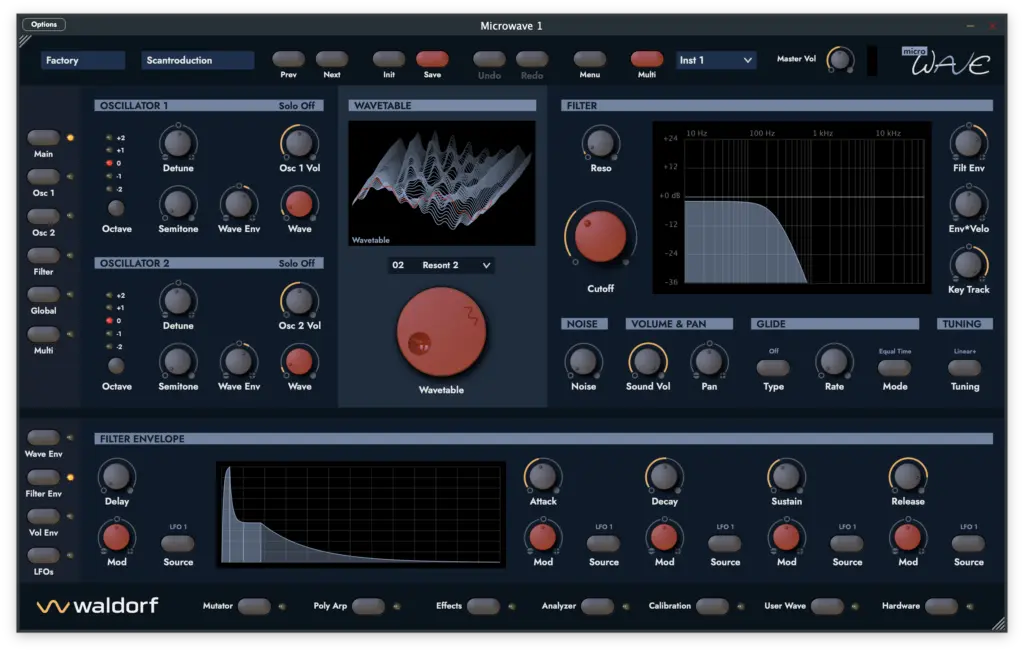
Waldorf Microwave 1 Plugin v2 Review: Can This Hybrid Classic Still Earn a Place in Modern Production?
Few software recreations carry expectations as high as the Waldorf Microwave. The original hardware earned its reputation by combining digital wavetable oscillators with analog filters, producing textures that still stand apart from both classic analog synths and today’s ultra-clean wavetable instruments. Decades later, the question is no longer whether that sound can be emulated, but whether it still offers a practical advantage inside a modern production workflow.
That question is more relevant now than it would have been five years ago. Contemporary productions rely on dense arrangements, aggressive loudness processing, and flawless DAW integration. A synthesizer with vintage pedigree is no longer valuable simply because it sounds different. It has to survive compression, limiting, codec conversion, and layered mixes while contributing something that established tools like Serum, Pigments, or Massive X cannot easily replicate.
Microwave 1 Plugin v2 is more than a maintenance update. Increased polyphony, workflow refinements, improved preset management, and expanded performance features make the instrument substantially easier to use in professional sessions. Those additions matter, but they are not what determines the plugin’s long-term value. The more important question is whether its hybrid architecture still delivers a sonic character that justifies a place alongside today’s flagship software synthesizers—and whether that character translates into faster mixing decisions, stronger arrangements, and masters that retain definition across real-world playback systems.
Contents
Why Hybrid Wavetable Synthesis Is Relevant Again
 Software synthesizers have never been more powerful. Between Serum, Massive X, Pigments, Phase Plant, Falcon, and dozens of modular environments, producers can generate almost any timbre imaginable. That level of flexibility has also created an unexpected side effect: many productions are beginning to sound technically perfect, but increasingly similar.
That shift helps explain why interest in older hybrid synthesizers has returned. The appeal is no longer vintage hardware itself. It’s the way those instruments generate harmonics before a signal reaches EQ, saturation, or dynamics processing. The Waldorf Microwave belongs to a small group of synthesizers whose character originates in the oscillator architecture rather than post-processing.
Unlike modern wavetable engines designed around unrestricted editing, the Microwave operates within a far more defined structure. The wavetable selection is limited, modulation is comparatively restrained, and the signal path reflects engineering decisions made decades before software synthesis became virtually unlimited. Those constraints are part of its identity. They encourage musical choices instead of endless parameter tweaking.
That design philosophy produces sounds that behave differently inside a mix. Instead of relying on effects to create movement, many Microwave patches generate natural harmonic variation directly from the oscillator and filter interaction. Pads develop motion without heavy modulation, basses retain articulation under compression, and evolving textures often remain intelligible after multiple processing stages.
This becomes increasingly valuable in contemporary production. Streaming normalization has largely ended the loudness war as the primary competitive factor. Translation now depends more on spectral balance, harmonic density, and source quality than on raw level. Engineers routinely spend hours correcting sounds that looked impressive in isolation but collapse once layered with vocals, drums, and other instruments.
The Microwave addresses that problem from the opposite direction. Instead of manufacturing complexity through saturation, exciters, stereo processors, or elaborate effect chains, it generates much of that complexity at the source. For experienced producers, this often means fewer corrective decisions during mixing and greater consistency throughout mastering.
That does not make the Microwave objectively superior to modern wavetable synthesizers. It serves a different purpose. Instruments like Serum or Pigments are built for maximum flexibility, rapid experimentation, and deep modulation. The Microwave prioritizes a recognizable sonic fingerprint. Its limitations are intentional, and for many productions, they become part of the creative process rather than obstacles.
Version 2 arrives at a time when more producers are questioning whether unlimited synthesis options actually improve productivity. In commercial sessions, efficiency often matters more than feature count. An instrument that consistently delivers mix-ready sounds can be more valuable than one offering thousands of possible routing combinations that rarely survive beyond the programming stage.
That perspective explains why the Microwave continues to attract experienced producers despite an abundance of newer alternatives. Its value is not rooted in nostalgia or collector appeal. It comes from a workflow that emphasizes strong source material—a principle that remains just as relevant in modern audio production as it was when the original hardware first appeared.
How Waldorf Microwave 1 Plugin v2 Fits Into a Modern Production Workflow
Feature lists rarely determine whether a synthesizer earns a permanent place in a professional template. What matters is how consistently it delivers usable sounds once a production moves beyond composition and into editing, mixing, and mastering.
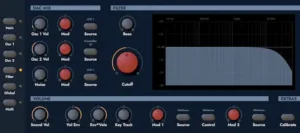
The Microwave’s defining characteristic remains the relationship between its wavetable oscillators and modeled analog filter stage. Modern wavetable synthesizers often prioritize precision, smooth interpolation, and virtually unlimited modulation. The Microwave takes the opposite approach. Its slightly irregular harmonic structure gives patches a stronger sense of physical presence without relying on layers of effects or complex routing.
That difference becomes obvious once a session grows. Modern electronic productions frequently stack multiple synthesizers competing for the same spectral space. The result is excessive masking that engineers later address with dynamic EQ, multiband compression, saturation, or aggressive automation. The Microwave tends to require less corrective work because much of its movement and harmonic density already exists at the source.
That doesn’t eliminate the need for proper mix decisions, but it shifts the workflow in a more efficient direction. Instead of repairing flat or sterile sounds, engineers can focus on balancing the arrangement. Well-designed source material almost always survives processing better than heavily reconstructed sounds.
Version 2 improves that workflow in practical ways rather than introducing headline features. Higher polyphony supports more complex arrangements without voice restrictions. The redesigned preset browser speeds up sound selection, while expanded arpeggiator functions make the instrument more useful beyond classic evolving pads and vintage sequences. None of these additions change the Microwave’s identity, but together they make it significantly easier to integrate into daily production work.
The software implementation also removes many of the compromises associated with vintage hardware. Total recall, automation, offline rendering, preset portability, and project compatibility across modern DAWs allow the Microwave to function like any contemporary virtual instrument while preserving the sonic behavior that made the original hardware desirable.
The most interesting advantage appears later in the production chain. Many synthesizers create oversized sounds in solo mode but lose definition after bus compression, brickwall limiting, or streaming normalization. That behavior becomes much easier to understand once you examine how a professional mastering stage reshapes dynamics, tonal balance, and translation across playback systems. How Professional Mastering Works explores that process in greater technical detail. Microwave patches generally retain their internal movement because the harmonic complexity is built into the synthesis engine rather than added through post-processing. As dynamic range decreases during mastering, that distinction becomes increasingly noticeable.
This is particularly relevant for producers delivering music to streaming platforms. AAC and Ogg Vorbis encoding tend to flatten synthetic textures that rely heavily on stereo enhancement or high-frequency excitation. The Microwave’s tonal complexity remains largely intact after codec conversion, allowing pads, basses, and evolving textures to preserve separation across headphones, studio monitors, consumer speakers, and mobile playback.
Film, television, and game composers may benefit even more than electronic producers. Modern hybrid scores combine orchestral recordings with synthetic layers that must occupy the same acoustic space without sounding disconnected. The Microwave’s controlled harmonic instability helps electronic elements blend naturally with acoustic material instead of competing against it.
Ultimately, Version 2 reinforces a production philosophy that has become increasingly valuable. Strong source sounds reduce processing, shorten mix revisions, and translate more consistently across playback systems. Those advantages rarely appear on a specification sheet, but they have a measurable impact on real-world production efficiency.
How Waldorf Microwave Performs Across Different Production Styles
One of the reasons the original Microwave has remained relevant is that it doesn’t impose a single production aesthetic. While its hybrid wavetable architecture immediately evokes late-1980s digital synthesis, its practical applications extend far beyond nostalgic recreations. The way its harmonic structure behaves under compression, saturation, and final mastering makes it surprisingly adaptable across several production styles where tonal identity is more valuable than unlimited modulation.
Synthwave. This is the most obvious match. The Microwave naturally produces evolving pads, metallic textures, glassy leads, and animated basses that sit comfortably beside drum machines and vintage-inspired arrangements. Unlike many modern wavetable synths, it rarely requires additional saturation to achieve the slightly unstable character associated with classic digital hardware.
Industrial and Dark Electronic. Aggressive upper harmonics and controlled digital roughness allow Microwave patches to cut through distorted drums and layered effects without excessive EQ. That quality often reduces the need for harmonic exciters later in the mixing process while preserving definition after mastering.
Techno and Electro. Rather than producing oversized supersaws, the Microwave excels at rhythmic sequences, evolving drones, and textured basslines that maintain clarity during heavy bus compression. Its naturally animated oscillator behavior keeps repetitive patterns engaging without relying on extensive automation.
Ambient and Experimental Music. Slow wavetable movement, restrained modulation, and the interaction between digital oscillators and analog-style filtering create evolving textures that remain interesting over long passages. Those characteristics make the instrument particularly useful for cinematic atmospheres and immersive soundscapes.
Film, Television, and Game Scoring. Hybrid scores increasingly combine orchestral recordings with electronic layers that need to occupy the same acoustic space. The Microwave produces synthetic textures with enough harmonic complexity to complement acoustic instruments instead of overpowering them, making it well suited for tension beds, science-fiction sound design, and modern cinematic production.
Across all of these applications, the Microwave’s greatest strength is consistency. It produces sounds that continue to hold their identity once they move through mixing, mastering, streaming normalization, and playback on consumer systems—a characteristic that remains surprisingly uncommon among software synthesizers designed primarily around unlimited flexibility.
Its Biggest Limitation: The Microwave Isn’t Built for Everything
 One of the easiest mistakes to make is evaluating the Microwave by the standards of modern wavetable synthesizers. It was never designed to compete with instruments like Serum, Pigments, Phase Plant, or Massive X, and Version 2 doesn’t change that. If your workflow revolves around deep modulation, visual wavetable editing, or highly animated sound design, you’ll reach those results faster with contemporary synthesis platforms.
The Microwave follows a far narrower design philosophy. Its architecture deliberately limits certain creative options in exchange for a recognizable sonic identity. That trade-off is exactly why many producers continue to value it—but it also explains why it cannot function as a universal synthesizer.
This distinction becomes especially relevant in commercial production. Pop, EDM, and cinematic trailer music often demand sounds that evolve continuously through macros, layered modulation, and complex automation. Those genres reward flexibility. The Microwave rewards restraint. It encourages producers to commit to a sound early rather than continuously redesigning it throughout the session.
Its tonal character can also become challenging in dense arrangements. The Microwave naturally projects a pronounced upper-midrange presence, and stacking several instances alongside bright vocals, distorted guitars, or aggressive supersaws can quickly increase spectral masking between roughly 1 and 5 kHz. Engineers should expect to solve that problem through arrangement before reaching for corrective EQ.
That isn’t a weakness of the synthesis engine. It’s the consequence of an instrument with a strong sonic fingerprint. Producers accustomed to cleaner digital synthesizers sometimes interpret that forward character as excessive harshness when, in reality, it reflects the way the original hardware occupied a mix.
Version 2 modernizes workflow without fundamentally modernizing the instrument itself. Preset management is faster, polyphony is less restrictive, and DAW integration meets current production standards, but the programming experience still reflects a synthesizer designed decades ago. Compared to today’s visually driven interfaces, it demands a more deliberate approach and a better understanding of synthesis fundamentals.
That learning curve will divide users. Producers looking for immediate experimentation may find the Microwave unnecessarily restrictive. Those who value consistency, repeatability, and a clearly defined sonic identity are more likely to appreciate exactly those same limitations.
The purchasing decision is therefore straightforward. If you need a single synthesizer capable of covering every genre and every production style, this is not the right choice. If you already own a flexible wavetable platform and want an instrument that delivers a character few modern synthesizers can convincingly reproduce, the Microwave becomes far more compelling.
Microwave vs Modern Wavetable Synths: Where Each One Excels
Comparing the Waldorf Microwave to modern wavetable synthesizers is less about sound quality than production intent. Serum, Pigments, Massive X, and Phase Plant were built to maximize flexibility. The Microwave was built to deliver a specific sound with minimal compromise. Those are fundamentally different design goals.
That distinction changes how each instrument is used in a session. Modern wavetable synths excel when a sound has to evolve continuously through automation, macros, and layered modulation. The Microwave works best when the tone itself carries enough personality that additional processing becomes secondary. Instead of encouraging endless tweaking, it encourages commitment.
For many experienced producers, that’s a practical advantage. Time spent refining modulation curves, effect chains, and routing can instead be spent arranging or mixing. The trade-off is obvious: less flexibility in exchange for a stronger default identity.
| Instrument | Excels At | Ideal User | Where It Falls Behind |
|---|---|---|---|
| Waldorf Microwave 1 Plugin v2 | Hybrid wavetable tone with distinctive harmonic character | Producers seeking recognizable textures instead of unlimited programming | Limited modulation compared to modern wavetable platforms |
| Xfer Serum | Advanced wavetable editing and EDM sound design | Electronic producers who build sounds from scratch | Often relies more heavily on post-processing to develop character |
| Arturia Pigments | Multiple synthesis methods within one environment | Composers, sound designers, hybrid scoring | Greater complexity can slow everyday workflow |
| Native Instruments Massive X | Complex modulation and evolving textures | Advanced electronic production | Less immediate workflow than many competitors |
| Waldorf Blofeld | Versatile wavetable synthesis across many styles | General-purpose electronic music production | Cleaner, more modern character than the original Microwave |
If your work centers on EDM, contemporary pop, bass music, or commercial electronic production, Serum or Pigments will likely remain the instruments you open first. They simply cover a broader range of production scenarios with fewer compromises.
The Microwave fills a different role. It excels when a track benefits from harmonic complexity that feels embedded in the synthesis engine rather than layered on with saturation, modulation, or effects. That makes it particularly effective for synthwave, industrial, ambient, electro, cinematic scoring, and hybrid productions where tonal character matters more than maximum programmability.
That philosophy mirrors the way many engineers approach analog console emulations during mixing. Rather than manufacturing character through multiple processors, they start with source material that already carries harmonic depth. We discussed a similar production mindset in our Acustica Audio Cream 3 review, where console coloration is evaluated as part of the overall mix strategy rather than a standalone effect.
Viewed through that lens, the Microwave is not competing with today’s flagship wavetable synthesizers. It complements them. Most professional producers are unlikely to replace Serum or Pigments with the Microwave, but many will find room for it alongside those instruments precisely because it approaches synthesis from a fundamentally different direction.
Where the Waldorf Microwave Still Outperforms Modern Wavetable Synths
Modern wavetable synthesizers dominate when maximum flexibility is the priority, but production efficiency is rarely determined by feature count alone. In real sessions, many engineers choose instruments based on how quickly they reach a finished mix rather than how many modulation options they provide. The Microwave continues to stand out in several production tasks where its hybrid architecture naturally produces results that often require more processing with contemporary software.
| Production Task | Microwave 1 Plugin v2 | Modern Wavetable Synths |
|---|---|---|
| Evolving pads with natural movement | ✔ Excellent | Usually requires additional modulation |
| Harmonic density at the source | ✔ Native characteristic | Often enhanced with saturation or effects |
| Mix translation after compression | ✔ Consistently strong | Depends heavily on programming |
| Distinctive sonic identity | ✔ Immediately recognizable | More dependent on user programming |
| Advanced wavetable editing | Limited | ✔ Major strength |
| Macro modulation and performance control | Basic | ✔ Extensive |
| Experimental sound design | Focused architecture | ✔ Nearly unlimited |
This comparison doesn’t suggest that the Microwave is technically superior. It highlights a different design philosophy. Modern wavetable synthesizers prioritize flexibility, while the Microwave prioritizes source character. Producers who spend more time mixing than programming may find that distinction has a greater impact on finished productions than another page of modulation options.
How Waldorf Microwave Performs During Mixing, Mastering and Streaming
 A synthesizer shouldn’t be judged in solo mode. The real test begins once it moves through bus compression, limiting, codec encoding, and the compromises of consumer playback systems. Many instruments that sound enormous during sound design lose definition long before a project reaches its final master.
The Microwave has historically avoided that problem because much of its character comes from the synthesis engine itself rather than heavy onboard processing. Its wavetable oscillators and modeled analog filters generate harmonic detail that remains identifiable after dynamic processing instead of relying on exaggerated stereo width or artificial high-frequency enhancement.
That changes the mixing process. Pads retain internal movement without requiring additional modulation effects, bass patches maintain articulation under compression, and layered textures are generally easier to separate than similarly dense sounds created with heavily processed modern wavetable synths. Engineers still need to manage masking and balance, but less corrective processing is usually required to establish a clear place in the mix.
The Microwave is not immune to poor arrangement decisions. Some presets project substantial energy through the upper midrange, and stacking multiple instances without spectral planning can quickly create congestion. Solving that problem through arrangement is considerably more effective than attempting to recover clarity with aggressive EQ during mixing, although modern spectral editing tools can sometimes help rescue problematic layers after the fact. Our Steinberg SpectraLayers 13 review examines where spectral editing genuinely improves complex mixes—and where it cannot replace better production decisions.
Streaming delivery introduces another stage of translation. Even well-balanced synthesizer patches can change once loudness normalization and perceptual codecs are applied by streaming services. If you’re interested in why this happens, see our detailed guide on Spotify Mastering and normalization. Perceptual codecs such as AAC and Ogg Vorbis often reduce the apparent depth of heavily processed synthetic material, particularly when wide stereo effects and harmonic exciters dominate the sound. Microwave patches generally remain recognizable after encoding because much of their complexity exists within the oscillator structure rather than external processing.
That characteristic also improves consistency across consumer playback systems. Earbuds, smartphones, Bluetooth speakers, laptops, and automotive audio all emphasize different frequency ranges, yet Microwave sounds tend to preserve their core identity without depending on exaggerated low end or artificial stereo expansion.
Monitoring remains critical. The instrument’s naturally forward midrange can appear more aggressive in untreated rooms than it actually is, making reliable reference monitoring especially important when layering multiple parts. Engineers working in controlled environments will find it easier to judge how much space the Microwave should occupy within a finished arrangement.
CPU performance is unlikely to influence purchasing decisions. Version 2 runs comfortably in modern production environments, and its support for automation, total recall, and stable DAW integration makes it practical for large commercial sessions. The bigger workflow advantage comes from requiring fewer repair decisions later in the mix. Strong source material rarely needs to be rescued, but even the best synthesizer cannot compensate for an unbalanced final mix. Before sending a project to mastering, it’s worth reviewing the common issues covered in our Prepare Mix for Mastering guide.
Verdict: Still One of the Most Distinctive Wavetable Synths Available
Waldorf Microwave 1 Plugin v2 succeeds because it avoids competing on feature count. It doesn’t try to replace Serum, Pigments, Massive X, or other modern wavetable platforms, and it doesn’t need to. Its value comes from a sound that remains immediately recognizable in a market where many software synthesizers have become increasingly interchangeable.
Version 2 modernizes the workflow without diluting the instrument’s identity. Higher polyphony, improved preset management, expanded performance features, and reliable DAW integration remove many of the practical compromises that once limited vintage-inspired software. What remains is a synthesizer that feels comfortable in contemporary production while preserving the harmonic behavior that made the original hardware influential.
It is not the right choice for every producer. Sound designers who depend on unrestricted modulation, advanced wavetable editing, or highly experimental synthesis will move faster with dedicated modern platforms. The Microwave rewards a different mindset—one that prioritizes source quality over endless customization.
That philosophy continues to hold up remarkably well. Throughout production, the instrument consistently produces sounds that retain definition after compression, limiting, and streaming delivery while requiring relatively little corrective processing. Those characteristics become increasingly valuable as sessions grow more complex and mix decisions become more constrained.
For producers working in synthwave, industrial, ambient, cinematic scoring, electro, techno, and other genres where tonal identity matters as much as flexibility, the Microwave remains a compelling addition to an existing toolkit. It is best viewed as a specialist rather than a replacement—and that’s precisely why it has remained relevant for more than three decades.
Ultimately, the strongest argument for Waldorf Microwave 1 Plugin v2 is neither nostalgia nor historical significance. It is the simple fact that distinctive source material still leads to better mixes, fewer corrective decisions, and more consistent translation across modern playback systems. Few software instruments demonstrate that principle as convincingly as the Microwave. If you’d like a deeper look at what happens after the mix is finished, our guide to the mastering chain explains how each processing stage influences the final release.
Overall Rating
| Category | Rating |
|---|---|
| Sound Quality | 9.5/10 |
| Workflow | 9/10 |
| Mix Translation | 9.5/10 |
| CPU Efficiency | 9/10 |
| Sound Design Flexibility | 7.5/10 |
| Value for Money | 9/10 |
| Overall | 9.1/10 |
Sound Quality — 9.5/10. The Microwave continues to deliver one of the most distinctive hybrid wavetable voices available in software. Its harmonic behavior remains immediately recognizable in dense productions without relying on heavy post-processing.
Workflow — 9/10. Version 2 modernizes day-to-day usability with higher polyphony, improved preset management, and reliable DAW integration while preserving the original instrument’s production philosophy. Programming is intentionally less immediate than modern visual synthesizers.
Mix Translation — 9.5/10. This is where the Microwave stands out. Well-programmed patches retain clarity after compression, limiting, and streaming delivery, reducing the amount of corrective processing required later in the production chain.
CPU Efficiency — 9/10. Performance is comfortably suited to modern production systems. Even larger sessions remain practical, although freezing tracks is still sensible in extremely dense orchestral or scoring templates.
Sound Design Flexibility — 7.5/10. The Microwave was never intended to compete with open-ended wavetable platforms such as Serum or Phase Plant. Its strength lies in a focused architecture and a consistent sonic identity rather than unrestricted modulation.
Value for Money — 9/10. For producers who already own a general-purpose wavetable synthesizer, the Microwave offers a genuinely different palette instead of duplicating existing capabilities. Its long-term value comes from character rather than feature count.
Overall — 9.1/10. Waldorf Microwave 1 Plugin v2 is not designed to be the most versatile software synthesizer on the market. It succeeds by delivering a hybrid wavetable sound that continues to translate exceptionally well through mixing, mastering, and modern streaming workflows. For producers who value source quality over unlimited programmability, it remains one of the strongest specialist instruments currently available.

Yurii Ariefiev evaluates audio software from the perspective of real mixing and mastering sessions, focusing on harmonic balance, mix translation, streaming delivery, and how virtual instruments behave after compression, limiting, and final mastering—not just how they sound in isolation.
His editorial work emphasizes production workflow, critical listening, and practical engineering decisions, helping producers understand how synthesizers, plugins, and processing choices affect commercial releases across today’s streaming platforms.
Frequently Asked Questions
Is the Waldorf Microwave 1 Plugin v2 suitable for modern music production?
Yes. Although it recreates a late-1980s synthesizer, its hybrid wavetable architecture still complements contemporary electronic music, cinematic scoring, synthwave, industrial, and experimental productions. The workflow feels vintage, but the plugin integrates seamlessly into modern DAWs.
Does the Microwave plugin replace a modern wavetable synthesizer like Serum or Pigments?
No. It serves a different role. Modern wavetable synthesizers prioritize flexibility and deep sound design, while the Microwave focuses on delivering a distinctive tonal character that would be difficult to recreate from scratch.
How well do Microwave sounds translate after mastering?
Generally very well. Its harmonically complex oscillator structure tends to retain clarity after bus compression, limiting, and loudness normalization, provided the arrangement avoids excessive frequency masking.
Is the plugin useful for mixing engineers who do not create presets?
Absolutely. Even users who rely primarily on factory sounds can benefit from the Microwave’s naturally layered harmonic content, which often requires less corrective EQ and saturation than cleaner digital synthesizers.
Does the Microwave plugin consume significant CPU resources?
For most current production systems, CPU usage is moderate and unlikely to become a bottleneck. Large orchestral templates with dozens of instances may still benefit from freezing tracks, but typical electronic music sessions should run comfortably.
Which genres benefit most from the Microwave’s sound?
It performs particularly well in synthwave, dark techno, industrial, ambient, cinematic scoring, IDM, electro, experimental electronic music, and retro-inspired productions where evolving digital textures are an important part of the arrangement.
Is the plugin a good investment if I already own several flagship synthesizers?
If your current collection already covers modern wavetable synthesis, the Microwave should be viewed as a complementary instrument rather than an upgrade. Its value comes from its unique character, not from replacing existing workflow tools.
Can the Microwave plugin recreate the original hardware exactly?
While Waldorf has invested considerable effort in modeling the original instrument, software and hardware inevitably differ in subtle ways. The more relevant question for most producers is whether the plugin captures the musical behavior and production value of the original—and in practical sessions, it does so convincingly.
Is Waldorf Microwave 1 Plugin v2 worth buying in 2026?
For producers seeking a recognizable hybrid wavetable sound with strong mix translation and long-term creative value, yes. Those looking for maximum synthesis flexibility may achieve better value from modern wavetable platforms, but few alternatives offer the Microwave’s particular combination of digital texture and analog-style weight.