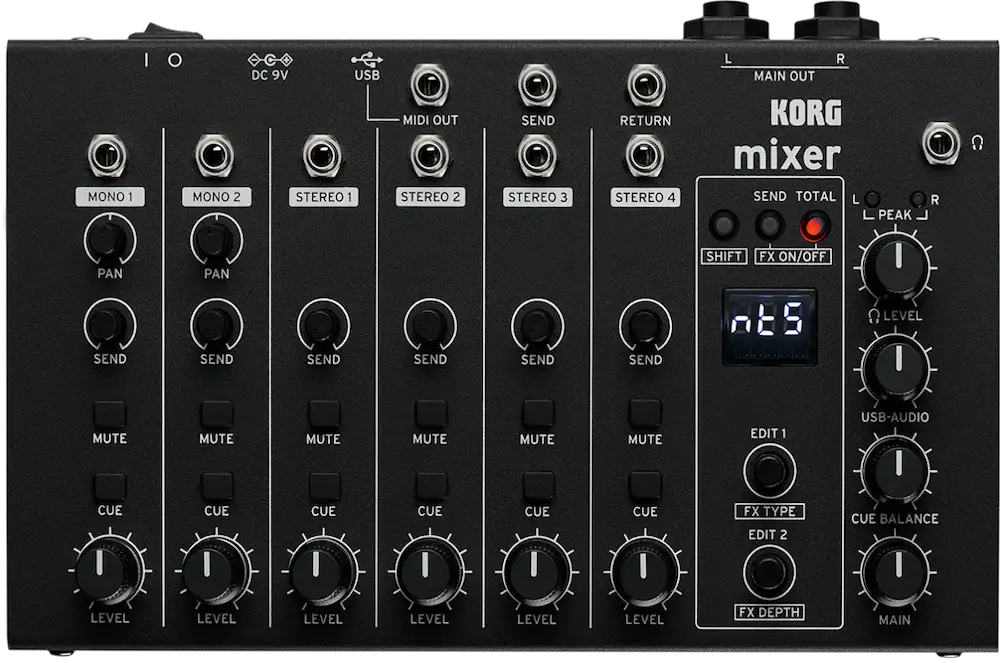
As hardware-based production continues to grow, one problem keeps resurfacing: compact mixers haven’t evolved at the same pace as modern synth rigs. Desktop synthesizers, Eurorack systems, grooveboxes, and drum machines are easy to combine creatively, but integrating them into a clean, portable workflow often requires a stack of utility devices—small mixers, USB interfaces, headphone amps, attenuators, and external effects. The Korg NTS-4 was designed to consolidate much of that infrastructure into a single compact unit, combining an analog mixer with onboard effects, USB audio, MIDI connectivity, and modular-friendly inputs.
That positioning makes the NTS-4 more interesting than its specifications initially suggest. This isn’t a studio mixer competing with recording consoles, nor is it trying to replace a dedicated mixing or mastering workflow. Its success depends on a different question entirely: does it remove enough friction from hardware-based audio production to justify its place at the center of a modern electronic music setup? The answer depends less on the feature list than on how—and where—you actually make music.
Contents
Why Performance Mixers Are Becoming Essential in Hardware-Based Studios
 The resurgence of hardware production has changed the requirements for compact mixers. Today’s electronic setups rarely revolve around a single synthesizer or drum machine. Instead, producers combine desktop synths, Eurorack modules, grooveboxes, samplers, and sequencers into hybrid systems that blur the line between studio production and live performance. While instruments have become smaller and more specialized, the infrastructure connecting them has often remained an afterthought.
That mismatch creates practical limitations long before audio reaches the DAW. A mixer originally purchased for two stereo sources quickly becomes the weakest link as additional instruments are added. Monitoring requires workarounds, external effects occupy more desk space, USB recording demands a separate interface, and modular-level signals frequently need attenuation before they can be integrated safely into a conventional line-level mixer.
Manufacturers have approached this problem from different directions. Some have prioritized multitrack recording, others have focused on digital routing or modular-specific ecosystems. Korg takes a more workflow-oriented approach with the NTS-4. Instead of building another compact recording mixer, it combines analog summing, performance controls, onboard effects, USB audio, MIDI output, and Eurorack compatibility into a single desktop unit designed to minimize setup time rather than maximize channel count.
That distinction defines the product far more accurately than its specifications. The NTS-4 is aimed at musicians who treat hardware as an instrument rather than simply another collection of sound sources feeding a DAW. The same performance-first philosophy increasingly extends beyond mixers to monitoring equipment, as discussed in our Sony IER-M500 review, where reliable stage monitoring proves just as important as efficient signal routing during live performance. Fast routing, immediate access to cue monitoring, dedicated mute controls, and integrated effects often have a greater impact on a live-oriented workflow than additional recording channels or deep configuration menus.
In many modern electronic studios, creativity is limited less by synthesis or sound design than by the time required to connect, monitor, and manage multiple devices. Reducing that technical overhead is where performance mixers have become increasingly relevant—and where the NTS-4 attempts to distinguish itself from both traditional compact mixers and larger digital recording systems.
Designed Around Workflow, Not Feature Count
Viewed as a specification sheet, the Korg NTS-4 looks fairly conservative. Six input channels, onboard effects, USB audio, MIDI output, and analog summing are hardly groundbreaking in 2026. Its value becomes clearer once you stop evaluating it as a compact mixer and start looking at it as a hardware workflow tool.
Technical Specifications
| Product | Korg Nu:Tekt NTS-4 |
| Category | Compact analog performance mixer |
| Stereo Inputs | 4 stereo channels |
| Mono Inputs | 2 channels with Eurorack attenuation |
| USB Audio | Stereo USB-C audio interface |
| MIDI | MIDI output |
| Built-in Effects | Delay, Reverb, Chorus, Filter, Compressor, Limiter, Flanger, Phaser, Distortion, Decimator and more |
| Assembly | Solder-free Nu:Tekt DIY kit |
| Power | USB powered |
| Compatibility | Desktop synthesizers, grooveboxes, Volca, Eurorack, hybrid hardware studios |
Most desktop synth setups don’t suffer from a lack of channels—they suffer from inefficient routing. As additional instruments are introduced, signal management quickly becomes more complicated than sound design itself. External effects require dedicated sends, modular gear operates above standard line level, monitoring becomes fragmented, and simple rehearsal setups gradually evolve into cable-heavy systems that are difficult to reconfigure.
The NTS-4 addresses those problems through integration rather than technical innovation. Four stereo channels reflect how contemporary hardware is actually used. Desktop synthesizers, grooveboxes, and many compact instruments generate stereo outputs by default, making stereo connectivity considerably more useful than increasing the number of mono inputs. It is a practical design decision that reduces compromises without increasing complexity.
The two mono inputs extend that flexibility into Eurorack environments through switchable attenuation. Modular systems typically produce significantly hotter output levels than conventional line-level equipment, forcing users to rely on external attenuators or dedicated interface modules. Integrating attenuation directly into the mixer removes an unnecessary stage from the signal path while making hybrid hardware setups easier to manage.
None of these features are technically revolutionary, but they reflect a clear understanding of current production workflows. Rather than introducing proprietary routing concepts or increasingly complex control layers, Korg focuses on solving everyday integration problems that many compact mixers still leave to the user.
The same design philosophy extends to performance controls. Dedicated cue buttons on every channel allow performers to audition signals privately before introducing them into the main mix—a feature long associated with DJ mixers but surprisingly uncommon on affordable hardware mixers. During live electronic performance, being able to prepare the next pattern, adjust effects, or synchronize an incoming sequence without exposing those changes to the audience is far more valuable than another submenu or software utility.
Channel mute buttons reinforce that workflow. Instead of relying on DAW automation or external MIDI controllers, performers can reshape arrangements directly from the mixer. These are simple additions, but they encourage faster decision-making and reduce dependence on software during live performance without adding unnecessary operational complexity.
Assembling the Nu:Tekt Kit
Unlike many pieces of studio hardware, the NTS-4 arrives as a Nu:Tekt kit that users assemble themselves. Fortunately, this is not a traditional DIY electronics project. Korg’s solder-free design allows the mixer to be assembled using only basic hand tools, making the process approachable even for musicians with no previous electronics experience.
The assembly process typically takes only a short time and is well documented by Korg. Rather than serving as a technical challenge, it provides users with a better understanding of the hardware while keeping manufacturing costs lower than a fully assembled unit.
For most buyers, assembly is unlikely to influence purchasing decisions once the mixer is in daily use. After completion, the NTS-4 behaves exactly like a conventional hardware mixer, with no compromises in reliability or workflow. Instead, the Nu:Tekt format simply offers a more engaging introduction to the device before it becomes part of a studio or live performance setup.
The Built-In Effects Prioritize Performance Over Sonic Refinement
The NTS-4 includes two separate processing stages. Individual channels have access to send effects—including delay, ping-pong delay, reverb, and chorus—while the master section adds utility processors such as filters, an isolator, flanger, phaser, distortion, compressor, limiter, and decimator.
Evaluating these effects by studio standards misses their intended role. Korg is not competing with dedicated DSP platforms or high-end plugin developers, nor does the mixer introduce new processing algorithms that fundamentally change what’s already available inside a DAW. The onboard effects exist to keep a hardware performance self-contained, reducing the need for external pedals, processors, and additional routing. Musicians looking for far deeper sound manipulation through dedicated external hardware may also be interested in our Gamechanger Audio Plus Pedal II review, which explores a completely different approach to performance-oriented signal processing.
That approach makes practical sense. During a live set, immediate access to a delay send or master filter is usually more valuable than the subtle improvements offered by a premium studio processor. Fast transitions, controlled buildups, and spontaneous sound manipulation contribute more to the performance than achieving the last few percent of sonic refinement.
The same applies to the dynamics processors. The onboard compressor and limiter should be viewed as performance utilities that help control output levels rather than precision tools for mixing or mastering. Producers expecting transparent bus compression or mastering-grade limiting will still reach for dedicated software or outboard hardware once a project enters post-production.
In other words, the NTS-4 extends the creative stage of production instead of replacing the finishing stage. Its effects are designed to support performance decisions before audio reaches the DAW—not compete with the processors used after recording.
USB Recording Trades Post-Production Flexibility for Simplicity
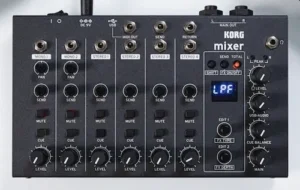 The integrated USB-C audio interface is arguably one of the NTS-4’s most useful additions. Eliminating a separate recording interface reduces both cost and setup complexity, making it easier to move between rehearsal, performance, livestreaming, and quick studio sessions without rebuilding an entire signal chain.
For many hardware musicians, stereo capture is all that’s required. Recording complete performances directly into a DAW is fast, reliable, and keeps the workflow focused on playing rather than engineering.
The trade-off becomes apparent as soon as those recordings move into commercial production.
Unlike multitrack USB mixers, the NTS-4 records only the final stereo mix. Every balance decision, effects adjustment, and level change becomes part of the printed performance. Once the recording is complete, individual instruments can no longer be rebalanced, reprocessed, or corrected independently.
That limitation affects far more than convenience. Professional productions often undergo multiple mix revisions before reaching the final master. Low-end relationships change, vocal levels evolve, stereo placement is refined, and dynamics processing is adjusted repeatedly throughout the production cycle. A stereo recording inevitably restricts those options.
This is less a design flaw than a design priority. Korg chose immediacy over production flexibility, targeting musicians who prefer committing to performance decisions rather than preserving every option for later editing.
For DAWless artists, live performers, and producers who treat hardware jams as complete musical statements, that trade-off is unlikely to be a concern. For engineers building commercial releases around extensive editing and post-production, it remains the NTS-4’s single most significant limitation.
The NTS-4 Improves the Workflow More Than the Signal Path
Many compact mixers are judged by specifications—channel count, effects, connectivity, or recording features. Those numbers matter, but they rarely determine whether a piece of hardware becomes part of a producer’s everyday workflow. The more meaningful question is whether it reduces complexity without introducing new operational compromises. That is where the NTS-4 makes its strongest case.
Small hardware studios have a tendency to grow organically. What begins as two synthesizers and a mixer often expands into multiple desktop instruments, Eurorack modules, external effects, MIDI utilities, USB interfaces, monitor controllers, and power supplies. Each addition solves one problem while creating another, gradually increasing both setup time and cable management.
The NTS-4 consolidates several of those support functions into a single device. That doesn’t make it the best mixer, audio interface, or effects processor in its respective category. Instead, it reduces the amount of infrastructure required to keep a compact hardware rig operational. For many musicians, removing three utility devices from the desktop has a greater day-to-day impact than marginal improvements in audio performance.
That distinction also explains why the NTS-4 should not be evaluated as an analog signal-enhancement tool. Its analog architecture is designed for routing and performance rather than sonic coloration. There are no transformer-balanced outputs, boutique gain stages, or discrete analog circuits intended to add harmonic character. Producers expecting improvements in depth, transient response, stereo imaging, or analog saturation are unlikely to hear a meaningful difference compared to other competent compact mixers.
The same principle applies to the onboard effects. They are designed to support live performance, not replace dedicated studio processing. Delays, reverbs, modulation effects, filters, compression, and limiting are immediately accessible during performance, but they remain convenience tools rather than high-end production processors. Once a project reaches the mixing or mastering stage, experienced engineers will almost certainly move to specialized plugins or outboard equipment offering greater precision and control.
Where the NTS-4 genuinely distinguishes itself is operational simplicity. Dedicated hardware controls eliminate the need for menu navigation, software configuration, or secondary control surfaces. Cue monitoring, mute functions, and effects remain immediately accessible regardless of the surrounding production environment. That predictability becomes particularly valuable during rehearsals and live performance, where reliability often matters more than feature depth.
There is, however, an unavoidable trade-off. Simplicity limits flexibility. Unlike digital mixers built around scene recall, programmable routing, or software integration, every adjustment on the NTS-4 remains entirely manual. Producers who rely on instant session recall or complex routing templates may find that limitation more significant than the workflow benefits the mixer provides.
Stereo USB Recording Is the NTS-4’s Biggest Compromise
Early discussions among hardware producers quickly converged on the same limitation: the NTS-4 records only a stereo mix over USB. For some musicians, that will never become an issue. For others, it fundamentally changes how the mixer fits into a professional production workflow.
Stereo capture works well when the performance is the finished product. Live sets, hardware jams, rehearsals, livestreams, and improvised sessions often benefit more from speed than from unlimited editing options. In those situations, recording the complete performance exactly as it happened is part of the creative process rather than a technical compromise.
Commercial production operates differently. A finished release typically goes through multiple rounds of editing, mixing, revision, and mastering before reaching distribution. Instrument balances evolve, effects are refined, dynamics processing changes, and low-frequency relationships are adjusted repeatedly as the mix develops.
Once the NTS-4 prints a stereo recording, those decisions become permanent. Individual instruments can no longer be rebalanced, processed independently, or corrected without recreating the original performance. That limitation becomes especially significant when working with improvised hardware arrangements, where reproducing the exact timing, automation, and interaction between multiple instruments is often unrealistic.
Consider a typical mastering revision. A limiter reveals excessive low-frequency energy that wasn’t obvious during tracking. Situations like this often develop into the kind of issues covered in our mastering problems guide, where the root cause usually originates much earlier in the production process. With a multitrack recording, the solution is straightforward: reduce the kick drum or bass synth inside the mix and deliver an updated master. With a stereo recording, the only available options are broad corrective processing or performing the entire piece again. Neither is ideal.
This is ultimately a workflow decision rather than an engineering shortcoming. Korg prioritized immediacy, portability, and performance over post-production flexibility. Producers building tracks around live hardware performance will likely accept that compromise. Engineers expecting the mixer to function as the front end of a commercial recording workflow probably will not.
Where the NTS-4 Fits in Today’s Hardware Mixer Market
The NTS-4 doesn’t compete directly with every compact mixer on the market because it isn’t trying to solve every production problem. Buyers considering this unit are usually deciding between two different philosophies: a performance-oriented mixer designed to keep hardware setups compact, or a recording-focused mixer built around multitrack production and post-processing flexibility.
That distinction makes direct specification comparisons less meaningful than they first appear. More channels, deeper routing, or multitrack recording are obvious advantages on paper, but they also introduce additional complexity that many live-oriented musicians simply don’t need.
Zoom’s LiveTrak L6 represents the recording-first approach. Its multitrack USB implementation makes considerably more sense for producers who expect every instrument to remain editable throughout the mixing process. For projects involving detailed post-production, recalls, or commercial release schedules, that flexibility outweighs the convenience of a smaller performance mixer.
The 1010music Bluebox pushes even further toward studio functionality. Its advanced routing, multitrack recording, internal storage, and digital architecture make it a far more capable production centerpiece. Those advantages come with higher cost, greater operational complexity, and a workflow that rewards careful session management over immediate performance.
Bastl’s Bestie targets a philosophy much closer to the NTS-4. Both products prioritize portability, immediacy, and hands-on performance over studio-oriented feature sets. Korg separates itself by integrating USB audio, MIDI output, onboard effects, and broader compatibility with hybrid hardware setups, creating a more complete all-in-one solution for musicians who regularly move between rehearsal, performance, and recording.
Even older products such as Roland’s MX-1 remain viable for established hardware rigs, although their aging connectivity standards and discontinued ecosystem support make them less attractive investments for new setups.
Ultimately, the choice depends less on specifications than on where the production process actually happens. If the DAW remains the center of every project, multitrack recording is difficult to ignore. If most creative decisions happen while performing on hardware, the NTS-4’s streamlined workflow becomes far more compelling than another list of recording features.
| Model | Primary Focus | Ideal User | Main Trade-Off |
|---|---|---|---|
| Korg NTS-4 | Hardware performance workflow | DAWless and hybrid electronic musicians | Stereo USB recording only |
| Zoom LiveTrak L6 | Multitrack recording | Studio-oriented producers | Larger workflow footprint |
| 1010music Bluebox | Digital production hub | Advanced hardware studios | Higher cost and complexity |
| Bastl Bestie | Portable analog mixing | Minimal live rigs | Less integrated functionality |
What the NTS-4 Means for Mixing and Mastering
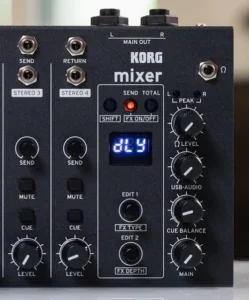 The NTS-4 is not intended for mix or mastering engineers, yet its recording architecture has a direct impact on everything that happens after a performance is captured. The decision to record a finished stereo mix shapes the entire post-production process long before the project reaches the mixing stage.
When every instrument is printed as part of a single stereo file, the mix engineer inherits a fundamentally different starting point. Individual sources can no longer be rebalanced, problematic effects cannot be removed selectively, and masking between instruments must be managed with broad stereo processing instead of precise track-level adjustments. The focus shifts from building a mix to preserving an already established performance.
The same principle extends into mastering. A mastering engineer can optimize tonal balance, dynamics, loudness, and playback translation, but mastering is not designed to reconstruct a mix. If you’re unsure where those responsibilities begin and end, our detailed guide on mixing vs mastering explains why balance problems should be solved before a project reaches the mastering stage. Excessive low-frequency energy, overloaded bus processing, or overly aggressive performance effects remain embedded in the recording and inevitably limit the available corrective options.
None of this prevents the NTS-4 from being used on commercially released material. It simply changes where production decisions are made. Musicians working with the mixer benefit from approaching each recording as a near-finished performance, paying close attention to gain staging, headroom, monitoring, and overall balance before committing the stereo mix. Much of this preparation mirrors the same principles discussed in our guide to preparing a mix for mastering, where decisions made before export have a direct impact on the final result.
For many hardware artists, that approach is a feature rather than a limitation. Committing to arrangement, levels, and performance decisions during recording often results in faster, more decisive productions with fewer revision cycles. Producers whose workflow depends on extensive editing, recalls, and iterative mix development are likely to find the NTS-4 less accommodating than multitrack recording systems.
Is the Korg NTS-4 the Right Choice for Your Studio?
The NTS-4 makes the most sense when viewed as a workflow device rather than a conventional mixer. It is not a compact recording console, nor is it intended to replace a dedicated multitrack interface. Its purpose is much narrower: simplifying the everyday operation of small hardware-based studios.
That objective shapes every aspect of the design. Stereo inputs reflect the realities of modern desktop synthesizers, integrated attenuation makes Eurorack easier to incorporate, onboard effects reduce reliance on external processors, and USB recording removes another piece of equipment from the signal chain. Individually, none of these features redefine the category. Together, they create a noticeably more streamlined production environment.
Those benefits come with clear compromises. Producers who rely on multitrack recording, extensive post-production, programmable routing, or complete session recall will reach the limits of the NTS-4 far sooner than users focused on live performance or DAWless production. Stereo-only USB recording remains the defining trade-off and the primary reason the mixer cannot replace more recording-oriented alternatives.
That trade-off is intentional. Korg has prioritized immediacy over flexibility, accepting fewer production options in exchange for a faster and more intuitive creative process. Whether that decision feels liberating or restrictive depends almost entirely on how your music is made.
The strongest aspect of the NTS-4 is not any single specification but the way its features work together. By combining mixing, monitoring, USB recording, MIDI connectivity, performance effects, and modular compatibility into a compact desktop format, it removes enough technical overhead that the hardware itself becomes less noticeable during the creative process.
In the end, the NTS-4 is unlikely to transform the sound of your productions—but it may well change how often you sit down, power up your instruments, and start making music. For many hardware musicians, that improvement is ultimately more valuable than another page of technical specifications.
Who Should Buy the Korg NTS-4?
Buy this mixer if:
- You primarily create music with hardware synthesizers, grooveboxes, or Eurorack systems.
- You value a fast, compact workflow more than extensive multitrack recording options.
- You perform live and need reliable cue monitoring, integrated effects, and immediate hands-on control.
- You want a single device that combines analog mixing, USB audio, and modular compatibility.
You may want another solution if:
- Your productions depend on multitrack USB recording.
- You regularly perform detailed mix revisions after recording.
- You require complex digital routing, scene recall, or software-controlled workflows.
- Your studio is centered entirely around DAW production rather than external hardware.
Final Verdict
The Korg NTS-4 succeeds because it focuses on removing workflow friction rather than adding another list of studio features. Rather than chasing longer feature lists or increasingly complex workflows, Korg has built a device that addresses the practical realities of modern hardware production: connecting multiple instruments, integrating modular gear, monitoring efficiently, and recording ideas with minimal setup.
Its value is measured less by audio specifications than by operational efficiency. The NTS-4 is unlikely to change the sound of a production in the way a high-end analog mixer, premium outboard processor, or dedicated mastering chain can. What it changes is the amount of time and effort required to move from a powered-off studio to a finished performance.
The stereo-only USB recording architecture remains its defining compromise. Producers who depend on multitrack editing, detailed mix revisions, and extensive post-production will be better served by recording-oriented mixers that preserve complete flexibility throughout the production process. Those limitations are real, but they stem from deliberate design priorities rather than technical shortcomings.
For musicians building DAWless systems, portable synthesizer rigs, or performance-focused hardware studios, the balance shifts considerably. In those environments, simplicity, reliability, and immediacy often contribute more to creativity than another layer of routing options or recording features.
Ultimately, the NTS-4 succeeds because it understands its audience. It is not the most powerful compact mixer available, nor the most feature-rich. It is one of the few that consistently prioritizes workflow over specification count—and for the right hardware musician, that may prove to be its most valuable feature.
Pros & Cons
Pros
- Excellent workflow for compact hardware studios
- Integrated USB audio and MIDI connectivity
- Useful onboard performance effects
- Dedicated cue monitoring and mute controls
- Eurorack-friendly input design
- Designed specifically for modern DAWless workflows
Cons
- Stereo USB recording only
- No multitrack recording capability
- Limited flexibility during post-production
- 3.5 mm connections may require adapters in some studio setups
Overall Rating
| Category | Rating |
|---|---|
| Workflow Efficiency | 9.8/10 |
| Connectivity & Integration | 9.3/10 |
| Live Performance Features | 9.4/10 |
| Studio Recording Flexibility | 8/10 |
| Build & Practical Design | 9.2/10 |
| Value for Money | 9.3/10 |
| Overall | 9.1/10 |
The Korg NTS-4 is not designed to compete with multitrack recording mixers or large studio consoles. Instead, it excels as a compact performance hub that combines analog mixing, USB recording, onboard effects, and modular-friendly connectivity into a workflow that removes technical friction from hardware-based music production. Its stereo-only USB architecture limits post-production flexibility, but for DAWless performers and hybrid hardware studios, the operational advantages easily outweigh that compromise.
Workflow Efficiency — 9.8/10. The NTS-4’s greatest strength is reducing setup complexity. Integrated routing, cue monitoring, onboard effects, USB audio, and dedicated controls allow musicians to spend less time configuring equipment and more time creating music.
Connectivity & Integration — 9.3/10. Stereo channels, USB-C audio, MIDI output, and Eurorack-compatible inputs make the mixer exceptionally versatile for modern desktop hardware studios without introducing unnecessary complexity.
Live Performance Features — 9.4/10. Cue monitoring, channel mute controls, immediate access to effects, and an intuitive hardware interface support confident live performance where speed and reliability are often more valuable than deep configuration options.
Studio Recording Flexibility — 8/10. Stereo USB recording keeps the workflow fast, but it inevitably limits mix revisions, post-production editing, and commercial production workflows that depend on isolated multitrack recordings.
Build & Practical Design — 9.2/10. The overall layout reflects a clear understanding of contemporary hardware production. Every control serves a practical purpose, while the compact desktop format remains well suited to portable electronic music setups.
Value for Money — 9.3/10. For musicians building hardware-centric studios, the combination of analog mixing, USB recording, performance effects, and modular compatibility delivers considerably more day-to-day value than purchasing several separate utility devices.
Frequently Asked Questions
Is the Korg NTS-4 suitable for professional studio recording?
Yes, but only for certain workflows. The NTS-4 works well for recording complete hardware performances and DAWless sessions. If your projects depend on multitrack editing, automation, or extensive post-production, a mixer with multitrack USB recording will offer considerably greater flexibility.
Can the NTS-4 replace an audio interface?
For stereo recording, yes. Its built-in USB-C audio interface allows direct recording into any compatible DAW without additional hardware. It is not intended to replace multichannel audio interfaces used in larger recording environments.
Does the NTS-4 improve audio quality?
Not by itself. The NTS-4 is designed to simplify signal routing and hardware integration rather than add audible analog coloration or improve fidelity. Its primary benefit is workflow efficiency, not changes in sonic character.
Can the Korg NTS-4 be used for mixing and mastering?
Not as a replacement for dedicated studio tools. The mixer can simplify hardware recording, but detailed mixing and mastering should still be carried out in a DAW or with specialized outboard equipment.
Is the NTS-4 compatible with Eurorack systems?
Yes. The dedicated mono inputs include switchable attenuation, allowing higher-voltage Eurorack signals to connect directly without requiring external attenuation modules.
How does the NTS-4 compare with the Zoom LiveTrak L6?
The NTS-4 emphasizes portability, hardware performance, and a streamlined workflow. The Zoom LiveTrak L6 focuses on multitrack USB recording and offers significantly greater flexibility for studio production and post-processing.
Is the NTS-4 good for livestreaming?
Yes. Stereo USB recording makes it well suited for livestreams, YouTube content, demonstrations, and live electronic performances where capturing the complete mix is more important than recording each instrument separately.
Is assembling the Nu:Tekt kit difficult?
No. Like other Nu:Tekt products, the NTS-4 uses a solder-free assembly process that most users can complete within a few minutes by following the included instructions.
Who should buy the Korg NTS-4?
The mixer is best suited to electronic musicians using hardware synthesizers, grooveboxes, Volcas, and Eurorack systems. Producers working primarily inside a DAW may benefit more from a multitrack recording mixer or dedicated audio interface.
Is the Korg NTS-4 a future-proof investment?
For hardware-focused musicians, it is likely to remain relevant for years. As long as compact synthesizer setups and DAWless production continue to grow, the NTS-4 addresses a practical workflow requirement that extends well beyond its individual specifications.

Yurii Ariefiev is a mastering engineer and audio production editor specializing in professional music production workflows. His equipment reviews evaluate how hardware performs beyond specifications, focusing on recording efficiency, signal management, mix preparation, and the practical impact each device has on the quality of the final master.
This review examines the Korg NTS-4 from the perspective of real-world studio use, analyzing how its routing, USB recording architecture, and performance-oriented design influence mixing decisions, mastering preparation, and modern hybrid hardware production.