Free Kontakt instruments usually fall into one of two categories: simplified demo versions with locked features or lightweight libraries that lose their appeal after a few sessions. While they’re useful for exploring a developer’s ecosystem, few become tools that professionals continue using once commercial projects start piling up.
Sonuscore Elysion Elements follows a different strategy. Instead of limiting the instrument’s architecture, Sonuscore limits the content. The free edition includes 30 curated Themes, but the underlying engine—including effects, modulation, arpeggiators, envelopes, panning, and mixer controls—remains fully accessible. That makes Elysion Elements feel less like a product demo and more like a compact cinematic instrument designed for real audio production workflows.
The more interesting question isn’t whether Elysion Elements can compete with flagship platforms like Omnisphere or Falcon—it can’t. The real question is whether it delivers enough speed, flexibility, and sonic quality to justify a permanent place in a professional composition template. That’s what this review focuses on.
Why Workflow Matters More Than Library Size in Modern Film Scoring
The market for cinematic virtual instruments has expanded well beyond traditional film scoring. Television, game audio, trailers, advertising, streaming content, and production music all demand faster turnaround times while maintaining increasingly polished production standards. For many composers, finishing cues quickly has become just as important as achieving maximum sonic realism.
That shift has changed how sample libraries are evaluated. Large preset collections still have value, but workflow often determines whether an instrument becomes part of a daily scoring template. An evolving texture that can be loaded, customized, and recorded in seconds is frequently more useful than hundreds of presets that require extensive programming before they fit a cue.
Most free cinematic instruments prioritize product exposure over long-term usability. They typically offer a small preset selection while locking essential editing features behind paid upgrades, making them difficult to integrate into professional production workflows where sounds rarely remain untouched.
Elysion Elements takes a noticeably different approach. Instead of restricting the engine, Sonuscore restricts the content. The free version includes only 30 Themes, but users retain access to effects, modulation, arpeggiators, envelopes, mixer controls, and performance parameters. For experienced producers, that’s a far more practical compromise than providing hundreds of presets with minimal editing flexibility.
The timing is significant. Hybrid scoring has become standard practice across modern media production, blending orchestral recordings with synthetic textures, evolving pads, rhythmic pulses, and cinematic transitions. Instruments that generate movement from the moment they’re loaded reduce setup time and help composers stay focused on writing rather than building complex signal chains.
That production philosophy explains why Elysion Elements stands out. It isn’t trying to compete with open-ended synthesis platforms. Instead, it addresses a more immediate problem: generating expressive, production-ready cinematic textures with minimal preparation while remaining flexible enough to adapt as the arrangement evolves.
Engine Architecture: Why Elysion Elements Prioritizes Composition Over Programming
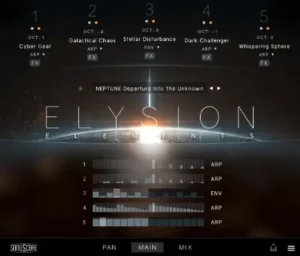 Elysion Elements is technically a Kontakt instrument, but treating it as just another sample library overlooks its actual design philosophy. Instead of presenting isolated sounds that require extensive programming, it delivers complete performance environments where rhythm, movement, dynamics, and spatial processing are already working together. The goal isn’t to build a cinematic texture from scratch—it’s to start writing before technical setup interrupts the creative process.
That approach reflects how many professional composers work today. Under commercial deadlines, the first objective isn’t designing the perfect patch; it’s establishing harmony, pacing, and dramatic direction while ideas are still developing. Sound refinement usually comes later. Elysion is clearly designed around that production reality.
At the center of the instrument are what Sonuscore calls Themes. While they function as presets from a technical standpoint, they behave more like complete scoring performances than individual sounds. Each Theme combines sampled material with built-in modulation, rhythmic movement, effects, stereo placement, and dynamic response, producing a texture that evolves as it’s played instead of remaining static.
That distinction becomes obvious when compared to a traditional synthesizer workflow. Building a cinematic patch from scratch often involves programming oscillators, envelopes, filters, modulation sources, delays, reverbs, rhythmic sequencing, and automation before a single musical idea is recorded. Elysion removes most of those preparation steps. The movement is already there, allowing composers to capture ideas immediately and refine the details later if the cue demands it.
For professionals working against production deadlines, that shift is more significant than it may appear. Creative momentum is often lost during technical preparation rather than composition itself. An instrument that eliminates repetitive setup encourages experimentation because recording an idea requires almost no commitment. If a texture doesn’t work, another can be loaded in seconds without rebuilding an entire signal chain.
The free edition includes only 30 Themes, organized into four practical categories rather than an overwhelming preset browser.
- Animated Themes focus on evolving motion and rhythmic development.
- Pads provide sustained harmonic layers for underscore, ambient scoring, and dialogue support.
- Hits are designed for transitions, impacts, and trailer-style punctuation.
- Pulses generate rhythmic movement without relying on external sequencers.
Thirty presets may sound restrictive compared to commercial libraries containing several hundred patches, but the number is somewhat misleading. Because each Theme exposes the underlying engine instead of locking users into fixed presets, the available material can be reshaped far beyond its original factory configuration. That flexibility gives the library considerably more longevity than most free cinematic instruments.
The most technically interesting aspect of Elysion isn’t the preset architecture—it’s the sampling approach itself. Rather than relying on a single synthetic sample whose playback level changes with MIDI velocity, Sonuscore recorded synthetic sources across multiple velocity layers. As a result, playing harder changes the instrument’s tonal character instead of simply making it louder.
That workflow is familiar in premium orchestral sampling, where different dynamic layers capture natural changes in articulation and harmonic content. Applying the same concept to synthetic material creates a noticeably more expressive response than conventional velocity scaling. Instead of reaching for automation to make a phrase feel more animated, much of the expression comes directly from the keyboard performance.
For composers using weighted controllers or expressive MIDI hardware, the difference is immediately noticeable. Softer passages retain a smoother tonal character, while higher velocities naturally introduce additional harmonic complexity and intensity without resorting to artificial EQ boosts or saturation. The instrument responds more like a playable instrument than a static sample playback engine.
That doesn’t make Elysion a replacement for dedicated synthesizers such as Omnisphere, Falcon, or Phase Plant. Those platforms remain vastly more flexible when the goal is building completely original sounds. Elysion solves a different problem. Rather than maximizing synthesis depth, it minimizes the time required to move from an empty project to a convincing cinematic sketch—a distinction that becomes increasingly valuable as project deadlines become shorter.
One of Elysion Elements’ strongest design decisions is what Sonuscore chose not to remove. Most free software instruments restrict the editing engine, exposing only a handful of presets while reserving modulation, effects, routing, or mixer controls for the paid version. Elysion follows the opposite strategy. The factory library is intentionally small, but the core engine remains largely intact.
That distinction has practical consequences in day-to-day production. Factory presets are rarely used unchanged in professional scoring sessions. They become starting points that are adjusted to fit orchestration, dialogue, tempo, or picture edits. By leaving envelopes, effects, arpeggiators, panning, mixer controls, and modulation available, Sonuscore allows composers to adapt a Theme to the arrangement instead of replacing it altogether.
The only significant limitation is the locked content browser. Users cannot access additional Themes beyond the included library, which means long-term variety is naturally more limited than in the commercial version. That’s a reasonable compromise. Restricting content creates a clear upgrade path without reducing the instrument to a static preset player.
The integrated effects also deserve attention because they are part of the instrument’s design rather than an afterthought. Delay, ambience, modulation, and stereo processing are built into each Theme, allowing movement and spatial depth to develop as part of the performance instead of being assembled from separate plugins later in the session.
That doesn’t mean the sounds are mix-ready. In a finished production, most patches still benefit from contextual EQ, automation, and level adjustments once orchestral libraries, percussion, vocals, or live instruments are introduced. What Elysion provides is a polished starting point that requires refinement, not corrective repair.
From a mixing perspective, that distinction matters. Instruments with exaggerated stereo enhancement or excessive low-frequency energy often create unnecessary work later in production. Elysion generally avoids both extremes. Most Themes arrive with controlled spectral balance and enough space for additional layers, making them easier to integrate into dense cinematic arrangements without extensive cleanup.
The workflow benefits extend beyond sound design. Large scoring templates can easily exceed one hundred instrument tracks, with multiple auxiliary effects, automation lanes, and routing folders. Any instrument capable of combining rhythmic motion, ambience, modulation, and harmonic texture into a single instance helps reduce session complexity before mixing even begins.
Instead of stacking separate synthesizers, sequencers, delays, modulation plugins, and stereo processors, a composer can often establish the foundation of a cue with a single Elysion instance. That results in fewer tracks to organize, fewer plugin windows to manage, and fewer automation passes during revisions—small efficiencies that become increasingly valuable across long-form projects.
The same advantage carries into collaborative workflows. Sessions built around fewer, more complete instrument layers are generally easier for mixing engineers to navigate, particularly when projects move between composers, editors, and post-production facilities. Cleaner organization rarely attracts attention on its own, but it consistently reduces friction during revisions.
Elysion Elements is not a mixing or mastering plugin, nor is it intended to replace dedicated processing tools. Its contribution is upstream. By producing balanced, expressive source material and reducing the amount of technical preparation required before writing begins, it improves the efficiency of the entire production chain—from composition and arrangement through final mix preparation.
Ultimately, the free edition succeeds because its limitations are focused on library size rather than creative capability. Thirty Themes won’t satisfy composers producing hundreds of cues each year, but retaining the complete workflow architecture makes Elysion Elements substantially more useful than many feature-restricted free instruments competing for the same audience. It feels like a professional tool with a smaller sound library, not a demo disguised as a product.
Real-World Workflow: Where Elysion Elements Delivers the Most Value
Elysion Elements isn’t trying to outperform flagship cinematic instruments in terms of sound design depth. Its strength lies elsewhere: reducing the time between opening a project and recording a usable musical idea. For composers working under deadlines, that advantage often matters more than having unlimited synthesis options.
In professional scoring, cues rarely begin as fully orchestrated productions. Most start with a harmonic framework, rhythmic motion, and an emotional direction that gradually develops into a complete arrangement. The faster those initial ideas can be captured, the less likely they are to be interrupted by technical setup.
That’s where Elysion Elements fits naturally. Instead of asking users to build movement through multiple synthesizers, effects, and automation passes, it provides complete performance textures that already contain rhythmic evolution, modulation, and spatial depth. The result isn’t less creative control—it simply shifts detailed sound design to a later stage, after the composition itself has taken shape.
For many composers, that’s a more meaningful workflow improvement than expanding a synthesis engine with additional oscillators, modulation sources, or editing pages. The instrument doesn’t reduce creative possibilities; it reduces the amount of preparation required before creativity can begin.
Faster Cue Development Without Sacrificing Flexibility
Creative slowdowns often have little to do with writing music. More often, they’re caused by technical preparation—building layered patches, configuring effects, assigning modulation, and assembling enough movement to make a cue feel alive. By the time everything is ready, the original musical idea has often evolved or disappeared altogether.
Elysion Elements reduces that overhead by combining several production stages into a single instrument. Instead of constructing a hybrid texture from multiple plugins, composers can begin with a playable sound that already contains rhythmic motion, spatial depth, and dynamic variation.
A typical scoring workflow might begin with an evolving pulse to establish momentum, followed by a pad to define harmonic space. Strings, piano, or other orchestral elements can then be layered as the arrangement develops, while percussion remains a later decision once the cue’s structure is established. The process prioritizes composition first and production detail second.
That workflow becomes particularly valuable during revision-heavy projects. When clients request alternative versions or structural changes, it’s far more efficient to reshape a musical idea than to repeatedly rebuild the same technical foundation. Saving even a few minutes at the start of every cue compounds into a meaningful productivity gain across an album, television series, or game score.
Velocity Layers That Shape Tone, Not Just Volume
One of Elysion Elements’ more sophisticated design choices is its use of multi-velocity sampling for synthetic source material. While the concept is standard in high-end orchestral libraries, it’s considerably less common in cinematic instruments built around electronic textures.
Many sampled synthesizers rely on a single recording whose output level changes with MIDI velocity. It’s an efficient approach, but one that offers limited expressive range because the sound itself remains fundamentally unchanged.
Elysion takes a different approach. Multiple velocity layers allow playing dynamics to influence harmonic content as well as loudness, producing natural tonal variation directly from performance. Lower velocities retain a smoother character, while harder playing introduces additional brightness and harmonic complexity without depending on filter automation, saturation, or auxiliary modulation.
The effect is subtle rather than dramatic, but it’s immediately apparent during expressive keyboard performances. Instead of feeling like a static patch responding to volume data, the instrument reacts more like a sampled acoustic instrument, where dynamics shape both intensity and timbre. For composers who prefer performing parts rather than drawing automation afterward, that behavior makes phrasing noticeably more convincing.
A Natural Fit for Kontakt-Based Scoring Templates
For composers already working inside the Kontakt ecosystem, Elysion Elements integrates with almost no additional overhead. Rather than introducing another standalone platform with its own browser, licensing system, and resource management, it slots directly into an environment that’s already central to most modern scoring templates.
That’s more important than it sounds. Large orchestral sessions routinely rely on dozens of Kontakt instances for strings, brass, percussion, choirs, and solo instruments. Keeping cinematic textures within the same playback engine simplifies project organization, memory management, and template maintenance, especially on large productions where consistency is critical.
Kontakt’s mature disk-streaming architecture also makes Elysion easy to incorporate into existing workflows without forcing composers to rethink how templates are built. Instead of becoming another isolated software ecosystem, it behaves like a natural extension of an established orchestral setup.
Cross-platform support further reinforces that flexibility. VST3, AU, and AAX versions ensure compatibility with the DAWs most commonly found in professional composition and post-production environments, including Cubase, Nuendo, Logic Pro, Pro Tools, Studio One, and Reaper. Whether the project moves between a composer’s writing rig and a dubbing stage, the instrument fits comfortably into standard production pipelines.
Why Mix Engineers Will Appreciate Well-Built Source Material
Elysion Elements is designed for composers, but some of its strongest qualities become apparent later in the production process. From a mixing perspective, well-designed source material is often more valuable than unlimited editing options.
Many hybrid cinematic instruments arrive with oversized stereo images, excessive sub-bass, or heavily hyped high frequencies that sound impressive in isolation but become difficult to integrate into a full arrangement. Those characteristics frequently translate into unnecessary corrective EQ, stereo management, or dynamic processing once orchestral libraries, dialogue, and percussion occupy the same mix.
Elysion generally takes a more restrained approach. The factory Themes are balanced enough to sit alongside traditional orchestral libraries without immediately dominating the frequency spectrum. Rather than relying on exaggerated brightness or cinematic low end to create impact, they leave room for additional instrumentation and contextual processing.
That doesn’t eliminate the need for EQ, compression, or automation—no virtual instrument can. What it does reduce is the amount of corrective work required before creative mixing can begin. Engineers spend less time solving avoidable spectral conflicts and more time shaping the arrangement as a whole. The same principle applies to dedicated processing tools, as discussed in our Baby Audio SubCulture review, where source quality and controlled low-frequency enhancement remain central to achieving a cleaner mix.
For collaborative productions, that translates into cleaner handoffs between composition and mix stages. Sessions built around controlled, predictable source material are easier to balance, easier to revise, and generally faster to move through the remainder of the production pipeline.
Mastering Perspective: Source Quality Still Matters
Elysion Elements has no direct role in the mastering stage. It isn’t designed to shape a mix, increase loudness, or solve tonal or dynamic problems once production is complete. Those responsibilities remain with the mix and mastering engineers.
Its influence is indirect, but still worth considering. Virtual instruments with controlled harmonic content, stable stereo imaging, and predictable transient behavior generally integrate into a mix more cleanly, making the final master easier to optimize for loudness, codec conversion, and streaming delivery.
Elysion’s factory Themes are programmed with enough restraint that they rarely create avoidable problems downstream. Stereo width is generally controlled, spectral balance remains usable, and transient information is preserved without relying on excessive enhancement or aggressive processing. That gives mix engineers a solid starting point instead of material that immediately demands corrective EQ or stereo repair.
Of course, no virtual instrument determines the quality of a master on its own. Arrangement, mix balance, gain staging, and proper mix preparation have a far greater influence on the final result than the choice of virtual instrument. If you’re unsure what actually matters before mastering, our guide to preparing a mix for mastering explains the process in detail. Even so, well-designed source material reduces cumulative processing throughout the production chain and helps preserve headroom for creative decisions rather than corrective ones.
Looking Beyond the Marketing: What Actually Matters
Software instrument marketing often revolves around subjective promises—more inspiration, greater creativity, or cinematic sound at the click of a button. Those claims may be effective advertising, but they reveal very little about how an instrument performs in a professional production environment. A more useful evaluation focuses on workflow, engineering decisions, and whether the product solves real problems inside a scoring session.
To Sonuscore’s credit, the company avoids many of the exaggerated claims common in this segment. The emphasis is placed on the instrument’s workflow rather than unrealistic promises of instant professional results. Even so, the features worth paying attention to are not necessarily the ones highlighted in promotional material.
The Features That Make a Practical Difference
The most significant engineering decision isn’t the collection of factory Themes—it’s the way the instrument responds to performance. Multi-velocity sampling gives playing dynamics a direct influence on timbre instead of treating MIDI velocity as little more than a volume control. While the technology itself isn’t new, applying it to hybrid cinematic textures makes the instrument noticeably more expressive than many competing libraries built around static synthetic samples.
Equally important is Sonuscore’s decision to leave the editing architecture largely intact. Many free instruments deliberately restrict modulation, effects, routing, or mixer controls to create a stronger incentive for upgrading. Elysion takes a more balanced approach by limiting the content library while preserving the tools needed to reshape what is included.
From a production standpoint, that’s a more sustainable strategy. Factory presets inevitably become starting points rather than finished sounds, particularly in commercial scoring work. An instrument with fewer editable patches is often more valuable over time than a much larger library that locks users into fixed programming with little room for adaptation.
Where the Innovation Ends
Elysion Elements introduces a refined workflow, not a new synthesis paradigm. Its engine combines proven Kontakt scripting with multi-layer sampling, sequencing, modulation, and integrated effects—technologies that have been part of professional virtual instruments for years.
That’s not a criticism. Innovation in software instruments doesn’t always come from inventing new DSP algorithms or synthesis methods. More often, it comes from reducing friction between an idea and a finished musical sketch. Elysion succeeds by improving workflow rather than attempting to redefine sound generation itself.
Composers looking for unrestricted oscillator design, modular routing, wavetable manipulation, granular synthesis, or experimental sound creation will still find considerably greater flexibility in platforms such as Omnisphere, Falcon, or Phase Plant. Those instruments are built for deep programming. Elysion is built for rapid composition.
That distinction is important because the two categories solve different production problems. Comparing Elysion directly with open-ended synthesis environments misses the point of its design. Its value lies in accelerating cue development, not replacing dedicated sound design platforms.
The Biggest Limitation Is Content, Not Capability
The free edition ships with just thirty Themes, and that eventually becomes its primary constraint. While the editing engine provides enough flexibility to reshape individual patches, the underlying source library is still relatively small by professional scoring standards.
For occasional soundtrack work or independent projects, the limitation is unlikely to become restrictive. For composers delivering large production music catalogs, episodic television scores, or long-form game soundtracks, familiar textures will inevitably begin to reappear across multiple cues.
That’s precisely where the commercial version offers the greatest advantage. The upgrade expands the available sound library rather than fundamentally changing the instrument’s architecture or workflow. In other words, users aren’t paying for a more capable engine—they’re paying for greater sonic variety.
Whether that investment makes sense depends less on audio quality than on output volume. Composers producing dozens or hundreds of cues each year will naturally benefit from a broader palette, while many users may find the free edition sufficient for occasional scoring work and creative sketching.
Can Elysion Elements Hold Its Own in Professional Productions?
Whether Elysion Elements qualifies as a professional instrument depends entirely on the expectations placed upon it. If the benchmark is unlimited synthesis, modular routing, or deep sound design, it isn’t competing in that category. More specialized platforms remain the better choice for building original instruments from the ground up.
Professional work, however, is rarely defined by maximum flexibility alone. In commercial scoring, reliability, speed, and consistency often matter just as much as technical depth. An instrument that produces convincing results in minutes can be more valuable than one offering limitless programming options that require significantly more preparation before recording begins.
Elysion Elements is designed around that production philosophy. Its strength isn’t replacing a comprehensive synthesizer; it’s providing expressive hybrid textures that are immediately playable while leaving enough editing access to adapt them to a specific cue. That balance makes it well suited to television, trailer, advertising, documentary, and game scoring workflows where deadlines routinely outweigh the need for experimental sound design.
Viewed through that lens, the free edition feels less like a limited demonstration and more like a focused production tool. It doesn’t try to become the centerpiece of an entire virtual studio. Instead, it fills a specific role—accelerating cinematic composition while preserving enough flexibility to remain useful long after the first impression wears off.
Is Elysion Elements Worth Downloading?
For most composers, the answer is yes. Elysion Elements offers considerably more than a typical free Kontakt instrument because Sonuscore chose to limit the content rather than the workflow itself. The included Themes are professionally produced, the editing engine remains largely intact, and the instrument integrates naturally into modern scoring templates without requiring the full version of Kontakt.
It isn’t intended to replace flagship synthesis environments or massive orchestral collections. Instead, it serves as a fast composition tool that allows ideas to develop before technical programming interrupts the creative process. For film composers, trailer producers, game audio professionals, and anyone building cinematic music inside Kontakt Player, Elysion Elements is one of the strongest free downloads currently available.
Who Should Download Elysion Elements?
| User | Recommendation |
|---|---|
| Film composers | ★★★★★ |
| Trailer composers | ★★★★★ |
| Game audio composers | ★★★★★ |
| Production music composers | ★★★★★ |
| TV and documentary scoring | ★★★★★ |
| Ambient music producers | ★★★★☆ |
| Students learning Kontakt | ★★★★★ |
| Kontakt Player users | ★★★★★ |
| EDM sound designers | ★★☆☆☆ |
| Experimental synthesis | ★☆☆☆☆ |
Elysion Elements is clearly designed for composers who value speed, playable cinematic textures, and efficient scoring workflows. Producers focused primarily on deep synthesis or electronic sound design will generally benefit more from dedicated synthesizer platforms.
How Elysion Elements Stacks Up Against Today’s Cinematic Instruments
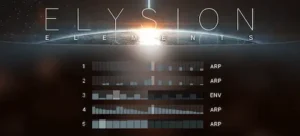 The market for cinematic virtual instruments has become increasingly specialized. Rather than competing on raw feature counts, developers now differentiate themselves through workflow, creative philosophy, and the type of composer they serve. As a result, comparing products purely by specifications often produces misleading conclusions.
Elysion Elements occupies a distinct position within that landscape. It isn’t designed to compete with open-ended synthesis environments, nor does it attempt to replace comprehensive orchestral collections. Its purpose is far more focused: generating convincing hybrid textures quickly enough that composition remains the priority instead of sound programming.
That places it in a different category from instruments such as Omnisphere or Falcon, whose primary strengths lie in building original sounds from scratch. Likewise, it differs from libraries such as Heavyocity’s cinematic collections, which emphasize large-scale layered production, and from Playbox, which explores generative composition through algorithmic phrase creation. Although all of these products can contribute to modern film scoring, they solve different creative problems.
Viewed through that lens, the decision is less about choosing the “best” cinematic instrument and more about selecting the workflow that matches the project. Composers who enjoy designing every sound may gravitate toward synthesis-heavy platforms, while those working under aggressive deadlines are likely to value an instrument that delivers production-ready ideas with minimal setup.
Workflow Comparison
| Instrument | Primary Strength | Learning Curve | Composition Speed | Sound Design Flexibility | Best Suited For |
|---|---|---|---|---|---|
| Sonuscore Elysion Elements | Fast hybrid scoring workflow | Low | Excellent | Moderate | Film cues, production music, rapid sketching |
| Spectrasonics Omnisphere | Deep synthesis and vast sound library | High | Moderate | Excellent | Custom sound design and advanced composition |
| UVI Falcon | Modular synthesis architecture | Very High | Moderate | Exceptional | Experienced programmers and sound designers |
| Native Instruments Playbox | Generative phrase creation | Low | Very High | Limited | Songwriting, sketching, creative exploration |
| Heavyocity Cinematic Series | Layered cinematic orchestration | Medium | High | Moderate | Film, television, and trailer production |
Where Elysion Elements Excels
Elysion Elements fills a space that many cinematic instruments overlook. It offers substantially more creative control than a conventional preset player while avoiding the complexity of fully modular synthesis environments. That balance makes it particularly effective for composers who value speed without feeling constrained by fixed factory programming.
Its strongest advantage is workflow efficiency. Themes load quickly, require minimal preparation, and already contain the movement, ambience, and rhythmic detail needed to establish a convincing cinematic foundation. Because the editing engine remains largely available in the free edition, those starting points can be adapted to individual projects instead of functioning as one-time presets.
Accessibility is another practical advantage. Running inside the free Kontakt Player removes one of the biggest barriers to entry, allowing composers to integrate the instrument into professional templates without investing in the full version of Kontakt. For freelancers, students, and independent media composers, that significantly improves its overall value.
Where Other Instruments Still Lead
Elysion’s focused design inevitably comes with trade-offs. Its engine is optimized for cinematic composition rather than unrestricted sound creation, so users looking to design entirely original instruments will reach its limits relatively quickly.
Platforms such as Spectrasonics Omnisphere and UVI Falcon remain in a different class when it comes to synthesis depth, modulation architecture, and signal routing. Likewise, modern synthesizers such as Phase Plant—or more traditional analog-inspired instruments like Safari Audio PolyRex—offer significantly greater programming flexibility than Elysion’s streamlined cinematic workflow.
That doesn’t make Elysion a weaker instrument—it makes it a more specialized one. It complements comprehensive synthesis platforms by accelerating the early stages of composition instead of attempting to replace them.
Who Will Benefit Most—and Who Probably Won’t
Elysion Elements is best suited to composers working in film, television, trailers, documentaries, advertising, and hybrid orchestral production, where quickly establishing mood and momentum is often more valuable than designing every sound from first principles. Once the score is complete, the challenges shift toward translation and delivery, which we cover separately in our guide to film score mastering.
Producers focused on EDM, pop, hip-hop, or experimental electronic music are likely to gain more from dedicated synthesizers with broader sound design capabilities. While Elysion can certainly contribute pads, textures, and transitional elements in those genres, its cinematic workflow is unlikely to become the centerpiece of a modern electronic production setup.
Ultimately, the choice depends less on genre than on production priorities. If the goal is creating original synthesis patches, there are stronger options available. If the goal is moving from an empty timeline to a convincing cinematic sketch as efficiently as possible, Elysion Elements makes a compelling case for itself.
Elysion Elements vs the Full Version of Elysion
| Feature | Elysion Elements | Full Elysion |
|---|---|---|
| Themes | 30 | Hundreds |
| Editing Engine | Nearly complete | Complete |
| Kontakt Player | Yes | Yes |
| Workflow | Excellent | Excellent |
| Best For | Learning and sketching | Professional daily production |
The biggest difference is content rather than functionality. Sonuscore intentionally preserves most of the editing workflow in Elysion Elements while limiting the available Themes, allowing users to evaluate the production experience before investing in the complete library.
Performance in Real-World Production and Mix Environments
A virtual instrument shouldn’t be judged by how impressive it sounds in a solo demonstration. The more meaningful question is how well it integrates into a complete production—alongside orchestral libraries, dialogue, percussion, vocals, and the countless processing stages that follow composition.
For film and media composers, that means evaluating more than presets. Source material has to remain balanced through arrangement, mixing, mastering, data-compressed distribution formats, and playback on everything from studio monitors to consumer headphones and television speakers.
Mix Integration
Elysion Elements generally arrives with well-controlled spectral balance. Rather than emphasizing oversized low end or artificially boosted top-end detail, most Themes occupy a defined space within the mix, making them easier to layer with orchestral sections and acoustic instruments.
That approach becomes particularly valuable in dense scoring sessions where dozens of tracks compete for headroom and frequency space. Instead of requiring extensive corrective EQ before other instruments can be introduced, Elysion typically leaves enough room for additional layers to develop naturally.
Several Themes also avoid excessive energy in the critical midrange, making them practical choices for productions where dialogue or narration must remain intelligible. While every arrangement still requires context-specific balancing, the factory programming generally starts from a sensible tonal foundation.
Stereo Imaging and Spatial Stability
Elysion favors width without depending on exaggerated stereo enhancement. Many cinematic instruments create an immediate sense of scale through aggressive widening algorithms, but those techniques can introduce phase inconsistencies that become apparent during mono playback or broadcast delivery.
In contrast, Elysion’s spatial presentation remains comparatively restrained. The stereo field feels expansive without becoming unstable, allowing textures to retain their character across headphones, nearfield monitors, soundbars, and mono-compatible playback systems. While individual projects should always be checked for phase coherence, the factory Themes generally provide a reliable starting point.
Behavior on Streaming Platforms
Streaming platforms no longer reward excessive loudness, making clean source material more important than aggressive peak levels. Although loudness normalization applies to the finished mix rather than individual virtual instruments, balanced source sounds tend to survive downstream processing with fewer unwanted side effects.
Elysion’s textures generally respond well to the dynamics processing and perceptual codecs used by services such as Spotify, Apple Music, YouTube, and TIDAL. Sustained pads and evolving layers retain their spatial character without drawing attention to compression artifacts, provided the overall mix is engineered appropriately.
That isn’t a unique capability, nor does it eliminate the importance of careful mixing and mastering. Final streaming performance depends on the completed production rather than the virtual instrument itself, a topic we explore in our guide to mastering for streaming platforms. Elysion simply avoids introducing unnecessary technical problems before the production process has even begun.
From a Mastering Engineer’s Perspective
Mastering engineers don’t evaluate virtual instruments in isolation—they evaluate the finished mix. By the time a project reaches mastering, the cumulative effect of arrangement, sound selection, processing, and mix decisions matters far more than the individual tools used during composition.
Even so, the quality of the original source material still influences the outcome. Instruments with controlled harmonic content, predictable transient behavior, and balanced spectral energy are generally easier to integrate into transparent mastering chains because they require less corrective processing before final loudness optimization.
Elysion Elements tends to follow that philosophy. Its factory Themes avoid the exaggerated low end, overly hyped high frequencies, and excessive stereo enhancement that can complicate downstream processing. As a result, mixes built around its textures typically preserve more headroom for creative mastering decisions instead of spending it on technical repairs.
That shouldn’t be overstated. No virtual instrument determines the quality of a master. Arrangement, gain staging, mix balance, dynamics, and engineering decisions throughout the production process remain far more influential than the choice of any individual library or synthesizer.
Efficiency Inside Modern Scoring Templates
One of Elysion Elements’ less obvious strengths is how easily it fits into established scoring workflows. Because it runs inside Kontakt Player, it integrates naturally with templates that already rely on Kontakt for orchestral sampling, avoiding the additional complexity of another standalone playback ecosystem.
Resource usage is also reasonable by contemporary standards. While overall performance naturally depends on the host system and project size, Elysion is unlikely to become a bottleneck in sessions where substantially larger orchestral libraries are already running. That makes it a practical choice for both desktop workstations and mobile composing rigs.
The larger productivity gain, however, comes from project organization rather than CPU efficiency. A single Theme often combines rhythmic movement, ambience, modulation, and harmonic texture that would otherwise require multiple instruments and processing chains. Fewer tracks, fewer plugin instances, and fewer routing decisions translate into sessions that are easier to navigate, revise, and hand off to collaborators.
As projects grow in scale, those workflow improvements become increasingly valuable. Cleaner templates simplify automation, reduce visual clutter, and make it easier for composers, mix engineers, and post-production teams to work from the same session without unnecessary complexity.
Overall Rating: Is Elysion Elements Worth It?
| Category | Rating |
|---|---|
| Sound Quality | 9.3/10 |
| Workflow | 9.8/10 |
| Mix Translation | 9.2/10 |
| CPU Efficiency | 9.4/10 |
| Sound Design Flexibility | 7.8/10 |
| Value for Money | 10/10 |
| Overall | 9.3/10 |
Rather than competing with flagship synthesis platforms, Sonuscore Elysion Elements focuses on something equally valuable: helping composers move from an empty project to a convincing cinematic sketch with exceptional speed. Its combination of high-quality source material, efficient Kontakt workflow, and unrestricted editing architecture makes it one of the strongest free cinematic instruments currently available.
Why These Scores?
Sound Quality — 9.3/10
The factory Themes are polished, expressive, and well balanced, with convincing spatial depth and dynamic response. While the library is intentionally compact, the overall production quality is comparable to many commercial cinematic instruments.
Workflow — 9.8/10
This is where Elysion Elements clearly excels. Nearly every design decision reduces the time between inspiration and recording, allowing composers to build usable cinematic ideas with minimal technical preparation.
Mix Translation — 9.2/10
From a mastering engineer’s perspective, the source material integrates cleanly into dense arrangements. Most Themes avoid exaggerated low-end buildup, harsh upper frequencies, and unstable stereo imaging, reducing the amount of corrective processing required later.
CPU Efficiency — 9.4/10
Performance remains efficient for a modern Kontakt Player instrument. Even within larger orchestral templates, multiple instances are unlikely to become a practical limitation on contemporary production systems.
Sound Design Flexibility — 7.8/10
The included editing tools offer meaningful control, but the library is intentionally built around curated cinematic workflows rather than unrestricted synthesis. Users seeking deep oscillator programming or modular routing will still prefer dedicated synthesizers.
Value for Money — 10/10
Considering that the instrument runs in the free Kontakt Player while preserving almost the entire workflow architecture, Elysion Elements offers exceptional value. Very few free cinematic instruments provide this level of editing freedom and production quality.
Overall — 9.3/10
Elysion Elements succeeds by focusing on practical composition rather than feature count. It isn’t designed to replace flagship synthesizers, but within its intended role it delivers an outstanding balance of sound quality, workflow efficiency, and professional usability that easily earns a place in modern scoring templates.
Pros & Cons
Pros
- Runs in the free Kontakt Player
- Full editing engine remains available
- Excellent workflow for rapid composition
- Balanced factory Themes that mix well
- Expressive multi-velocity sampling
- Very efficient for scoring templates
Cons
- Only 30 factory Themes
- Limited long-term sound variety
- Not intended for deep synthesis
- No access to the complete commercial library
Verdict
Elysion Elements doesn’t try to be an all-purpose synthesizer, and that’s precisely why it works. Instead of chasing unlimited sound design possibilities, Sonuscore has built an instrument that removes friction from the earliest stages of composition while preserving enough editing flexibility to remain useful in professional projects.
The free edition is defined more by what it retains than by what it omits. Rather than disabling the core engine, Sonuscore limits the content library while keeping the workflow intact. That approach makes Elysion Elements feel like a genuinely capable production tool instead of a feature-restricted demonstration designed solely to promote the commercial version.
Thirty Themes won’t satisfy composers producing large television schedules, extensive production music catalogs, or long-form game scores. Over time, the available source material inevitably becomes familiar. Even so, the editable architecture extends the practical lifespan of the library far beyond what its modest size initially suggests.
For composers working in film, television, trailers, documentaries, ambient music, and hybrid orchestral production, Elysion Elements delivers exactly what it promises: fast access to polished cinematic textures without sacrificing meaningful creative control. Those looking for unrestricted synthesis, modular routing, or experimental sound design will still be better served by dedicated synthesis platforms.
Within its intended role, however, Elysion Elements stands out as one of the most thoughtfully designed free cinematic instruments available today. It proves that a streamlined workflow, disciplined engineering, and a focused feature set can often deliver greater real-world value than a much larger instrument built around unlimited possibilities.
Installation and System Requirements
Elysion Elements runs inside the free Native Instruments Kontakt Player and supports VST3, AU, and AAX plugin formats on both macOS and Windows. Installation is handled through Native Access, making it consistent with other Kontakt libraries and easy to integrate into existing production systems.
Actual performance depends on the size of the scoring template, available RAM, storage speed, and CPU resources. In most modern production environments, Elysion Elements remains efficient enough to run alongside large orchestral templates without becoming a significant performance bottleneck.
Frequently Asked Questions
Does Elysion Elements require the full version of Kontakt?
No. Elysion Elements runs in the free Kontakt Player, so there’s no need to purchase the full version of Kontakt to use it.
Is Elysion Elements suitable for professional scoring work?
Yes. Although the free edition includes a limited number of Themes, the underlying engine remains fully capable of producing polished, production-ready textures for film, television, documentaries, advertising, trailers, and production music.
Can Elysion Elements replace Omnisphere or Falcon?
No. Those platforms are designed for deep synthesis and extensive sound design. Elysion serves a different purpose by prioritizing fast composition and playable cinematic textures over unlimited programming flexibility.
How demanding is Elysion Elements on system resources?
Resource usage is comparable to other modern Kontakt Player instruments. Actual CPU and memory consumption will vary depending on project size, polyphony, effects, and the rest of the scoring template.
Is the free version heavily restricted?
Not in terms of workflow. The primary limitation is the size of the included library rather than the editing architecture. Modulation, effects, mixer controls, and performance parameters remain largely available, allowing meaningful customization.
Does Elysion Elements offer any advantages during mixing?
Indirectly, yes. Its factory programming generally avoids exaggerated spectral balance and excessive stereo processing, making the source material easier to integrate into dense mixes. Final results, however, still depend on the arrangement and mix itself.
When is upgrading to the commercial version worthwhile?
The upgrade becomes more attractive as project volume increases. Composers producing large libraries of cues will benefit from the expanded content, while occasional users may find the free edition more than sufficient.
Which DAWs are supported?
Because Elysion Elements runs through Kontakt Player, it works with any DAW that supports Kontakt’s VST3, AU, or AAX formats, including Cubase, Nuendo, Logic Pro, Pro Tools, Studio One, Reaper, and other modern production environments.
Is Elysion Elements limited to cinematic music?
No. While it’s clearly optimized for cinematic scoring, its evolving pads, hybrid textures, and atmospheric layers also work well in ambient music, post-rock, game audio, multimedia production, and selected electronic genres. It’s less suited to producers whose primary focus is EDM, hip-hop, or mainstream pop sound design.
Is Elysion Elements really free?
Yes. Sonuscore Elysion Elements is available as a free Kontakt Player instrument. The free version limits the available Themes rather than restricting the editing engine, allowing users to evaluate the workflow before upgrading.
Best Alternatives to Elysion Elements
| Instrument | Best For |
|---|---|
| Spectrasonics Omnisphere | Deep synthesis and cinematic sound design |
| UVI Falcon | Advanced modular programming |
| Heavyocity cinematic libraries | Large-scale hybrid orchestral production |
| Native Instruments Playbox | Fast generative composition |
| Safari Audio PolyRex | Analog-inspired cinematic synthesis |
| Phase Plant | Unlimited sound design flexibility |
The right alternative depends less on sound quality than on workflow. Elysion Elements prioritizes rapid cinematic composition, whereas Omnisphere, Falcon, and Phase Plant focus on unrestricted sound creation. Heavyocity libraries emphasize large hybrid orchestral productions, while Playbox offers an entirely different generative songwriting approach.

Yurii Ariefiev reviews virtual instruments from the perspective of complete music production rather than isolated feature lists. His evaluations focus on workflow efficiency, Kontakt-based composition, mix translation, and how cinematic tools perform inside professional scoring and post-production environments.
This review analyzes Sonuscore Elysion Elements as a practical composition instrument, examining its sampling architecture, editing workflow, real-world usability, and how well its source material supports modern mixing, mastering, and streaming-ready music production.