
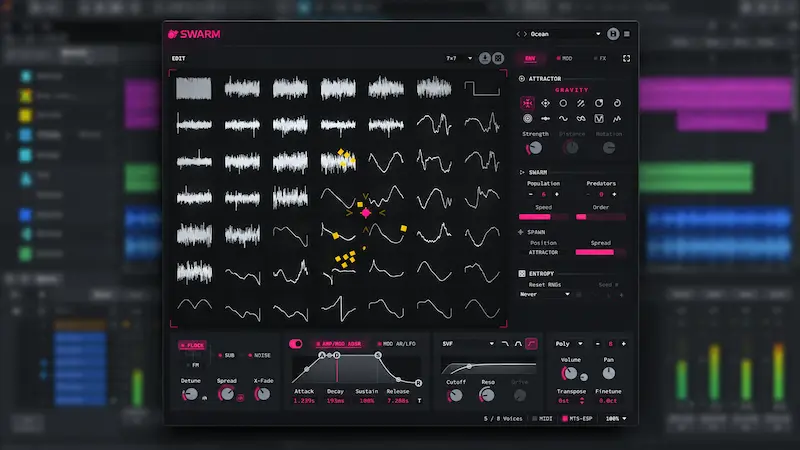
Morpheral Machines has released The Swarm, a polyphonic wavetable synthesizer that uses groups of moving oscillators, called boids, to scan a two-dimensional grid of single-cycle waveforms. Each boid plays the waveform at its current position, making its movement part of the sound-generation process. Released on November 5, 2026, The Swarm is the developer’s debut synthesizer and launched alongside Desense, a separate free effect.
Flocking-Based Wavetable Synthesis
The Swarm uses a flocking engine to control how groups of oscillators move through its wavetable grid. Each voice can contain up to 24 boids, whose movement is shaped by neighboring boids, attractors, and predators. As they move across the grid, the oscillators play different waveforms, producing continuously changing sonic patterns.
The synthesizer provides up to 12 attractors and nine predators. Attractors draw boids toward specific positions, while predators push them away. The flocking behavior is shared across voices, allowing notes in a chord to follow related movement patterns without necessarily moving in exactly the same way.
Wavetable grids can range from 3×3 to 13×13 cells. Users can import WAV, FLAC, and WT files, edit waveforms manually, or generate grids from audio samples. The sample analysis process extracts distinctive waveform cycles and arranges them according to their similarity.
Modulation, Filters, and Effects
The Swarm’s modulation matrix provides 32 routing slots per voice, with 17 sources and 28 targets. Sources include flock alignment, separation, distance, and position, allowing the movement of each voice’s boids to modulate parameters such as filter cutoff, oscillator pitch, and delay settings. Each voice has its own modulation matrix, so different notes can have independent modulation behavior.
The sound-shaping section includes frequency modulation with four modes (Sine, Half-Sine, Square, and Feedback), a sub-oscillator, and a noise generator. Five filter models are available: SVF, K35, OTA, MGT, and MGD. The signal chain also includes a waveshaper with several processing modes and a tap-cloud delay with eight taps per voice.
The Swarm uses seeded pseudo-randomness to make certain aspects of its behavior repeatable. Users can choose when the random generators reset, including on the first note, every note, or in sync with the host transport. With the same seed and note sequence, the corresponding randomized behavior can be reproduced. The synthesizer also supports MPE, CLAP and VST3 note expressions, and MTS-ESP microtuning.
Compatibility and Pricing
The Swarm is available in VST3 and CLAP formats for Windows, macOS, and Linux, with AUv2 support on macOS. The 64-bit plugin runs natively on Apple Silicon and requires Windows 10 or 11, macOS 11 or later, or Linux with glibc 2.35 or later.
The regular price is $79 or €79. Through November 30, 2026, the introductory price is $59 or €59. Each license covers up to three computers, and activation is available online or offline. The unregistered demo includes the full feature set but introduces brief interference bursts and pitch drift approximately once per minute.
Product specifications and purchase information are available from Morpheral Machines.
Desense: A Free Interference Instrument
Morpheral Machines has also released Desense, a free instrument that recreates interference sounds such as cellphone transmission bursts, electrical hum, modem tones, and radio whistles. It offers four modes—GSM, Mains, Data, and Radio—each producing a different type of interference. A sidechain input lets users process external audio, including vocals, drum loops, and pads, through these effects.
Desense is available in VST3 and CLAP formats for Windows, macOS, and Linux, with AUv2 support on macOS. It is free to download and does not require an account.
While Desense focuses on playable interference effects, The Swarm takes a different approach to sound design, using moving oscillator groups and a two-dimensional wavetable grid as the basis for its synthesis engine.
