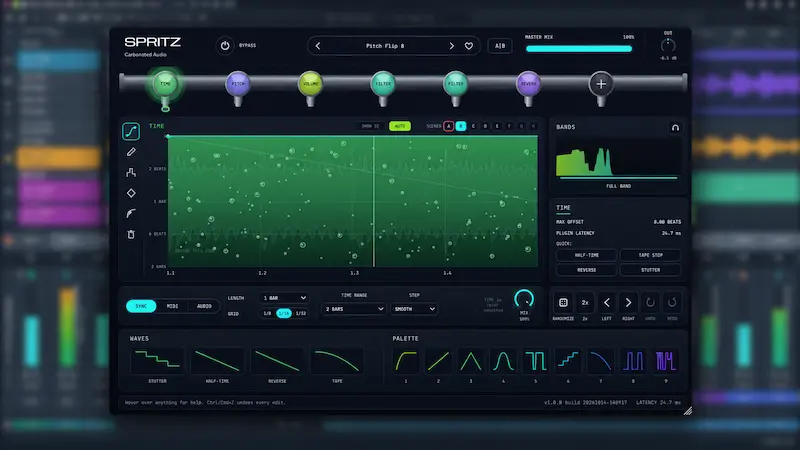
Carbonated Audio has released SPRITZ, a curve-driven multi-effect plugin for beat manipulation and rhythmic sound design. Its effects rack features 11 modules, with up to eight available in a single chain. Users draw custom curves to control how each module processes audio over time, creating rhythmic variations from loops and samples.
Each module follows its own curve, which can be synchronized to the project tempo. This allows producers to create effects such as tape stops, stutters, reverse playback and rhythmic volume dips, as well as more complex processing patterns by combining multiple modules.
11 Effects in a Modular Processing Rack
SPRITZ includes 11 processing modules: Time, Volume, Filter, Drive, Pitch, Reverb, Pan, Width, Crush, Liquid and Noise. Users can combine up to eight modules in a single signal chain, building custom processing chains without loading multiple plugins.
Each module serves a different sound-design purpose. Time can create tape stops, stutters and playback-speed changes, while Volume uses drawn level curves for rhythmic gating and sidechain-like pumping. Filter, Pitch and Reverb offer further ways to shape movement and transitions. Pan and Width add stereo modulation, while Crush, Liquid and Noise provide additional texture.
Every module can be controlled with an editable curve, allowing its effect to evolve in sync with the music. SPRITZ also includes 143 curve shapes and 912 factory presets, giving users a range of starting points for different effects and production styles.
Multiband Processing, Scenes and Trigger Modes
SPRITZ also supports multiband processing. Each module can be split into up to four frequency bands, with a separate control curve for each band. This allows users to apply different rhythmic effects across the frequency spectrum instead of processing the entire signal in the same way.
The plugin includes eight scenes, labeled A through H, each capable of storing a different set of curve configurations. Users can switch between scenes manually, via MIDI or automatically, making it possible to move between processing patterns without rebuilding the effect chain.
SPRITZ offers several ways to control playback and modulation. Curves can follow the host tempo, respond to MIDI triggers or be activated by incoming audio. Each module also features an envelope follower, allowing its processing to respond to the dynamics of the input signal.
Compatibility and Technical Details
SPRITZ supports macOS 11 and later on both Apple Silicon and Intel Macs, as well as 64-bit Windows 10 and 11. On macOS, the plugin is available in VST3, AU and AAX formats. The Windows version is available in VST3 format only.
Carbonated Audio lists compatibility with several major DAWs, including Pro Tools, Logic Pro, Ableton Live, FL Studio, Studio One, Cubase and Reaper. Windows users should be aware that SPRITZ does not support AAX, making it incompatible with the Windows version of Pro Tools.
According to the official documentation, SPRITZ introduces 22 ms of latency plus 128 samples, which amounts to approximately 24.7 ms at a 48 kHz sample rate. Certain configurations involving Audio triggering and the Pitch module can introduce additional latency. SPRITZ reports its latency to the host DAW to support delay compensation.
Price and Availability
Carbonated Audio SPRITZ is available for a one-time payment of $49. The purchase includes a license for up to three machines and lifetime updates. No iLok account or hardware dongle is required.
A free demo is available for macOS and Windows. It includes the full feature set, but playback is interrupted by a 10-second mute period after every 60 seconds. Carbonated Audio also provides a user manual covering the plugin’s controls and operation.
With curve-based modulation, multiband processing and scene switching, SPRITZ gives producers and sound designers a flexible tool for reshaping loops and creating rhythmic variations. Its feature set is particularly relevant to electronic music production, beat-making and creative sound design.