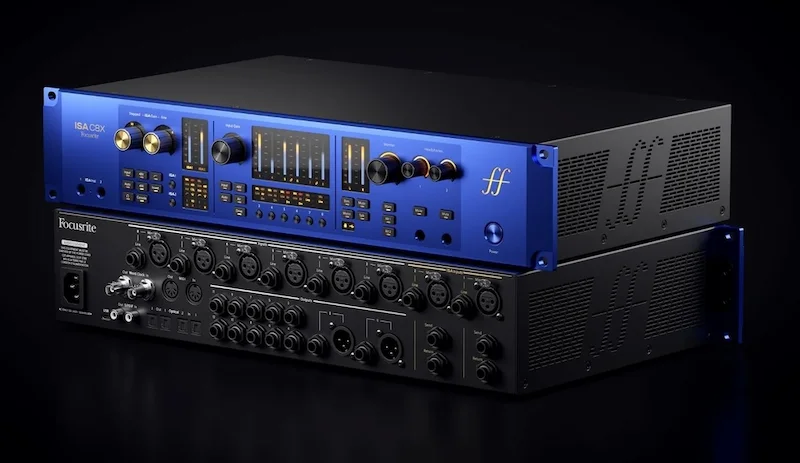
Focusrite ISA C8X audio interface puts ISA into a USB box — but only gives you two real channels
Focusrite ISA C8X audio interface has been announced — and on paper, it looks like a major shift: ISA preamps inside a modern USB interface. In reality, it’s something more calculated. Focusrite isn’t recreating ISA in an interface. It’s rationing it.
Out of eight onboard preamps, only two are true transformer-based ISA channels. The rest? Clean, controlled, modern preamps designed for workflow — not character.
Quick specs (what actually matters)
- 26-in / 28-out USB-C interface
- 2 ISA preamps (Lundahl LL1538 transformers)
- 6 clean Focusrite preamps
- Console mode (soft clipping, low-end weight)
- 430 Air mode (inductor-based high shelf)
- Auto Gain across all 8 channels
- 24-bit / 192 kHz, up to 125 dB dynamic range
- Immersive monitoring up to 7.1.4
This is not a spec sheet problem. It’s a positioning decision.
Why Focusrite did this — and why now
The interface market has split cleanly:
- RME owns stability and routing
- Universal Audio owns DSP ecosystems
- Antelope pushes channel count and hybrid processing
Focusrite didn’t try to beat any of them directly. Instead, the Focusrite ISA C8X audio interface creates a middle lane:
“just enough analog to matter, not enough to complicate.”
That’s the entire strategy.
What you’re actually getting from “ISA”
Let’s strip the branding down to signal path reality.
Two channels:
- Lundahl LL1538 transformer
- up to 79 dB gain
- impedance switching, inserts, HPF
Six channels:
- low-noise, transformerless
- up to 69 dB gain
- designed for consistency, not tone
So the workflow becomes obvious:
- ISA → lead sources (vocals, DI instruments)
- standard pres → everything else
This is not an “ISA interface.” It’s an interface with two ISA inputs.
Console and 430 Air — useful, but controlled
Focusrite added two analog circuits to extend tonal options:
- Console — soft clipping with low-end emphasis
- 430 Air — high-frequency lift via inductor-based shelf
These are not replacements for analog chains. They’re decision accelerators.
In tracking, they let you commit faster. In mixing, they behave closer to a light plugin layer than a full analog stage.
They shape tone, but they don’t define it.
Where it actually works in production
The Focusrite ISA C8X audio interface makes the most sense in hybrid workflows where speed beats perfection.
- Vocal tracking — ISA channels add density without over-coloring
- Drum sessions — 8 inputs, fast gain staging via Auto Gain
- Podcast / broadcast — consistent levels with minimal setup
- Multi-room setups — immersive monitoring up to 7.1.4
In mixing and mastering contexts:
- Console mode can introduce subtle harmonic rounding
- 430 Air can replace quick top-end EQ moves
But no one is replacing dedicated mastering chains with this.
What doesn’t hold up under scrutiny
This is where the product gets less convincing.
Only two ISA channels
Most of your session will not touch the feature being marketed.
Analog modes are limited in scope
They’re useful, but controlled — closer to curated coloration than open-ended analog behavior.
Conversion is solid, not exceptional
125 dB DR is competitive, but not in mastering territory.
Auto Gain trades precision for speed
Great for fast sessions. Risky for controlled gain staging.
This is a workflow-first device — not a tone-first one.
Where it sits against Apollo, RME and Antelope
It doesn’t beat them. It avoids competing directly.
- Universal Audio Apollo x8p — deeper processing via DSP, tighter plugin ecosystem
- RME UFX III — unmatched reliability and routing depth
- Antelope Orion Studio — higher channel density, FPGA effects
The Focusrite ISA C8X audio interface lands in a different space:
- less complex than Apollo
- less surgical than RME
- less expansive than Antelope
But easier to deploy than all three.
Pricing and market reality
The unit launches around:
- £1899.99
- €1848.73
That puts it in direct competition with mid-to-high tier interfaces — but without dominating any single category.
This is a value proposition based on integration, not raw performance.
Verdict — what this product really is
The Focusrite ISA C8X audio interface isn’t trying to recreate analog workflows.
It’s trying to simplify them.
You’re not buying ISA.
You’re buying controlled access to it.
And for a lot of modern production environments, that’s enough.
Just don’t mistake it for something deeper than it is.