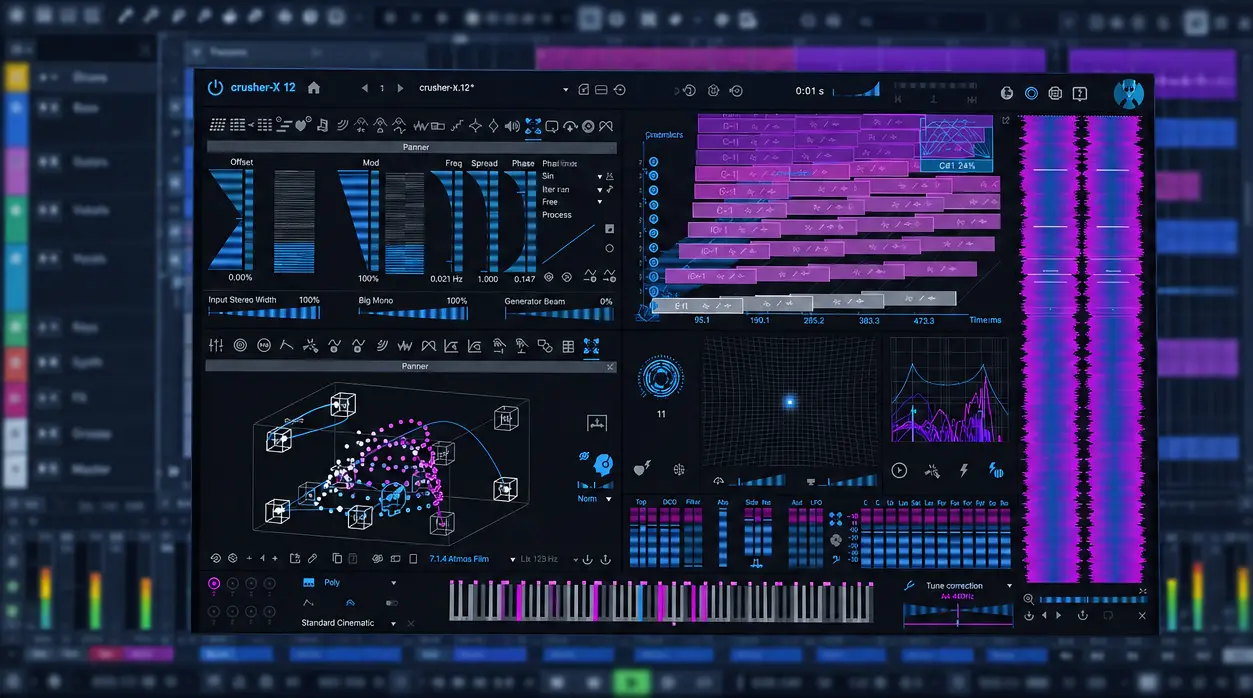
crusher-X 12.20 is a real-time granular synthesis instrument and effect designed to transform live or recorded audio at the grain level. It has never behaved like a conventional effect plugin: audio is broken into grains, shaped, spatialized and recombined in ways that can range from subtle texture to heavily transformed material.
Version 12.20 introduces a new binaural processor, a substantially revised pitch tracker, improvements to the granular engine, lower CPU and memory overhead, expanded file-format support, and a series of fixes affecting playback and sample handling. None of these changes turns crusher-X into a different instrument. They address specific friction points that become important when the software is used extensively inside a production session.
The practical question is therefore not how many new functions appear in the update, but how much control and predictability they add when crusher-X is pushed beyond conventional granular effects. For sound design and experimental production, the changes are significant. For mixing, their value depends heavily on the source and the role of the effect. In mastering, crusher-X remains a specialist creative processor rather than a conventional mastering tool.
crusher-X 12.20 at a Glance
| Product | crusher-X 12.20 |
|---|---|
| Type | Real-time granular synthesis instrument and effect |
| Platforms | Windows and macOS |
| Plugin formats | VST2, VST3, AAX and AU on macOS |
| Major 12.20 feature | Binaural Processor with HRTF and BRIR processing |
| Full license | €369 |
| Upgrade / Crossgrade | €149 |
| Demo | Free demo available |
What’s New in crusher-X 12.20?
crusher-X 12.20 is a free update to crusher-X 12, but its importance is less about adding another set of controls than about improving three areas of the existing granular architecture: spatial rendering, pitch-dependent processing and the ability to run complex patches with less operational overhead.
The new Binaural Processor extends the existing 3D grain system into headphone-oriented spatial rendering, while the revised Pitch Tracker makes pitch-related granular transformations more usable on voices and instruments. These are the changes most directly connected to what crusher-X can do with musical source material rather than simply how many functions appear in the interface.
The remaining changes are more infrastructural. Lower CPU and memory overhead, faster parameter and program handling, broader sample-format support and fixes to grain playback address the less visible problems that become important when crusher-X is used with dense patches or multiple instances. Taken together, version 12.20 is better understood as a refinement of crusher-X’s existing architecture than as a new generation of the instrument.
From Granular Processing to Spatial Sound Design
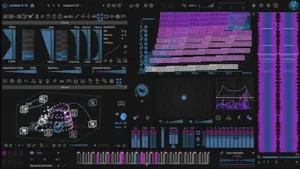 crusher-X 12 already had a substantial spatial-processing architecture, including multichannel routing and three-dimensional grain positioning. The binaural addition in version 12.20 therefore does not fundamentally change what crusher-X can generate. It changes how that spatial information can be rendered for headphone listening.
The new Binaural Processor is integrated into the crusher-X panner and combines generated HRTFs with BRIR-based convolution. HRTF processing applies frequency-dependent cues associated with the position of a sound relative to the listener, while BRIR processing can introduce information associated with the acoustic response of a room. In practical terms, the system is designed to turn crusher-X’s existing spatial coordinates into a binaural presentation rather than simply altering the left-right balance.
That distinction matters with granular synthesis because the spatial object does not have to be the original recording. Individual grains can become the events being positioned. A vocal fragment, percussion transient or short section of a sustained sound can occupy a different point in the spatial field while the granular engine continues to control density, timing, pitch and texture.
This opens up workflows that a conventional stereo panner cannot reproduce convincingly. Vocal grains can be distributed around a headphone image, isolated percussion fragments can be given different spatial positions, and dense granular textures can be spread through depth and direction without relying on conventional stereo widening.
There is also a practical caveat. Binaural spatialization is inherently dependent on the listener, headphones and monitoring conditions. HRTFs are not universal, so a spatial cue that reads as a precise position for one listener may translate differently for another. The 12.20 implementation should therefore be judged through actual headphone monitoring rather than treated as a guaranteed representation of a fixed three-dimensional position.
For that reason, the binaural processor is best understood as a new spatial rendering option inside crusher-X’s granular architecture. Its value is greatest when the spatial movement itself is part of the sound design, rather than when the goal is simply to make a conventional stereo mix appear wider.
Give Your Mix the Same Attention to Detail
Granular processing can reshape pitch, density and spatial detail, but the finished mix still needs controlled dynamics, tonal balance, stereo focus and reliable translation across playback systems. A mastering pass provides an independent check of those relationships without assuming what the mix needs in advance. Upload up to 40 seconds of your mix for a free mastering demo and hear how the material responds to a professional mastering workflow. Upload Your Mix for a Free Mastering Demo →
Pitch Tracking May Be the More Practical Improvement for Everyday Production
The binaural processor is the headline feature, but the revised Pitch Tracker may have greater practical value in conventional production work. Pitch information becomes especially important when granular processing is applied to material that still needs to retain a recognizable musical identity.
Granular pitch manipulation is inherently difficult because the processor is making several decisions at once: where to extract grains, how long they should remain active, how their playback position changes, and how the resulting material relates to the source pitch. Transients, vibrato, harmonics, noisy consonants and overlapping notes can all make pitch detection less stable. Once the detected pitch becomes unreliable, the resulting granular texture can produce octave shifts, unstable note changes or a loss of tonal focus.
Version 12.20 introduces Tune Sync and Base Key Sync modes for working with detected pitch. accSone also reports steadier tracking, fewer phantom notes, improved octave recognition and a wider operating range. These are manufacturer-reported improvements rather than independent benchmark results, but they address a genuine constraint of pitch-dependent granular processing.
For a vocal or other clearly pitched source, the workflow becomes more direct. The detected note can provide a musical reference while the granular engine changes timing, density and spectral behavior. The same approach is relevant to guitars, synthesizers, strings and other sources where preserving the underlying pitch relationship matters even after the original performance has been heavily transformed.
The Pitch Tracker is therefore better understood as a control source for granular resynthesis than as a conventional pitch-correction system. It provides pitch information that can guide the transformation while the source is fragmented, stretched, redistributed and recombined.
That makes the revised tracker most useful when the target is creative resynthesis with retained pitch identity. The closer the desired result is to conventional pitch correction, the less relevant crusher-X becomes; the more aggressively the source is being transformed, the more valuable stable pitch information can be.
crusher-X 12.20 Performance and CPU Changes
Performance is a more important part of the crusher-X workflow than it would be with a conventional EQ or compressor. A complex granular patch can involve multiple active processing stages, dense grain generation, modulation, spatial processing and several audio streams at once. Once several instances are running in the same session, CPU and memory overhead become part of the practical limit of the instrument.
Version 12.20 addresses this at several levels. accSone reports more efficient handling of inactive filters, sends and outputs, improved multithreaded scheduling for the Granulizer engine, and lower processing overhead during parameter changes and automation. The Apple Silicon version also benefits from improved distribution of Granulizer processing across performance cores.
Memory use has been reduced as well. accSone reports approximately 75 MB less memory consumption per open instance, or roughly one-third lower usage under the conditions measured by the developer. In a session with one instance, that difference may be unimportant. With multiple crusher-X instances and large source buffers, it becomes more relevant to overall session headroom.
Sample handling has also received practical attention. Version 12.20 allows samples to be loaded while keeping the editor responsive, rather than making the interface effectively unavailable during the operation. Program and parameter changes have been optimized as well, which matters when crusher-X is being automated or used as part of a larger sound-design workflow.
There is an important limit to what can be concluded from these changes. No independent standardized CPU benchmark for crusher-X 12.20 establishes a specific percentage reduction under controlled conditions. The performance figures and optimization claims therefore remain manufacturer-reported. The engineering changes are directly relevant to known granular-workflow bottlenecks, but the actual gain will depend on the patch, session configuration, host, processor architecture and number of active instances.
crusher-X 12.20: Routing and Workflow Changes
The most relevant routing change is the new Generator Beam control in the Panner. It allows unpanned Generator output to bleed into the Granulizer outputs, giving the direct generator signal a different relationship with the spatialized grain material. This is more consequential to sound design than the expanded file-format support because it changes how the internal signal architecture can be balanced.
FLAC loading, additional MP3 sample-rate support, Default Program and Default Pack behavior, and the extended DCO range down to 0.001 Hz are useful refinements, but they are secondary to the binaural, pitch-tracking, performance and routing changes when evaluating version 12.20 as a production update.
crusher-X 12.20 in Real Mixing Workflows
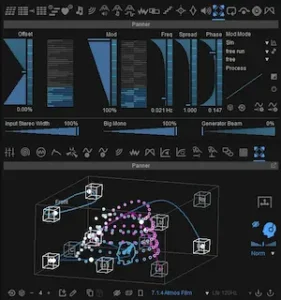 crusher-X is rarely the first choice for corrective mixing. Its value is in changing the character, movement or spatial behavior of a source, which makes it better suited to parallel processing, dedicated effect returns and selective inserts than to routine EQ or dynamics work.
A vocal is a good example. A short vocal fragment can become source material for a transformed layer, while the dry performance remains intact. With crusher-X, that source can then be fragmented, spatialized and blended underneath the original. For a pitch-dependent vocal treatment, the revised Pitch Tracker can provide a musical reference while grain density, timing and spatial position are changed independently. The result is better treated as a supporting texture than as a replacement for the original vocal. The same approach works with drums, guitars, synths and field recordings: preserve the recognizable source, then use the granular layer to introduce movement, density or texture around it.
A practical signal flow is:
Original source → crusher-X transformation → EQ, dynamics or spatial cleanup → blend with the production
Example: granular vocal layer. Keep the original vocal as the primary signal, send a duplicate into crusher-X, use pitch information to retain a recognizable tonal relationship, then introduce changes in grain density and spatial position. Treat the resulting signal as an effect return and shape it with conventional EQ or dynamics before blending it into the arrangement.
Processing the granular return after crusher-X is often more useful than trying to make the granular output behave like a finished mix element on its own. Once grains have been pitched, stretched, scattered or spatialized, conventional EQ and dynamics can be used to carve the resulting texture into the arrangement. The same discipline applies when preparing the finished mix for mastering: the mix should remain stable as playback level increases, rather than relying on mastering to correct problems introduced by the balance or dynamics of the production.
Transitions are another strong application. Instead of building a rise or breakdown from several unrelated effects, crusher-X can derive the transition directly from the source material. Increasing grain density, changing grain position, introducing pitch movement, feeding back selected material or automating spatial position can turn a vocal, drum hit or sustained instrument into a transition while retaining a recognizable connection to the original recording.
The advantage is not necessarily fewer plugins or less automation. It is that the transformation is generated from the source itself, giving the effect a closer relationship to the musical material and making complex movement possible from a single granular processing stage.
Mastering: A Specialist Creative Tool, Not a Mastering Processor
From a mastering perspective, crusher-X occupies a very different role from the processors normally used on a stereo master. It is designed to transform the source rather than preserve its existing tonal, dynamic and spatial relationships with minimal intervention.
That makes it unsuitable as a substitute for conventional mastering tools such as transparent EQ, bus compression, limiting or clipping. A conventional mastering workflow uses these stages to control the final stereo signal without fundamentally rebuilding its timing or pitch structure; the actual mastering chain is shaped around what the mix needs at each stage. crusher-X solves a different problem: its granular engine can alter timing, pitch, density and spectral structure, while the binaural processor adds another spatial layer that needs to be evaluated carefully under the intended monitoring conditions.
There are legitimate mastering workflows where crusher-X can make sense. Experimental releases, deliberately transformed sections, immersive sound-design elements and interludes can all benefit from granular processing when the transformation is part of the artistic direction. In those cases, crusher-X is better treated as a creative stage in the production or pre-mastering process than as a final-stage mastering processor.
For conventional mastering, the distinction is straightforward: if the objective is to refine an existing mix while preserving its musical balance and translation, crusher-X solves a different problem. Its relevance increases when the mastering workflow includes intentional sound transformation rather than corrective or transparent processing.
crusher-X Compared With Other Granular Tools
The main alternative to crusher-X is often not another granular processor. It is a simpler workflow. Many producers need granular effects occasionally, and a processor that reaches a usable result quickly can be more appropriate than an instrument built around deep granular control.
| Tool | Core Approach | Workflow Character | Where It Fits |
|---|---|---|---|
| crusher-X | Deep granular synthesis, multichannel processing and spatial grain control | Highly configurable | Sound design, experimental production, granular resynthesis |
| Output Portal | Granular effects built around fast sound transformation | Immediate and effect-oriented | Creative production and mix effects |
| Arturia Efx Fragments | Granular effects with an accessible modulation workflow | Fast and structured | Electronic production and creative mixing |
| Audio Damage Quanta | Granular synthesis presented in a more conventional synthesizer architecture | Synth-focused | Electronic production and sound design |
| UVI Falcon | Broad sampling and synthesis environment that includes granular techniques | Deep and modular | Advanced synthesis, sampling and sound design |
Portal and Efx Fragments are better suited to situations where the objective is a usable granular effect without building the processing architecture from the ground up. Quanta approaches granular synthesis more like a dedicated synthesizer, while Falcon places granular processing inside a much broader sampling and synthesis environment. For a more focused granular approach, FRCTL GRN 4 takes a similarly grain-level approach, with its own emphasis on source selection, per-grain processing and controlled variation.
crusher-X takes a more specialized route. Its value increases when granular synthesis is a recurring part of the sound-design process and detailed control over grains, routing, modulation and spatial behavior justifies the additional complexity. If granular processing is an occasional color rather than a core production technique, that depth can become workflow overhead rather than an advantage.
The Main Weakness: Control Comes With a Learning Curve
crusher-X’s depth comes with a practical trade-off: the instrument exposes considerably more of its granular architecture than a typical effect-oriented plugin. Routing, grain behavior, modulation, spatial processing and synthesis parameters can interact in ways that are powerful once understood but slow to navigate when the workflow is unfamiliar.
That is more than an interface preference. In a professional session, operational speed has a real value. If a routing change or granular adjustment takes several steps to locate and configure, the additional control only pays off when it produces a result that a simpler processor cannot deliver.
This is where crusher-X separates its audience. Engineers and sound designers who regularly build granular patches can justify the time required to learn its architecture. Someone looking for an immediate texture, transition or vocal effect may reach a usable result faster with a more narrowly focused granular processor.
Version 12.20 improves responsiveness, parameter handling and overall efficiency, but it does not attempt to simplify the underlying instrument. The learning curve is therefore still part of the product’s character — and an important factor when deciding whether its depth will actually be used.
Monitoring, Translation and the Binaural Question
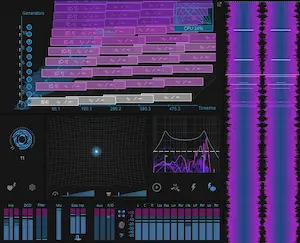 The binaural processor introduces a monitoring issue that matters particularly when the processed material is intended for a final release rather than a temporary sound-design element. A headphone binaural rendering is not interchangeable with a conventional stereo mix, because its spatial cues depend on the listener’s HRTF, headphones and playback conditions.
That makes binaural processing easier to manage when it is treated as a deliberate part of the production format or as a controlled creative layer. It should not be assumed that a position that reads clearly over one pair of headphones will produce the same spatial impression on another system.
For a release that ultimately exists as conventional stereo, the granular and binaural contribution should therefore remain under tight control during the final mix. Checking the result on headphones is essential when the spatial effect is intentional, but it should also be evaluated through ordinary stereo monitoring to make sure the processing does not compromise balance, focus or mono compatibility.
Lossy encoding is another part of the translation chain worth checking. Dense granular material can contain rapidly changing spectral content and closely spaced transients, which may make encoding artifacts more noticeable in some heavily processed passages. The practical solution is not to avoid granular processing, but to audition the finished mix through the delivery path when that path is known. This is particularly relevant when the track is being prepared for multiple streaming services, where mastering has to account for how the finished file behaves after platform encoding and playback normalization. The goal is to confirm that the texture survives without becoming brittle, smeared or unnecessarily distracting.
For mastering engineers, this reinforces a basic rule: the binaural version should be judged as a complete listening format, not in isolation from the stereo master and its actual delivery conditions.
Who Should Use crusher-X 12.20?
crusher-X 12.20 is primarily aimed at sound designers, composers and electronic producers who use granular synthesis as a recurring part of their production process. Its combination of grain-level control, modulation, routing and spatial processing is most useful when the source is intended to be transformed rather than simply enhanced.
Mixing engineers can use it as a specialist creative processor for parallel textures, transitions and resynthesis. For mastering engineers, its role is narrower: it makes sense when deliberate sound transformation or spatial creative processing is part of the project, not as a replacement for conventional mastering processors.
Beginners can learn crusher-X, but the amount of available control makes it less suitable as a first introduction to granular processing.
Is crusher-X 12.20 Worth the Upgrade?
For existing crusher-X 12 users, version 12.20 is a free update that addresses several practical areas of the instrument: binaural processing, pitch tracking, engine efficiency, sample handling and playback reliability. The main reason to install it is therefore not a single headline feature, but the combination of changes across workflows that can become demanding when granular processing is used extensively.
For a new user, the decision is less about the number of features and more about whether the granular architecture matches the way the instrument will actually be used. The current full license is listed at €369, with an upgrade/crossgrade option listed at €149. That places crusher-X in a specialist software category where its value depends heavily on repeated use of deep granular processing rather than occasional effect duties.
The free demo is therefore an important part of the buying decision. The most useful evaluation is to work with several real sources: a pitched vocal or instrument, a transient-heavy drum sound, and a sustained or atmospheric recording. If pitch-dependent processing, complex resynthesis and spatial grain movement become useful parts of the workflow, crusher-X’s depth has a clear production rationale. If the requirement is mainly occasional granular texture, a more focused processor may provide a faster path to the desired result.
Editorial Assessment
| Area | Assessment |
|---|---|
| Granular architecture | Exceptionally deep, with extensive control over grain behavior, routing, modulation and resynthesis. |
| Pitch-dependent processing | 12.20 makes pitch-related granular transformation more practical through the revised tracker and new sync modes. |
| Spatial processing | The binaural processor adds a meaningful headphone-oriented extension to the existing 3D grain architecture, with translation dependent on HRTF and monitoring conditions. |
| Workflow | Highly configurable, but the depth of the architecture creates a substantial learning and operational overhead. |
| Version 12.20 | A substantial refinement of crusher-X 12 rather than a fundamentally different instrument. |
crusher-X 12.20 is most relevant when granular synthesis is a recurring part of the production process and detailed control over resynthesis, pitch behavior, routing and spatial grain movement justifies the learning curve. The main compromise is operational complexity: users looking for fast, effect-oriented granular processing may reach a usable result more quickly with a simpler architecture.
Before Adding Another Processor, Check What the Mix Actually Needs
crusher-X can introduce substantial changes in grain density, pitch, timing and spatial detail, but once those creative decisions are in place, the final question is how the complete mix holds together: dynamics, tonal balance, stereo focus and translation across different playback conditions. Another plugin is not necessarily the answer. A professional mastering comparison can show what changes when the finished mix is processed as a complete stereo signal, without assuming in advance where the problem lies. Upload up to 40 seconds of your mix and receive a free mastering demo prepared by a real mastering engineer, so you can compare the original and mastered versions directly. Upload 40 Seconds for Your Free Mastering Demo →
FAQ
Is crusher-X 12.20 a new plugin?
No. crusher-X 12.20 is a free update to crusher-X 12. It adds new processing capabilities along with changes to the engine, workflow, performance and audio playback.
Does crusher-X 12.20 work on Mac and Windows?
Yes. The current release supports 64-bit Windows and macOS. Available formats include VST, VST3 and AAX, with Audio Units available on macOS, in addition to the standalone version.
Is crusher-X good for mixing vocals?
It is useful for creative vocal processing rather than conventional correction. The revised Pitch Tracker is particularly relevant when granular processing needs to retain a relationship with the original vocal pitch while the timing, density or spectral structure is being transformed.
Can crusher-X replace a conventional mastering plugin?
No. crusher-X is not a substitute for mastering EQ, compression, limiting or clipping. Its mastering applications are primarily creative and experimental rather than corrective or transparent.
Is crusher-X CPU intensive?
Complex granular patches can require substantial processing resources. Version 12.20 includes changes intended to reduce CPU and memory overhead, but there are no independent standardized benchmarks establishing a single performance figure for the current release. Actual usage depends on the patch, host, processor and number of active instances.
Is the crusher-X binaural processor useful for headphones?
Yes. The processor is designed specifically for binaural spatialization over headphones using HRTF processing and BRIR-based convolution. Because binaural perception varies between listeners, headphones and HRTF characteristics, spatial translation should still be checked under the monitoring conditions relevant to the final release.
What are the main alternatives to crusher-X?
The appropriate alternative depends on the required workflow. Output Portal and Arturia Efx Fragments focus on faster granular effect processing, while Audio Damage Quanta presents granular synthesis in a more conventional synthesizer architecture. UVI Falcon provides granular techniques within a much broader sampling and synthesis environment.
Is crusher-X suitable for beginners?
It can be learned by a beginner, but the instrument exposes a large amount of granular, modulation and routing control. Users who already understand synthesis, signal flow and modulation will generally have an easier time getting productive with its architecture.
Should crusher-X 12 owners install version 12.20?
Version 12.20 is a free update for crusher-X 12 and includes the new binaural processor, revised pitch tracking, performance optimizations and numerous audio and workflow fixes. Existing users should also check compatibility with any legacy projects before replacing an established production build.

Yurii Ariefiev is a mastering engineer and audio production editor focused on the technical behavior of music-production software, with particular attention to signal flow, dynamics, spatial processing and how processing decisions translate into finished mixes.
Enjoyed this review? If you found it useful, you can support independent audio research with a coffee.
☕ Buy me a coffee