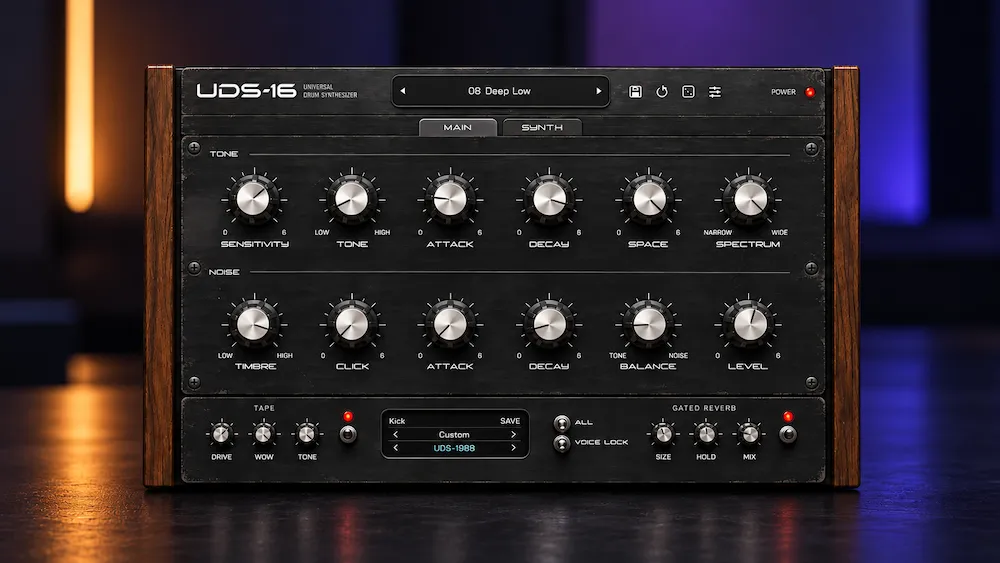
Tapechild UDS-16 takes a different approach to drum production: instead of triggering recorded one-shots, it generates each drum voice in real time. Its four synthesis models draw from the Lel UDS, Formanta Rockton, and Tapechild’s own drum-synthesis design. The interesting question is not how faithfully it recreates Soviet hardware, but whether that architecture gives a producer more useful control over the source before the mix starts.
That matters in a production environment where sample libraries already cover almost every conventional drum sound. A good sample can get a track moving quickly, but its pitch envelope, decay, transient structure, and harmonic content are largely fixed. UDS-16 moves those decisions back into the synthesis stage, allowing the producer to shape the drum around the arrangement rather than search for a sample that happens to fit it.
That makes UDS-16 most relevant to electronic production, sound design, and mixing workflows built around synthesized percussion. Its role is narrower than a full drum workstation: it is designed to build and shape drum sources in real time, with sequencing and detailed mix processing left to the DAW. That distinction becomes important when comparing it with broader drum instruments later in the review.
Why Synthesized Drums Still Matter in a Sample-Heavy Production Workflow
 Sample libraries solved one production problem extremely well: getting a usable drum sound quickly. But when a producer has thousands of kicks, snares, hats, and percussion sounds to choose from, finding the right source can sometimes take longer than designing one.
A sampled kick arrives with its pitch envelope, decay, transient structure, noise content, and harmonic behavior largely fixed. Processing can reshape those characteristics, but it cannot completely change the underlying architecture. If the body is right but the decay is too long, or the transient works in the verse but starts masking the bass in the chorus, the mix often ends up compensating for a source that was never quite right.
Synthesis reverses that relationship. Instead of searching through recordings for a closer match, the producer changes the mechanism generating the sound.
That is the practical rationale behind UDS-16. Its four models generate drum voices in real time rather than triggering recorded one-shots. The synthesis architecture provides separate tone and noise components, attack and decay controls, resonant click, pitch behavior, and model-specific parameters. Tapechild’s own UDS-16 engine adds PUNCH, PITCH TIME, MATERIAL, and DRIVE controls for shaping the drum’s body, pitch envelope, resonant character, and saturation.
From a mixing perspective, that distinction matters more than the Soviet hardware references themselves. A synthesized drum can be tuned, shortened, reshaped, and driven at the source before corrective EQ or compression is applied. When the drum already fits the arrangement in terms of pitch, decay, transient length, and spectral character, the mix requires less corrective processing to make it sit where it belongs.
Four Drum Engines, One Kit: Where UDS-16 Actually Differentiates Itself
UDS-16 provides four synthesis models: UDS-1987, UDS-1988, ROKTON, and Tapechild’s original UDS-16 engine. The first two are inspired by the Lel UDS channel, while ROKTON draws from the Formanta Rockton. Tapechild presents these as hardware-inspired designs rather than exact emulations, and UDS-16 is not affiliated with the original manufacturers.
The important distinction is not historical accuracy. It is the range of synthesis architectures available inside a single instrument.
The two Lel-inspired models represent different voicings of the same basic circuit concept rather than two unrelated synthesis engines. ROKTON moves to the Formanta Rockton reference, while Tapechild’s own UDS-16 model is the outlier: it is not tied to a historical hardware counterpart and uses its own pitched body, pitch-envelope behavior, harmonic content, noise layer, and transient design. The practical difference is therefore architectural: changing models changes how the drum is constructed, not just how a preset is voiced.
That makes hybrid kits practical. A producer can build a tuned kick with the UDS-16 engine, use a Lel-inspired model for the snare, and turn to ROKTON for hats or percussion without switching between separate instruments.
The factory content is also substantial for a focused instrument: UDS-16 includes 20 factory libraries with complete kits and individual drum presets covering its synthesis models. That gives the instrument a usable starting point without changing its role as a source-focused drum synthesizer.
The tone-and-noise architecture is more significant from a sound-design and mixing perspective. Separating the tonal body from the noise component gives the producer direct control over how much of the drum’s identity comes from pitched material and how much comes from transient texture. That becomes useful when a drum sounds right on its own but competes with another element once the full arrangement is playing.
The original UDS-16 model is particularly useful when a drum needs to move beyond the tone-plus-noise architecture shared by the hardware-inspired models. Its pitched body, pitch envelope, harmonic shaping, noise layer, and inharmonic partials give it a different route to metallic and synthetic percussion, so it is more than a fourth preset family attached to the Soviet-inspired models.
A snare that feels too thick, for example, may be better served by reducing its tonal body than by carving another EQ notch. A kick that lacks definition may benefit from a tighter pitch envelope and controlled click rather than another high-frequency boost. The advantage is not simply that UDS-16 can produce unusual sounds; it lets the producer correct the character of the sound at the synthesis stage, before corrective processing becomes necessary.
Give Your Drum Sources a More Controlled Final Context
Drum synthesis gives you control over pitch, decay, transient structure, and tonal balance at the source. The same source-first approach matters when the full mix reaches mastering, where low-end balance, dynamics, stereo image, punch, and detail all interact with translation across playback systems. Hear how your mix holds together before committing to a final master with our free mastering demo. Upload up to 40 seconds of your mix and let us evaluate it in a mastering context. Upload your mix for a free mastering demo →
The Mixing Engineer’s Perspective: Source Design Before Processing
The strongest argument for UDS-16 is not that it sounds “analog.” It is that it moves several mix decisions upstream, into the sound-generation stage.
Take a kick that has to coexist with a sustained bass line. With a sample, the workflow often becomes selection, tuning, EQ, compression, transient shaping, and sometimes saturation. If the fundamental, pitch envelope, or decay is still fighting the bass, the producer ends up using more processing to compensate for a source that was never a good fit.
With a synthesized kick, those characteristics can be designed before the signal reaches the mixer. A shorter pitch envelope can tighten the initial impact. Changing the body pitch can move the drum away from a competing bass fundamental. The click can be shaped independently instead of being forced forward with a broad high-frequency boost.
That does not make EQ or compression obsolete. It changes what they are being asked to do. When the source already fits the arrangement, those processors can be used to shape tone, dynamics, and impact rather than spending the mix chain correcting basic problems in the drum itself.
The same principle applies to electronic snares and percussion. UDS-16 allows the decay, tonal body, noise content, and transient character to be designed around the arrangement rather than selected from a fixed collection of recordings.
That matters in dense electronic mixes, where drum tails can compete continuously with bass, synths, effects, and sidechain movement. A few hundred milliseconds of unnecessary decay can create more low- and mid-frequency congestion than another corrective plugin will solve elegantly.
For mastering, the relevance is upstream rather than procedural. A kick with a controlled envelope and a percussion track without unnecessary low-frequency or transient buildup gives the final mix more usable headroom and fewer source-level problems to compensate for.
Tape Saturation and Gated Reverb: Where the Built-In Processing Fits
UDS-16 includes tape-style saturation with Drive, Wow, and Tone controls, along with a gated reverb featuring Size, Hold, and Mix. Neither is the reason to buy the instrument, but both can be useful at the sound-design stage.
The advantage is integration. A gated reverb built into a drum synthesizer makes it possible to shape the character and decay of a snare or percussion voice without immediately setting up an external effects chain. That is particularly useful when building a complete kit and trying to keep its processing consistent from voice to voice.
The same principle applies to the saturation stage. Placing nonlinear processing close to the voice generator lets the producer hear how drive changes the synthesized tone, transient, and harmonic content as the drum is being designed. This is a different role from a dedicated saturation processor such as Mixland Grey Matter, where nonlinear coloration is the processing itself rather than an integrated part of the drum generator. Saturation becomes part of the sound rather than a separate decision made later in the mix.
There are obvious limits, however. A dedicated reverb provides substantially more control over space, modulation, diffusion, stereo behavior, and routing. Likewise, a specialized saturation processor may offer more detailed control over frequency-dependent drive, processing topology, oversampling, and parallel operation.
The built-in effects are therefore best treated as extensions of the synthesis workflow. Their value is speed and interaction: generate the drum, shape its envelope, add harmonic coloration or gated ambience, and judge the result as a complete source before it reaches the main mix chain.
Where the UDS-16 Concept Falls Short
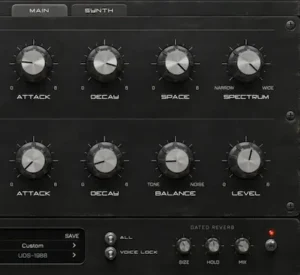 There is no internal sequencer, so UDS-16 is a sound-generation instrument rather than a complete drum-production environment. Patterns still need to be programmed in the DAW or another sequencing tool. For producers who want synthesis, sequencing, and arrangement in the same interface, a broader drum instrument will be more appropriate.
There is also no sample import. That makes UDS-16 fundamentally different from a hybrid drum sampler. If a production requires synthesized percussion alongside specific acoustic recordings, found sounds, or custom one-shots, those sounds have to come from another instrument or sampler.
Per-voice mixing is similarly focused rather than comprehensive. UDS-16 does not provide a full per-drum EQ and compressor architecture, so it should not be treated as a self-contained drum mixer. Detailed corrective processing still belongs in the DAW or a dedicated mix environment.
Format support creates another practical boundary. UDS-16 is available as VST3 and Audio Unit on macOS, with VST3 support on Windows, but there is no AAX version listed. Native Apple Silicon support and the standalone application are useful, but they do not solve compatibility for a Pro Tools-based workflow that depends on AAX plug-ins.
The absence of a trial is also worth considering. At $49, the purchase price is relatively low for a specialized instrument, but the lack of a trial makes the decision more dependent on whether its particular synthesis character fits the producer’s music and workflow.
These limitations define the intended role more clearly: UDS-16 is a dedicated drum-synthesis instrument for generating distinctive voices inside an existing DAW-based setup. It is closer to a specialized drum source or character layer than to a complete drum workstation, and that distinction is important when comparing it with broader kit-design instruments.
UDS-16 vs. Other Drum Synthesizers: Choosing the Right Workflow
| Instrument | Primary Focus | Best Suited To | How UDS-16 Differs |
|---|---|---|---|
| Tapechild UDS-16 | Real-time drum synthesis | Distinctive electronic percussion and source design | More focused on synthesis character than sequencing or drum mixing |
| Sonic Charge Microtonic | Drum synthesis and sequencing | Pattern-based electronic production | UDS-16 takes a different approach to synthesis and emphasizes Soviet-inspired circuit character |
| Baby Audio Tekno | Integrated electronic drum production | Sequencing, synthesis, and processing in one environment | UDS-16 is narrower and puts more emphasis on the individual drum source |
| AIR Drum Synth 500 | Multi-engine drum synthesis | Broader drum sound design and production workflows | UDS-16 has a more specific synthesis identity built around its four models |
| Dedicated kick synthesizers | Kick and bass-drum design | Detailed control over pitch, amplitude, and transient envelopes | UDS-16 applies synthesis principles across an entire drum kit rather than concentrating on the kick |
| D16 Nepheton 2 | Classic Roland-style drum synthesis | 808-oriented production | UDS-16 moves toward a less familiar palette built around Soviet-inspired designs and Tapechild’s own engine |
| D16 Drumazon 2 | Classic Roland-style drum synthesis | 909-oriented production | UDS-16 moves toward a less familiar palette built around Soviet-inspired designs and Tapechild’s own engine |
The meaningful difference is workflow: UDS-16 is built around source design, while the alternatives in this table put more emphasis on sequencing, broader synthesis methods, or integrated drum mixing.
A pattern-driven workflow may place greater importance on integrated sequencing. A dedicated kick synthesizer makes more sense when kick architecture is the main sound-design task. An 808 or 909-oriented instrument is aimed at producers who specifically want that established drum-machine vocabulary.
UDS-16 occupies a narrower position. It makes the most sense when sequencing already happens in the DAW and the producer wants a compact instrument for designing distinctive synthesized drums at the source.
That distinction is especially important against broader drum instruments. Microtonic and Tekno put more emphasis on sequencing and integrated production, while Drum Synth 500 offers a wider set of synthesis methods and per-drum processing. UDS-16’s differentiator is narrower: its four-model architecture gives the kit a specific circuit-derived identity that those broader workflows do not target in the same way.
What UDS-16 Means for Real-World Production, Translation, and Mastering
Drum synthesis becomes particularly useful when a dense arrangement makes source selection a significant part of the mix problem. The closer the drum is to what the arrangement actually needs, the less corrective processing is required later—especially when kick and bass are competing for the same low-frequency space. Problems that begin with the drum source can become much harder to correct once they reach the final mix; this is one reason low-frequency problems in mastering are often traced back to the mix rather than the mastering chain itself.
A kick with an unnecessarily long sub tail can consume low-frequency headroom throughout the mix. A snare with excessive low-mid body can force broader EQ moves on the drum bus. A hat with an overly sharp transient can become disproportionately aggressive once bus compression, clipping, or limiting starts reacting to it.
UDS-16 does not solve any of these problems automatically. Its advantage is that the producer can address characteristics such as pitch, decay, tonal body, noise, and transient definition before those problems reach the mix bus.
That matters in streaming-oriented production, where downstream processing cannot compensate cleanly for every problem in the mix. As discussed in mastering for streaming platforms, loudness normalization does not correct an unbalanced low end, and lossy encoding does not make an uncontrolled transient disappear. A limiter can reduce peak level, but it cannot turn a poorly designed drum envelope into a better one without changing the underlying mix.
A synthesized drum with a controlled body, pitch envelope, and decay can therefore give the mix more room to breathe than a poorly matched sample that has to be pushed through several corrective stages.
The same principle applies to high-frequency content and codec resilience. Dense percussion can expose encoding artifacts, particularly when saturation or clipping adds upper harmonics that were not present in the original source. UDS-16’s Tape stage can be useful as a creative effect, but its contribution should be judged as part of the finished mix rather than in isolation.
A practical workflow is to design the drum in the context of the arrangement, check its relationship with the bass and other transient-heavy elements, and then evaluate the complete mix at realistic monitoring levels before applying heavy bus or mastering processing. This is also part of preparing a mix for mastering: the goal is not to eliminate processing, but to make sure the processing is solving musical problems rather than compensating for poorly fitted drum sources.
There is currently no independent published CPU benchmark establishing a reliable per-instance or 16-voice CPU figure for UDS-16. The instrument supports up to 4× oversampling, but independent aliasing measurements are not yet available. Producers working in large sessions should therefore treat CPU and oversampling behavior as variables to test in their own DAW rather than relying on unverified performance claims.
Who Should Use Tapechild UDS-16?
UDS-16 is aimed primarily at producers, sound designers, composers, and mixing engineers who want to build synthesized percussion at the source rather than rely entirely on recorded one-shots. Its appeal is strongest when the character, envelope, and interaction of the drum are part of the sound-design decision, rather than being left to post-processing; that source-first approach also differs from processors such as FRCTL GRN 4, which transform existing audio material into new textures.
That makes it a natural fit for electronic production, including techno, electro, EBM, industrial, synthwave, and experimental music, as well as soundtrack work where percussion often functions as part of the overall sonic palette.
It can also work as a character layer in pop, hip-hop, and other sample-based productions. A synthesized snare, kick layer, or percussion voice can sit underneath a conventional recording to add controlled pitch, harmonic content, noise, or transient definition without replacing the original source.
The instrument is less suited to workflows centered on realistic acoustic drums, integrated pattern sequencing, sample-based construction, or extensive per-drum mixing inside the instrument. It is also not designed specifically to reproduce the established 808/909 workflow. Its appeal is elsewhere: creating drum sources with a distinct synthesis character and enough control to shape them around the arrangement.
Is Tapechild UDS-16 Worth $49?
At $49, UDS-16 does not need to replace a producer’s existing drum instruments to justify the purchase. The more useful question is whether its synthesis approach provides enough sonic and workflow difference to earn a place in a working setup.
For producers who already have extensive sample libraries and conventional drum synthesizers, the main argument is character. The Lel UDS- and Rockton-inspired models move away from the familiar 808/909-derived palette, while Tapechild’s own UDS-16 engine extends the instrument beyond those hardware references.
The licensing model also keeps ownership relatively straightforward: one license can be used on up to three machines, with online or offline authorization and no iLok or physical dongle requirement. The absence of a trial is a more meaningful consideration, because the usefulness of a specialized synthesizer depends heavily on whether its particular sound and controls fit the producer’s workflow.
At this price, UDS-16 is best understood as a specialist addition to an existing drum-production setup rather than a foundational instrument. Its value comes from having another way to design the source, particularly when conventional samples and familiar drum-machine emulations are not providing the character or control the track needs.
Review basis: This assessment considers UDS-16’s documented synthesis architecture, production use cases, processing design, compatibility, limitations, and the independent evidence currently available for the product. Where independent CPU, aliasing, or blind-listening measurements are unavailable, those areas are not treated as established technical advantages.
Overall Rating
| Category | Rating |
|---|---|
| Synthesis Architecture | 8.5/10 |
| Drum Voice Control | 8.6/10 |
| Sonic Character | 8.4/10 |
| Integrated Processing | 7.8/10 |
| Kit Versatility | 8.3/10 |
| Production Integration | 7.2/10 |
| Overall | 8.1/10 |
The four models give UDS-16 meaningful architectural variety without turning it into a broad multi-purpose drum workstation; the strongest value comes from being able to change the synthesis basis of individual voices while keeping the same instrument.
Separate control over tonal body, noise, pitch behavior, decay, resonant click, and transient character gives the producer meaningful control over the actual construction of each drum rather than relying primarily on fixed recordings.
Its sonic identity is a strong point because the Lel UDS- and Formanta Rockton-inspired approaches move away from the more familiar 808/909 vocabulary, while the dedicated UDS-16 engine provides an additional sound source that is not dependent on historical emulation.
The integrated effects strengthen UDS-16 as a source-design instrument, but they remain secondary to the synthesis architecture. Tape saturation and gated reverb are useful for committing to a sound inside the instrument; they are not substitutes for dedicated processors when routing, spatial control, or detailed dynamics shaping become important.
Using different synthesis models within the same kit gives UDS-16 useful range across kicks, snares, hats, and percussion without forcing the producer into a single sonic architecture.
The main compromise is that UDS-16 remains a focused sound generator: the lack of sequencing, sample import, comprehensive per-voice processing, and AAX support means additional tools are required for a broader drum-production environment.
UDS-16’s strongest quality is the degree of control it places at the source, particularly for producers who want electronically generated drums with a less familiar sonic identity. The trade-off is deliberate specialization: it provides focused synthesis rather than attempting to combine sequencing, sampling, detailed drum mixing, and synthesis in one instrument.
Verdict: A Specialized Drum Synth With a Clear Reason to Exist
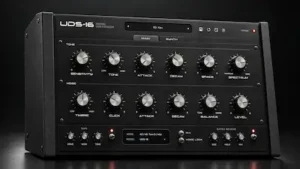 Its identity comes from how those elements are assembled around a less familiar sonic reference. The Lel UDS- and Formanta Rockton-inspired models move beyond the familiar 808/909 palette, while Tapechild’s own UDS-16 engine gives the instrument an identity that is not dependent on recreating historical hardware.
The practical value is in source control. Pitch, decay, transient structure, tone/noise balance, and saturation can be shaped while the drum is being generated, before the signal reaches the corrective stages of the mix. That makes UDS-16 more interesting from an engineering perspective than a drum instrument built primarily around presets.
For producers who already sequence drums in a DAW and want a distinctive synthesis source, UDS-16 is a focused $49 instrument rather than a general-purpose drum workstation. Its strongest case is adding a different voice architecture to an existing setup, particularly when conventional samples or familiar 808/909-derived sounds do not provide the character or control required.
Bottom line: UDS-16’s strongest case is not feature count but source control: four distinct synthesis models, per-voice shaping, and an original engine that moves beyond the familiar 808/909 vocabulary. It makes the most sense as a dedicated drum-synthesis layer inside an existing DAW workflow.
Before Adding Another Plugin, Hear What the Mix Actually Needs
The UDS-16 review comes back to one engineering principle: source control matters, but not every mix problem is solved by adding another processor. Once the drums, bass, dynamics, and spectral balance are working together, the next useful step is to hear how the complete mix responds to mastering rather than judging individual tracks in isolation. Compare your own mix before and after professional mastering with a free mastering demo prepared by a real mastering engineer. Upload up to 40 seconds of your mix and hear the difference in context. Upload up to 40 seconds for your free mastering demo →
Tapechild UDS-16 FAQ
Does Tapechild UDS-16 use samples?
No. UDS-16 generates its drum voices in real time rather than playing back conventional drum samples. The resulting sound is shaped by the selected synthesis model, tone and noise components, envelopes, transient controls, and built-in processing.
Is UDS-16 an 808 or 909 plugin?
No. UDS-16 is built around models inspired by Soviet drum circuits, including the Lel UDS and Formanta Rockton, alongside Tapechild’s own UDS-16 engine. Its sonic approach is therefore different from a conventional 808/909 emulation.
Does UDS-16 have a built-in sequencer?
No. MIDI sequencing is handled by the DAW or another MIDI source. UDS-16 is focused on drum synthesis rather than providing a complete pattern-based production environment.
How many synthesis models are included in Tapechild UDS-16?
UDS-16 includes four models: UDS-1987, UDS-1988, ROKTON, and Tapechild’s original UDS-16 engine, with the model selectable per drum voice.
Is UDS-16 useful for mixing engineers?
Yes, particularly when the drum source itself needs adjustment. Pitch, decay, transient character, tone/noise balance, and saturation can be shaped before the signal reaches corrective EQ or compression in the mix.
Can UDS-16 be used for mastering?
Not as a mastering processor. Its relevance to mastering is upstream: better-controlled drum sources can reduce problems with low-frequency buildup, excessive decay, and transient peaks before the mix reaches the mastering stage.
Does UDS-16 support Apple Silicon?
Yes. The macOS version uses Universal 2 and supports both Apple Silicon and Intel Macs. It requires macOS 11 or later and is available in VST3, Audio Unit, and standalone formats.
Does UDS-16 work in Pro Tools?
There is no AAX version listed. Because Pro Tools uses AAX for native plug-in hosting, UDS-16 cannot be loaded directly as a native Pro Tools plug-in.
How much CPU does UDS-16 use?
There is not enough independent benchmark data to quote a reliable CPU figure. Actual load will depend on factors including the DAW, buffer size, sample rate, voice activity, synthesis model, and oversampling setting. Producers working with large sessions should test CPU usage in their own system.
Does UDS-16 have oversampling?
Yes. UDS-16 supports up to 4× oversampling. Independent published measurements quantifying its effect on aliasing or nonlinear-processing artifacts were not available at the time of review.
Is Tapechild UDS-16 worth buying at $49?
Its value depends on whether its particular synthesis character fits the production workflow. The $49 price makes it a relatively inexpensive way to add a specialized drum-synthesis instrument, while producers who need integrated sequencing, sample import, extensive per-drum mixing, AAX support, or a dedicated 808/909 workflow will need a different type of instrument.

Yurii Ariefiev evaluates drum synthesizers from an engineering perspective, with particular attention to how synthesis architecture translates into controllable drum sources. For instruments such as Tapechild UDS-16, the useful questions are how pitch envelope, decay, tonal body, noise content, and transient structure can be shaped without relying on a fixed sample.
Enjoyed this review?
If you found it useful, you can support independent audio research with a coffee.
☕ Buy me a coffee