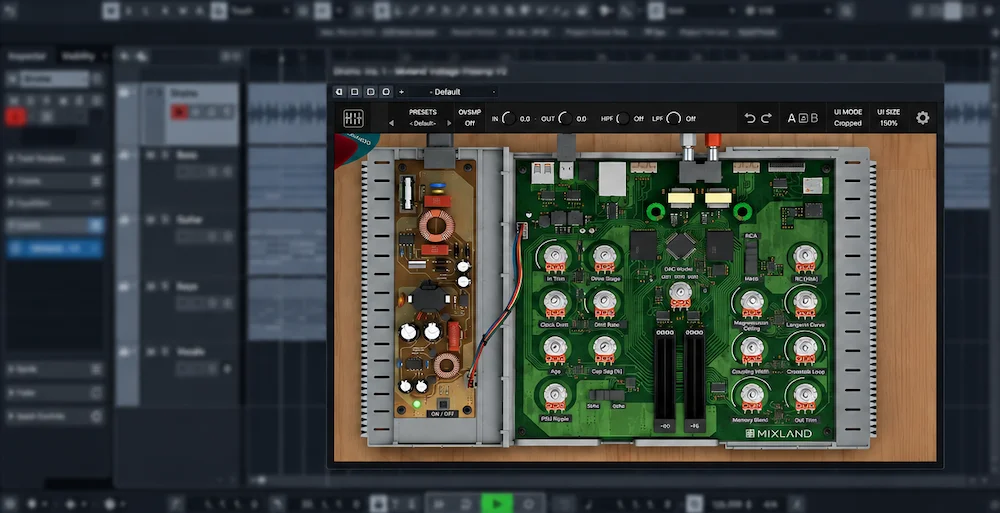
Mixland Grey Matter review: Grey Matter is a physics-based saturation and distortion plugin built around modeled Delta-Sigma converter stages rather than a conventional tape, tube, transformer, or console circuit. Mixland combines that converter-oriented processing with an interactive circuit sandbox designed to let the nonlinear behavior change as the signal drives the model harder.
That makes Grey Matter a more unusual proposition than another analog-style saturator. At restrained settings, it can be used for harmonic density, subtle coloration, and mix-bus character; pushed further, the same processing moves toward audible degradation and sound-design effects. The important question is therefore not whether Grey Matter sounds “analog,” but whether its converter-inspired nonlinear behavior offers something genuinely useful beyond the saturation tools engineers already have.
This review looks at Grey Matter from that perspective: its Delta-Sigma concept, circuit controls, source-specific applications, mastering limitations, workflow predictability, compatibility, pricing, and the technical claims that can — and cannot — be established from the information currently available.
Mixland Grey Matter at a Glance
Core concept: Delta-Sigma converter modeling + interactive circuit sandbox
Processing: Nonlinear saturation, harmonic coloration, circuit-style degradation
Formats: VST3, AU, AAX
Platforms: Windows 64-bit, macOS, native Apple Silicon
License: Lifetime license, no iLok required
Trial: Fully functional 14-day trial
Listed price: $29.99
Regular price: $49.99
From Analog Hardware Models to Converter-Based Saturation
 Most saturation plugins take their reference point from established analog circuits: tape, transformers, tubes, consoles, transistors, or dedicated distortion stages. The engineering logic is familiar. Each circuit introduces a characteristic combination of harmonic generation, level-dependent compression, transient shaping, and frequency-dependent coloration.
Grey Matter approaches the problem from a different direction. Mixland describes its processing as a physics-based circuit model that responds to real-world circuit strain and voltage behavior, with the Delta-Sigma section built around three vintage converter stages. MusicTech has described the concept in relation to DAC circuitry associated with the original Sony PlayStation One. The result is intended to move beyond a conventional fixed saturation curve and create nonlinear behavior that changes as the modeled circuit is driven.
That distinction matters in practice. Grey Matter is not primarily trying to reproduce the tonal fingerprint of a famous analog box. Its appeal is the behavior of the conversion stage itself: the way nonlinear processing, harmonic generation, and high-frequency shaping interact as the signal pushes the model harder.
For an engineer, that makes Grey Matter less about choosing between “warm” and “clean” and more about deciding whether converter-style coloration solves a specific problem in the mix. Used conservatively, it can add density and soften the character of an overly clean source. Driven harder, it becomes a deliberately destructive processor for drums, synths, vocals, basses, and sound-design work. The useful range is therefore determined less by the label “saturation” than by how much nonlinear behavior the material can actually tolerate.
Where Grey Matter Earns a Place in the Mixing Chain
Grey Matter is best approached as a tone-shaping processor, not a corrective tool. It has no reason to sit where an EQ, compressor, clipper, or limiter is already doing a clearly defined job. Its role is to change the way a source behaves — adding harmonic content, altering transient density, or introducing controlled degradation when a cleaner signal feels too static.
Drum buses provide a useful context for Grey Matter because the processor can be driven as a coloration stage rather than treated as a transparent dynamics tool. The relevant distinction is between adding a familiar layer of harmonic density and deliberately changing the nonlinear behavior of the bus. At restrained settings, the former is possible; as the circuit is pushed harder, the latter becomes the more important part of the sound. The latter is particularly useful when the drums need texture rather than simply more level or apparent punch.
Bass presents a different opportunity. Generating upper harmonics can make a sub-heavy source easier to perceive on smaller playback systems, but the added information has to remain subordinate to the fundamental. Grey Matter can be useful here when the goal is to give a bass line more midrange identity without simply boosting the mids with EQ. Push it too far, however, and the added harmonics can occupy the same region as guitars, synths, vocals, and snare information. In a dense arrangement, that can reduce separation rather than improve translation.
Synths are where the processor’s less predictable behavior becomes particularly useful. A synth patch is already an electronically generated sound, so there is little reason to preserve an artificial sense of cleanliness if the production calls for movement or character. Grey Matter can become part of the sound-generation process itself, especially on sustained pads, basses, leads, and one-shot elements. Automating its settings or blending a heavily processed duplicate underneath the dry signal can produce movement that would be difficult to obtain from a conventional saturation stage alone.
Vocals require more restraint. A small amount of coloration can increase apparent density or add an edge that helps a vocal maintain presence without relying entirely on high-frequency EQ. More aggressive processing is usually easier to control on a parallel bus, where the distorted signal can be blended underneath the clean vocal. That preserves intelligibility while allowing the nonlinear component to contribute attitude. Grey Matter does not replace editing, compression, de-essing, or corrective EQ; it belongs later in that decision chain, once the vocal itself is under control.
Guitars are more dependent on the source. A heavily distorted guitar may have little to gain from another nonlinear stage and can become congested quickly. Cleaner guitars, DI signals, parallel guitar buses, and deliberately degraded textures offer more room for experimentation. In those cases, Grey Matter can supply a layer of harmonic complexity without forcing the entire guitar sound through an additional conventional amp or distortion model.
The practical rule is simple: use Grey Matter where the existing signal needs a change in behavior, not merely a change in level or frequency balance. That makes it most useful after the basic mix problem has been identified and before the processor becomes an excuse for one.
Hear What Your Mix Can Do With More Control
Saturation can change harmonic density, transient behavior, and perceived balance, but the right amount depends on the mix and the full mastering chain. If you want to hear how your own track responds to professional mastering decisions, you can send us up to 40 seconds for a free mastering demo.
Upload Your 40-Second Mastering Demo →
Grey Matter in Mastering: Useful Color, Limited Tolerance
Mastering leaves very little room for uncontrolled nonlinear processing. On a finished stereo mix, a small change in harmonic balance, transient shape, high-frequency response, or stereo interaction can affect translation far more than it would on an individual track. That does not rule Grey Matter out; it defines the part of its range that is realistically useful. Its position within the wider mastering chain also matters, because the same nonlinear processing can behave differently depending on what follows it.
At conservative settings, Grey Matter can function as a coloration stage when the master needs a little more density or a change in tonal character without an obvious “effect” sound. The important test is whether the processed signal still preserves the balance and transient relationships established in the mix. If the plugin solves one tonal problem while creating a new masking or brightness problem, the processing has simply moved the work downstream.
Placement also matters. When Grey Matter is used before compression or limiting, the harmonics and nonlinear level response it generates become part of what the downstream dynamics processors see. That can be useful, particularly when the goal is to make a limiter respond to a slightly denser signal. It can also make the final stage less predictable. For that reason, the processor should be evaluated as part of the complete mastering chain rather than in isolation.
The extreme end of Grey Matter has a different role. Once the circuit behavior becomes an obvious audible effect, the question is no longer whether the master is transparent. It becomes whether the degradation is intentional and contributes to the record’s aesthetic. That can work on electronic, experimental, lo-fi, or deliberately aggressive material, but it is not a substitute for the controlled harmonic processing normally expected in conventional mastering.
This is why Grey Matter should be considered a specialist mastering color rather than a core mastering processor. There is little reason to replace an established saturation tool simply because Grey Matter uses a more unusual modeling concept. The stronger case is when its particular nonlinear response produces a result that is difficult to obtain with the processors already in the mastering chain.
Level matching is critical when making that decision. Saturation can increase apparent loudness as it adds harmonics and changes peak-to-average relationships. If the processed signal is even slightly louder than the bypassed version, the comparison can favor the effect before its tonal contribution has been judged properly. A mastering evaluation should therefore be made at matched loudness, followed by a check of the complete chain at normal monitoring level and on more than one playback system.
Inside Grey Matter: Dynamic Nonlinear Processing vs. Static Saturation
The technical premise behind Grey Matter is more specific than another saturation curve with an analog-style response. Mixland describes a real-time circuit model in which factors such as circuit strain, thermal load, and voltage behavior influence the processing as the signal drives the model. The plugin also provides an interactive set of circuit parameters intended to let the user push that model beyond conventional operating conditions.
That approach is fundamentally different from a simple waveshaper. A static waveshaper applies a defined nonlinear relationship between input and output. Its response may be complex, but the transfer function itself does not retain a meaningful memory of what happened to the signal before the current sample. A state-dependent circuit model can behave differently: previous signal levels and internal model states can influence the response that follows. In practical terms, that creates more possibilities for level-dependent harmonic generation, transient deformation, and changes in character as the signal continues to drive the processor.
This is where the distinction between physics-inspired DSP and physically accurate modeling becomes important. A developer can use concepts such as thermal behavior, circuit strain, hysteresis, or voltage sag to construct a sophisticated nonlinear algorithm without necessarily reproducing every electrical characteristic of the original hardware. The same distinction applies to other circuit-modeled processors, including valve EQs built around real-time circuit simulation: the sonic result can still be useful, while physical accuracy and musical usefulness remain separate questions.
Grey Matter’s public documentation does not provide enough technical detail to independently verify the complete DSP implementation or quantify how closely its model reproduces a particular vintage converter at the circuit level. There is also no substantial independent measurement set yet covering its harmonic response, aliasing behavior, dynamic state response, or other characteristics that would allow those claims to be tested rigorously.
That does not make the modeling approach cosmetic. The exposed controls and the range of behavior described for the processor indicate a deliberate nonlinear design rather than a conventional saturation effect with new terminology. The unresolved question is narrower: how much of Grey Matter’s character comes from genuinely state-dependent circuit behavior, and how much comes from the broader voicing and signal-processing decisions built around that model?
The Circuit Sandbox Is Grey Matter’s Main Workflow Differentiator
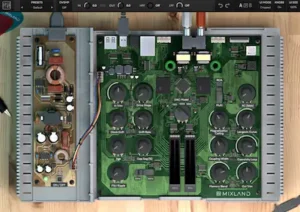 Grey Matter’s most distinctive feature is not the fact that it is a saturation plugin, but the way it exposes the nonlinear system to the user. Instead of centering the interface around a single Drive control, the plugin provides several interacting parameters that change how the modeled circuit responds to the incoming signal.
The available controls include Memory Blend, RC Feedback, Langevin Curve, Mag Ceiling, Coupling Width, and Coercivity Loop. Their names describe different aspects of the modeled behavior rather than conventional mix-engineering functions such as threshold, ratio, or tone. That makes Grey Matter feel less like a traditional saturation stage and more like an experimental nonlinear processor in which the character of the distortion is part of the parameter set.
Grey Matter also provides three interface modes — Raw, Loaded, and Clean — which change how the circuit-oriented processing is presented inside the plugin. This matters more for workflow than for the underlying processing itself: the experimental circuit presentation is useful when exploring the model, while a cleaner interface can make the same processor easier to approach as a conventional DAW insert.
This has a direct effect on the workflow. With a conventional saturation plugin, the process is usually straightforward: establish how much coloration is required, adjust the drive and tonal balance, and use the mix control if necessary to keep the effect under control. Grey Matter encourages a different approach. Instead of starting with a predetermined amount of saturation, the engineer can change the behavior of the nonlinear stage itself and then determine where that behavior is useful.
That workflow is particularly relevant on sources where texture is part of the production decision. A drum bus may benefit from a more aggressive response, a synth can be pushed into deliberate degradation, and a parallel processing path can use a heavily altered version of the signal underneath a cleaner source. The same controls can therefore serve conventional mixing as well as sound-design applications, depending on how far the model is driven.
The trade-off is predictability. More interacting parameters create a larger range of possible responses, but they also make it easier to move away from settings that are immediately repeatable from one source to another. A setting that produces an interesting result on a synth or drum loop may have little relevance to a full mix, and a useful character at one input level may not translate identically when the source dynamics change.
That is not necessarily a weakness. For production and sound design, the exploratory nature of the interface is part of the appeal. In mastering or other applications where repeatability, recall, and tightly controlled tonal changes take priority, the same flexibility can make Grey Matter less convenient than a more predictable saturation stage.
Grey Matter vs. Conventional Saturation Approaches
Grey Matter is easier to evaluate when saturation processors are compared by their underlying processing behavior rather than by the generic label “saturation.” Tape, console, transformer, tube, and distortion processors may all generate harmonics, but they do not produce the same type of nonlinear response or serve the same production workflow. Integrated analog-style chains such as tape, EQ, and tube processing combine several familiar stages, while Grey Matter concentrates on converter-inspired nonlinear behavior and circuit interaction.
| Processor category | Typical strength | Workflow predictability | What changes with Grey Matter | Where the alternative has an advantage |
|---|---|---|---|---|
| Mixland Grey Matter | Dynamic nonlinear coloration and experimental circuit behavior | Moderate | Broader range of circuit-oriented parameter interaction and deliberate degradation | Less conventional workflow and limited independent technical testing at launch |
| Analog-style saturation | Controlled harmonic enhancement and level-dependent coloration | High | More experimental control over the character of the nonlinear stage | Usually faster to dial in and easier to reproduce across multiple sources |
| Tape emulation | Tape compression, harmonic coloration, transient rounding, and tonal shaping | High | Moves the coloration away from tape-specific behavior toward converter-inspired nonlinear processing | More appropriate when tape response itself is the intended sonic target |
| Console saturation | Consistent channel, group, and mix-bus coloration | High | Provides a less standardized and more exploratory nonlinear response | Better suited to repeatable mix-wide coloration and established console-style workflows |
| Dedicated distortion | Obvious harmonic generation and aggressive signal degradation | Moderate to high | Combines nonlinear coloration with a more parameter-driven circuit model | Often preferable when the objective is straightforward, immediately audible distortion |
The comparison does not produce a single winner because these processors are solving different problems. Grey Matter is not a replacement for tape emulation when tape compression is the desired result, nor does its circuit modeling make a conventional console processor redundant in a mix that calls for predictable channel coloration.
The more useful distinction is between known coloration and exploratory coloration. Established saturation tools often make it possible to reach a familiar result quickly and recall it reliably. Grey Matter is more interesting when the engineer wants to investigate what happens when the nonlinear system itself becomes part of the sound-design decision.
That also makes “warmth” a poor standalone criterion for evaluating the plugin. If the requirement is simply to add harmonics, soften a transient, or increase density, many mature processors can already accomplish those tasks. Grey Matter has a stronger case when its particular combination of nonlinear response, parameter interaction, and converter-inspired character produces something the existing chain does not.
What Grey Matter’s Technical Model Actually Establishes
The strongest part of Grey Matter’s technical positioning is the underlying processing concept. The plugin is presented as a nonlinear circuit model rather than a conventional static distortion stage, and its parameter set is consistent with that approach. Launch coverage from MusicTech also documents the unusual focus on DAC circuitry and the processor’s range from relatively restrained coloration to deliberately extreme degradation.
The terminology around the model requires more careful interpretation. References to molecular physics, kinetic energy, thermal load, and related physical processes describe the concepts used to construct or characterize the processing, but they do not by themselves explain the mathematical implementation or establish how closely the DSP reproduces a particular electrical circuit.
For an engineer, that distinction matters. A physically informed model can produce complex, useful nonlinear behavior without being a one-to-one electrical simulation of the hardware that inspired it. Conversely, a processor does not need laboratory-level hardware equivalence to be valuable in a production. What matters sonically is the resulting transfer behavior, harmonic structure, level dependency, transient response, and how consistently those characteristics can be controlled.
The same principle applies to references to analog “give.” Digital nonlinear processing can reproduce many of the audible consequences associated with analog circuits, including harmonic generation, level-dependent response, and changes in transient character. Those similarities should not automatically be interpreted as evidence that the underlying digital process is electrically equivalent to an analog device.
Grey Matter is therefore best judged on two separate levels: what the developer says the model represents and what the processor actually does to an audio signal. The first can be evaluated from the published design description. The second requires listening, level-matched comparisons, and ideally independent measurements.
For production work, that distinction keeps the evaluation grounded. The physical-modeling terminology is interesting because it points toward a particular DSP architecture; it is not, by itself, a reason to prefer the plugin. The useful question is whether Grey Matter’s nonlinear behavior produces a controllable result that earns a place in the mix or mastering chain.
Production, Translation, Loudness, and Delivery
Grey Matter has to be evaluated as part of the complete signal path, particularly when it is used on a mix bus or during mastering. Nonlinear processing does not simply add a fixed amount of coloration; it changes the spectral and dynamic information that subsequent processors have to handle.
On dense electronic material, aggressive settings can generate additional upper harmonics and alter the peak-to-average relationship of the source. Those changes may become more pronounced after compression or limiting. A setting that sounds exciting at the output of Grey Matter can therefore require a different judgment once the complete master has been brought to its final delivery level.
Lossy encoding introduces another stage that should be considered during final evaluation. Codec behavior depends on the spectral content, signal density, bitrate, and encoder implementation, so it would be too broad to assume that saturation automatically causes audible problems after streaming conversion. The practical concern is whether the additional high-frequency information and increased density remain clean and balanced after the actual delivery process, which is one reason mastering for streaming platforms has to be evaluated beyond the sound of the unencoded master.
This is particularly important on a mix bus. A subtle amount of saturation may sound controlled before the limiter, while the same processing can become more prominent once the limiter increases average level and reduces remaining peak headroom. The appropriate comparison is therefore level-matched and made against the finished chain, not against an isolated plugin output. Listening at normal monitoring levels is equally important because close, loud monitoring can make small amounts of added high-frequency detail appear more significant than they are in normal playback.
For mastering, the useful workflow is straightforward: audition Grey Matter at the intended gain structure, evaluate it before and after the downstream dynamics processing, level-match the bypass comparison, and check the final result on more than one playback system. Understanding how LUFS and loudness are evaluated in mastering is also important when comparing processed and bypassed versions, because added harmonic content can change perceived loudness even when the underlying tonal difference is relatively small. If the character disappears completely at normal listening levels, the processing may not be contributing enough to justify the added complexity. If it becomes distracting only after limiting or delivery encoding, the setting is too dependent on the earlier stage of the chain.
CPU performance is a separate technical consideration. Grey Matter is available in VST3, AU, and AAX formats, with native Apple Silicon support and 64-bit Windows support. However, there is not yet a sufficiently broad independent benchmark set to make a meaningful claim about its CPU efficiency in different DAWs, buffer sizes, sample rates, or session configurations.
The same caution applies to latency, oversampling implementation, aliasing performance, and large-session stability. These characteristics are best established through repeatable DAW measurements rather than inferred from the plugin format list or from subjective impressions during normal use.
Grey Matter Compatibility, Licensing, and Price
Grey Matter is available in VST3, AU, and AAX formats for Windows and macOS, with native Apple Silicon support and 64-bit Windows compatibility. Mixland also lists a lifetime license and does not require iLok authorization. Mixland lists Grey Matter at $29.99 against a stated regular price of $49.99, with a fully functional 14-day trial available.
For someone building a first collection of saturation tools, Grey Matter is a specialized option rather than a foundation for basic mix processing. Its appeal is centered on experimentation and circuit-oriented coloration, while more conventional saturation processors may provide a more direct route to familiar tasks such as harmonic enhancement, transient softening, and general mix-bus density.
For an experienced producer or engineer who already has those bases covered, the evaluation is more straightforward. The question is whether Grey Matter produces a distinct enough result to justify another processor in the template, particularly for drums, bass, synths, vocals, parallel processing, or deliberate sound degradation.
The 14-day trial makes that comparison relatively easy to perform without relying on the introductory price as the deciding factor. A useful test is to level-match Grey Matter against the existing saturation stage and compare the same source at conservative and more aggressive settings. Drums, bass, synths, vocals, and a mix bus will expose different aspects of the processor’s behavior, while bypassed and processed comparisons at matched loudness make it easier to determine whether the difference is genuinely useful or simply louder.
Mixland Grey Matter Review Rating
| Category | Rating |
|---|---|
| Processing Concept | 9.0/10 |
| Control & Flexibility | 8.6/10 |
| Workflow Differentiation | 8.8/10 |
| Source Versatility | 8.5/10 |
| Predictability | 7.4/10 |
| Technical Transparency | 7.2/10 |
| Overall | 8.3/10 |
Grey Matter scores strongly for its unusually specific processing concept and the amount of control exposed around the nonlinear stage. The circuit-oriented workflow is more distinctive than a conventional drive-and-mix saturation design, while the broader parameter interaction also makes repeatability less straightforward.
The main limitation at launch is technical transparency rather than feature count. The available product information explains the intended modeling approach, but it does not provide enough independent measurement data to establish the exact harmonic response, aliasing behavior, CPU load, or hardware-level accuracy of the modeled converter stages.
The overall score therefore reflects the strength and differentiation of the documented design rather than a laboratory measurement or substitute for hands-on listening tests.
The Bottom Line for Mixing and Mastering
 Grey Matter occupies a specific position in the saturation market. Its Delta-Sigma converter concept and interactive circuit controls move the processing away from familiar tape, tube, transformer, and console emulations and toward a more exploratory form of nonlinear coloration.
For mixing, that makes the plugin most relevant when harmonic density, transient deformation, or deliberate degradation is part of the production decision. Drums, bass, synths, vocals, parallel buses, and sound-design sources all provide more room for its character than corrective or highly transparent processing tasks.
Mastering is a narrower application. Conservative settings can provide additional coloration, but the nonlinear response has to be evaluated within the complete chain because any change in harmonic balance or peak behavior can affect downstream compression, limiting, and translation.
The main unresolved technical questions are not about the product’s positioning but about implementation: independent measurements of harmonic response, aliasing, CPU load, and the exact behavior of the modeled circuit are still limited at launch. Those measurements would be useful additions as more third-party testing becomes available.
The 14-day fully functional trial is therefore more useful than the launch price as a purchasing criterion. The practical question is simple: does Grey Matter produce a form of nonlinear coloration that your existing saturation toolkit does not already provide?
Before Adding Another Processor, Check the Mix in the Mastering Chain
Not every problem in a mix is solved by adding more saturation, changing harmonic density, or pushing another nonlinear stage. What matters is how the finished mix holds together through the final processing chain — including balance, dynamics, stereo image, and translation. Send us up to 40 seconds of your mix and hear a free mastering demo prepared by a real mastering engineer, giving you a direct before-and-after reference for what professional mastering can and cannot change.
Upload Your Mix for a Free 40-Second Mastering Demo →
Mixland Grey Matter FAQ
Is Mixland Grey Matter a saturation or distortion plugin?
Both. At lower drive levels, Grey Matter can be used for nonlinear coloration and added harmonic density. With more aggressive settings, it moves into obvious distortion and sound-design territory. Its workflow is more experimental than that of a conventional tape or console saturator.
Can Mixland Grey Matter be used in mastering?
Yes, but its role is relatively specialized. Conservative settings can add coloration to a finished mix, while heavier processing is better suited to intentionally colored or experimental masters. Level-matched comparisons and evaluation after the limiter are important.
Does Mixland Grey Matter emulate a Sony PlayStation DAC?
MusicTech describes Grey Matter in relation to DAC circuitry associated with the original Sony PlayStation One, while Mixland’s own product description focuses on three vintage Delta-Sigma converter stages. The public documentation does not establish the exact degree of hardware-level electrical accuracy, so the PlayStation reference is better treated as part of the product’s technical context rather than proof of a one-to-one hardware recreation.
Does Grey Matter replace tape saturation?
No. Tape emulation remains the more direct choice when tape-specific characteristics such as compression, frequency response, head behavior, and hysteresis are part of the desired sound. Grey Matter is designed around a different type of nonlinear coloration.
Is Grey Matter CPU-heavy?
There is not yet enough independent benchmarking to establish a reliable CPU figure across DAWs, buffer sizes, sample rates, and session configurations. Mixland lists native Apple Silicon and 64-bit Windows support, but platform compatibility does not indicate processing efficiency.
Does Grey Matter have a free trial?
Yes. Mixland currently lists a fully functional 14-day trial, allowing the plugin to be evaluated before purchase.
What are the best uses for Grey Matter?
Practical applications include drums, bass, synths, vocals, parallel processing, selected mix-bus applications, and sound design. More aggressive settings are particularly relevant to electronic, hip-hop, cinematic, and experimental production where deliberate degradation is part of the sound.
Does Grey Matter work with Pro Tools?
Yes. AAX support allows Grey Matter to run in Pro Tools, while VST3 and AU versions cover compatible DAWs on Windows and macOS.
Does Grey Matter require iLok?
No. Mixland lists the plugin as a lifetime license without an iLok requirement.

Yurii Ariefiev evaluates saturation processors from an engineering perspective, with particular attention to harmonic coloration, nonlinear behavior, transient response, and how a processor behaves as input level changes. For Grey Matter, the relevant question is not simply how much distortion it can produce, but whether its converter-oriented character remains controllable enough to be useful across real audio sources.
Enjoyed this review? If you found it useful, you can support independent audio research with a coffee.
☕ Buy me a coffee