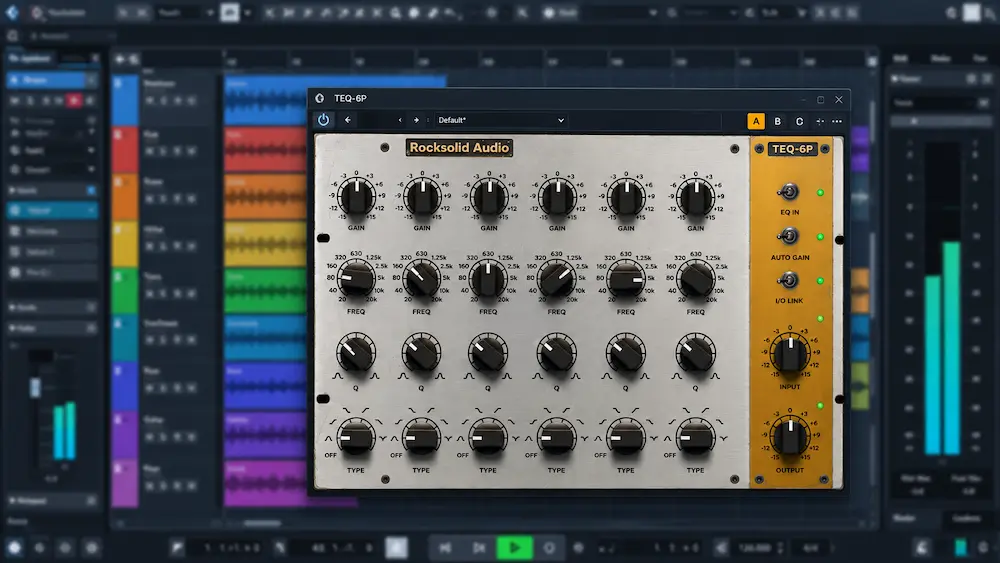
Rocksolid Audio TEQ-6P is a six-band parametric valve EQ that simulates its signal path at circuit level rather than recreating one specific vintage unit. The important distinction is not simply that the plugin uses circuit simulation, but that the simulated path is combined with six fully parametric bands, selectable valve and transformer characteristics, and modeled component tolerances in the Unique Edition.
That gives TEQ-6P a different position from both fixed-function vintage emulations and transparent digital EQs. The frequency-shaping side is flexible enough for modern production, while the circuit model is intended to make the processing itself part of the tonal decision.
The unresolved question is how much of that additional modeling translates into a useful sonic difference. The architecture is documented; its measurable and audible advantage over other well-engineered analog-modeling EQs is not yet independently established.
This review separates Rocksolid Audio’s published design claims from what can currently be established independently. Because independent measurements and controlled hardware comparisons are not yet available, conclusions about TEQ-6P’s circuit behavior and sonic advantage should be treated as an engineering assessment rather than a verified measurement result.
TEQ-6P Circuit-Level Modeling Explained
 Rocksolid Audio describes TEQ-6P as a real-time simulation of the underlying electrical circuit. The model includes the valves, transformers, coils, resistors, and capacitors that make up the simulated signal path. In principle, that means the EQ stage and its nonlinear elements are not treated as completely separate processes; the behavior of the simulated circuit changes as the signal moves through it.
For mixing and mastering, the important consequence is level-dependent behavior. A real valve or transformer stage does not behave as a fixed transfer curve at every operating level. Drive, headroom, harmonic generation, and the interaction between circuit stages can change as the signal amplitude changes. A circuit-based model has the potential to capture those changes in a way that a purely static EQ curve cannot.
That matters most when the EQ is doing more than correcting frequency balance. A broad boost through a clean digital EQ is primarily a frequency-domain operation. Driving a modeled valve circuit while making the same tonal adjustment is a different process: the filter response is accompanied by whatever nonlinear behavior the circuit introduces at that operating level. The broader question of when that analog behavior is useful rather than simply different is closely related to the analog vs. digital mastering decision.
This also changes how TEQ-6P should be evaluated. A frequency-response plot can show whether the filters behave as expected, but it cannot establish whether the nonlinear model is convincing. The more useful measurements are level-dependent frequency response, harmonic and intermodulation distortion, phase behavior, and aliasing under nonlinear drive. Those tests would show whether the circuit-simulation approach produces an audible engineering advantage rather than simply a more elaborate implementation.
Does Your Master Hold Up Beyond the EQ Plugin?
TEQ-6P highlights how much tonal balance, nonlinear character, dynamics, stereo integrity, and translation can interact in a finished master. If you want to hear how your own mix responds to professional mastering decisions, upload up to 35 seconds for a free mastering demo and evaluate the result on your material. Upload your mix for a free mastering demo →
How TEQ-6P Fits Into a Mixing and Mastering Workflow
TEQ-6P is best understood as a tonal EQ with nonlinear circuit behavior, not as a corrective or intelligent processing tool. It does not replace surgical EQ, resonance control, dynamic processing, or dedicated saturation. Its appeal is the ability to make a broad tonal move while the modeled valve circuit contributes its own response to the signal.
That puts TEQ-6P firmly in the tonal-processing category. The strongest applications are sources and buses where the engineer already knows the spectral move and wants the processing stage itself to contribute character.
Vocals
On vocals, TEQ-6P can make sense when EQ and harmonic character need to be considered as one decision. A low-mid cut, presence lift, or high-frequency boost can be evaluated through the same processing stage rather than through a clean EQ followed by separate saturation.
The practical advantage is workflow rather than a guaranteed sonic improvement. If the circuit response complements the voice, fewer processors may be needed to arrive at the desired balance. If it does not, a conventional digital EQ and dedicated saturation stage will usually give the engineer more independent control.
Bass and Low-End Instruments
Bass is a useful test of whether the nonlinear character is actually helping. Broad EQ combined with harmonic generation can make a bass part translate more effectively on smaller playback systems, particularly when the added harmonics reinforce the instrument’s perceived presence without requiring an aggressive top-end boost.
The trade-off is low-end definition. Excessive drive can add harmonic density without improving the fundamental, and that can make a crowded arrangement harder to manage. TEQ-6P should therefore be judged at matched output levels rather than on the immediate impression of a louder or denser bass.
Drum Bus and Mix Bus
Broad tonal moves are where TEQ-6P is most naturally suited to bus processing. A modest low-end adjustment, presence lift, or high-frequency shelf can change the overall balance while the modeled circuit adds character to the complete signal rather than to an isolated track. On acoustic drums, that stage can be especially effective after drum bleed has been brought under control, since unwanted hi-hat and cymbal spill can otherwise become more pronounced once the bus is compressed or saturated.
This is also where the processor becomes more interesting than a conventional EQ curve. The engineering decision is not only which frequencies to change, but how that change behaves through the nonlinear signal path. That interaction can be useful on a drum bus or mix bus when the goal is tonal shaping with some additional density.
It is not inherently an advantage, though. If the mix already has sufficient harmonic content, a transparent EQ may produce the more controlled result.
Mastering
Mastering is the more demanding test. Broad EQ moves are common at this stage, and a valve-based circuit can be useful when a small spectral adjustment needs to be accompanied by a subtle change in density or harmonic structure.
The margin for error is also much smaller. Any nonlinear processor used across a finished mix needs to be evaluated for more than its tonal curve: low-frequency stability, transient behavior, stereo integrity, distortion, phase response, and aliasing all matter. Circuit simulation by itself does not establish how TEQ-6P performs against those criteria.
For mastering, the sensible approach is therefore empirical: level-match the processor, compare it against a clean EQ and a trusted analog-modeling alternative, and listen at both normal and very low monitoring levels. TEQ-6P is worth testing in that context, but it should not be treated as a proven mastering reference until independent measurements and extended professional use establish that position.
Real-Time Circuit Simulation: What Is Actually Different About TEQ-6P?
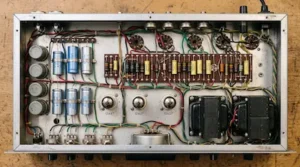 Real-time circuit simulation is a credible approach to analog modeling, but it is not a technology unique to TEQ-6P. The meaningful question is what Rocksolid Audio does with that approach. TEQ-6P combines component-level circuit simulation with a six-band parametric design and selectable valve and transformer characteristics, so the distinction is not the modeling method alone but how the simulated signal path shapes the result.
Black Rooster Audio, for example, has used component-based simulation in its VEQ processors, while Shattered Glass Audio has taken a circuit-oriented approach in products such as Phoenix. These examples are more relevant to TEQ-6P than a simple comparison of marketing terminology: they show that circuit-level analog modeling is an established engineering approach rather than a technology invented for this plugin.
Universal Audio takes a related approach in its Pultec collection, where the modeled signal path includes elements such as transformers, tubes, and the passive EQ network rather than treating the hardware as a simple frequency-response curve.
TEQ-6P therefore should not be positioned as a breakthrough because it uses circuit simulation. The more relevant question is how Rocksolid Audio has implemented the circuit, what behavior that implementation produces, and whether the result is useful in a working mix or mastering chain.
That last point matters because circuit accuracy and production practicality are separate engineering problems. A detailed nonlinear model can require substantially more computation than a conventional EQ. For mixing, the relevant test is not theoretical complexity but predictable performance: CPU load, latency, oversampling behavior, stability across multiple instances, and whether the additional processing translates into an audible benefit.
Without independent measurements or controlled comparisons, TEQ-6P’s circuit architecture is best treated as a technically interesting design choice rather than proof of superior sound. The implementation has to earn that distinction in use.
Why TEQ-6P’s Six-Band Design Matters
TEQ-6P is not a recreation of a single famous vintage EQ. Its six-band parametric architecture covers the 20 Hz–20 kHz range, with six response curves available per band. Rocksolid Audio also provides three valve styles and three transformer styles, giving the engineer control over both the frequency shaping and the character of the simulated signal path.
That makes a single instance practical for several types of tonal work: shaping a vocal, tightening a bass part, adjusting a guitar or drum bus, or making broad changes to a mix. Unlike a fixed-frequency hardware recreation, the engineer is not restricted to one historical EQ layout, while the valve and transformer options add another layer of control over the resulting character.
There is a clear trade-off. Once an analog-style EQ offers this much parametric control, it competes with a large field of modern EQ plugins that already provide precise filters, flexible routing, dynamic processing, spectrum analysis, and automation. TEQ-6P therefore cannot rely on its six-band layout as a differentiator on its own.
The value of the architecture depends on what happens around those six bands: how the modeled circuit responds to the signal, how the nonlinear behavior interacts with the EQ moves, and whether that combination offers something a cleaner parametric EQ does not.
Classic vs. Modern Interface: A Workflow Choice
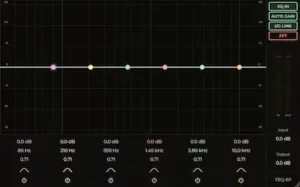
TEQ-6P offers two interface layouts: Classic, which follows a more hardware-oriented control approach, and Modern, which adds an FFT analyzer and draggable EQ controls.
The distinction is useful in practice. The Classic layout suits engineers who prefer dedicated controls and a hardware-style interaction, while the Modern view is faster for visual EQ work, especially when locating broad spectral imbalances or making several adjustments from a single display.
Neither interface changes the underlying processing. The FFT analyzer and graphical controls are workflow features, not evidence of better DSP or more accurate circuit modeling. Their value is simply that the same EQ can accommodate two different ways of working without switching to another processor.
TEQ-6P Unique Edition: Does the Randomized Circuit Matter?
The Unique Edition changes the model at the component level rather than simply adding another cosmetic “analog” mode. Rocksolid Audio assigns each copy a randomized set of component tolerances and a unique serial number, intended to reproduce the unit-to-unit variation found in physical analog hardware. The interesting engineering question is therefore not whether the copies are mathematically different, but whether those differences survive at the output as a meaningful and repeatable sonic variation.
From an engineering perspective, modeling component tolerances is a reasonable way to introduce unit-to-unit variation into a circuit model. What remains unproven is the practical significance of those variations. There is not enough independent testing to establish how large the differences are, whether they remain consistent across different program material, or whether an engineer could reliably identify one virtual unit from another in a level-matched comparison.
That makes the Unique Edition difficult to justify on sound alone. There is no basis for assuming that one randomized instance will be inherently better than another, and the feature should not be treated as a sonic upgrade over the Standard Edition.
The more tangible advantage is licensing. Rocksolid Audio lists three machine licenses, a unique unit serial number, unlimited transfers, and the ability to sell the license with the Unique Edition. Those terms can matter to engineers who work across multiple systems or want software ownership with transfer value.
For an engineer evaluating TEQ-6P primarily as an EQ, the Standard Edition is the logical place to start. The Unique Edition makes more sense when its licensing flexibility is valuable to your setup, or when controlled listening tests convince you that the unit-to-unit variation is actually useful in your workflow.
What TEQ-6P Cannot Replace
TEQ-6P is not a substitute for a transparent digital EQ when precision and control are the priority. Its circuit character is part of the processing, so there are situations where adding that behavior is simply counterproductive.
- narrow resonance removal and surgical corrective EQ;
- precise cuts where coloration is undesirable;
- dynamic EQ for frequency-dependent problems that change over time;
- linear-phase processing when its specific phase behavior is required.
The same distinction applies to saturation. A dedicated saturator gives the engineer independent control over drive, harmonic processing, and signal-path order. With TEQ-6P, the EQ and nonlinear circuit behavior are inherently linked, which can be an advantage for tonal work but a limitation when those processes need to be controlled separately.
The more accurate description is therefore a tonal valve EQ with integrated nonlinear character. That is a specific role, not a weakness. TEQ-6P makes the most sense when the character of the processing is part of the reason for making the EQ move in the first place.
TEQ-6P vs. Other Analog-Modeled EQs
The useful comparison is not which plugin is “most analog.” These processors model different pieces of the analog-EQ problem, and the better choice depends on whether the priority is a specific hardware topology, flexible parametric control, passive-EQ behavior, or nonlinear coloration.
| Plugin / Approach | Primary Character | Best Fit | How TEQ-6P Differs |
|---|---|---|---|
| Rocksolid Audio TEQ-6P | Six-band parametric valve EQ built around real-time circuit simulation | Tonal EQ where valve and circuit behavior are part of the processing decision | It is not modeled around one recognizable vintage EQ topology; the emphasis is on a flexible parametric design and simulated circuit behavior |
| Black Rooster VEQ Series | Component-based analog modeling with dedicated vintage-style EQ designs | Engineers looking for specific analog-inspired tonal responses | TEQ-6P takes a less hardware-recreation-focused approach and provides six parametric bands |
| Universal Audio Pultec Collection | Detailed modeling of classic Pultec hardware and its signal path | Broad EQ moves and the characteristic interaction of a well-established hardware design | TEQ-6P is not intended to reproduce a particular historical unit |
| Pulsar Massive / MP-EQ | High-end analog EQ modeling with a mastering-oriented feature set | Mix-bus and mastering EQ where broad tonal shaping and analog behavior are central | TEQ-6P uses a different circuit concept and places more emphasis on a six-band parametric architecture |
| SPL Passeq | Passive-EQ design with extensive frequency-selection options | Detailed tonal shaping based on a recognizable hardware-derived topology | TEQ-6P takes a valve-based circuit-simulation approach rather than reproducing the Passeq’s passive EQ architecture |
Ownership of a mature analog EQ collection is therefore not, by itself, a reason to add TEQ-6P. Its case depends on whether its particular combination of parametric control and nonlinear circuit behavior gives you a useful option that your existing EQs do not. That is a sonic and workflow decision, not a technology checklist.
How to Evaluate TEQ-6P: Level-Matched Testing
 Because independent measurements are not available yet, this review cannot establish TEQ-6P’s nonlinear behavior through original lab or listening data. The appropriate way to validate the plugin is a level-matched comparison that separates the EQ curve from the additional coloration introduced by the simulated circuit.
TEQ-6P includes automatic gain compensation, which can simplify this process, but the final comparison should still be checked independently. Match the bypassed and processed signals as closely as possible, then compare the same EQ moves against a clean digital EQ and, where available, another analog-modeled processor.
The test should also be repeated at different input levels. If the circuit model is contributing meaningful nonlinear behavior, changing the level feeding the processor should produce measurable or audible changes in the result. Listen for harmonic density, transient behavior, low-end definition, upper-mid texture, high-frequency smoothness, stereo stability, and perceived depth.
Those comparisons are more revealing than simply asking whether TEQ-6P sounds different. A valve-based nonlinear processor is expected to introduce some difference. The real test is whether that difference remains useful after the level advantage and novelty of the analog effect have been removed.
For mastering work, this distinction is critical. A processor that sounds more impressive simply because it is louder or denser has not demonstrated an advantage. TEQ-6P should therefore be judged by whether its circuit character remains useful once level is matched and the same tonal move is compared against a clean EQ and an established analog-modeling alternative.
CPU, Oversampling, and Large-Session Reality
Real-time circuit simulation can make CPU efficiency more relevant than it is with a conventional digital EQ. A detailed nonlinear model has more processing to perform, particularly when oversampling is used to control the artifacts that can accompany nonlinear DSP.
TEQ-6P supports oversampling and is available in VST3, AU, and AAX formats for macOS and Windows. Those specifications make it suitable for normal DAW workflows, but they do not tell us how the plugin scales under a heavy session.
There is currently not enough independent benchmark data to make a reliable claim about CPU consumption across different oversampling settings, sample rates, DAWs, or Apple Silicon and Windows systems. That distinction matters when comparing one instance on a vocal or mix bus with dozens of instances distributed across a large production.
The practical test is straightforward: run TEQ-6P inside the actual template you use for mixing or mastering, enable the intended oversampling mode, and monitor CPU load, latency, and system stability as the session grows. A demo period is far more useful for this evaluation than a CPU figure measured in an otherwise empty project.
Price and Value: Which TEQ-6P Edition Makes Sense?
Rocksolid Audio lists TEQ-6P at £89 for the Standard Edition and £129 for the Unique Edition, with both sold as one-time purchases rather than subscriptions. The developer also offers a 14-day full trial, which is the most useful way to determine whether the plugin’s valve character and circuit behavior justify adding another analog-modeled EQ to an established toolkit.
At £89, the Standard Edition sits in a competitive part of the analog-modeling EQ market. There are already well-established processors covering vintage hardware emulations, passive EQ designs, and component-level circuit modeling, so TEQ-6P needs to justify its price through its particular combination of six-band parametric control and nonlinear valve behavior rather than through the modeling methodology alone.
The Standard Edition is the more straightforward purchase for most engineers. The Unique Edition costs more primarily because of its individualized component tolerances and more flexible licensing: Rocksolid Audio specifies three machine licenses, a unique serial number, unlimited transfers, and the ability to sell the license. For a single-system setup, those additional licensing benefits are unlikely to justify the higher price unless the unit-to-unit concept itself has practical value.
The sonic case for the Unique Edition is harder to establish without controlled comparisons between different virtual units. If those tolerance variations are not demonstrably audible in your material, the additional cost is primarily buying licensing flexibility rather than a guaranteed improvement in sound.
The Critical Question: What Does the Circuit Simulation Actually Prove?
The main limitation of TEQ-6P is evidentiary rather than architectural. Rocksolid Audio documents a sophisticated circuit model, but the available material does not independently establish how its nonlinear behavior compares with other analog-modeling EQs under controlled conditions.
The unanswered questions are specific: harmonic and intermodulation behavior, aliasing, phase response, level-dependent response, CPU cost, and the audibility of Unique Edition tolerance differences. Those are the areas where measurement or controlled listening would materially strengthen the case for the technology.
Until that evidence exists, TEQ-6P should be treated as a technically credible and unusually designed valve EQ, not as a demonstrably more accurate analog model.
TEQ-6P Editorial Rating
This rating reflects the documented design, feature set, production role, and limitations discussed in this review. It is an editorial assessment, not a substitute for independent laboratory measurements or a controlled hardware comparison.
| Category | Rating |
|---|---|
| Tonal Shaping & Nonlinear Character | 8.2/10 |
| Parametric Control | 8.5/10 |
| Circuit & Nonlinear Design | 7.6/10 |
| Tonal EQ Workflow | 8.1/10 |
| Interface & Visual Control | 8.0/10 |
| Mastering Suitability | 7.2/10 |
| Overall | 7.9/10 |
Final Verdict: A Serious Valve EQ With Something to Prove
Rocksolid Audio TEQ-6P occupies a fairly specific position: it is a flexible six-band valve EQ where the circuit model is part of the tonal decision rather than a separate coloration stage. That makes it more adaptable than a fixed vintage EQ, but less suitable than a transparent parametric EQ when the goal is purely corrective processing.
The strongest part of the design is the combination of six-band parametric control with selectable valve and transformer characteristics. The weaker part is the evidence gap. The available documentation establishes how Rocksolid Audio says the processor is built, but not whether that architecture produces a measurable or consistently audible advantage over other high-quality analog-modeled EQs.
The bottom line: TEQ-6P is worth evaluating if you want one EQ stage to combine broad frequency shaping with valve-style circuit character. The Standard Edition is the sensible starting point for most users. The Unique Edition is primarily a licensing and unit-variation proposition until controlled comparisons demonstrate that its randomized tolerances have a useful audible effect.
Before You Add Another Processor, Hear What Your Mix Actually Needs
Not every balance, low-end, transient, stereo, or translation problem is solved by another EQ or more nonlinear processing. The useful test is what happens to the complete mix when level, dynamics, tonal balance, and stereo integrity are evaluated together. Upload up to 35 seconds of your mix and get a free mastering demo prepared by a real mastering engineer, then compare the original and mastered versions directly on your own material. Upload up to 35 seconds for your free mastering demo →
TEQ-6P FAQ
Is TEQ-6P a tube EQ or a conventional parametric EQ?
TEQ-6P is a six-band parametric EQ built around a modeled valve-based circuit. It combines conventional frequency shaping with the nonlinear behavior of the simulated signal path.
Does TEQ-6P replace a digital EQ?
No. A transparent digital EQ remains the better choice for surgical correction, resonance removal, dynamic EQ, and other situations where coloration is unwanted. TEQ-6P is primarily a tonal EQ with integrated valve character.
Is real-time circuit simulation better than conventional analog modeling?
Not inherently. Circuit simulation is a modeling methodology, not a guarantee of better sound. Its value depends on the accuracy of the circuit model, nonlinear processing, numerical implementation, and oversampling, as well as whether those differences are audible and useful in production.
Is TEQ-6P suitable for mastering?
It can be useful for broad tonal shaping in mastering, particularly when subtle valve coloration is desirable. Because mastering leaves little margin for unwanted artifacts, the plugin should be evaluated for distortion, aliasing, phase behavior, level dependence, and translation before becoming part of a critical chain.
Does TEQ-6P use a lot of CPU?
There is not enough independent benchmark data to assign a reliable universal CPU figure. Since TEQ-6P uses real-time circuit simulation and nonlinear processing, the sensible approach is to test it in the actual DAW template, particularly with multiple instances and higher oversampling settings.
What is the difference between TEQ-6P Standard and Unique Edition?
The Unique Edition uses randomized component tolerances to create an individual virtual unit with its own serial number. It also provides three machine licenses, unlimited transfers, and license resale. There is currently no independent evidence that one virtual unit is sonically superior to another.
Can TEQ-6P replace a Pultec-style EQ?
Not as a direct replacement. TEQ-6P can cover some of the same broad tonal-processing territory, but its six-band parametric architecture is fundamentally different from a specific Pultec-style hardware topology.
Is TEQ-6P good for vocals?
Yes. Broad low-mid shaping, presence adjustment, and high-frequency enhancement are natural applications, particularly when some valve coloration is desirable. Corrective EQ may still be better handled by a separate transparent processor.
Is TEQ-6P worth buying if I already own several analog EQ plugins?
Only if it gives you a result or workflow advantage that your existing processors do not. The circuit-simulation approach is technically interesting, but that alone is not a reason to add another EQ. The 14-day trial is the best way to determine whether TEQ-6P earns a permanent place in your setup.

Yurii Ariefiev evaluates EQ processors from an engineering perspective, with particular attention to frequency balance, nonlinear behavior, harmonic response, and how analog-style processing holds up under controlled level-matched comparison. For a valve EQ such as TEQ-6P, the key question is not how closely the interface resembles hardware, but whether the circuit behavior produces a useful result in real audio work.
Enjoyed this review? If you found it useful, you can support independent audio research with a coffee.
☕ Buy me a coffee