Drum bleed becomes a serious problem when the sound you want and the spill you want gone occupy the same moment. Hi-hat leaks into the snare transient, cymbals wash through tom microphones, and compression can turn otherwise tolerable spill into a constant layer of high-frequency clutter. A conventional gate can reduce what happens between hits, but it cannot reliably separate two instruments that arrive together.
MDrumCleaner is MeldaProduction’s dedicated answer to that problem. Instead of relying on a single gate, it combines five processing approaches: frequency-focused cymbal suppression, sidechain-based removal, spectral cleaning, a spectrum gate, and conventional gating. The useful question is not how many algorithms the plugin contains, but whether they give an engineer more control over difficult drum tracks without sacrificing ghost notes, transient definition, resonance, or natural decay.
That distinction matters at the mix stage. A drum-cleanup processor earns its place when it reduces the editing, automation, and corrective processing normally required to keep bleed under control. MDrumCleaner is particularly relevant to recorded acoustic drums, where the difference between a cleaner close mic and an over-processed one can determine how aggressively the entire drum bus can be shaped later.
| Type | Drum bleed removal and cleanup processor |
| Processing | Cymbal Killer, Side-chain Remover, Spectrum Cleaner, Spectrum Gate, Gate |
| Formats | VST, VST3, AU, AAX |
| Platforms | Windows and macOS |
| Latency | Zero-latency modes available; Side-chain Remover adds latency |
| Trial | 15-day fully functional trial |
| Launch Price | $34 at MeldaProduction at the time of review; regular price $173 |
Why Drum Bleed Has Become Harder to Control With Conventional Gates
 Close-mic bleed is nothing new in acoustic drum recording. The problem is what happens to that bleed once the rest of the mix starts working on it. A snare microphone can sound perfectly usable on its own, then become saturated with hi-hat after EQ, compression, clipping, or parallel drum processing. The same thing happens on toms: cymbal spill that seemed harmless in the raw track can become a bright, sustained layer that fights the kit once the close mics are pushed forward.
A gate remains effective when there is a clear level difference between the drum and the spill. The problem starts when the two sources overlap in time. A ghost note may sit close to the level of the hi-hat leaking into the snare mic; a cymbal crash can arrive during a tom fill; an open hi-hat can be loud enough to keep the gate open even when the snare is not being played. The gate can only make a level-based decision. It does not know which instrument produced the energy.
Manual editing solves some of these cases, but it comes with its own tradeoff. Detailed clip-gain work and automation can produce extremely clean tracks, yet the amount of intervention grows quickly across a full multi-miked kit. More importantly, edits that work on isolated hits may become obvious when the drums are compressed, saturated, or routed through parallel buses.
Newer drum-cleanup processors take a more selective approach. Oxford Drum Gate 2 combines drum detection with adaptive decay, while Acon Digital DeBleed:Drums uses neural-network processing alongside conventional DSP. MDrumCleaner takes a different route, putting several distinct cleanup methods—gating, frequency-focused filtering, spectral processing, and sidechain-based removal—inside one plugin.
The practical advantage is not that a conventional gate suddenly becomes obsolete. It is that the engineer has more options when simple threshold control stops being enough. For straightforward tom tracks, a gate may still be the fastest solution. For a snare buried under hi-hat spill or a tom track that needs to retain its natural decay, a frequency- or source-aware approach can offer a more useful compromise between isolation and realism.
How MDrumCleaner Handles Difficult Drum Bleed
MDrumCleaner’s five modules are not five versions of the same gate. They make different decisions about what should be reduced: Cymbal Killer targets high-frequency spill around drum hits, Side-chain Remover uses another microphone as a reference, Spectrum Cleaner builds a profile of the wanted drum, Spectrum Gate works from frequency-dependent level differences, and Gate handles conventional level-based separation.
Cymbal Killer: Targeting Hi-Hat and Cymbal Spill
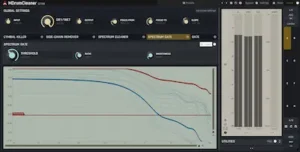
Cymbal Killer is designed for the high-frequency leakage that causes some of the most obvious problems in close drum microphones. It suppresses the upper spectrum when the target drum is not being detected and allows more of that range through during the hit.
The primary application is a snare microphone with excessive hi-hat spill, but the same principle applies to cymbal leakage in tom tracks. A static low-pass filter can reduce the problem, but it also removes part of the snare’s attack, wire detail, and upper harmonics. Making the high-frequency reduction dependent on the drum hit allows the engineer to keep more of that information where it matters.
The important distinction is workflow rather than novelty. Cymbal Killer can replace a manually assembled combination of dynamic filtering and gating when the problem is specifically high-frequency cymbal spill. Its usefulness therefore depends on whether that targeted reduction preserves enough of the snare or tom’s attack and upper harmonics to remain useful later in the mix.
Side-chain Remover: Using Another Microphone as a Reference
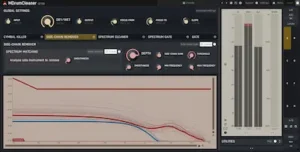
Side-chain Remover is the module that gives MDrumCleaner its most distinctive workflow. Instead of judging the target track only by its own level or spectrum, it can use an external signal as a reference for the material that needs to be reduced.
The important workflow difference is that Side-chain Remover requires a reference recording of the unwanted source. In the classic snare-versus-hi-hat case, the separate hi-hat microphone gives the processor information about how that source appears in the target snare microphone.
That makes this approach fundamentally different from threshold gating, but it also makes the quality of the reference important. The hi-hat captured by the snare mic has a different level, timing, frequency balance, and acoustic path from the dedicated hi-hat track. The sidechain should therefore be treated as source information rather than a literal subtraction signal.
The tradeoff is latency. MeldaProduction specifies that the Side-chain Remover introduces latency, making it better suited to mix-stage cleanup than latency-sensitive tracking or monitoring.
Spectrum Cleaner: Learning the Drum You Want to Keep
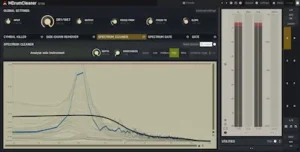
Spectrum Cleaner approaches the problem from the other direction. Rather than supplying a reference for the unwanted source, it learns the spectral characteristics of the desired drum and attenuates material that falls outside the learned profile.
That can be useful when the target microphone has a reasonably consistent tonal identity. It also introduces a limitation that applies to any learned drum profile: acoustic drums are highly variable. A hard snare hit, rimshot, ghost note, and soft backbeat can have very different spectra, while tom resonance changes with playing dynamics and sympathetic vibration from the rest of the kit.
For that reason, the useful setting is rarely the most aggressive one. A profile that removes every deviation from the learned spectrum may produce impressive isolation in solo while taking away legitimate variation from the performance. The better target is controlled attenuation of spill while retaining the characteristics that make the microphone sound like a real drum.
Spectrum Gate: Reducing Bleed by Frequency
Spectrum Gate applies the gating concept across the frequency spectrum rather than treating the entire signal as one broadband envelope. This is particularly relevant when the wanted drum and the unwanted spill occupy different parts of the spectrum.
On a tom track, for example, cymbal energy can remain prominent even when a conventional gate is tuned to preserve the tom’s natural decay. Spectral attenuation can target more of the upper-frequency spill while leaving the low-mid body and resonance comparatively intact.
There is still a hard limit. When wanted and unwanted sources overlap heavily in frequency, level, and timing, no spectral gate can separate them perfectly. It can improve the compromise between isolation and naturalness, but pushing the process too far risks audible tonal movement or loss of legitimate drum information.
The Gate: Still the Right Tool for Simple Bleed
MDrumCleaner’s conventional Gate should not be dismissed simply because the plugin offers more sophisticated processing. If a tom is 15 dB above its cymbal spill and the release can be set without damaging the decay, a normal gate is still the fastest solution.
The advantage of having all five approaches in one processor is that the engineer can escalate only when the basic solution stops working. Start with level-based gating when the recording allows it. Move to frequency-selective or source-aware processing when the bleed overlaps the performance too closely for a conventional gate to handle cleanly.
That is where MDrumCleaner makes the most sense: not as a replacement for basic drum gating, but as a more surgical option when basic gating has reached its limits.
Give Your Mix the Space to Translate
Cleaning up individual drum tracks can give you more control over dynamics, punch, and balance, but the final test is how those decisions hold together in the finished mix. If you want to hear how your track can translate with controlled dynamics, clarity, and depth, you can send us up to 35 seconds of your mix for a free mastering demo.
Submit your mix for a free mastering demo →
Where MDrumCleaner Actually Changes the Mixing Workflow
MDrumCleaner’s useful output is not the isolated track; it is the signal that reaches the next processor. If hi-hat spill is repeatedly triggering snare compression or feeding harsh cymbal energy into saturation, reducing that spill upstream changes what those processors react to.
Take a typical multi-miked rock or metal session: kick in and out, snare top and bottom, several toms, overheads, and room microphones. The kick and the rest of the drum arrangement still depend on upstream choices about layering, phase alignment, and low-frequency interaction, while the close tracks may require gating, clip-gain edits, fades, and automation before they can be processed aggressively. The problem is rarely consistent across the song. A setting that works for isolated verse hits can fall apart when the drummer opens the hi-hat, crashes through a fill, or moves from ghost notes to full-force backbeats.
This is where a dedicated bleed-removal processor can reduce maintenance. If the unwanted cymbal content is reduced before compression, the compressor spends less of its gain-reduction range reacting to the cymbal spill. If high-frequency leakage is controlled before saturation, the saturator has less abrasive material to exaggerate. The result is not simply a cleaner soloed track; it is a more predictable signal feeding the rest of the mix.
Snare and Hi-Hat Spill
The snare top is probably the most obvious place to test MDrumCleaner. Hi-hat spill often occupies exactly the range an engineer wants to emphasize when adding snare attack and presence. Bright EQ can make the snare more articulate while simultaneously turning the hi-hat into a constant layer of hash.
Cleaning that spill before the main snare processing changes the balance of the entire chain. Compression responds more to the snare itself, saturation generates fewer unwanted cymbal harmonics, and high-frequency EQ can be used for the snare rather than as a compromise between the snare and the hat.
The important test is what remains after the processing chain is engaged. A snare that sounds pristine in solo but loses its ghost notes or becomes unnaturally dry in the full kit is not a successful cleanup. The useful setting is the one that gives the mixer more freedom without making the isolation audible.
Tom and Cymbal Bleed
Toms present a different problem. Their microphones can spend most of the song capturing cymbals and room information, then become important for a few seconds during a fill. A conventional gate can handle the obvious cases, but preserving a natural tom decay often means leaving more cymbal spill than the mix really needs.
Spectrum-based processing is potentially more useful here because the goal is not necessarily to shut the microphone off. Reducing the upper-frequency cymbal content while retaining the tom’s low-mid body and resonance can produce a more natural result than forcing a broadband gate to do the entire job.
Overheads and Room Microphones
Overheads and room microphones are where I would use MDrumCleaner most cautiously. Their bleed is part of the recording by design: it contributes to the kit’s depth, timing relationship, and sense of acoustic cohesion.
Targeted cleanup can still make sense when one cymbal or hi-hat dominates the balance, but aggressive processing can easily make the kit smaller, drier, or less cohesive. For these channels, MDrumCleaner is better treated as corrective processing than routine track cleanup.
The useful rule is simple: remove only the bleed that is limiting the next mix decision. If the spill is not preventing useful EQ, compression, saturation, or balance work, there may be no reason to remove it.
Where Drum Bleed Removal Starts to Work Against the Mix
 The danger with any aggressive drum-cleanup processor is simple: more isolation can produce a worse drum sound. Bleed is not automatically unwanted information. Some leakage is part of how a multi-miked acoustic kit acquires its depth, timing relationship, and sense of being a single instrument.
That makes soloed tracks a poor way to judge the result. A snare can sound impressively clean with the rest of the kit muted and then feel unnaturally small when the overheads, rooms, and toms come back in. The useful question is whether removing the spill gives the mix more control without changing the character of the performance.
Ghost Notes Are a Real Stress Test
Quiet snare work is where intelligent cleanup has less margin for error. A hard backbeat is easy to distinguish from moderate hi-hat spill; a ghost note may not be. If the processor interprets low-level snare information as bleed, the track can become cleaner while losing the subtle dynamics that make the performance feel played rather than programmed.
The same issue applies to tom fills and resonant hits. A useful drum-cleanup setting has to preserve the low-level information that defines the drummer’s phrasing, not simply maximize the amount of silence between obvious hits.
Spectral Cleanup Can Create Its Own Problems
Frequency-selective processing introduces a different failure mode from a conventional gate. Instead of an obvious open-and-close action, the tonal balance can move as the processor decides which parts of the spectrum belong to the drum. Push that process too far and the result may be a shifting top end, shortened resonance, or an unnatural transition around individual hits.
Those artifacts are easy to underestimate on a raw track. Compression, saturation, clipping, and parallel processing can magnify them later in the chain. For that reason, MDrumCleaner should be judged through the processing that will actually follow it, not only by how impressive the cleaned signal sounds in isolation.
Evaluation note: This review focuses on MDrumCleaner’s published processing design, documented features, workflow implications, and how those approaches fit real drum-mixing decisions. Because the plugin is newly released, there is not yet enough independent long-session or controlled comparison data to make definitive claims about CPU efficiency, artifact performance, or overall superiority.
MDrumCleaner Alternatives: Oxford Drum Gate 2 and DeBleed:Drums
MDrumCleaner sits between conventional drum gating and more automated separation tools. The comparison is therefore less about which plugin has the longest feature list and more about how much control the engineer wants over the cleanup process.
| Feature | MDrumCleaner | Sonnox Oxford Drum Gate 2 | Acon Digital DeBleed:Drums |
|---|---|---|---|
| Primary approach | Gating, spectral processing, frequency-focused cleanup, and sidechain-based removal | Intelligent drum detection, adaptive gating, decay control, and drum preparation | Neural-network separation combined with DSP |
| Best fit | Engineers who want multiple ways to reduce difficult drum bleed | Detailed drum gating, decay shaping, leveling, and broader drum preparation | Engineers looking for automated separation of drum hits from microphone spill |
| Sidechain-based removal | Yes | Not a primary workflow | Not a primary workflow |
| Spectral processing | Yes | Primarily detection- and gate-based processing | Source-separation processing |
| Drum detection | Used within the processing workflow | Yes, including drum-type detection | Source-aware neural processing |
| MIDI extraction | No dedicated MIDI extraction workflow | Yes | No |
| Phase/time alignment | No dedicated equivalent | Yes | No dedicated equivalent |
| Latency | Zero-latency modes available; Side-chain Remover adds latency | Substantial latency; primarily suited to mixing | Real-time processing |
| Price position | Low introductory price; higher regular price | Premium | Mid-priced specialist tool |
Oxford Drum Gate 2 is the broader drum-preparation option. Its intelligent detection, adaptive decay, leveling, MIDI output, and timing, polarity, and phase functions extend well beyond bleed reduction. If those capabilities are already important to your drum-editing workflow, MDrumCleaner is not a direct replacement.
DeBleed:Drums is the more automated alternative. Acon Digital uses neural-network technology alongside DSP to separate drum hits from microphone spill. MDrumCleaner takes a different approach, giving the engineer several dedicated cleanup methods rather than relying primarily on automated source separation.
For engineers who already solve straightforward bleed with a gate, dynamic EQ, clip gain, and automation, MDrumCleaner becomes easier to justify when those methods start requiring too much intervention. Its main selling point is not that it eliminates the need for conventional tools, but that it gives you additional options when they stop being enough.
Black Salt Audio Silencer is another relevant specialist alternative. Its workflow is centered on drum gating and dedicated bleed reduction, with a more focused control set than MDrumCleaner. That makes it relevant when the problem is primarily conventional drum-gating cleanup rather than choosing between several different bleed-reduction approaches.
What Drum Bleed Cleanup Changes Downstream
 MDrumCleaner is a mixing processor rather than a mastering tool, but the decisions made at the drum-microphone level can affect everything that follows in the signal chain. That is part of the broader mix preparation process: the cleaner and more controlled the mix is before delivery, the fewer problems have to be managed downstream.
The most immediate change is dynamic control. Reducing hi-hat spill before snare compression allows the compressor to respond more consistently to the snare itself instead of repeatedly bringing the hat forward. The same principle applies to saturation, clipping, and parallel processing: the less unwanted high-frequency material enters those stages, the less aggressively the downstream processing has to compensate for it.
The mastering impact is indirect. MDrumCleaner cannot selectively remove drum bleed from a finished stereo mix, so its value belongs earlier in the production chain. The useful question is whether the cleanup produces a more controlled drum bus before the stereo mix is finalized—not whether the plugin provides a mastering-specific advantage.
Latency is mode-dependent. MDrumCleaner provides zero-latency processing modes, while the Side-chain Remover introduces latency and is therefore better suited to mixing than latency-sensitive tracking. There is not yet enough independent benchmarking to make a meaningful CPU-efficiency claim across large sessions.
Overall Assessment
| Category | Assessment |
|---|---|
| Bleed Reduction Control | Excellent potential |
| Selective Processing | Strong |
| Preservation of Drum Character | Needs careful use |
| Multi-Mic Workflow Utility | Strong |
| Latency Flexibility | Good |
| Independent Evidence | Limited at launch |
| Overall | Promising specialist tool |
MDrumCleaner’s strongest value is its range of ways to approach difficult drum bleed rather than any single processing method. It is particularly useful for multi-miked acoustic drums where conventional gates have reached their limits, but the lack of independent testing means its transparency and artifact performance should still be judged on real sessions rather than assumed from the published design.
MDrumCleaner Verdict: A Useful Specialist Tool, Not a Must-Have
MDrumCleaner addresses a real problem in recorded acoustic drums: microphone bleed that becomes increasingly difficult to manage once compression, saturation, EQ, and bus processing are applied. Its strongest feature is not any single algorithm, but the ability to approach the same problem from several directions.
For snare and tom tracks where conventional gating is already forcing compromises, that flexibility can be genuinely useful. Cymbal-focused suppression, spectral processing, sidechain-based removal, and conventional gating give the engineer more ways to find a workable balance between isolation and natural drum character.
The limitations are equally important. Aggressive cleanup can reduce ghost notes, transient detail, resonance, or the acoustic relationship between close microphones and overheads. The plugin is also too new for independent testing to establish a clear advantage in transparency, artifact control, CPU efficiency, or large-session performance.
My conclusion: MDrumCleaner is worth auditioning if drum bleed is a recurring mixing problem and conventional gates are no longer giving you enough control. It is a specialist tool for difficult multitrack drums—not a replacement for every gate, editor, or drum-processing processor in the session.
Hear What Your Mix Really Needs
Not every drum-mix problem is solved by adding another processor. Once bleed, compression, saturation, and spectral cleanup have been addressed, the more useful question is what the finished mix actually gains in clarity, punch, depth, dynamics, stereo balance, and detail. A real mastering comparison can reveal whether those mix decisions are translating as intended, and where the stereo master still needs attention. Upload up to 35 seconds of your mix and receive a free mastering demo prepared by a real mastering engineer. Upload your mix and hear the free mastering demo →
FAQ
Can MDrumCleaner remove hi-hat bleed from a snare track?
Yes. Hi-hat spill on snare microphones is one of the most practical applications for MDrumCleaner. Cymbal Killer can reduce high-frequency leakage, while Side-chain Remover can use another microphone as a reference for the unwanted source. The goal should usually be controlled reduction rather than complete isolation, since aggressive processing can affect snare transients, ghost notes, and natural decay.
Should MDrumCleaner go before or after drum compression?
Usually before compression. A compressor can bring low-level cymbal spill forward along with the wanted drum signal, making the bleed more difficult to control later. Cleaning the close microphone first gives the compressor a more useful signal to work with. The final setting should still be judged through the compression and saturation that follow it.
Can MDrumCleaner replace manual drum editing?
Not completely. It can reduce the amount of clip editing, fades, and automation required when microphone spill is relatively consistent. Manual editing remains the better option when individual hits need different treatment, bleed changes significantly between sections, or precise control over every decay is required.
Is MDrumCleaner better than a regular gate for toms?
It can be when cymbal spill overlaps the tom’s natural decay or when quieter hits make conventional threshold gating unreliable. A standard gate is still the simpler choice when there is a clear level difference between the tom and the bleed. Spectral or source-aware processing is most useful when a conventional gate forces too much of a compromise between isolation and naturalness.
How does MDrumCleaner compare with Oxford Drum Gate 2?
They overlap, but they are not direct substitutes. MDrumCleaner focuses on several methods of reducing drum bleed, including gating, spectral processing, and sidechain-based removal. Oxford Drum Gate 2 provides a broader drum-preparation workflow with intelligent detection, adaptive decay, leveling, MIDI output, and timing, polarity, and phase-related tools. Engineers who need those additional functions may find Sonnox the better fit.
Does MDrumCleaner use AI?
MDrumCleaner should not be described as a neural-network drum-separation plugin based on MeldaProduction’s published information. Its processing is built around multiple DSP approaches, including spectral analysis, detection, gating, filtering, and sidechain processing. This differs from Acon Digital DeBleed:Drums, which explicitly uses neural-network technology trained on drum recordings.

For drum-cleanup processors, the useful result is not maximum isolation. I pay particular attention to what happens to ghost notes, transient definition, resonance, and cymbal spill once the cleaned track is pushed through compression and the rest of the drum chain.
Enjoyed this review? If you found it useful, you can support independent audio research with a coffee.
☕ Buy me a coffee