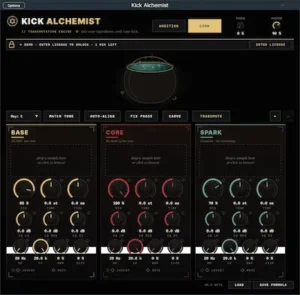
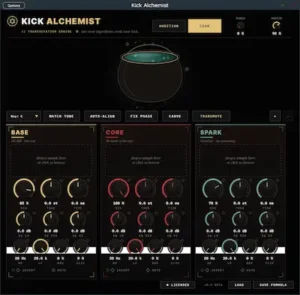
ForgeDSP Kick Alchemist is a sample-based kick construction plugin designed to turn existing drum samples into a finished one-shot. Instead of generating the sound from a synthesis engine, it combines three dedicated layers: BASE for the low end, CORE for the body, and SPARK for the attack. Each layer can be tuned, phase-adjusted, and frequency-shaped before the finished kick is rendered as a single one-shot.
That approach targets one of the more tedious parts of electronic drum production. Layering kicks is easy; making the layers behave as one coherent instrument is not. A sub and body sample can reinforce each other or partially cancel in the low end, while adding a separate click can increase attack without improving the kick’s overall definition. The limiting factor is rarely sample selection alone. It is the timing, frequency overlap, and phase relationship between the layers.
From a mixing and mastering perspective, that makes Kick Alchemist more interesting as a kick-layering workflow than as a conventional kick plugin. Its purpose is to consolidate several repetitive production tasks—layer management, tuning, phase adjustment, frequency carving, and final rendering—into one focused environment. The question is whether that specialization saves enough time and produces enough control to justify replacing a workflow that can already be built with standard DAW tools.
In This Review
Kick Alchemist at a Glance
| Specification | Details |
|---|---|
| Developer | ForgeDSP |
| Plugin Type | Sample-based kick construction plugin |
| Layer Structure | BASE, CORE and SPARK |
| Layer Controls | Tuning, phase adjustment and frequency shaping |
| Combination Tool | TRANSMUTE |
| One-Shot Rendering | COOK |
| Plugin Format | VST3 |
| Initial Platform | Windows |
| macOS | Planned |
| Introductory Price | $55 |
| Regular Price | $69 |
| Demo | Fully functional 25-minute demo |
Kick Alchemist is deliberately narrower than a full kick synthesizer. Its purpose is to organize and refine existing samples rather than generate every part of a kick from an internal synthesis engine. That makes its value highly dependent on the producer’s existing sample library and the need for a repeatable layering workflow.
Why Sample-Based Kick Layering Still Works
 Dedicated kick synthesizers now offer precise control over pitch envelopes, decay, harmonics, and transient shape. That does not make samples obsolete. In many electronic productions, the fastest route to the right kick is still to combine specific pieces of existing material: a low-end sample with the right decay, a body with the right punch, and a transient that survives the arrangement.
The hard part is getting those elements to behave like a single sound rather than three unrelated samples.
Low-frequency overlap is where the problems become most obvious. When two kick layers contain energy in the same range, their relative timing and polarity determine whether that energy is reinforced or partially canceled. A second layer can therefore make a kick sound smaller rather than larger. The same problem can affect the attack: a transient layer may add high-frequency energy while making the composite kick less focused because its timing does not agree with the main body.
That is why effective kick layering is less about stacking more samples and more about assigning each layer a defined job. The low-end layer should establish the foundation; the body should contribute punch and character without unnecessarily competing for sub energy; the transient should add definition without turning the attack into a separate event. Checking the combined result in mono is particularly useful because phase-related weaknesses that are easy to miss in stereo can become immediately obvious.
Kick Alchemist takes that division of labor and turns it into a dedicated workflow: BASE handles the low end, CORE the body, and SPARK the attack. The useful part is being able to make those decisions while the three components are heard as one kick, then commit the result as a single one-shot.
What Kind of Kicks Is Kick Alchemist Best For?
Kick Alchemist is best suited to electronic productions where the kick needs to combine a controlled low-frequency foundation with a separate body and transient. It makes particular sense when the producer already has useful samples but needs more control over how their envelopes, frequency ranges and phase relationships interact.
The workflow is less compelling when the kick needs to be synthesized from scratch or when a finished kick only requires conventional EQ, compression, clipping or saturation. Its sweet spot is the production stage between sample selection and committing a finished kick to the arrangement.
This also explains why the plugin can be useful even when the individual samples are already good. The problem is not necessarily finding a better kick sample; it is making several suitable sources behave as one instrument without unnecessary editing and routing.
Hear How Your Kick and Low End Translate in the Full Mix
Once the kick has the right punch, low-end weight and transient balance, the next question is how those elements hold together in the finished mix. Our free mastering demo lets you hear how your track responds to professional mastering decisions, with up to 35 seconds of your mix to evaluate clarity, depth, dynamics and translation before committing to a full master. Submit your free mastering demo →
What Kick Alchemist Changes in the Kick-Layering Workflow
Kick Alchemist reduces the construction process to three defined layers: BASE for the low end, CORE for the body and punch, and SPARK for the attack and click. The division is simple, but it forces a useful engineering decision: each sample has a specific job rather than competing with the other layers across the entire spectrum.
Each layer can be tuned independently, adjusted for phase, and frequency-shaped before the three are combined. Once the kick is working, COOK renders the stack to a single one-shot that can be dragged directly into the DAW. TRANSMUTE adds a faster way to audition different layer combinations without manually swapping samples.
The deliberately limited architecture is one of the plugin’s strengths. A conventional DAW gives you more flexibility, but reproducing the same workflow usually means managing three audio or sampler tracks, matching their timing, tuning each layer, filtering overlapping frequencies, checking polarity and phase, routing the layers to a bus, and finally printing the result. None of those operations is technically demanding. The friction comes from having to repeat them every time you build another kick.
Kick Alchemist moves those decisions into a single instrument. That does not make the underlying processing more sophisticated than what a DAW can already provide. It makes the process more contained and repeatable. For producers who build kicks frequently, that reduction in routing, track management, and context switching is the product’s most convincing advantage.
Kick Tuning Is About the Bass Relationship, Not Just the Song Key
Tuning a kick to the song’s root note is an unreliable shortcut. What matters in a finished mix is how the kick’s pitch, pitch envelope, and decay interact with the bass line. A kick can be technically “in key” and still occupy the wrong part of the low end, masking the bass or losing impact as the two decay together.
This becomes especially important with a sustained sub layer. If the BASE sample has a strong tonal tail, its frequency content can remain exposed long after the initial transient. Matching that layer to the musical context can make the kick easier to balance, but the correct target is not necessarily the root note. Depending on the arrangement, a different pitch or shorter decay may leave more room for the bass while preserving the perceived weight of the kick. The same fundamental-versus-harmonics relationship appears when designing modern 808s and synthesized bass, where the bass source itself may need to be controlled before it competes with the kick.
Per-layer tuning is therefore one of Kick Alchemist’s more useful controls. A producer can retain a CORE or SPARK sample whose character already works and change the low-frequency behavior independently. That is considerably faster than replacing the entire kick simply because its sub component does not fit the track.
There is a trade-off. Pitch-shifting a sample changes more than its nominal note: it also alters its timing, harmonic spacing, and overall spectral balance. Large transpositions can make the low layer less natural or change the character that made the source useful in the first place. The final decision should be made against the bass and full arrangement, not from the tuner display alone.
Why Phase Alignment Matters in Layered Kicks
Phase control is arguably the most technically consequential part of Kick Alchemist’s workflow. When two kick layers carry substantial energy in the same low-frequency range, small differences in timing can change how their waveforms combine. The result is not simply more or less bass: certain frequencies can be reinforced while others are reduced, changing the perceived weight and punch of the finished kick.
This is why adding another low-frequency layer does not necessarily make a kick sound larger. If the waveforms interact unfavorably, the additional sample can reduce the very energy it was meant to reinforce. The effect may be difficult to judge in stereo, particularly when the layers sound impressive in isolation, but a mono check can expose a weak or hollow low end quickly.
Kick Alchemist makes this adjustment part of the layer-building process rather than requiring the producer to move between samples, DAW editing tools, and separate phase utilities. That is a legitimate workflow advantage: the phase relationship can be adjusted while auditioning the BASE, CORE, and SPARK combination as a single instrument.
When the low-frequency layers are shifted against one another, the useful comparison is not the phase control itself but what happens to the composite kick in mono. A setting that initially sounds fuller in stereo can lose some of that weight after the layers are summed, so I would treat the phase control as an auditioning tool rather than look for a single “correct” position.
There is a distinction worth keeping clear, though. Phase alignment does not mean maximizing correlation. The most correlated setting is not automatically the best-sounding one, and deliberate phase offsets can produce useful changes in punch, attack, or low-end character. The correct setting is the one that gives the kick the intended response in the arrangement while remaining stable under mono playback.
Where Kick Alchemist Actually Saves Production Time
None of the individual steps is unusual. The practical difference appears when the same sequence has to be repeated across several kick variations: load another sample, tune it, check the overlap, adjust the phase relationship, route the layers together and then print the result. Kick Alchemist puts those steps into one dedicated instrument.
Kick Alchemist compresses that process into a dedicated workflow: load the samples, assign them to BASE, CORE, and SPARK, tune and shape each layer, adjust their phase relationship, audition alternate combinations with TRANSMUTE, then use COOK to print the result as a single one-shot.
COOK becomes particularly useful once the kick is finished. After the layers have been balanced, the composite can be committed as a one-shot and treated like any other kick sample in the arrangement. In a production session, that removes the need to keep the three source layers active just to reproduce a sound that has already been approved. The result is a cleaner handoff from sound design to arrangement.
The real gain, then, is not raw processing power. It is repeatability with less session management. A producer can move from sample selection to a finished kick without building and maintaining a miniature multi-track drum chain for every variation. For someone who designs kicks frequently, that is a meaningful workflow improvement; for an occasional user, it is mostly convenience.
TRANSMUTE Is Useful, But It Does Not Fix a Bad Kick Layer
 TRANSMUTE is most useful once the source samples are already in the layer slots. If the CORE is working but the BASE is not quite right, different combinations can be auditioned without moving files between samplers or rebuilding the routing. It does not replace sample selection; it makes the comparison stage faster.
That makes TRANSMUTE a sound-selection shortcut, not a sound-design substitute. Randomization cannot compensate for incompatible source material. A muddy sub sample and a dense body sample will not become coherent simply because software has combined them. The producer still needs to recognize what the kick is missing and choose source material accordingly.
The same principle explains why Kick Alchemist’s three-slot architecture is more useful than it may initially appear. Unlimited layering sounds flexible, but every additional layer introduces more frequency overlap, more phase interaction, and more decisions about what each component is actually contributing. Limiting the design to BASE, CORE, and SPARK encourages a clearer division of labor and keeps the composite kick easier to diagnose and control.
Kick Alchemist vs. Kick Synths and Conventional Sample Layering
Kick Alchemist sits between two established approaches to kick design: dedicated kick synthesis and conventional DAW-based sample layering. It is not intended to replace a full kick synthesizer, and it does not fundamentally change what can be achieved with standard DAW tools. Its focus is narrower: combining existing samples into a coherent kick with less track management and fewer separate processing steps.
ForgeDSP Kick AlchemistThree-layer sample constructionFast tuning, phase adjustment, frequency carving and consolidationRelies on source samples; no deep kick synthesis engineProducers who already have kick samplesSonic Academy KICK 3Kick synthesis plus sample-based layersExtensive control over pitch, amplitude, harmonics, phase and structureBroader system with a deeper sound-design workflowProducers who want deep kick synthesisd16 PunchBox 2Kick synthesis, sampling and effectsMultiple sound-generation methods and extensive processing optionsMore parameters and a broader design environmentProducers who want synthesis, sampling and effectsDawesome Chop SueyTime-based kick-component sequencingDistinct approach to combining transient, body and tail elementsDifferent workflow from conventional simultaneous layeringExperimental kick constructionStandard DAW workflowSeparate samplers or audio tracksMaximum flexibility with no dedicated kick plugin requiredMore routing, editing and consolidation workProducers who want maximum flexibility
The current kick-plugin market illustrates the distinction. Sonic Academy KICK 3 is positioned as a much broader kick-design environment, combining synthesis, sample import, multiple layers and detailed pitch, amplitude and phase control. d16 PunchBox 2 similarly covers several kick-generation methods alongside sampling and effects. These tools make sense when the goal is to build the kick itself from a deeper set of synthesis and processing controls.
Kick Alchemist solves a different problem. If the producer already has suitable source material, its value is in keeping the construction process contained: three defined layers, independent tuning and shaping, phase adjustment, rapid combination changes with TRANSMUTE, and final consolidation through COOK.
KICK 3 is the stronger choice when the producer wants extensive control over how the kick is generated and shaped. Kick Alchemist is more compelling when the raw material already exists and the priority is combining those samples quickly and predictably.
Chop Suey is the more interesting conceptual alternative because it approaches the same general problem from a different direction. Rather than treating all kick components as simultaneous layers, it uses time-separated stages for elements such as transient, body and tail. That makes it less of a direct substitute for Kick Alchemist and more of an alternative philosophy for constructing a composite kick.
The standard DAW workflow remains the benchmark that Kick Alchemist has to justify. Everything the plugin does at a fundamental level can be approximated with samplers, audio editing, EQ, filtering and phase tools. Once the kick has been consolidated, however, it becomes a normal mix source that may still need tonal shaping, dynamics or controlled coloration; those decisions belong to the downstream mix chain rather than the kick-construction stage. For example, console-style preamp and compression processing can be useful when shaping drum density and character after the source itself is already under control. The question is therefore not whether Kick Alchemist enables otherwise impossible results. It is whether its dedicated environment makes repeated sample-based kick construction faster, cleaner and easier to reproduce.
For producers who already work primarily from existing samples, that narrower scope is the product’s strongest competitive argument.
The Limits: What Kick Alchemist Does Not Solve
Kick Alchemist does not solve source selection. The three-layer structure gives each sample a defined role, but the result still depends on whether the chosen BASE, CORE and SPARK samples actually complement one another. If the source layers have incompatible envelopes or too much overlapping energy, the plugin gives you more control over the problem; it does not remove the problem.
It also stops short of final kick processing. A finished one-shot may still benefit from saturation, clipping, compression, transient shaping or additional EQ depending on the production. Those processes are outside the plugin’s core purpose, and that is not necessarily a weakness; Kick Alchemist is primarily a construction and consolidation tool rather than a complete kick-processing chain.
Platform support is a more practical limitation. At launch, Kick Alchemist is available as a Windows VST3 plugin, with macOS support planned rather than currently available. For a Mac-based studio, that is a straightforward compatibility barrier rather than a minor inconvenience.
There is also not enough independent performance data to make firm claims about CPU consumption, latency, large-session stability, aliasing or oversampling behavior. Those remain unanswered technical questions. Until controlled measurements or broader independent testing are available, they should not be presented as either strengths or weaknesses.
Where Kick Alchemist Fits in Mixing and Mastering
Kick Alchemist is primarily a music-production and pre-mix sound-design tool, but its relevance to mixing is straightforward: kick construction decisions made before the mix can have a significant effect on what the mix engineer has to solve later.
A poorly constructed kick can create problems that initially look like mix problems: unstable sub energy, excessive low-mid buildup, a transient that loses definition under heavy limiting, or a kick whose low end changes substantially between stereo and mono playback. Some of these issues can persist into mastering, where low-frequency problems may require a different diagnostic approach. EQ, compression, clipping and bus processing can sometimes manage the symptoms, but processing cannot always compensate for a fundamentally incompatible set of source layers.
That is where the BASE/CORE/SPARK architecture has a practical advantage. Keeping most of the low-frequency responsibility in BASE, the musical body in CORE, and the upper transient in SPARK gives the producer a clearer way to diagnose the composite sound before it reaches the mix. If the sub is wrong, the producer can address the sub layer rather than reshaping the entire kick with downstream processing.
For a mixing engineer, that distinction matters. A well-constructed kick gives the mix more predictable low-frequency behavior and reduces the need to use corrective processing to compensate for problems that originated during sound selection.
Mastering is different.
A mastering engineer should rarely have a reason to reach for a dedicated kick-layering instrument. By the time a stereo mix reaches mastering, the decision to combine individual kick samples should normally already have been made. If the kick is fundamentally wrong, the mastering engineer can sometimes improve its balance or impact, but cannot reliably reconstruct the intended source design from a finished stereo file.
Kick Alchemist can therefore contribute to mastering outcomes only indirectly: by helping producers create a more controlled kick before the mix is printed. It is a production tool with consequences for mixing and mastering, not a mastering processor.
Translation, Loudness and the Finished Mix
A well-designed kick is not simply the one that sounds biggest in solo. Its usefulness is determined by how reliably its weight, punch and attack survive in the context of the full mix and across different playback systems.
The lowest part of the kick may contribute heavily to the perceived weight on a full-range system while becoming much less audible on smaller speakers. The SPARK layer addresses the other end of that problem by providing upper-frequency attack that can help preserve the kick’s definition when the sub component is no longer reproduced effectively.
That makes the three-layer architecture relevant to translation, but it does not guarantee it. The composite kick still needs to be evaluated against the bass line, checked in mono and auditioned at realistic monitoring levels. A kick that sounds impressive in isolation can occupy excessive low-frequency headroom once its tail interacts with sustained bass content.
This becomes particularly important in loud electronic mixes. Excessive low-frequency overlap can make a limiter or clipper respond more strongly to the kick than the producer expects. The result may be reduced punch, increased pumping or a less stable low end even though the individual kick sounded powerful before the mix bus was driven hard. The relationship between low-frequency control, clipping and perceived loudness is also part of the broader loudness-versus-clipping problem in mastering.
Kick construction and mastering are therefore connected, but indirectly. The goal is not to make the kick as large as possible; it is to give the mix a controlled low-frequency source with a useful transient and predictable decay. Better source control leaves the mix bus and mastering chain with less unnecessary low-frequency work to manage.
Who Should Actually Buy Kick Alchemist?
 Electronic producers who build kicks from samples are the clearest target. If kick construction is a recurring part of the production process, the combination of per-layer tuning, phase adjustment, frequency carving, TRANSMUTE and one-shot consolidation directly addresses a repetitive task.
Techno, hard techno, EDM, house and bass-music producers are likely to get the most value when the kick is a prominent element of the arrangement and its low-end weight, body and transient need to be shaped independently. This is particularly relevant in electronic productions where the kick and bass carry a large share of the track’s perceived energy, much like the considerations involved in mastering EDM productions. The plugin is less compelling when kicks are mostly selected from finished sample packs and rarely modified.
Experienced bedroom producers can also be a strong fit, particularly for those who already understand sample selection and basic phase and frequency management. The plugin does not replace that knowledge; it packages the workflow into a more focused instrument.
Mixing engineers have a narrower use case. It makes sense when electronic production or pre-mix sound design is part of the service, but there is little reason to add a dedicated kick-layering instrument to a mixing setup if clients normally deliver finished drum sounds.
Mastering engineers are an even lower-priority audience. Kick Alchemist does not address a typical mastering task, and there is no compelling reason to buy it for mastering alone. Its relevance begins earlier in the production chain.
Rock and acoustic producers have a limited use case because the plugin is built around sample-based electronic kick construction rather than the problems associated with recording, editing and shaping acoustic drums.
Composers and game-audio designers may find it useful for specialized electronic percussion, but it should not be mistaken for a general-purpose drum or sound-design environment. Its value is highest when the specific task is constructing layered electronic kicks from existing samples.
In practical terms, the buying decision is simple: if you repeatedly build electronic kicks from individual samples, Kick Alchemist solves a real workflow problem; if you mostly choose finished kicks, synthesize them from scratch, mix stereo stems, or master completed mixes, its value drops sharply.
Is Kick Alchemist Worth $55?
At the introductory $55 price, the main value of Kick Alchemist is workflow efficiency rather than deeper kick synthesis. That can represent good value if sample-based kick construction is a recurring part of the production process.
If you build kicks regularly, reducing the repeated work around sample selection, tuning, phase adjustment, frequency carving and consolidation can justify the cost quickly. If you build a kick only occasionally, the same features are more likely to feel like convenience than a meaningful production improvement.
The regular $69 price does not fundamentally change that calculation. The question is less about the absolute price than how often the workflow is used.
The fully functional demo is therefore particularly important. Because Kick Alchemist’s main proposition is workflow rather than unique sound generation, the useful test is not whether it can produce a good kick. A competent DAW already can.
The useful test is whether it lets you build your normal kick faster, with less routing and fewer repetitive decisions, while giving you enough control over the final result.
If the answer is yes, $55 is an easy justification for a producer who builds kicks frequently. If the answer is no, there is little reason to buy the plugin simply because the feature set looks convenient on paper.
How We Evaluated Kick Alchemist
I tested Kick Alchemist by rebuilding layered kicks from separate source samples rather than judging the plugin from its interface or feature list alone. The focus was on the point where sample selection becomes an actual production decision: whether BASE, CORE and SPARK could be made to behave as one kick without rebuilding the same routing and editing workflow in the DAW.
The test concentrated on three areas: how independently the low end, body and attack could be shaped; how quickly phase and tuning decisions could be auditioned while listening to the complete kick; and whether COOK made the final result easier to move from sound design into the arrangement.
- Choose a BASE sample with the appropriate low-end envelope and decay.
- Select a CORE sample that contributes something the BASE does not.
- Keep SPARK restrained until the low end and body are working together.
- Tune BASE against the bass line and arrangement rather than simply matching the song’s root note.
- Carve CORE where necessary so it does not unnecessarily duplicate the sub content.
- Adjust the phase relationship while monitoring the composite kick, including a mono check.
- Compare the finished composite against the original single-layer kick at matched loudness.
- COOK the result and audition it in the actual arrangement.
- Compare the complete process with the DAW workflow normally used for the same task.
The most noticeable difference was not the sound of the individual layers but the number of decisions that could be made without leaving the instrument. Changing the BASE while keeping the CORE and SPARK intact made it possible to judge the low-end change immediately against the same body and attack, rather than rebuilding the layer routing each time. That is where the dedicated workflow proved more useful than the feature list alone suggests.
Overall Rating
| Category | Rating |
|---|---|
| Kick Construction Workflow | 9.5/10 |
| Low-End Control | 9/10 |
| Phase Management | 9/10 |
| Sound Quality | 8.5/10 |
| Mix Readiness | 9/10 |
| Sound Design Range | 7.5/10 |
| Value for Money | 9/10 |
| Overall | 8.8/10 |
Kick Construction Workflow — 9.5/10. This is where Kick Alchemist makes its strongest case. The BASE/CORE/SPARK structure, per-layer controls, TRANSMUTE and COOK turn a repetitive multi-track task into a contained workflow. The gain is primarily in speed, organization and repeatability rather than processing power.
Low-End Control — 9/10. Independent tuning and frequency shaping make it easier to separate the sub foundation from the kick’s body and attack. The controls do not automatically produce a better low end, but they give the producer the right level of control over the part of the kick that most often creates problems in the mix.
Phase Management — 9/10. Having phase adjustment directly inside the layering workflow is a significant practical advantage. It makes low-frequency interaction easier to evaluate while the layers are being combined, although the final result still depends on the source samples and engineering judgment.
Sound Quality — 8.5/10. The composite can sound convincing when the source samples are well matched, and the layer controls make it easier to shape the result into a coherent kick. The score should not be read as a claim that Kick Alchemist has a distinctive sound engine; the character of the finished kick still comes primarily from the samples being combined.
Mix Readiness — 9/10. The ability to consolidate the finished layer stack into a single one-shot makes the result straightforward to integrate into a production. More importantly, the workflow encourages problems with timing, spectral overlap and low-end interaction to be addressed before the kick reaches the mix bus.
Sound Design Range — 7.5/10. The focused three-layer architecture is efficient, but it is also the main limitation. Producers looking for deep synthesis, extensive pitch envelopes, waveform control or broader internal processing will find dedicated kick synthesizers substantially more flexible.
Value for Money — 9/10. At the introductory $55 price, the plugin offers strong value for producers who repeatedly construct kicks from samples. Its value drops for users who rarely layer kicks or already have a fast DAW template that solves the same problem.
Kick Alchemist earns its 8.8/10 not because it does more than every competing kick tool, but because it handles one specific production task unusually well. Its strongest qualities are controlled sample layering, low-end management, phase-aware construction and a workflow that gets from individual sources to a usable one-shot with very little session overhead.
Verdict: A Focused Tool for a Specific Production Problem
Kick Alchemist makes the most sense when the samples are already chosen but the kick still needs to be assembled, tuned and checked as a single instrument. In that situation, the useful part is not any individual control. It is being able to work on the low end, body, attack and phase relationship without leaving the same three-layer environment.
That makes the plugin a workflow tool first and a sound-design tool second.
The individual controls are familiar, but the workflow is unusually focused. BASE, CORE and SPARK give the layers clear jobs, while tuning, phase adjustment, TRANSMUTE and COOK keep the process inside one environment from initial selection to finished one-shot. That is the part of Kick Alchemist that survives comparison with a conventional DAW setup.
Kick Alchemist therefore occupies a sensible niche: producers who already have good kick samples and want to turn them into finished, phase-conscious one-shots without rebuilding a small multi-track processing setup every time.
If layered kick construction is already part of your production workflow, Kick Alchemist has a clear reason to exist. If your kicks are usually finished samples or generated from a dedicated synthesizer, the plugin solves a problem you may simply not have.
Before Adding More Processing, Hear What Your Mix Actually Needs
A carefully built kick can still change the way the entire mix behaves. Low-frequency overlap, transient balance and the relationship between kick and bass become especially important once the mix is pushed toward its final level. Not every problem at that stage is solved by adding another processor; sometimes the more useful step is hearing how the complete mix responds to mastering treatment.
Upload up to 35 seconds of your mix and get a free mastering demo prepared by a real mastering engineer. Use the before-and-after comparison to judge changes in low-end balance, punch, dynamics and overall translation on your own material. Get your free mastering demo →
Kick Alchemist FAQ
Is Kick Alchemist a kick synthesizer?
Not in the conventional sense. Kick Alchemist is a sample-based kick construction tool built around three layers: BASE, CORE and SPARK. It provides tuning, frequency shaping and phase control, but does not offer the deeper synthesis architecture of dedicated kick synthesizers.
Can Kick Alchemist replace Sonic Academy KICK 3?
Only for a primarily sample-based workflow. KICK 3 is the more capable choice for detailed kick synthesis, pitch and amplitude shaping, waveform control and broader kick programming. Kick Alchemist is better suited to producers who already have the samples they want and need a faster way to combine and refine them.
Does Kick Alchemist automatically fix phase problems?
No. It provides per-layer phase adjustment, but there is no universal setting that works for every combination of samples. Phase should be evaluated by ear in the full kick and checked in mono, particularly when multiple layers contain significant low-frequency energy.
Can Kick Alchemist be used with my own kick samples?
Yes. Using existing samples is central to the workflow. The plugin is designed to combine source material into BASE, CORE and SPARK rather than requiring the producer to work from a fixed preset library.
What is Kick Alchemist best used for?
Kick Alchemist is best used for building electronic kicks from existing samples when the producer wants separate control over the low end, body and attack. Its main advantage is the dedicated construction workflow rather than a unique synthesis engine.
Is Kick Alchemist useful for mixing engineers?
It can be useful for mixing engineers who also produce or substantially edit electronic drums. It is much less relevant when the engineer receives finished drum sounds and begins work at the mixing stage.
Should mastering engineers use Kick Alchemist?
Generally, no. Kick construction is normally an upstream production decision. A mastering engineer may encounter a kick that needs tonal or dynamic correction, but a dedicated sample-layering workflow is rarely relevant once the stereo mix has been delivered.
Does Kick Alchemist use less CPU than layering kicks in a DAW?
There is not enough independent benchmark data to make a reliable numerical comparison. The architecture is focused, but actual CPU usage should be evaluated in the user’s DAW, buffer configuration and session rather than inferred from the feature set.
Is Kick Alchemist available for Mac?
At the time of this review, the released version is a Windows VST3 plugin. macOS support is planned but was not part of the initial release.
Is Kick Alchemist worth $55?
For producers who build layered electronic kicks regularly, the introductory price is reasonable if the plugin materially reduces setup and consolidation time. Producers who rarely layer kicks can reproduce the underlying process with standard DAW tools and may not gain enough from the dedicated workflow to justify the purchase.
What is the best alternative to Kick Alchemist?
It depends on the workflow. Sonic Academy KICK 3 is the stronger choice for synthesis-heavy kick design, while d16 PunchBox 2 provides a broader combination of synthesis, sampling and effects. A standard DAW sampler and mixer remains the most flexible alternative when the producer does not want a dedicated kick plugin.

Yurii Ariefiev evaluates audio production tools from an engineering perspective, with particular attention to sample-based sound design, low-frequency interaction, phase relationships and mix translation. His reviews focus on whether a plugin’s workflow produces predictable results beyond the initial sound-design stage.
At AREFYEV STUDIO, production decisions are considered in the context of the finished mix. For electronic drums, that means looking at how kick and bass interaction, transient definition, frequency overlap and mono compatibility affect the material that eventually reaches mixing and mastering.
☕ Buy me a coffee