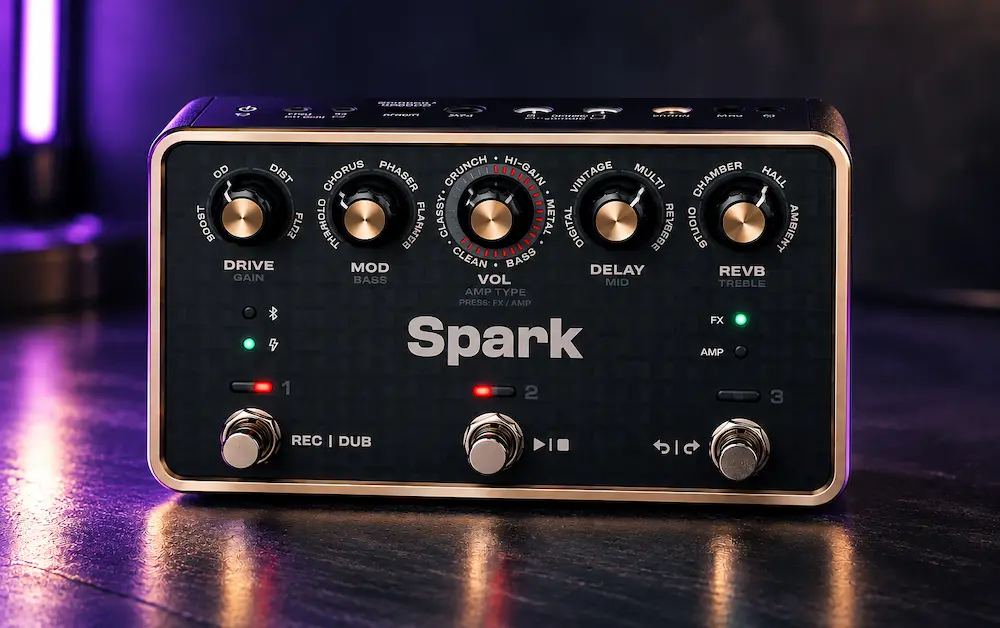
The Positive Grid Spark Pedal is built around a practical production problem: how much of a usable guitar rig can be condensed into a single floor unit without making the workflow cumbersome? At $199, it combines 33 amp models, 43 effects, a looper, MIDI, an expression-pedal input, Bluetooth, USB audio, rechargeable battery power and access to the Spark ecosystem. The feature count is substantial, but for recording and production the more important question is whether those functions translate into a faster, more repeatable way of getting a guitar track into a session.
The underlying technology is evolutionary rather than new: Spark Pedal uses the same HD Tone Engine platform found in Spark 2. The more important question is what that processing becomes in pedal form. Here, the tradeoff is clear: Positive Grid puts amp modeling, effects, looping, direct recording and battery operation into a compact unit, while accepting less physical control and less modeling depth than larger systems.
Positive Grid Spark Pedal at a Glance
| Specification | Positive Grid Spark Pedal |
|---|---|
| Type | Hardware guitar amp and effects processor |
| Price | $199 |
| Amp Models | 33 |
| Effects | 43 |
| Looper | 60 seconds |
| Onboard Presets | 6 presets across 2 banks |
| Recording | USB-C audio interface |
| Outputs | Stereo line outputs and 1/8-inch headphone output |
| MIDI | MIDI input/output via TRS and DIN adapters |
| Expression | 1/4-inch TRS expression input |
| Wireless | Bluetooth 5.0 and 2.4 GHz Wi-Fi |
| Battery | Rechargeable 3000 mAh battery, up to 7 hours |
At $199, Spark Pedal sits between a conventional multi-effects pedal and a compact digital guitar production system. Its appeal is not based on having the deepest amp-modeling architecture in its class. The more practical advantage is that Positive Grid combines amp modeling, effects, looping, direct recording, wireless connectivity, MIDI and battery operation in a single pedal-sized unit.
How Good Does the Spark Pedal Actually Sound?
The strongest evidence from current hands-on reviews points to a clear tonal split: Spark Pedal is more convincing once the amp is being pushed. Clean models expose more of the gap between this $199 unit and higher-end modeling platforms, while overdrive and high-gain sounds have received substantially stronger feedback.
GuitarPlayer’s evaluation covered headphones, direct recording, conventional amplifiers and a powered FRFR system with both a Fender Telecaster and Gibson Les Paul. The resulting pattern is more useful than a generic “good tone” verdict: driven and high-gain sounds were the stronger part of the system, while clean tones made the modeling limitations easier to hear. The reviewer also found the physical controls less suitable for fine adjustment than the Spark App.
Bonedo reached a similar practical conclusion after testing the pedal both directly into an audio interface and through a clean Sovtek MIG-50H driving a Marshall 4×12 cabinet. Its assessment was positive overall, but the sound was described as somewhat thinner than higher-end modeling systems. That distinction is important: Spark Pedal does not need to reproduce every amplifier with reference-level realism to be useful, but engineers should not confuse its strong price-to-feature ratio with the performance ceiling of more expensive modeling platforms.
For production, the most useful question is therefore not whether Spark Pedal wins a blind comparison against every premium modeler. It is whether the selected tone has the frequency balance, dynamics and midrange behavior needed to survive the arrangement. A slightly less sophisticated amp model can still be the better production choice if it sits in the mix without excessive low-end buildup or unnecessary upper-mid energy.
That is where Spark Pedal makes the most sense: as a fast source of usable guitar tones that can be recorded, recalled and replaced later if the arrangement demands something different.
Where Spark Pedal Actually Fits in a Guitar Production Workflow
 Spark Pedal’s differentiator is not the presence of amp modeling itself, but how many recording and performance functions are built around it. Spark Pedal can feed a cabinet-emulated stereo signal to a PA, drive headphones for silent monitoring, connect to a DAW over USB, integrate with a conventional pedalboard, or run as an effects processor with its amp and cabinet processing bypassed. The rechargeable battery, MIDI I/O and expression-pedal input extend that flexibility beyond a conventional practice pedal.
For recording, the real advantage is repeatability and reduced setup time. A guitarist can recall a prepared rig and go straight from the instrument into the DAW without placing a microphone, opening an amp-sim plugin, assembling an effects chain or rebuilding the monitoring path. That does not make the resulting guitar tone inherently better than a well-configured software rig. It does make the path from idea to recorded part considerably shorter.
That distinction becomes important in a production environment. Spark Pedal is not designed to compete with the deepest hardware modelers on routing or front-panel control. Its workflow is deliberately more dependent on the Spark app, where the complete signal chain can be edited and presets managed. ToneCloud adds a large library of user-created tones, while Spark AI can generate a starting point from a text description. The tradeoff is straightforward: less hardware complexity in exchange for greater dependence on the software ecosystem.
For a producer who records guitar regularly, that can be a sensible trade. For an engineer who already has a mature DI, reamping and software amp-modeling workflow, it is much less compelling. In that context, Spark Pedal is primarily a fast utility source rather than a replacement for an established guitar-production chain.
Hear How Your Mix Translates Beyond the Guitar Track
A convincing guitar tone is only one part of a finished production. What matters is how the complete mix holds together in terms of balance, dynamics, depth and stereo image across real playback systems. Our free mastering demo lets you hear how your own mix translates through a professional mastering workflow. Upload up to 35 seconds of your mix and get a practical reference for what the finished production can support. Upload your mix for a free mastering demo →
Spark Pedal DSP and Signal Chain: What You Actually Get
Spark Pedal uses the same HD Tone Engine platform found in Spark 2, so its technical significance is evolutionary rather than architectural. The pedal does not introduce a fundamentally new amp-modeling method or a different DSP engine. Positive Grid is repackaging an established modeling platform for a compact floor-based workflow, with the main gains coming from integration, control and portability rather than a new approach to amp simulation.
The available processing is substantial for a device of this size: 33 amp models and 43 effects, arranged around a seven-block signal chain. The architecture places the amp and cabinet section between three effect blocks before it and three after it. The system also covers electric guitar, acoustic guitar and bass, making it more useful as a general-purpose recording and performance processor than its compact hardware suggests.
The limitation is control rather than processing depth. The front panel provides five multifunction knobs: the main control selects amp or FX types, while the remaining controls handle core amp parameters such as gain, bass, mid and treble. In FX mode, those controls take on different functions for the Drive, Modulation, Delay and Reverb sections. Three footswitches handle preset selection and looper functions. More detailed editing is delegated to the Spark App, which effectively becomes the primary interface for shaping the signal chain.
That division makes sense from a hardware-design perspective, but it has consequences in a production session. The pedal is excellent at recalling and performing a prepared rig; it is less efficient when you need to make numerous small parameter changes from the floor. GuitarPlayer’s hands-on testing also found the onboard controls somewhat sensitive for precise adjustments, while the app provided a more practical environment for detailed editing.
For recording, this means Spark Pedal works best when the sound is built and refined before tracking. Once the preset is dialed in, the hardware becomes a fast, repeatable front end. If the workflow depends on constant deep editing of amp, modulation, delay and reverb parameters, a modeler with more extensive physical controls remains the more efficient choice.
Where Spark Pedal Saves Time in a Studio Workflow
The strongest studio use case for Spark Pedal is fast guitar capture. It is less about replacing a full software rig and more about reducing the number of decisions between picking up a guitar and recording a usable part.
Imagine a production session that needs a clean arpeggio, a saturated rhythm and a lead part. With a software amp-modeling workflow, the engineer still has to choose the amp, cabinet or IR, establish gain staging, build the effects chain and save the setup. None of that is difficult, but every additional decision adds friction when the priority is capturing a performance before the idea disappears.
Spark Pedal shifts much of that work into preset recall. Once the required sounds have been prepared, the guitarist can switch between them, track the parts and keep the session moving. The same approach works well between rehearsal and home recording: the signal chain travels with the player instead of depending on a particular computer, DAW session or collection of software plugins.
The built-in battery extends that workflow beyond the studio. With up to seven hours of rated operating time and a roughly 4.5-hour charging time, Spark Pedal can serve as a portable songwriting rig, rehearsal backup or emergency performance setup without an amplifier or conventional pedalboard power supply. That is a practical advantage rather than a sonic one.
There is an important limitation, though. Fast capture does not guarantee mix-ready guitar tone. A sound that feels full and convincing in isolation can accumulate low-mid energy, mask the bass or compete with vocals once it enters a dense arrangement. The engineer still has to judge the guitar in context, at realistic monitoring levels, and make the necessary EQ, dynamics and spatial decisions afterward.
That is ultimately where Spark Pedal earns its place in a production workflow: it makes getting a repeatable guitar source into the session faster. It does not eliminate the engineering work that determines whether that source actually works in the mix.
Spark Pedal for Mixing: Judge the Guitar by Mix Translation
A guitar modeler should not be judged by the soloed track alone. The more meaningful test is mix translation: how the modeled guitar behaves once it has to share spectrum, dynamics and depth with the rest of the arrangement.
Independent testing suggests that Spark Pedal is more convincing with driven and high-gain tones than with its cleanest amp models. GuitarPlayer reached a similar conclusion in hands-on testing, finding the overdriven and high-gain sounds more satisfying while clean tones made the limitations of the modeling easier to hear.
From a mixing perspective, that distinction is less important than it first appears. A guitar does not need to reproduce every nuance of a miked amplifier to be useful. What matters is whether its midrange focus, compression and harmonic content give the mixer a stable source that can sit between bass, drums, vocals and other guitars without excessive corrective processing.
A slightly colored model can therefore be more useful than a technically impressive but oversized guitar tone. Excessive low-end energy can compete with bass and kick, while an aggressive upper-mid emphasis can mask vocal presence or make distorted guitars fatiguing at higher playback levels. Those problems are easier to identify with the full arrangement running than with the guitar soloed.
For example, a high-gain Spark Pedal patch that sounds impressive in isolation can become less useful once bass, kick, vocals and another guitar occupy the same range. The better preset is often the one that leaves less low-mid buildup and provides enough upper-mid definition to remain identifiable without making the mix harsh. In production terms, the useful model is the one that survives the arrangement with the least corrective processing.
Recording Spark Pedal Direct vs. a Software Amp Simulator
Direct recording is one of Spark Pedal’s most useful production applications. Over USB-C, the unit can function as an audio interface and send its processed guitar signal directly into a DAW. That turns the pedal into a self-contained recording front end rather than simply an effects processor.
Compared with a plugin-only setup, the advantage is speed. The amp, cabinet and effects chain are already part of the recalled preset, so the guitarist can establish a sound and start tracking without rebuilding the signal path inside the DAW. For songwriting sessions, overdubs and fast production work, that reduction in setup time can be more valuable than having access to hundreds of additional amp models.
The tradeoff is where the production decision is made. A conventional DI workflow preserves the guitar’s unprocessed performance and leaves the amp, cabinet, microphone character, gain structure and effects open to revision after tracking. If Spark Pedal’s processed output is recorded as the only guitar track, those decisions are effectively printed at the source.
That is not necessarily a disadvantage. Printing the tone can be the better choice when the sound is already working and the goal is to preserve the performance rather than create another round of technical decisions. The problem arises when the guitar later needs a fundamentally different amp response, cabinet voicing or gain structure that cannot be recreated from the recorded signal. Once the production is complete, the quality of that balance also becomes part of what needs to be right before mastering, because mastering can refine a finished mix but cannot replace a guitar-production decision that was made incorrectly at the source.
For higher-stakes sessions, a hybrid workflow is the safer option when the setup allows it: use Spark Pedal for the player’s monitoring and immediate production tone while retaining a clean DI for hardware reamping or software amp modeling later. That preserves the speed advantage of the hardware without giving up the ability to change the guitar sound when the arrangement or mix develops in a different direction.
Spark App and Spark AI: Faster Tone Building, Not New DSP
The Spark App is an important part of how Spark Pedal is meant to be used. It provides deeper signal-chain editing, preset management, ToneCloud access and Spark AI’s text-to-tone function. Auto Chords adds another layer aimed primarily at practice and songwriting, analyzing audio played through the app and displaying chord information in real time.
For production, Spark AI is the feature worth paying attention to, but its role is narrower than the AI label might suggest. It does not process the recorded guitar, mix a track or generate a new amp-modeling algorithm. It works more like an AI-assisted preset search and generation layer: describe the desired character, get a starting configuration, then refine it by ear.
That can be useful when the goal is to move quickly from a vague production idea to a playable guitar sound. Instead of auditioning amp, gain and effect combinations manually, the guitarist can start from a generated configuration and spend the time refining what actually matters in the arrangement.
GuitarPlayer’s hands-on testing found that Spark AI could produce useful starting points for requests such as classic-rock crunch and country-style clean tones, although the resulting presets still benefited from manual adjustment. That limitation is important. A text prompt can describe a style, but it cannot reliably determine what a particular guitar track needs in the context of a finished arrangement.
Spark AI is therefore most useful at the beginning of the tone-building process. It can reduce the time spent searching for a starting preset, but it does not remove the need to adjust gain, voicing and effects for the actual guitar and arrangement.
Where Spark Pedal Falls Short
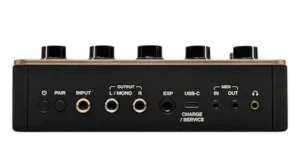 The main compromises are control depth, onboard preset access, ecosystem dependence and modeling realism.
The first is control depth. The seven-module signal chain covers the core categories needed for a complete guitar rig—Gate, Comp/Wah, Drive, Amp/Cab, Mod/EQ, Delay and Reverb—but individual modules do not provide the same depth of editing available from larger multi-effects systems or software-based modelers. The six onboard presets also limit how much of the pedal’s available sound library can be immediately accessible without moving back to the app.
The second limitation is physical control. The multifunction hardware controls are useful for performance and quick adjustment, but deeper tone shaping is generally easier inside the Spark App. That makes Spark Pedal more attractive as a compact production and performance system than as a device for detailed front-panel programming.
There are also ecosystem limitations. Spark Pedal is closely tied to Positive Grid’s software environment for deeper editing and library management, while competing platforms such as TONEX ONE offer a different approach centered on captured Tone Models and custom IR workflows. Spark Pedal’s broader integrated feature set is a strength, but it also means that users looking specifically for open-ended amp capture or third-party IR experimentation may find other platforms more flexible.
Latency deserves a separate qualification. Independent reviews currently do not provide a sufficiently consistent measurement set to establish a precise Spark Pedal round-trip or playing latency figure. It should therefore not be presented as a confirmed weakness or strength until reproducible measurements are available.
The more fundamental limitation is the modeling ceiling. GuitarPlayer found the pedal’s overall realism below what is available from higher-end systems such as Fractal, Line 6 and Neural DSP, even while considering the Spark Pedal strong value at its price. Bonedo was more critical of the overall presentation, describing the sound as somewhat thin compared with more sophisticated modeling systems.
These findings point to a fairly clear position in the market. Spark Pedal can deliver usable, mixable guitar tones without pretending to be a flagship modeler. Its compromises are easier to accept when the priorities are portability, preset recall, integrated practice features and fast recording. They become harder to justify when the priority is maximum modeling realism, deep editing or a complex live control scheme.
Spark Pedal vs. TONEX ONE, POD Express and Valeton
The most relevant alternatives to Spark Pedal are not flagship floor processors. They are compact modelers built around the same fundamental requirement: get a usable guitar signal from the instrument to an amp, PA, headphones or recording system with minimal setup.
| Product | Primary Advantage | Where It Falls Behind Spark Pedal | Best Fit |
|---|---|---|---|
| Positive Grid Spark Pedal | Integrated app ecosystem, battery operation, looper, broad effects and direct recording | Six onboard presets and relatively limited physical editing | Portable all-in-one rig for practice, recording and performance |
| IK Multimedia TONEX ONE | Strong amp-capture/modeling ecosystem, custom IR support and compact studio workflow | Less integrated as a standalone practice and songwriting platform | Players and producers prioritizing amp capture and tonal flexibility |
| Line 6 POD Express | Established Helix-derived modeling ecosystem and simple hardware operation | Less focused on the integrated practice and AI-driven workflow found around Spark | Players who want a straightforward compact live or pedalboard processor |
| Valeton GP-series | Deeper conventional modeler architecture, extensive effects and broader routing options | More hardware complexity and less emphasis on a unified Spark-style ecosystem | Users who prioritize routing, editing depth and conventional modeler control |
These products therefore solve slightly different problems. Spark Pedal is the strongest choice when the priority is an integrated, battery-powered guitar workflow with amp models, effects, looping, direct recording and app-based tone creation. TONEX ONE is more compelling when captured amp realism, custom IR loading and a focused amp-modeling ecosystem matter more than built-in workflow features. Valeton and other conventional multi-effects processors can offer deeper routing and broader conventional processing at a similar price, while giving up some of Spark Pedal’s integrated ecosystem and battery-powered convenience.
What Spark Pedal Actually Replaces
Spark Pedal does not replace a high-end amp modeler, a full DAW-based guitar rig or a dedicated audio interface. It can consolidate several smaller workflow components: a compact practice setup, a basic multi-effects unit, a standalone looper and a tuner and, in some sessions, the need to build a software amp chain before recording a usable guitar part.
That is why its value is higher than the number of amp models alone suggests. The pedal can move from practice to tracking to basic performance without rebuilding the signal chain. For a songwriter, producer or guitarist who values portability and fast recall, that consolidation is arguably more important than having the largest possible model library.
In a professional studio, the replacement case is narrower. Spark Pedal is not a substitute for a comprehensive amp-modeling library, dedicated DI/reamping workflow or high-end floor processor. Its practical role is as a guitar-production utility: an immediately available rig for tracking, sketching arrangements, travel or backup use.
Its value therefore comes from speed, portability and repeatability, rather than replacing every other guitar-production tool.
Who Should Buy the Spark Pedal?
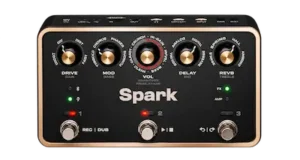 Home producers and serious bedroom guitarists are the clearest fit. At $199, the combination of amp modeling, effects, practice features, direct recording and battery-powered portability covers a large portion of the basic guitar workflow without requiring a separate collection of hardware.
Songwriters and producers also have a strong use case if guitar is part of the writing process. The main advantage is getting from an idea to a playable, recordable tone quickly. If maximum modeling realism is the primary requirement, however, the value proposition changes.
Live players should view it as a compact or backup rig rather than an automatic replacement for a larger floorboard. The six-preset onboard architecture and multifunction controls are workable for simple setups but less convincing when a show requires extensive preset changes and immediate hands-on editing.
Mixing engineers may find it useful as a fast source-generation tool, particularly when a guitarist needs a modeled sound without building a software chain from scratch. It has no meaningful role as a mixing processor itself.
Professional studios can justify it as a low-friction utility and backup rig, but not as a replacement for an established amp-modeling or reamping system.
Existing Spark users have perhaps the most obvious reason to add it. Spark Pedal extends the existing ecosystem into recording, rehearsal and performance situations where carrying a Spark amplifier is less practical, while keeping the same general tone-building environment.
Overall Rating
| Category | Rating |
|---|---|
| Amp Modeling Performance | 7.4/10 |
| Signal-Chain Capability | 8.4/10 |
| Hardware Control | 6.8/10 |
| Direct Recording Integration | 8.8/10 |
| Preset Recall & Production Utility | 8.5/10 |
| Portability & Standalone Utility | 9.0/10 |
| Overall | 8.2/10 |
The amp modeling is capable and particularly convincing with driven and high-gain material, but clean tones and overall realism remain below the strongest higher-end modeling systems described on the page.
The seven-block architecture, 33 amp models and 43 effects provide enough processing depth for a broad range of guitar-production tasks, although the fixed signal-chain structure limits more complex routing approaches.
The compact hardware interface is the weakest area: multifunction controls and sensitive parameter adjustment make detailed editing less efficient from the floor, with the Spark App becoming the more practical environment for precise changes.
USB-C audio turns the pedal into a self-contained recording front end, substantially reducing the setup required to capture a processed guitar signal directly into a DAW.
Preset recall makes prepared guitar rigs highly repeatable, which is particularly useful for fast tracking and production sessions, although the six-preset onboard limit reduces its suitability for more demanding live setups.
Battery operation, stereo outputs, headphones, PA connectivity and the ability to function across studio, rehearsal and backup scenarios give the unit unusually broad utility for a compact guitar processor.
Overall Comment: Spark Pedal earns its 8.2/10 primarily through workflow, recording integration and portability; its main compromises are modeling realism and limited physical control depth.
Verdict: Strong Workflow Value, Moderate Modeling Ambition
Positive Grid Spark Pedal makes the most sense as a compact guitar production system rather than as a pure amp-modeling benchmark. At $199, its strongest advantage is the combination of amp modeling, effects, looping, USB recording, preset recall, MIDI and battery operation in one unit.
The modeling is good rather than class-leading. Driven and high-gain sounds are the stronger area in current hands-on reviews, while clean tones, physical editing depth and open-ended cabinet flexibility leave room for more capable alternatives.
For fast tracking, songwriting, portable production and backup use, those compromises are reasonable. For maximum amp realism, deep routing or capture-based flexibility, TONEX ONE and higher-end modelers remain stronger choices.
Find Out What Your Guitar Mix Actually Needs
Spark Pedal can get a guitar into the session quickly, but a convincing tone in isolation is not the same as a balanced finished mix. Low-mid buildup, excessive upper-mid energy, dynamics and stereo depth only become clear when the entire production is judged as one piece. Instead of solving every remaining issue with another processing stage, compare your mix before and after professional mastering and hear what changes are actually available at the final stage. Upload up to 35 seconds of your mix and receive a free mastering demo prepared by a real mastering engineer, giving you a direct before/after reference for how your production translates. Upload 35 seconds and hear your free mastering demo →
FAQ: Positive Grid Spark Pedal for Recording and Production
Can the Positive Grid Spark Pedal record directly into a DAW?
Yes. Spark Pedal can function as a USB audio interface, allowing its processed guitar signal to be recorded directly into a DAW over USB-C. This provides a direct recording path without requiring a microphone and guitar amplifier setup.
Is the Spark Pedal good enough for professional guitar recording?
It can be. Spark Pedal is capable of producing a usable recorded guitar source, but its suitability for a finished release depends on the tone, performance and mix rather than the hardware alone. Its main production advantage is fast, repeatable capture rather than maximum amp-modeling realism.
Can You Use Spark Pedal Without the Spark App?
Yes. Spark Pedal handles its core functions directly from the hardware, including preset recall, amp and effects operation, looping and tuning. The Spark App becomes important for deeper parameter editing, ToneCloud, Spark AI and broader preset management. The pedal is therefore usable on its own, but the app substantially expands its editing and tone-building capabilities.
Can Spark Pedal be used with a real guitar amplifier?
Yes. The amp and cabinet processing can be bypassed, allowing Spark Pedal to operate primarily as an effects processor in front of a conventional guitar amplifier. This makes it possible to integrate the pedal into an existing hardware rig rather than using its amp modeling for every setup.
Is Spark Pedal better than TONEX ONE for studio recording?
Not universally. Spark Pedal is more compelling as an integrated practice, songwriting, recording and performance platform, while TONEX ONE is stronger for users who prioritize amp capture, Tone Models and custom IR-based workflows. The better choice depends on whether the priority is an integrated ecosystem or greater modeling and cabinet flexibility.
Can Spark Pedal load third-party impulse responses?
Third-party IR loading is not a core Spark Pedal feature. That limits its flexibility for engineers who rely on external cabinet IR libraries or build their guitar workflow around custom impulse-response collections.
How many presets can Spark Pedal store for live use?
Six presets are available directly from the hardware, arranged as two banks of three. Additional presets can be managed through the Spark App, while MIDI provides another way to control the unit in a larger live or studio setup.
Is Spark Pedal suitable as a backup live rig?
Yes. Its compact design, battery operation, stereo outputs, preset recall and direct-to-PA capability make it practical as a lightweight backup rig. The main limitation is the six-preset onboard architecture, which can become restrictive for more complex live sets.
Is the $199 Spark Pedal worth buying if I already own a high-end amp modeler?
Usually not as a replacement or upgrade. It makes more sense as a portable secondary rig for songwriting, travel, rehearsal, fast tracking or backup use. Owners of established Fractal, Helix, Neural DSP or similar systems are unlikely to gain a significant sonic advantage by moving their primary guitar workflow to Spark Pedal.

Yurii Ariefiev covers guitar production from a recorded-audio perspective, with particular attention to amp-modeling behavior, direct recording workflows, mix translation and the practical trade-offs between hardware and software guitar rigs.
Enjoyed this review?
If you found it useful, you can support independent audio research with a coffee.
☕ Buy me a coffee