Prophet-5 Plugin Review: Sound, Workflow, Mix Translation & Production Analysis
The market is full of analog synth emulations. Few carry the expectations attached to the Prophet-5. Since its introduction in 1978, Sequential’s flagship polysynth has become a reference point for analog synthesis, influencing everything from classic pop and rock productions to modern electronic music, film scores, and contemporary audio production.
That history makes software recreation unusually difficult. Users are not evaluating a generic vintage-style synth. They are comparing the instrument against decades of records, countless hardware units, and a reputation built on one of the most recognizable analog architectures ever designed.
The official Prophet-5 plugin from GForce and Sequential enters a category that already includes respected alternatives such as Repro-5 and Arturia Prophet-V. The difference is that this release was developed with direct involvement from the company behind the original instrument, giving it access to design knowledge and revision-specific behavior that third-party developers can only approximate.
The critical question is not whether the plugin sounds analog. Modern software has largely solved that problem. The more relevant question is whether it captures the characteristics that made the Prophet-5 valuable in professional production environments: the way it responds to performance, occupies space in an arrangement, and translates through the entire production chain.
That distinction matters for more than vintage synth enthusiasts. For producers, mixing engineers, and mastering engineers, a synthesizer is not judged by solo demos. It is judged by how effectively it integrates into a record. Frequency balance, midrange density, stereo behavior, and mix translation ultimately determine whether an instrument remains useful long after the initial excitement of a new release fades.
Reviewed and tested in 2026 using current production workflows, modern DAW environments, streaming delivery standards, and commercial mixing and mastering conditions.
Contents
Testing Methodology
For this review, the Prophet-5 was evaluated inside real production sessions rather than isolated preset demonstrations. Testing focused on arrangement density, mix translation, stereo behavior, CPU efficiency, layering performance, harmonic balance, and playback consistency across multiple listening environments.
The plugin was used in projects ranging from electronic music and synth-driven productions to vocal-centered arrangements where midrange management and instrument placement become critical. Particular attention was given to how Prophet sounds interacted with drums, bass, vocals, bus compression, limiting, and mastering-stage processing.
Additional evaluation focused on revision-specific behavior, layer functionality, modulation flexibility, workflow efficiency, and the practical differences between the Prophet-5 and competing software alternatives commonly found in professional studios.
Translation was assessed across studio monitors, headphones, consumer speakers, Bluetooth playback systems, and streaming-oriented listening conditions. Rather than evaluating sounds exclusively in solo mode, the goal was to determine how effectively the instrument survived the full production chain from composition through final release.
This review therefore focuses less on marketing claims and preset demonstrations and more on how the Prophet-5 behaves in real-world production environments where arrangement decisions, mix balance, mastering, and playback translation ultimately determine long-term value.
Comparison testing also included Repro-5, Arturia Prophet-V, and several modern software synthesizers commonly used in commercial production. The goal was not to identify a universal winner, but to evaluate how the Prophet-5 performs within practical recording, mixing, and release workflows.
Why the Prophet-5 Still Matters in Modern Audio Production
Many vintage synthesizers are remembered for their historical importance. The Prophet-5 remains relevant because producers continue using the underlying sound in modern records. The Prophet-5 remains relevant because its design continues to address problems that producers face every day.
When the original Prophet-5 arrived, it helped establish a new standard for polyphonic synthesis. Programmable patch memory, immediate hands-on control, and a flexible voice architecture made it practical in professional studio environments where speed mattered as much as sound quality.
Those priorities have not changed.
Modern productions are often built around increasingly dense arrangements. A single session may contain layered drums, multiple synth parts, vocal stacks, effects returns, and extensive automation. In that environment, the most useful instruments are not necessarily the most complex. They are the ones that occupy space predictably and remain manageable throughout the mixing process.
This is where the Prophet-5 has always excelled.
Its sounds tend to carry substantial harmonic information without overwhelming an arrangement. Pads feel wide without relying on excessive stereo enhancement. Brass and lead patches cut through a mix without requiring aggressive high-frequency boosting. Even dense polyphonic parts often retain clarity because the instrument naturally distributes energy across the spectrum in a way that leaves room for other elements.
That behavior helps explain why Prophet-derived sounds continue to appear in productions decades after the original hardware was introduced. The appeal goes beyond vintage character. The instrument generates tones that are inherently usable in real-world arrangements.
This becomes increasingly important as software synthesizers grow more sophisticated. Modern instruments offer enormous modulation systems, wavetable engines, granular synthesis, and virtually unlimited routing possibilities. Those capabilities can be powerful, but they often create sounds that require significant cleanup before a track reaches the mastering stage.
The Prophet-5 follows a different philosophy. Its architecture encourages decisions rather than endless experimentation. Oscillators, envelopes, and filters interact in ways that frequently produce mix-ready results with relatively little effort.
Experienced engineers encounter this difference regularly. Tracks built around well-designed Prophet-style sounds often require less corrective EQ, less dynamic control, and fewer compromises during arrangement and mixing. The instrument contributes character without creating unnecessary technical problems.
That is ultimately why the Prophet-5 continues to matter. Its influence is not based solely on history. It remains relevant because the underlying design still works within modern production workflows, from composition and sound design through mixing, mastering, and final release.
The Real Challenge of Recreating a Prophet-5 in Software
 Most analog emulations succeed at capturing frequency response. Far fewer succeed at capturing behavior.
Frequency curves, oscillator measurements, and circuit models are relatively straightforward to analyze. The harder task is reproducing the small inconsistencies that make vintage hardware feel responsive rather than predictable.
A classic analog synthesizer is never completely static. Individual voices drift slightly. Envelopes do not always respond with identical timing. Oscillators interact differently depending on register, note combinations, and filter settings. These variations create movement that exists even when no modulation is active.
That movement is a significant part of what musicians describe as depth, dimension, or character.
Many software recreations can match the tonal profile of vintage hardware surprisingly well. The limitation often becomes apparent during longer production sessions. A patch may sound convincing during a brief demonstration yet feel comparatively flat once it carries an arrangement for several minutes.
The Prophet-5 presents a particularly difficult challenge because there is no single Prophet-5 sound.
Different hardware revisions developed distinct personalities over time. Early Rev1 and Rev2 units are commonly associated with SSM-based filters that produce a smoother and often more rounded response. Rev3 models introduced Curtis components that many producers perceive as tighter, more focused, and more forward in a mix.
Neither approach is objectively superior. Engineers often prefer one revision over another depending on genre, arrangement density, and production goals.
As a result, a convincing software Prophet cannot rely on a single reference unit. It must capture the characteristics that distinguish these revisions while preserving the subtle interactions that make them feel different in practice rather than simply different on paper.
This is one area where the partnership between GForce and Sequential carries genuine significance.
Most developers building vintage emulations work through analysis, measurement, and reverse engineering. GForce had direct access to the company responsible for the original instrument, including insight into design decisions, revision history, and operational behavior that are not always obvious from hardware inspection alone.
That advantage should not be confused with a guarantee of authenticity. Official branding does not automatically produce a better instrument. What ultimately matters is execution.
The real benchmark is whether the plugin reproduces the interaction between oscillators, filters, envelopes, and voice architecture in a way that remains convincing during actual production work—not just in isolated demonstrations or marketing videos.
That distinction becomes increasingly important when evaluating a synthesizer intended for modern recording environments, where sounds must survive layering, processing, mixing, mastering, and distribution rather than simply impressing during a preset audition.
What Makes the GForce Prophet-5 Different From Previous Emulations
The Prophet-5 software category was already well established before GForce entered the market. Producers looking for classic Sequential-style sounds could choose from respected instruments such as Repro-5, Arturia Prophet-V, and numerous analog-inspired synthesizers covering similar territory.
The challenge for GForce was not creating another Prophet-inspired instrument. It was providing a reason to choose it over products that had already earned a place in professional studios.
The answer lies less in sound alone and more in how the instrument balances authenticity with modern workflow requirements.
Most vintage emulations fall into one of two categories. Some focus almost entirely on historical accuracy, reproducing the original instrument as closely as possible. Others use the hardware as a starting point before adding layers of modern functionality that gradually move the instrument away from its original identity.
The GForce Prophet-5 sits somewhere between those approaches.
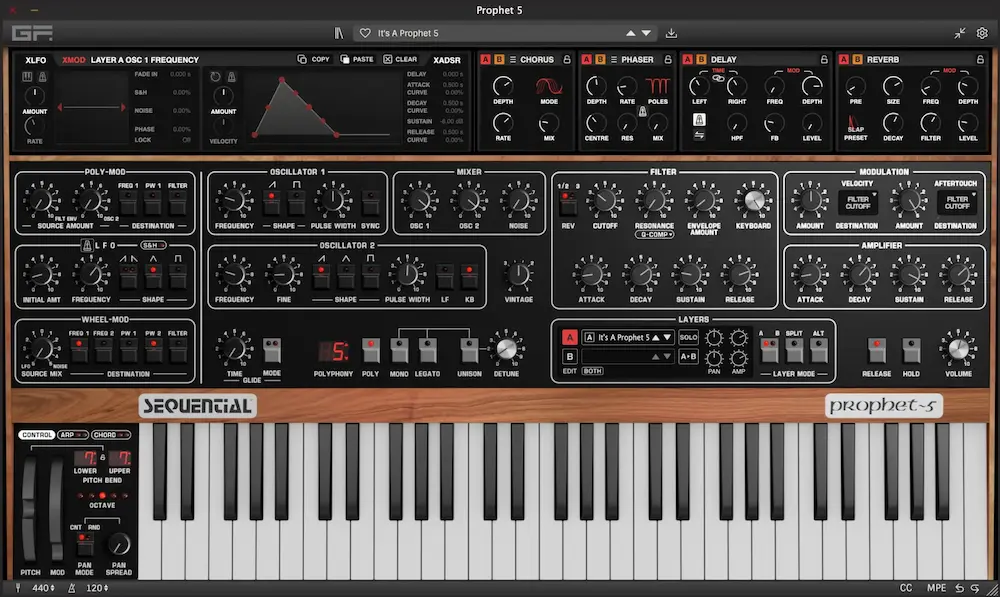
The core architecture remains familiar to anyone who has spent time with a Prophet. Oscillator behavior, filter structure, modulation routing, and panel layout retain the direct workflow that helped make the original hardware successful. The interface encourages fast decisions rather than extensive menu navigation.
That design choice has practical value in professional production environments.
Many modern synthesizers offer extraordinary flexibility, but flexibility often comes at the expense of speed. Sound design can become an exercise in managing options rather than creating music. One reason vintage instruments remain popular is that they establish a direct connection between an idea and a result.
The Prophet-5 workflow continues to benefit from that simplicity.
Where GForce separates itself from strict recreations is in the way it expands the instrument without fundamentally changing its character.
The redesigned X-Modifiers are a good example. The original Prophet architecture was never built around the type of extensive modulation systems found in contemporary synthesizers. GForce adds significantly more routing flexibility while avoiding the common mistake of turning a vintage emulation into an entirely different instrument.
For production work, this matters more than it may appear on a specification sheet. Additional modulation options allow evolving textures, performance-driven movement, and more sophisticated automation directly inside the instrument rather than relying on external processing or complex DAW automation.
The dual-layer architecture arguably has an even greater impact on workflow.
Layer mode makes it possible to build larger composite sounds without opening multiple plugin instances. Split mode expands performance options for composers and keyboard players. Alternate mode introduces subtle variation that helps reduce the mechanical consistency often associated with software instruments.
These additions are not merely feature-list enhancements. They address practical production scenarios that the original hardware was never designed to solve.
That distinction is important because most buyers are not searching for a museum piece. They are building records, producing soundtracks, creating commercial music, and working within modern DAW-based environments where efficiency matters as much as authenticity.
The strongest aspect of the GForce approach is that the additional functionality remains optional. Producers can work within traditional Prophet boundaries or take advantage of the expanded feature set without feeling like they have abandoned the instrument’s underlying identity.
This becomes even more relevant when paired with modern controller workflows. Producers increasingly expect hands-on access to software instruments rather than relying exclusively on mouse-driven editing, which is one reason compact controllers such as the Arturia MiniLab 37 continue to play an important role in contemporary production setups.
Many vintage emulations struggle to maintain that balance. The Prophet-5 succeeds largely because its modern additions support the workflow rather than compete with it.
What’s Actually New Here?
The Prophet-5 software market was already mature before this release. Repro-5 established itself as a benchmark for analog modeling, while Arturia approached the concept from a broader sound-design perspective. That means the real question is not whether the GForce Prophet-5 sounds authentic. The question is what it adds that existing Prophet-inspired instruments do not.
The most important difference is the combination of official Sequential involvement, multiple hardware revision personalities, dual-layer architecture, expanded modulation capabilities, and modern performance features inside a single instrument.
None of these features are revolutionary on their own. What makes them relevant is how they work together. Instead of forcing users to choose between historical accuracy and contemporary workflow, the Prophet-5 attempts to deliver both simultaneously.
For producers who already own Prophet-inspired plugins, this distinction matters more than small tonal differences. The strongest argument for the GForce version is not that it replaces existing alternatives. It is that it combines authentic Prophet workflow with practical production features that make the instrument easier to integrate into modern recording, mixing, and composition environments.
Sound Character and Preset Quality
A Prophet-style instrument ultimately succeeds or fails on one simple question: does it inspire useful musical decisions the moment you start playing?
The GForce Prophet-5 performs particularly well in this area because its sound rarely feels detached from practical production needs. Many modern synthesizers are capable of creating impressive demonstrations, but not every instrument produces sounds that remain useful once a project begins to take shape. The Prophet-5’s strength lies in the fact that many patches already feel connected to finished records rather than isolated sound-design exercises.
Pads are arguably where the instrument feels most comfortable. Wide chords develop natural movement without relying heavily on modulation effects, and sustained textures tend to maintain depth without becoming overly dense. Instead of filling every available frequency range, many pad sounds leave enough space for vocals, guitars, and other melodic elements to coexist comfortably. This characteristic has always been one of the defining traits of the Prophet sound and remains largely intact here.
Leads benefit from a similar balance. Rather than emphasizing aggressive brightness, the instrument often generates presence through harmonic content and midrange focus. As a result, lead sounds frequently remain audible inside complex arrangements without requiring excessive equalization or saturation. This becomes particularly useful in synth-pop, electronic music, cinematic scoring, and modern pop productions where multiple layers compete for attention.
Bass sounds are less about extreme low-frequency dominance and more about definition. Producers looking for modern wavetable-style aggression may prefer other instruments, but the Prophet-5 delivers basses that integrate naturally into a mix. There is usually enough weight to establish a foundation while preserving clarity for kick drums and other low-frequency elements.
Classic brass patches remain another highlight. The combination of oscillator movement, filter response, and envelope behavior creates sounds that cut through arrangements without becoming harsh. These patches continue to work exceptionally well for synth-pop, soundtrack production, retro-inspired electronic music, and layered arrangement work where articulation matters more than sheer volume.
String-style textures are similarly convincing. While the instrument is not attempting to replace orchestral libraries, it excels at creating synthetic string layers that add width, movement, and harmonic support. In many cases, these sounds function more effectively as arrangement tools than as standalone showcases.
The factory library reflects a production-oriented philosophy. Rather than overwhelming users with thousands of presets of varying quality, the collection generally focuses on sounds that demonstrate the instrument’s strengths. Many presets feel immediately usable inside real sessions, requiring only minor adjustment to fit a specific arrangement.
The inclusion of the original factory patches also provides useful historical context. While some sound unmistakably rooted in an earlier era of synthesis, many continue to reveal why the Prophet architecture became so influential in the first place. They are often less complex than modern presets but remain surprisingly effective within contemporary productions.
Preset management deserves recognition as well. The browser is fast, organized, and practical, making it easy to move between categories without interrupting creative momentum. This may sound like a small detail, but efficient preset navigation often has a greater impact on day-to-day workflow than additional synthesis features.
Perhaps the most important observation is that the instrument consistently generates mix-ready sounds. Not every patch will fit every project, but many arrive with a balanced spectral profile that requires relatively little corrective processing. That quality is difficult to quantify in specifications or marketing materials, yet it often determines which instruments remain in active use long after the excitement surrounding a new release has faded.
Rev1, Rev2 and Rev3: Why the Filter Choice Actually Matters
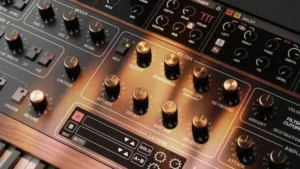 Filter models are often treated as marketing bullet points. In many software instruments, the differences become difficult to identify once a sound is placed inside a full arrangement. The Prophet-5 is one of the few cases where revision choice can have a meaningful impact on production decisions.
The reason is simple: the various Prophet revisions do not just sound different in isolation. They occupy space differently inside a mix.
The Rev1 and Rev2 models are associated with SSM filter designs that many engineers describe as smoother and more forgiving through the upper mids. Chords tend to develop a softer harmonic texture, resonance feels less aggressive, and sustained sounds often create a greater sense of depth without drawing excessive attention to themselves.
This behavior becomes particularly useful in arrangements built around atmosphere and harmonic movement. Large pads, evolving textures, and layered chord structures can fill significant space without creating the fatigue that often accompanies dense midrange content.
From a mixing standpoint, SSM-based sounds frequently require less corrective work. Harmonic information tends to spread more evenly across the spectrum rather than accumulating around narrow frequency bands that compete with vocals or lead instruments.
The Rev3 tells a different story.
Curtis-based filters generally produce a more direct and focused presentation. Transients feel slightly sharper, filter sweeps generate stronger contrast, and important midrange information becomes easier to identify inside dense arrangements.
Those characteristics can be advantageous in contemporary productions where synthesizers must compete with heavily processed drums, layered vocal productions, distorted guitars, or aggressive low-end content.
A Rev3-style patch often establishes presence with less processing because the sound naturally projects forward in the mix. What may feel slightly restrained in solo playback can become an advantage once multiple elements begin competing for attention.
Neither revision is objectively better. The decision is largely contextual.
SSM-based revisions often complement cinematic scoring, ambient music, downtempo production, melodic electronic genres, and arrangements where depth is more important than forwardness.
Curtis-based revisions tend to excel in synth-pop, commercial pop, rock productions, modern electronic music, and situations where stronger articulation helps a part maintain definition against dense instrumentation.
What makes the GForce implementation particularly practical is that these options exist within the same production environment. Producers can evaluate multiple interpretations of the Prophet architecture without leaving the session, reprogramming sounds, or committing to a specific hardware personality at the beginning of a project.
That flexibility has real-world value because sounds rarely behave the same way in a finished arrangement as they do during sound design.
Mix engineers encounter this constantly. A pad that sounds enormous in solo mode can disappear once vocals arrive. A lead that feels perfectly balanced during composition may lose impact after bus compression, limiting, or mastering increases overall density.
Being able to move between revision characteristics allows producers to solve these problems at the source rather than relying on increasingly aggressive EQ, saturation, or dynamic processing later in the chain.
In practice, this may be more important than the authenticity debate itself. Most listeners will never know which Prophet revision was used. They will notice whether the sound remains clear, balanced, and emotionally effective once the record reaches streaming platforms, consumer headphones, car speakers, and other real-world playback systems.
That is ultimately where the value of multiple revisions becomes apparent—not as a historical feature, but as a production tool that helps sounds survive the realities of modern mixing, mastering, and distribution.
Prophet-5 in a Modern Mixing Environment
A synthesizer can sound impressive on its own and still create problems once a mix begins to take shape.
This is one area where many plugin reviews provide limited value. Solo demonstrations reveal very little about how an instrument behaves when competing with drums, bass, vocals, guitars, orchestral layers, and bus processing. The more relevant question is whether the sound remains useful after the arrangement becomes crowded.
The Prophet-5 has maintained its reputation for decades largely because it tends to integrate into mixes more easily than many modern synthesizers.
A significant part of that comes from its midrange behavior.
Many contemporary instruments generate enormous spectral density across the entire frequency range. While this can sound impressive during sound design, it often creates conflicts once vocals and other key elements enter the arrangement. The result is frequently a cycle of corrective EQ, multiband processing, and compromise.
The Prophet-5 generally avoids that problem.
Even relatively complex patches tend to distribute harmonic information in a way that leaves room for other instruments. The sound remains rich and full, but it rarely feels oversized. Pads can provide width and harmonic support without dominating the center of the mix, while leads often maintain presence without requiring excessive high-frequency emphasis.
This becomes particularly valuable in vocal-driven productions where intelligibility remains the primary objective.
Well-designed Prophet patches often support a vocal rather than compete with it. Instead of filling every available frequency range, they contribute harmonic depth while preserving space for the elements that carry the song.
That said, the instrument is not immune to poor decisions.
The dual-layer architecture significantly increases the potential for low-mid accumulation. Sounds that appear balanced individually can create substantial buildup once layered together, particularly between 200 Hz and 600 Hz.
This frequency range is responsible for much of the warmth associated with classic Prophet sounds. It is also where arrangements can lose clarity surprisingly quickly.
By the time masking becomes obvious, the mix often already feels smaller and less defined than it should.
For that reason, successful Prophet-based mixes typically depend more on sound selection than corrective processing. This reflects the same principle discussed in Prepare Mix for Mastering: problems solved at the source almost always produce better results than problems addressed later in the production chain. Choosing a patch that occupies the right space is usually more effective than attempting to repair an oversized sound later with aggressive EQ moves.
The oscillator behavior also deserves consideration.
Unlike many modern virtual instruments that prioritize absolute consistency, Prophet oscillators generate subtle variations that contribute to perceived width and dimension. Those variations are part of what makes the instrument feel alive, but they can also increase interaction between layered parts occupying similar frequency ranges.
Arrangement decisions therefore become just as important as mixing decisions.
Producers who treat the Prophet-5 as a compositional tool often achieve better results than those who approach it as a preset source. A small number of carefully chosen parts will frequently create a larger and more cohesive production than multiple layers competing for the same harmonic territory.
This has always been one of the strengths of the Prophet design. The instrument rewards restraint. When used strategically, it can deliver size, depth, and movement without requiring the excessive layering that often complicates modern mixes.
How Prophet-5 Behaves During Mastering
Mastering has a way of exposing problems that remain hidden during production and mixing. Tonal imbalances become easier to hear, frequency masking becomes more obvious, and harmonic content that seemed controlled can take on a very different character once average level increases.
The Prophet-5 generally holds up well under that level of scrutiny.
One reason is that its sound is typically built around harmonic density rather than aggressive top-end emphasis. Many modern synthesizers create excitement by concentrating energy in the upper mids and high frequencies. That approach can sound impressive early in the production process but often becomes problematic once compression, limiting, and loudness optimization enter the picture.
As overall level rises, those same harmonics can become fatiguing. A patch that initially felt detailed and energetic may start drawing unnecessary attention to itself, forcing mastering engineers to spend time controlling harshness instead of refining the overall presentation.
The Prophet-5 tends to behave differently.
Its character is usually derived from oscillator interaction, filter movement, and harmonic complexity distributed across a broader portion of the spectrum. Because of that, pads, polyphonic textures, and sustained leads often retain their musicality as a track approaches commercial release levels.
For mastering engineers, this can simplify decision-making. Less effort is spent managing excessive brightness, allowing more attention to remain on translation, balance, dynamics, and overall consistency across playback systems. Understanding how professional mastering works makes it easier to appreciate why stable harmonic behavior often matters more than raw brightness during the final stage of production.
This behavior is particularly valuable in genres where synthesizers occupy a central role in the arrangement. Synthwave, melodic techno, progressive house, cinematic electronic music, ambient productions, and modern pop frequently benefit from sounds that remain stable as loudness increases.
That stability should not be mistaken for immunity to mastering problems.
The same characteristics that make the Prophet-5 sound rich during production can create challenges if arrangement decisions are not carefully managed. Low-mid information remains the most common issue.
Multiple Prophet layers occupying similar ranges can generate substantial energy between roughly 200 Hz and 600 Hz. During mastering, broadband compression and limiting often increase the perceived density of this region even further.
The result is a mix that becomes louder but not necessarily larger. Clarity decreases, instrument separation suffers, and the record may feel narrower despite occupying more level.
This is rarely a mastering problem in the traditional sense. More often, it is the consequence of arrangement and sound-selection decisions made much earlier in the production process.
The strongest Prophet-based mixes usually arrive at mastering with clear frequency separation already established. Pads, leads, bass elements, and supporting textures each occupy defined roles within the arrangement. When that foundation exists, the instrument translates exceptionally well through limiting, codec conversion, loudness normalization, and consumer playback systems.
When that foundation does not exist, mastering can only mitigate the problem. It cannot fully recover clarity that was never present in the mix to begin with.
This may be one of the most overlooked strengths of the Prophet-5. The instrument rewards disciplined arrangement and sound selection. When used thoughtfully, it tends to retain depth, balance, and musicality throughout the final stages of production instead of forcing engineers into increasingly corrective processing decisions.
Translation Across Streaming Platforms and Real-World Playback Systems
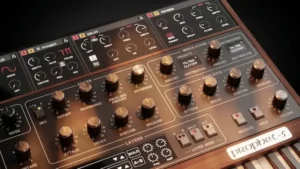 A synthesizer’s job does not end when the mix is finished. What ultimately matters is how the sound survives after encoding, normalization, playback conversion, and reproduction across systems that bear little resemblance to a studio monitoring environment.
Modern releases encounter numerous translation variables before reaching listeners. Streaming codecs remove information. Loudness normalization alters playback level. Producers unfamiliar with platform normalization behavior often underestimate how strongly playback perception can change after release, which is why understanding LUFS in mastering remains relevant even when evaluating synthesizer sounds.
Many sounds that appear impressive inside a DAW become noticeably less effective once they leave the studio.
The Prophet-5 has historically performed well under these conditions, and the reasons have less to do with nostalgia than with the way the instrument generates its core character.
A significant portion of that character exists in the midrange, which remains the most critical region for translation. Human hearing is particularly sensitive throughout this range, allowing important musical information to remain audible even when playback systems have limited low-frequency extension or restricted high-frequency detail.
This helps explain why Prophet-based parts often remain recognizable across radically different listening environments.
Stereo behavior is another factor.
Many modern synthesizer patches achieve width through aggressive stereo enhancement, modulation effects, or phase-dependent processing. While these techniques can create an impressive headphone experience, they often become less reliable when playback collapses toward mono or encounters phase-related limitations.
The Prophet architecture generally produces width more naturally through voice interaction, tuning variation, and harmonic movement. As a result, sounds tend to retain their identity even when stereo information becomes partially reduced.
The GForce implementation benefits from these characteristics. Many patches maintain depth and separation without relying on exaggerated brightness, excessive stereo width, or effect-heavy processing chains to remain engaging.
That does not guarantee strong translation.
Poor arrangement decisions can still undermine the result. Excessive layering, unmanaged low-mid buildup, and overly wide stereo construction remain common causes of translation problems regardless of the instrument being used.
In practice, the Prophet-5 provides a strong foundation because its sounds are often built around elements that survive playback-system limitations more effectively than many modern synthesis approaches. The instrument encourages tones that remain recognizable after codec conversion, loudness normalization, and consumer playback processing rather than depending on fragile production tricks that disappear outside the studio.
Ultimately, translation is not determined by a synthesizer alone. It is determined by the combination of sound selection, arrangement, mixing, and mastering decisions that follow. The Prophet-5 simply starts that process from a position that tends to work in its favor.
Why Some Prophet Sounds Survive Dense Mixes While Others Disappear
A common assumption is that analog-inspired synthesizers naturally fit into a mix better than modern digital instruments. In practice, the outcome has far less to do with analog character and far more to do with how a sound occupies space within an arrangement.
This becomes obvious when working with Prophet-style patches.
Some remain clearly audible even as a production grows more complex. Others seem to lose definition the moment drums, vocals, guitars, bass, or additional synth layers are introduced. The difference is rarely a question of authenticity. It is usually a question of spectral design.
The most effective Prophet sounds tend to perform a specific role exceptionally well. A pad may provide harmonic support without extending too far into the vocal range. A lead may establish a strong midrange presence without consuming excessive bandwidth. A brass patch may add articulation and energy without competing across the entire spectrum.
Problems begin when a single sound attempts to do everything at once.
Patches containing substantial low-end energy, wide stereo information, dense harmonic content, and aggressive high-frequency detail often sound impressive during solo playback. Inside a full arrangement, they become much harder to manage because they compete with nearly every major element in the mix.
This is one reason experienced mix engineers rarely judge sounds in isolation.
A patch that feels slightly restrained on its own may become the stronger choice once the arrangement is complete. Conversely, a sound that dominates during sound design can become surprisingly ineffective when forced to coexist with the rest of the production.
The strongest mixes are usually built around complementary sounds rather than individually impressive ones. Every instrument occupies a defined role, allowing the arrangement to feel larger as a whole than any single element would suggest on its own.
The Prophet-5 tends to perform well within that framework because its architecture naturally encourages focused sounds rather than excessively broad ones. Even complex patches often retain a sense of purpose, making them easier to place alongside vocals, drums, bass, and supporting instrumentation.
This characteristic helps explain why Prophet-based sounds continue to appear in professional productions decades after the original hardware was introduced. Their value extends beyond nostalgia or analog credibility. They frequently solve practical arrangement problems by providing harmonic depth, movement, and presence without demanding control of the entire mix.
The software version succeeds when it preserves that behavior. The goal is not simply to recreate the circuitry of a vintage synthesizer. The goal is to create sounds that continue to function once they encounter the realities of arrangement density, mix processing, mastering, loudness normalization, and real-world playback conditions.
Where the Plugin Excels and Where It Falls Short
The most successful software instruments are usually built around a clear identity. Rather than attempting to cover every synthesis method or production style, they focus on doing a specific job exceptionally well.
The Prophet-5 follows that approach.
It is not designed to compete with modern synthesis platforms built around wavetable engines, granular processing, modular environments, or experimental sound design. Its strength comes from delivering a recognizable sonic character through a workflow that remains fast, direct, and highly musical.
That immediacy is one of the plugin’s strongest attributes.
Many contemporary synthesizers offer enormous flexibility but require significant programming before useful results emerge. The Prophet-5 often reaches production-ready territory much faster. Oscillator relationships, filter behavior, and envelope responses naturally encourage sounds that feel musical before extensive tweaking begins.
In professional environments, that efficiency has real value.
Production schedules rarely reward complexity for its own sake. Producers, composers, and engineers benefit more from tools that support rapid decision-making than from instruments that require extensive programming to reveal their strengths.
The Prophet-5 consistently performs well in that role. Sounds develop quickly, adjustments remain intuitive, and the instrument rarely encourages endless technical experimentation at the expense of musical progress.
The expanded architecture also broadens the instrument’s practical usefulness without fundamentally changing its identity.
Dual-layer functionality allows users to create larger textures, performance splits, evolving pads, and composite sounds that would have required multiple hardware units in the past. For composers working under deadlines, this can significantly streamline the production process.
The preset library is another area where the plugin compares favorably with many competitors.
Factory content often serves primarily as a demonstration of features. Here, a substantial portion of the library feels designed for actual production use. Many sounds can be integrated into arrangements immediately rather than functioning solely as showcase material.
The plugin is not without limitations.
The biggest limitation is not sound quality but overlap. Producers already invested in Repro-5 may find the differences smaller than expected, particularly inside dense productions where workflow advantages become more noticeable than dramatic tonal differences.
The most obvious challenge is the market itself.
Prophet-inspired software is no longer a niche category. Potential buyers are comparing this instrument against mature alternatives that have already established strong reputations. For users who rely heavily on products such as Repro-5, the differences may feel evolutionary rather than transformative.
That is not necessarily a weakness. It simply changes expectations.
The Prophet-5 should be viewed as a refinement of an established concept rather than a complete redefinition of it.
There are also limits to its sonic range.
Although the expanded modulation system adds flexibility, the instrument remains rooted in the Prophet architecture. Producers searching for aggressive wavetable movement, granular manipulation, advanced resynthesis, physical modeling, or highly experimental sound-design workflows will find more capable options elsewhere.
This is largely a consequence of specialization rather than a design flaw.
The Prophet-5 excels at creating harmonically rich pads, leads, polyphonic textures, and performance-oriented sounds that integrate naturally into musical arrangements. Outside that territory, other instruments may offer greater flexibility and a broader palette of synthesis techniques.
Viewed in that context, the plugin’s strengths and weaknesses are closely related. Its focused design is precisely what makes it effective, but that same focus inevitably defines where its advantages begin and end.
Marketing Claims Versus Production Reality
Vintage-inspired software often arrives with a familiar narrative. Authentic circuit modeling, historical accuracy, and legendary hardware heritage are presented as if they are direct paths to better records.
The reality is less straightforward.
A Prophet-5 plugin can provide access to the tonal behavior of a famous instrument, but it cannot recreate the conditions that made the original recordings memorable. Those records were shaped by arrangements, performances, engineering decisions, monitoring environments, recording chains, and production aesthetics that extended far beyond the synthesizer itself.
This distinction is important because expectations often become disconnected from practical results.
The same issue appears in discussions about so-called analog magic.
There is no question that the Prophet architecture possesses a distinctive character. Chords can feel larger than expected. Pads often develop depth without extensive processing. Leads frequently exhibit a sense of movement that is difficult to attribute to any single parameter.
However, those qualities are only valuable when they serve the arrangement.
Many productions struggle because of frequency masking, weak arrangement choices, excessive layering, limited dynamic contrast, or poor sound selection. None of those problems are solved by switching synthesizers.
A Prophet-5 can improve the quality of the source material entering the mix, but it cannot compensate for weaknesses elsewhere in the production process.
What matters more in practice is whether the instrument helps producers arrive at stronger musical decisions, build better arrangements, and create sounds that remain effective through mixing, mastering, and distribution.
Viewed through that lens, the Prophet-5 becomes easier to evaluate. Its value does not come from historical significance alone. It comes from the fact that its architecture continues to generate sounds that integrate well into contemporary productions without requiring excessive processing or corrective work.
The most productive way to think about the instrument is not as a shortcut to vintage records, but as a high-quality source. The synthesizer influences the starting point. Everything that follows—arrangement, mixing, mastering, and playback translation—still determines the final outcome.
Prophet-5 vs Repro-5 vs Arturia Prophet-V vs Hardware
Any serious evaluation of the Prophet-5 plugin eventually leads to the same comparison: how does it stack up against the alternatives that producers are already using?
The answer depends less on marketing claims and more on what a producer actually values in day-to-day work. Sound quality alone is no longer enough to separate these instruments. Workflow, flexibility, recall, CPU efficiency, and integration into modern production environments often matter just as much as tonal character.
| Feature | GForce Prophet-5 | u-he Repro-5 | Arturia Prophet-V | Hardware Prophet-5 |
|---|---|---|---|---|
| Primary Focus | Authentic recreation with modern workflow enhancements | Deep analog modeling and sound quality | Expanded sound design flexibility | Original hardware experience |
| Official Sequential Involvement | Yes | No | No | Native Hardware |
| Rev1 / Rev2 / Rev3 Character Options | Yes | Partial Interpretation | No | Single Unit Dependent |
| Layer and Split Functions | Yes | No | Yes | No |
| MPE Support | Yes | Limited | Varies by Version | No |
| Project Recall | Instant | Instant | Instant | Manual |
| Multiple Instances | Unlimited | Unlimited | Unlimited | No |
| Maintenance Requirements | None | None | None | Potentially Significant |
| Best Fit | Production, composition, scoring, mixing | Sound-focused producers and synth enthusiasts | Broader sound design workflows | Collectors, performers, hardware-focused studios |
| Best For | Producers wanting authentic Prophet workflow | Users prioritizing analog modeling depth | Users wanting expanded sound design | Collectors and performers |
| Learning Curve | Low | Medium | Medium | Low |
The most direct competitor remains Repro-5.
For many producers, Repro-5 set the benchmark for software Prophet emulations years ago. It remains one of the most convincing analog-modeled synthesizers available, with a reputation built on sound quality rather than branding. Users already comfortable with Repro-5 may not find the GForce release dramatically different at first listen.
Where GForce begins to separate itself is through workflow and scope. The combination of official Sequential involvement, multiple revision models, modern modulation options, MPE support, and dual-layer functionality creates a broader production environment without moving too far away from the original instrument.
Arturia approaches the category from a different direction.
Its Prophet-inspired instruments generally prioritize flexibility and expanded sound design potential over strict historical recreation. For producers interested in pushing beyond traditional Prophet territory, that approach can be appealing. For those seeking a closer connection to the original hardware experience, GForce and Repro-5 remain more focused options.
Hardware occupies a separate category altogether.
The discussion often becomes emotional because hardware ownership involves factors that extend beyond sound. Physical interaction, collectability, historical significance, and studio prestige all influence purchasing decisions.
From a production standpoint, however, software offers advantages that are difficult to ignore. Instant recall, unlimited instances, automation, portability, session compatibility, and lower long-term ownership costs all fit naturally into modern workflows.
The sonic gap between high-end software and hardware has also narrowed considerably. While experienced users may still identify differences in feel, response, or behavior, those differences are often less significant in a finished mix than arrangement, performance, and engineering decisions.
For most producers, the real choice is not between software and hardware. It is between different software interpretations of the same instrument. In that context, the GForce Prophet-5 distinguishes itself by balancing historical accuracy with practical workflow improvements rather than pursuing either goal exclusively.
Is the Prophet-5 Plugin Worth the Price?
For most buyers, the question is not whether the Prophet-5 sounds good. The question is whether it offers enough value over instruments they already own.
Most producers purchasing the Prophet-5 are not choosing between this plugin and no synthesizer at all. They are comparing it against established alternatives, many of which already occupy a place in professional studios.
That reality changes the buying decision considerably.
For users entering the Prophet ecosystem for the first time, the value proposition is relatively straightforward. The plugin combines official Sequential involvement, multiple hardware revision models, modern workflow enhancements, MPE support, dual-layer functionality, and a production-focused design that extends beyond simple vintage recreation.
For existing Repro-5 or Prophet-V owners, the equation becomes more dependent on workflow preferences than dramatic sonic differences. The Prophet-5’s strongest advantages are not necessarily found in isolated A/B comparisons. They emerge through day-to-day use, project recall, revision flexibility, performance options, and overall production efficiency.
This is where many purchasing decisions become misleading. Producers often compare synthesizers based on individual presets or short demonstrations when long-term value is usually determined by how frequently an instrument remains useful across real projects.
The Prophet-5 earns its value by combining historical credibility with practical workflow improvements. Whether that justifies the investment depends largely on how important the Prophet sound remains within your own production process.
Who Should Buy the Prophet-5 Plugin—and Who Shouldn’t
The Prophet-5 is best suited to producers who value musical outcomes more than technical complexity.
Its strengths become most apparent in workflows centered around songwriting, composition, arrangement, and production rather than experimental sound design. Producers working in synth-pop, electronic music, film scoring, ambient music, melodic house, indie productions, and modern pop will likely find the instrument particularly useful because it generates sounds that integrate naturally into finished arrangements.
The plugin is also a strong fit for engineers and composers who appreciate classic analog character but have no interest in managing the practical limitations of hardware. Instant recall, automation, multiple instances, and seamless DAW integration make it considerably easier to incorporate into modern production environments than an original Prophet unit.
Perhaps its most valuable audience is made up of producers who prefer making musical decisions quickly.
The Prophet architecture has always rewarded directness. Strong sounds emerge with relatively little effort, allowing users to focus on performance, arrangement, and production rather than spending hours building patches from scratch. In professional environments where deadlines matter, that efficiency often becomes more important than an extensive feature list.
The plugin is a less obvious choice for producers whose primary focus is cutting-edge synthesis.
Users heavily invested in wavetable design, granular processing, modular routing, algorithmic modulation, or experimental sound creation will eventually encounter the limits of the Prophet architecture. While the GForce version expands the original design in useful ways, it remains fundamentally tied to the strengths and constraints of a classic analog polysynth.
The buying decision also becomes more nuanced for users who already own established Prophet-style instruments.
A producer working extensively with Repro-5, for example, may not experience a dramatic shift in sound quality. The value proposition is more likely to come from workflow preferences, revision modeling, feature set, and overall user experience than from a night-and-day difference in tone.
This is ultimately where the Prophet-5 should be evaluated.
The plugin is not trying to replace every synthesizer in a modern studio. It is designed to deliver a specific set of sounds, a specific workflow, and a specific production experience. For producers who connect with that approach, it can become a frequently used tool. For those seeking unlimited sound-design possibilities, there are better options available.
Its strongest selling point is not authenticity alone, nor is it the expanded feature set. It is the combination of musical immediacy, proven sonic character, modern workflow conveniences, and sounds that continue to work well in real-world productions long after the novelty of a new release disappears.
Who Should Skip the Prophet-5?
Producers focused primarily on wavetable synthesis, granular sound design, modular routing, algorithmic modulation, or highly experimental production techniques will likely find more suitable options elsewhere. The Prophet-5 is intentionally focused on a mature analog workflow rather than unlimited synthesis flexibility.
It may also be a difficult upgrade to justify for users who already rely heavily on Repro-5 and are completely satisfied with their existing workflow. In that scenario, the differences are more likely to be evolutionary than transformative.
Final Buying Recommendation
The answer depends less on sound quality and more on what already exists in your workflow.
If you do not currently own a Prophet-style instrument, the Prophet-5 makes a strong case for itself. It delivers one of the most influential analog architectures ever created while adding modern conveniences that fit naturally into contemporary production environments. For many producers, composers, and engineers, it can easily become a primary source of pads, leads, brass sounds, and polyphonic textures.
The decision becomes less straightforward if you already own Arturia Prophet-V.
Arturia’s interpretation offers broader sound-design flexibility and a more expansive feature set. Producers who regularly move beyond traditional Prophet territory may find less urgency to switch. The GForce instrument feels more focused on capturing the original workflow and sonic personality rather than expanding it into something entirely different.
For Repro-5 users, the calculation is even more nuanced.
Repro-5 remains one of the most respected analog emulations available and continues to perform exceptionally well in professional productions. The Prophet-5 does not render it obsolete. Instead, it offers a different interpretation supported by official Sequential collaboration, multiple revision models, dual-layer architecture, and a workflow that more closely reflects the original hardware experience.
Producers searching for a vintage-inspired workflow with fast decision-making, strong mix translation, and a proven musical character will likely find substantial value here.
Producers focused primarily on advanced wavetable synthesis, granular manipulation, experimental sound design, or modular-style routing should look elsewhere. The Prophet-5 remains intentionally focused on a specific musical philosophy.
Viewed realistically, the plugin is not attempting to become the most flexible synthesizer on the market. It succeeds because it delivers a mature sound, efficient workflow, and production-ready results without requiring endless programming.
Real-World Production Perspective
The most meaningful way to evaluate the Prophet-5 is not as a synthesizer, but as part of a production workflow.
A sound may seem impressive during programming or preset browsing, yet become difficult to manage once the arrangement expands. Professional productions are ultimately judged by how well individual elements survive editing, layering, mixing, mastering, codec conversion, and playback across a wide range of listening environments.
Viewed from that perspective, one of the Prophet-5’s most valuable qualities is consistency.
Sounds that work during composition often continue working as a project develops. Pads that provide harmonic support during writing generally maintain that role during mixing. Leads that establish a clear focal point in an arrangement rarely require extensive corrective processing later in the production cycle.
That may not sound particularly exciting, but it solves a problem that many modern synthesizers create.
Some instruments generate sounds that appear enormous in isolation yet become increasingly difficult to manage as additional elements are introduced. Excessive spectral density, exaggerated stereo information, unstable low-end content, and overly complex modulation can create a chain reaction of corrective processing throughout the mix.
In those situations, equalization becomes damage control rather than refinement. Compression is used to contain problems instead of enhancing musical intent. Valuable production time is spent fixing issues that originated at the sound-design stage.
The Prophet-5 generally avoids this pattern.
Its architecture tends to produce sounds with a clear sense of purpose and a relatively balanced distribution of harmonic information. That balance does not eliminate the need for engineering decisions, but it often reduces the amount of corrective work required later.
This characteristic becomes especially useful in contemporary productions where analog-inspired synthesizers frequently coexist with heavily processed drums, layered vocals, sampled instruments, and complex digital textures. The Prophet’s harmonic profile typically integrates into these arrangements without demanding constant adjustment.
As a result, producers can spend more time refining musical decisions and less time solving technical conflicts. While difficult to measure on a specification sheet, that efficiency often determines which instruments remain part of a professional workflow long after the excitement surrounding a new release has faded.
Ultimately, the Prophet-5’s value is not defined by how closely it recreates vintage hardware. Its value is defined by how reliably it moves from composition to final master without creating unnecessary obstacles along the way. For many engineers, that workflow continuity is a major reason why understanding the difference between mixing and mastering remains essential when evaluating production tools.
CPU Usage and Workflow Efficiency
Workflow efficiency matters more than ever in modern production environments. Large sessions routinely combine software instruments, sample libraries, effects chains, automation, oversampling, and CPU-intensive processing. Under those conditions, a synthesizer must justify not only its sound but also its impact on day-to-day work.
The Prophet-5 performs well in this respect because it avoids many of the workflow issues that accompany increasingly complex software instruments.
The interface is built around direct access to core functions rather than layered menus or multi-page editing systems. Most sound-shaping decisions can be made from a single view, allowing users to focus on the result rather than the navigation process.
That may sound like a minor advantage, but workflow inefficiencies compound quickly over the course of a project. A few additional steps repeated hundreds of times across writing, arranging, and mixing sessions can have a measurable impact on productivity.
The Prophet architecture has always been effective because of its immediacy. Oscillators, envelopes, filters, and modulation controls remain visible and accessible, encouraging experimentation without interrupting creative momentum. GForce preserves that approach while adding modern functionality that feels integrated rather than bolted on.
Preset management is similarly well executed. Sounds can be located quickly, categories remain logical, and the browser supports the kind of rapid auditioning that producers rely on during active sessions.
The expanded feature set could easily have complicated the workflow, particularly with the addition of layer functions, advanced modulation options, effects processing, and MPE support. Instead, these features remain accessible without obscuring the instrument’s primary controls.
From a production standpoint, that balance is more important than it may initially appear. Many synthesizers become slower to use as functionality increases. The Prophet-5 largely avoids that trap by preserving the straightforward workflow that helped define the original hardware. The same principle applies throughout the studio environment, where reliable tools often outperform feature-heavy alternatives, as discussed in our SSL 1 review.
The result is an instrument that encourages fast decisions and sustained creative flow rather than extended periods of technical configuration. In professional environments where efficiency directly affects output, that can be just as valuable as any improvement in sound quality.
This may ultimately be one of the plugin’s most underrated strengths. While much of the discussion focuses on authenticity and analog character, the day-to-day experience is defined by how quickly ideas move from concept to finished production. The Prophet-5 remains exceptionally effective at supporting that process.
Long-Term Value for Professional Producers
Most software instruments generate attention at launch. Far fewer remain part of professional workflows years later.
The difference usually comes down to utility rather than innovation.
Many products are built around emerging trends, new synthesis methods, or headline features designed to attract immediate interest. While some of these tools become long-term standards, many lose relevance as production styles evolve and the next generation of software arrives.
The Prophet-5 operates on a different timeline.
Its underlying architecture has already proven capable of surviving multiple decades of changes in recording technology, musical trends, production techniques, and distribution formats. Few synthesizer designs have demonstrated that level of longevity.
That track record matters when evaluating a software instrument as a long-term investment rather than a short-term purchase.
Professional producers are rarely looking for sounds that will remain fashionable for a single release cycle. They are looking for tools that continue solving musical problems across different projects, genres, and production environments.
The Prophet architecture has repeatedly demonstrated that flexibility. Variations of its sound have appeared in rock, synth-pop, electronic music, film scoring, television production, commercial advertising, indie records, and contemporary mainstream releases. The common thread is not a specific genre but the instrument’s ability to generate harmonically rich sounds that remain useful in a wide range of musical contexts.
That adaptability gives the software version a stronger long-term outlook than many new releases.
Its relevance is unlikely to depend on temporary trends, signature presets, or a particular production style. Instead, it is rooted in a synthesis architecture that continues to produce sounds with broad musical applicability.
For producers building a working collection of instruments rather than chasing novelty, that distinction is significant. A synthesizer earns its place over time by continuing to contribute to new projects long after the excitement of its release has faded.
The Prophet-5 has already demonstrated that capability in hardware form for decades. The software version’s long-term value will ultimately depend on the same factor: whether it remains useful once the marketing cycle ends and the focus returns to making records.
Pros and Cons
| Pros | Cons |
|---|---|
| Mix-ready sounds with minimal processing | Limited beyond Prophet-style synthesis |
| Excellent pads, leads and polyphonic textures | Strong competition from Repro-5 |
| Multiple Prophet revisions in one instrument | Not designed for experimental sound design |
| Dual-layer architecture | Premium positioning |
| Fast and intuitive workflow | May overlap with existing Prophet-V workflows |
| Official Sequential collaboration | Evolutionary rather than revolutionary for Prophet users |
Overall Rating
| Category | Rating |
|---|---|
| Sound Quality | 9/10 |
| Workflow | 9.5/10 |
| Mix Translation | 9/10 |
| Preset Quality | 8.5/10 |
| Value for Money | 8.5/10 |
| Overall | 9/10 |
The Prophet-5 is not the most experimental synthesizer on the market, nor is it attempting to be. Its strength lies in delivering a proven analog workflow, strong mix behavior, professional sound quality, and modern production efficiency within a focused instrument that remains relevant across multiple genres and production environments.
Quick Summary
Best for: Producers seeking authentic Prophet workflow with modern production features.
Not ideal for: Advanced wavetable, granular, or experimental sound-design workflows.
Biggest strength: Mix-ready sound and workflow efficiency.
Biggest weakness: Strong overlap with existing Prophet-style plugins such as Repro-5.
Verdict
After extensive testing, the Prophet-5 stands out less because of authenticity and more because of usability. It consistently produces sounds that survive arrangement, mixing, mastering, and streaming playback with fewer compromises than many modern synthesizers.
The plugin balances historical authenticity with practical usability more effectively than many vintage-inspired releases. The familiar oscillator and filter architecture remain intact, but modern additions such as layer functionality, expanded modulation options, MPE support, integrated effects, and contemporary preset management make the instrument considerably more adaptable to current production workflows.
More importantly, the underlying sound continues to exhibit the characteristics that have kept the Prophet relevant for decades. Harmonic richness, strong midrange presence, predictable mix behavior, and reliable translation across different playback systems remain central to the experience.
That does not automatically make it the right choice for every producer.
Users already invested in mature Prophet-style instruments may find the differences less dramatic than the marketing suggests. Likewise, producers focused on advanced wavetable synthesis, modular experimentation, granular processing, or highly unconventional sound design will likely find more specialized tools better suited to those objectives.
Where the Prophet-5 excels is in creating sounds that support the larger production rather than competing with it. The instrument consistently encourages arrangement-focused decisions, efficient workflows, and tones that remain effective through mixing, mastering, and final distribution.
That may ultimately be its most important quality.
Many software instruments are designed to impress during demonstrations. The Prophet-5 is more convincing during actual production work. Its value becomes apparent over the course of a project rather than during the first few minutes of exploration.
For producers, composers, and engineers looking for a mature polysynth with a proven musical vocabulary and a workflow that integrates naturally into contemporary studios, the GForce Prophet-5 stands as one of the most complete software interpretations of the instrument currently available.

Yurii Ariefiev is a mastering engineer and audio production editor specializing in mix translation, spectral balance, playback consistency, and mastering for streaming platforms. His work includes evaluating how synthesizers, virtual instruments, and production tools behave across real-world mixing and mastering environments.
This Prophet-5 analysis was written from a production and mastering perspective, focusing on arrangement efficiency, frequency behavior, workflow impact, and how sounds translate from composition to final release rather than relying on marketing claims or feature lists.
FAQ
Can the Prophet-5 plugin be used in professional music production?
Yes. The instrument is fully capable of professional work, from commercial music releases to film scoring and television production. As with any synthesizer, the quality of the final result depends more on arrangement, sound selection, mixing, and mastering decisions than on the instrument itself.
How does the Prophet-5 compare to Repro-5?
Repro-5 remains one of the most respected analog-modeling synthesizers available and continues to sound excellent in modern productions. The GForce Prophet-5 differentiates itself through official Sequential involvement, multiple revision models, dual-layer functionality, MPE support, and a workflow designed around the original hardware experience.
Is the Prophet-5 better than Repro-5?
Not necessarily. Repro-5 remains one of the most respected analog emulations available. The Prophet-5 differentiates itself through official Sequential collaboration, multiple hardware revision models, dual-layer functionality, and workflow features. The better choice depends more on workflow preferences than on dramatic sound-quality differences.
Can the Prophet-5 plugin replace a hardware Prophet-5?
For many studio workflows, yes. Software provides instant recall, automation, portability, and unlimited instances within a project. Hardware still offers a unique tactile experience, but the practical advantages of software are difficult to ignore in modern production environments.
Is the Prophet-5 a good choice for film scoring and cinematic music?
The instrument is particularly effective for cinematic work. Its ability to create evolving pads, layered textures, atmospheric chords, and expressive polyphonic parts makes it well suited to underscore, ambient compositions, and emotional scoring applications.
How CPU-intensive is the Prophet-5 plugin?
In practical testing, CPU consumption remained moderate even with layered patches, built-in effects, and higher voice counts enabled. Modern systems should have no difficulty running multiple instances inside professional production sessions, although resource usage naturally increases with complex layered sounds and heavy polyphony. Layer mode and higher polyphony naturally increase resource consumption, but CPU behavior remained predictable throughout testing.
Does the Prophet-5 support MPE controllers?
Yes. MPE support enables per-note expression, allowing independent control over parameters such as pitch, pressure, and timbre. This significantly expands the performance capabilities of the instrument compared to the original hardware.
Which Prophet revision should I choose: Rev1, Rev2, or Rev3?
The answer depends on the role the sound needs to play in a mix. Rev1 and Rev2 typically provide a smoother and more rounded character, while Rev3 often feels more focused and forward. The most effective choice is usually determined by the arrangement rather than personal preference alone.
Does the Prophet-5 work well in modern electronic music?
Yes. Although the instrument is closely associated with classic analog synthesis, it remains highly relevant in genres such as melodic techno, progressive house, synthwave, cinematic electronic music, indie electronic productions, and contemporary pop.
Are the built-in effects sufficient for finished productions?
The integrated effects are useful for sound design, composition, and many production tasks. However, most professional projects will still involve additional processing during mixing and mastering to fit the sound into the context of a complete arrangement.
Is the Prophet-5 worth buying if I already own Repro-5?
That depends on what you already use and what you expect from the instrument. Producers looking for a fundamentally different synthesis method may find limited overlap. Those specifically interested in the Prophet workflow, revision modeling, and official Sequential-backed implementation may find the plugin offers enough distinction to justify its place alongside existing tools.
Does the Prophet-5 sit well in a mix?
One of the reasons the Prophet architecture remains popular is its ability to occupy space without overwhelming an arrangement. Well-programmed patches often require less corrective processing than more aggressive modern synthesizer sounds, particularly in vocal-driven productions where midrange management is critical.
Does the Prophet-5 plugin sound better than the hardware?
Not necessarily. Hardware and software provide different experiences rather than a simple quality hierarchy. Original hardware may offer a unique tactile workflow and slight behavioral differences, while the software version provides instant recall, multiple instances, automation, revision switching, and modern production flexibility. In a finished mix, arrangement, performance, and engineering decisions typically have a greater impact than the remaining differences between hardware and software.
What genres benefit most from the Prophet-5 sound?
The instrument is commonly associated with synth-pop, electronic music, film scoring, ambient music, progressive house, indie productions, and modern pop. Its versatility comes from the way it balances harmonic richness, clarity, and mix compatibility rather than from any specific genre affiliation.
Is the Prophet-5 plugin good for beginners?
Yes, provided the goal is learning subtractive synthesis and traditional analog workflow. The interface is considerably easier to understand than many modern modular or wavetable instruments.