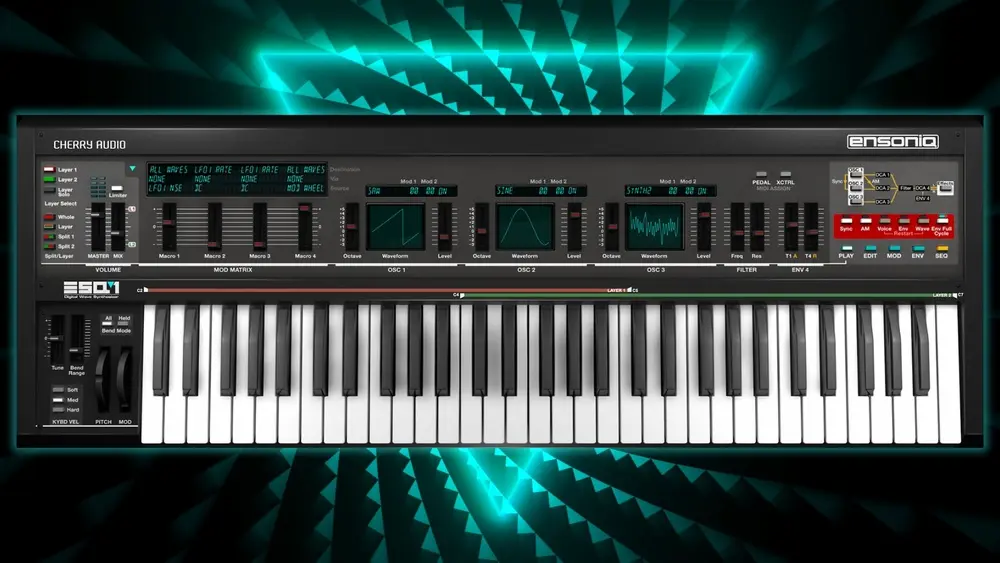
Cherry Audio ESQ-1 Review: Does This Classic Hybrid Synth Still Matter in Modern Production?
The Cherry Audio ESQ-1 enters a software synth market that has largely solved the problem of authenticity. Accurate analog modeling, detailed component-level emulations, and expansive wavetable engines are no longer difficult to find. The challenge today is different: finding instruments that contribute something useful to an actual production workflow. For producers considering the Cherry Audio ESQ-1 plugin, the question is not whether it recreates a classic synthesizer. The more important question is whether the design principles that made the original Ensoniq ESQ-1 successful still offer an advantage in modern mixing, mastering, and audio production.
When Ensoniq released the ESQ-1 in the second half of the 1980s, the synthesizer industry was moving through a transitional period. Analog designs were losing ground, digital synthesis was expanding rapidly, and workstation-style instruments were becoming increasingly sophisticated. The ESQ-1 took a different approach by combining sampled digital oscillators with analog filters and a surprisingly deep modulation architecture. The result was neither fully analog nor fully digital. It occupied a space between the two, producing textures that felt more aggressive than traditional analog synths while retaining movement and musicality that many early digital instruments lacked.
That hybrid character is the reason the ESQ-1 remains relevant decades later. Its appeal has little to do with nostalgia. Many modern synthesizers generate enormous spectral density, ultra-wide stereo images, and highly polished harmonic content. Those qualities can sound impressive during preset browsing but often require significant work once tracks enter a dense arrangement. The ESQ-1 approaches sound differently. Its oscillators carry a recognizable digital edge, yet many patches leave room for vocals, drums, guitars, and other competing elements. In practice, that often translates to faster mix decisions and fewer corrective moves later in the production process.
Cherry Audio ESQ-1 at a Glance
| Developer | Cherry Audio |
| Based On | Ensoniq ESQ-1 Hybrid Synthesizer |
| Synthesis Type | Digital Oscillators with Analog-Style Filtering |
| Formats | VST3, AU, AAX, Standalone |
| Best For | Synthwave, Ambient, Cinematic Scoring, Industrial, Electronic Production |
| Workflow Focus | Vintage Hybrid Synthesis and Mix-Friendly Sound Design |
- What Made the Original Ensoniq ESQ-1 Different?
- What Cherry Audio Got Right About the ESQ-1 Sound
- Factory Sounds, Presets, and Musical Character
- Workflow Implications for Producers and Mix Engineers
- Cherry Audio ESQ-1 vs Arturia SQ80 V
- Real-World Production Perspective: Mixing, Mastering, and Translation
- What the Cherry Audio ESQ-1 Does Not Do Well
- Verdict
- FAQ
Why the ESQ-1 Matters in Today’s Software Synth Market
Most software synthesizers released today compete on features. Larger wavetable libraries, deeper modulation systems, integrated effects, AI-assisted preset generation, and increasingly polished user interfaces dominate product development. The result is a market filled with instruments that can do almost everything, often at the expense of a clear sonic identity.
The ESQ-1 comes from a different design philosophy. It was built around a relatively small collection of digital waveforms, analog filtering, and a modulation structure that rewards intentional programming rather than endless experimentation. By modern standards, its architecture is limited. In practice, those limitations are part of what makes it useful.
Many producers looking at vintage synthesizer emulations are not searching for historical accuracy. They are looking for sounds that behave differently inside a finished arrangement. That distinction becomes increasingly important as modern productions grow more layered and spectrally dense.
One of the recurring challenges in contemporary mixing is managing instruments that occupy too much space. Modern wavetable synths, virtual analog designs, and heavily processed presets often generate substantial harmonic density across the frequency spectrum. A sound that appears impressive in isolation can become problematic once multiple layers compete for the same midrange territory. The result is often additional EQ work, dynamic control, stereo field management, and corrective processing during mixing and mastering.
The ESQ-1 tends to create a different set of outcomes. Its digital oscillators produce a recognizable texture, but many sounds remain surprisingly focused. Pads, keys, and evolving textures typically establish a clear position within an arrangement without dominating it. Vocals, guitars, drums, and acoustic instruments generally require less accommodation than they do with many contemporary synthesizer patches.
This is one of the reasons the original ESQ-1 remained relevant long after newer technologies surpassed it on paper. Its value was never based solely on specifications. It came from the way its sounds interacted with other elements in a production. For Cherry Audio, accurately recreating that behavior is arguably more important than reproducing every detail of the original hardware design.
What Made the Original Ensoniq ESQ-1 Different?
The original Ensoniq ESQ-1 entered a market crowded with analog synthesizers, FM instruments, and increasingly sophisticated digital workstations. What separated it from most competitors was its hybrid architecture. Instead of relying entirely on analog oscillators or purely digital synthesis, the ESQ-1 combined digitally generated waveforms with analog Curtis filters and an unusually deep modulation system.
At the time, this approach gave producers access to sounds that neither traditional analog synths nor early digital instruments could easily produce. The ESQ-1 could create aggressive digital bells, evolving pads, synthetic choirs, punchy basses, metallic plucks, and animated textures while retaining enough filter movement to keep sounds musical inside a mix.
The hardware also earned a reputation for offering substantial programming depth at a price that was considerably lower than many competing professional synthesizers. As a result, it found its way into electronic studios, soundtrack production environments, pop recordings, industrial music projects, and television scoring work throughout the late 1980s and early 1990s.
Much of the instrument’s long-term appeal comes from the way its oscillators interact with the filter section. The resulting sound is neither conventionally analog nor clinically digital. Even decades later, many producers continue searching for the distinctive ESQ-1 sound because it occupies a tonal space that remains surprisingly uncommon among modern software synthesizers. Understanding why those sonic characteristics survive through the production process also helps explain many of the decisions discussed in What Is Audio Mastering.
What Cherry Audio Got Right About the ESQ-1 Sound
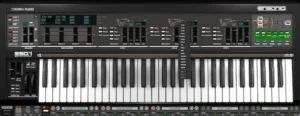 The challenge of recreating a synthesizer like the ESQ-1 is not simply matching its frequency response or duplicating individual waveforms. What made the original instrument successful was the interaction between its digital oscillators, analog filtering, modulation architecture, and performance behavior. Those elements combined to create sounds that felt distinct without requiring extensive processing.
The Cherry Audio ESQ-1 plugin appears to understand that distinction. The plugin captures much of the character that separated the ESQ-1 from both traditional analog synthesizers and the cleaner digital instruments that followed. The oscillators retain the slightly coarse texture associated with Ensoniq’s early hybrid designs. Pads carry a subtle metallic quality that remains recognizable without becoming harsh. Bell tones, digital pianos, plucked textures, evolving sequences, and hybrid bass sounds preserve the complexity that helped make the original hardware popular in soundtrack, ambient, industrial, and electronic productions.
More importantly, the instrument avoids a common problem found in modern vintage recreations: overcorrection. Many developers attempt to modernize classic designs by smoothing filters, tightening oscillator behavior, reducing inconsistencies, and removing imperfections that might be viewed as technical flaws. While those changes can produce cleaner measurements, they often move the instrument further away from the musical behavior that made the original worth recreating in the first place.
The ESQ-1 has always benefited from a certain amount of roughness. Its sound rarely feels entirely analog or entirely digital. Instead, it occupies an unusual middle ground where digital harmonics coexist with filter movement and modulation behavior that remain musical under heavy use. That balance is a significant part of the instrument’s identity.
The strongest validation comes when the plugin is used in complete productions rather than preset demonstrations. Many synthesizers sound impressive during solo playback but become difficult to place once vocals, drums, guitars, and additional layers enter the arrangement. The Cherry Audio ESQ-1 generally avoids that problem. Its sounds tend to establish a defined position within a mix, often requiring fewer corrective EQ moves than modern synthesizers generating comparable harmonic complexity. For producers and mix engineers, that characteristic is ultimately more valuable than strict technical authenticity.
Factory Sounds, Presets, and Musical Character
One reason the original Ensoniq ESQ-1 developed such a loyal following was the musical usefulness of its factory sounds. Unlike many modern synthesizers that emphasize extreme sound design demonstrations, the ESQ-1 became known for patches that could be placed directly into productions with relatively little adjustment.
The Cherry Audio ESQ-1 preserves much of that philosophy. Many of the instrument’s most recognizable sounds revolve around evolving pads, digital bells, hybrid keyboard patches, synthetic choirs, animated plucks, atmospheric textures, and punchy basses. These sounds retain the slightly gritty character associated with the original hardware while remaining practical inside contemporary arrangements.
What makes many ESQ-1 presets interesting is not their complexity but their balance. Rather than occupying the entire frequency spectrum, many patches leave room for other instruments while still maintaining a strong identity. This helps explain why ESQ-1 sounds continue to appear in soundtrack work, ambient music, synth-driven productions, and layered electronic arrangements decades after the hardware was released.
For producers evaluating the Cherry Audio version, the value of the preset library is less about nostalgia and more about access to a collection of sounds that continue to solve real production problems. Many patches reach a usable state quickly, making them effective starting points for composition, arrangement, and mix-focused workflows.
Workflow Implications for Producers and Mix Engineers
Sound quality alone rarely determines whether a synthesizer becomes part of a long-term production workflow. Many instruments excel during sound design sessions but create additional work once arrangements become dense and projects move toward mixing and mastering.
The ESQ-1 has historically earned its reputation for a different reason. Its sounds tend to integrate into productions with relatively little resistance. While modern wavetable and virtual analog synthesizers often generate extremely dense harmonic structures, many ESQ-1-style patches occupy a more focused spectral footprint. This leaves greater freedom when layering multiple instruments and reduces the amount of corrective processing required later in the project.
That characteristic becomes particularly valuable in productions built around stacked melodic content. Genres such as synthwave, ambient, cinematic scoring, indie electronic music, and progressive electronic production frequently rely on multiple pads, arpeggiated elements, atmospheric textures, and supporting harmonic layers. In these environments, the challenge is rarely creating complexity. The challenge is maintaining separation between competing parts without stripping away the character that made them appealing in the first place.
The ESQ-1’s architecture often helps solve that problem naturally. Its digital waveforms provide definition and presence, while the overall spectral balance remains controlled enough to coexist with vocals, drums, guitars, and acoustic instruments. Engineers are less likely to find themselves carving away large sections of the midrange simply to create space in the arrangement.
Transient behavior is another area where the instrument remains surprisingly relevant. Many modern synthesizers are designed to create immediate impact during preset auditions. Aggressive attack characteristics and highly controlled transient shaping can sound impressive in isolation but frequently become more difficult to manage once bus compression, limiting, and mastering processing are introduced.
The ESQ-1 generally produces softer and more natural transient structures. As a result, sounds often retain clarity under dynamic processing without becoming brittle or excessively forward. This is particularly noticeable in dense productions where multiple synthesizer layers must survive loudness optimization without collapsing into upper-midrange congestion.
These workflow advantages rarely appear in marketing materials because they are difficult to demonstrate in short audio examples. In practice, cleaner synth architecture often reduces the amount of corrective work required later, which directly affects how successfully a mix translates into mastering. Producers unfamiliar with that relationship may find value in understanding the differences outlined in Mixing vs Mastering. These benefits become increasingly apparent during real production work, where arrangement efficiency, mix translation, and processing requirements often matter more than individual preset quality.
The Marketing Narrative Versus Production Reality
Few areas of the audio industry rely on nostalgia as heavily as vintage synthesizer emulations. Product descriptions routinely emphasize heritage, authenticity, and historical significance, often implying that recreating a respected instrument automatically translates into better production results. In practice, successful tools survive because they solve problems, not because they recreate history.
The original ESQ-1 was a highly capable instrument for its time, but it was never a universal solution. Its interface demanded patience. Programming was considerably slower than on many modern synthesizers. Accessing deeper modulation functions required a level of commitment that many contemporary users may find unfamiliar. Even during its original production run, the ESQ-1 was valued for specific strengths rather than unlimited versatility.
Those realities remain relevant when evaluating the Cherry Audio version. Producers coming from instruments such as Serum, Pigments, Phase Plant, or Falcon may find the workflow comparatively constrained. The architecture offers fewer opportunities for complex visual modulation, rapid experimentation, and large-scale sound manipulation. Users who rely heavily on preset ecosystems may also discover that the instrument rewards understanding its structure more than browsing through hundreds of finished sounds.
At the same time, those constraints are closely tied to the plugin’s appeal. Modern synthesis platforms often encourage continuous tweaking because almost every parameter can be expanded, automated, or transformed. The ESQ-1 encourages a different mindset. Decisions tend to happen earlier. Sounds reach a usable state faster. Arrangements can progress without becoming trapped in endless sound-design refinement.
Whether that approach feels limiting or efficient depends largely on the producer. Those looking for maximum flexibility may view the ESQ-1 as a specialized instrument with a relatively narrow range of strengths. Producers searching for a recognizable sonic identity, predictable mix behavior, and a workflow that prioritizes musical decisions over technical experimentation may reach the opposite conclusion.
That distinction is ultimately more important than any discussion about authenticity. The value of the Cherry Audio ESQ-1 is not that it recreates a classic synthesizer. Its value is that it preserves a production philosophy that has become increasingly rare in modern software instruments.
Competitive Positioning: Where the Cherry Audio ESQ-1 Fits in 2026
The Cherry Audio ESQ-1 is not competing for the same users as Serum, Pigments, Falcon, or Phase Plant. Those platforms are designed as broad production environments capable of covering an enormous range of synthesis tasks. The ESQ-1 occupies a narrower space. Its appeal comes from a specific sound architecture and a workflow that favors commitment over unlimited flexibility.
That distinction is important because the software synthesizer market has largely moved toward feature accumulation. Most flagship instruments offer deeper modulation systems, larger preset ecosystems, more advanced effects processing, and significantly broader sound design potential than the original ESQ-1 ever possessed. Judged purely by specifications, the ESQ-1 is at a disadvantage.
The value of the ESQ-1 lies in the predictability of its results. Its architecture naturally pushes users toward textures that sit between vintage analog synthesis and early digital synthesis. Pads, evolving atmospheres, hybrid keys, soundtrack textures, and layered electronic arrangements emerge quickly without requiring extensive programming. For many producers, reaching a useful sound in minutes is more valuable than having thousands of possible destinations.
This positioning makes the plugin particularly relevant for composers, electronic producers, and mix-focused users who prioritize sonic identity over maximum flexibility. It is less compelling for sound designers whose work depends on deep modulation networks, advanced wavetable manipulation, granular processing, or highly experimental synthesis techniques.
| Plugin | Core Strength | Primary Limitation | Most Suitable For |
|---|---|---|---|
| Cherry Audio ESQ-1 | Hybrid digital-analog character with strong mix integration | Focused architecture with limited synthesis scope | Synthwave, cinematic scoring, ambient, retro-inspired electronic music |
| u-he Diva | Exceptional analog modeling and filter behavior | Higher CPU consumption in larger projects | Analog emulation, house, techno, classic synth production |
| Xfer Serum | Industry-standard wavetable flexibility | Can produce spectrally dense sounds that require additional mix management | EDM, bass music, modern pop production |
| Arturia SQ80 V | Expanded interpretation of the Ensoniq synthesis concept | Less focused on recreating the original ESQ-1 workflow | Hybrid synthesis, advanced programming, sound design |
| Korg Wavestate Native | Deep evolving textures and motion sequencing | Steeper learning curve and more complex workflow | Film scoring, ambient production, experimental composition |
The most relevant comparison is Arturia SQ80 V because both instruments trace their origins to the same Ensoniq lineage. The difference is philosophical rather than technical. Arturia treats the concept as a foundation for expansion, adding modern functionality and broader programming possibilities. Cherry Audio focuses more heavily on preserving the behavior, workflow, and sonic balance that made the original hardware appealing.
Neither approach is inherently superior. Producers looking for an Ensoniq-inspired sound design platform will likely find more depth in SQ80 V. Producers searching for the specific character associated with the original ESQ-1 may find the Cherry Audio version more convincing. The decision ultimately depends on whether the goal is exploration or recreation.
Cherry Audio ESQ-1 vs Arturia SQ80 V
For many producers, the most relevant alternative to the Cherry Audio ESQ-1 is Arturia SQ80 V. Both instruments originate from the same Ensoniq design lineage, but they approach that heritage from different directions.
Cherry Audio focuses on preserving the workflow and sonic behavior associated with the original ESQ-1. The interface remains relatively straightforward, programming decisions happen quickly, and the instrument tends to encourage commitment rather than endless exploration.
Arturia’s SQ80 V takes a broader approach. It expands the original concept with additional functionality, deeper modulation capabilities, modern effects, and greater sound-design flexibility. For producers who enjoy building complex patches and pushing beyond the boundaries of the original hardware, SQ80 V offers a larger creative playground.
The tradeoff is that greater flexibility often comes with greater complexity. Many users will spend more time designing sounds in SQ80 V than they would in the Cherry Audio ESQ-1. Whether that is an advantage depends entirely on the project.
Another practical difference appears during mixing. Many producers choose the ESQ-1 because it tends to reach a finished sound quickly, while SQ80 V often encourages deeper editing and customization. Neither approach is inherently better, but they lead to different workflows. Producers focused on composition and arrangement may appreciate the immediacy of the Cherry Audio ESQ-1, whereas dedicated sound designers are more likely to benefit from the expanded architecture of SQ80 V.
From a production perspective, both instruments can deliver excellent results. The Cherry Audio ESQ-1 tends to appeal to producers looking for the recognizable Ensoniq character with minimal friction. SQ80 V is often the stronger choice for users who want the same sonic foundation but prefer a modernized sound-design environment.
Neither plugin replaces the other completely. They simply prioritize different aspects of the Ensoniq legacy.
Who Should Use the Cherry Audio ESQ-1?
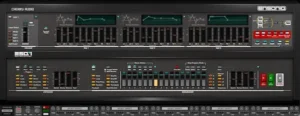 The Cherry Audio ESQ-1 is best suited for producers who prioritize recognizable sonic character over maximum synthesis flexibility. It is not designed to function as an all-purpose production workstation. Instead, it excels in projects where texture, movement, and tonal identity play a larger role than technical complexity.
The instrument feels particularly comfortable in genres that benefit from layered harmonic content and evolving atmospheres. Synthwave, ambient, cinematic scoring, soundtrack work, industrial music, indie electronic production, and retro-inspired genres are natural fits. Producers working in orchestral-hybrid environments may notice similar workflow priorities discussed in our VSL Synchron Solo Violin 1 & Cello Sordino Review, where realism, layering efficiency, and mix integration are often more important than raw feature count. In these contexts, the ESQ-1’s combination of digital oscillators and analog-style filtering can generate sounds that feel detailed and animated without becoming overly dense.
One of the plugin’s strengths is its ability to create motion without requiring extensive programming. Pads develop naturally, digital textures retain interest over longer passages, and hybrid keyboard sounds often sit comfortably within an arrangement. Producers building tracks around mood, space, and atmosphere will generally find more value here than producers focused on aggressive sound design experimentation.
The ESQ-1 is a less obvious choice for workflows centered around modern EDM production, bass music, or highly technical synthesis. Users who regularly build complex modulation systems, rely on advanced wavetable manipulation, or expect a synthesizer to cover every possible production scenario may find its architecture restrictive. Instruments such as Serum, Phase Plant, Pigments, and Falcon provide significantly broader sound design capabilities.
Viewed through a production lens, the ESQ-1 works best as a specialist rather than a generalist. Producers looking for a distinctive hybrid character that can be integrated quickly into real-world arrangements are likely to appreciate its strengths. Those searching for a single synthesizer capable of replacing an entire software arsenal should probably look elsewhere.
Real-World Production Perspective: Mixing, Mastering, and Translation
The difference between a useful synthesizer and an impressive synthesizer often becomes clear during mixing. Many modern instruments are designed to create maximum impact during preset browsing, generating wide stereo images, dense harmonic content, and highly polished top-end detail. Those qualities can sound impressive in isolation but frequently introduce additional work once a track reaches the arrangement, mixing, and mastering stages.
The ESQ-1 follows a different path. Its sounds tend to occupy a defined space within an arrangement without demanding excessive accommodation from other elements. Pads retain width without overwhelming the stereo field. Digital textures remain present without dominating the upper midrange. Keyboard sounds often maintain clarity while leaving sufficient room for vocals, guitars, percussion, and supporting instrumentation.
That behavior becomes increasingly relevant as productions move toward release. Modern music is expected to translate consistently across a wide range of playback environments, many of which reveal weaknesses that remain hidden in studio monitoring conditions. A synth patch that feels impressive on nearfield monitors can quickly become harsh, crowded, or unstable once subjected to codec compression, streaming normalization, consumer earbuds, Bluetooth speakers, and automotive playback systems.
The ESQ-1’s architecture tends to generate sounds with relatively focused harmonic structures and controlled spectral distribution. As a result, many patches retain their identity even when subjected to lossy encoding and aggressive playback processing. High-frequency detail generally remains intelligible without becoming brittle, while complex textures often preserve separation better than heavily layered modern synthesizer sounds.
From a mastering perspective, this behavior has practical implications. One of the most common issues encountered in contemporary electronic productions is excessive spectral density. Many of the challenges that appear during mastering actually originate in arrangement and sound-selection decisions long before the final stage of production, a topic explored in greater detail in How Professional Mastering Works. Large stereo synths, stacked layers, and heavily processed virtual instruments frequently accumulate energy across the upper mids and high frequencies, creating mixes that appear exciting initially but become fatiguing under commercial loudness conditions.
The ESQ-1 rarely eliminates these problems entirely, but it often contributes less to them. Its sounds typically arrive with more defined boundaries, requiring fewer corrective EQ decisions, less stereo management, and fewer compromises during loudness optimization. For engineers working toward competitive release levels, the relationship between tonal balance, dynamics, and perceived loudness is discussed in the LUFS Mastering Guide. That efficiency becomes particularly valuable when multiple synthesizer layers must coexist without sacrificing clarity or translation.
None of this suggests that the ESQ-1 is inherently easier to mix than every modern synthesizer. Production quality still depends on programming decisions, arrangement choices, and engineering skill. What the instrument consistently provides is a set of sonic characteristics that integrate predictably into professional workflows. In commercial production environments, predictability is often more valuable than raw complexity.
CPU Performance and Workflow Efficiency
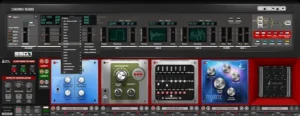 CPU consumption rarely dominates discussions about synthesizer quality, but it remains a practical consideration for producers running large sessions. Modern instruments such as Diva, Serum, Falcon, and other flagship platforms can place significant demands on system resources when projects contain dozens of active instances. The Cherry Audio ESQ-1 occupies a more efficient position. In real-world production sessions, running multiple ESQ-1 instances rarely becomes the bottleneck that forces producers to freeze tracks, raise buffer settings, or compromise workflow efficiency.
This becomes particularly relevant in arrangements built around layered synthesizer parts. Film composers, electronic producers, and soundtrack creators often work with sessions containing dozens of virtual instruments running simultaneously. In those environments, a synthesizer’s practical value is determined not only by how it sounds, but by how easily it scales as projects become more complex.
Large projects expose workflow problems much faster than product demos. A synthesizer that sounds excellent on a single track can become far less attractive when dozens of virtual instruments compete for CPU resources and screen space. In those situations, workflow efficiency becomes a practical production advantage rather than a marketing bullet point. The same principle applies to hardware controllers and production ecosystems, a topic explored in our Arturia MiniLab 37 Review, where workflow speed often proves more valuable than headline specifications.
The ESQ-1’s relatively modest resource requirements help avoid those distractions. Producers can focus on arrangement, sound selection, and mixing decisions rather than system optimization. While CPU efficiency alone is not a reason to choose a synthesizer, it remains a meaningful advantage for users working on larger projects where stability and responsiveness are just as important as sonic capabilities.
What the Cherry Audio ESQ-1 Does Not Do Well
The strengths of the ESQ-1 become easier to understand once its limitations are acknowledged. This is not a synthesizer designed to compete with modern flagship sound-design platforms, nor does it attempt to be a universal solution for every production scenario.
Users accustomed to contemporary workflows may find the interface relatively conservative. Instruments such as Serum, Pigments, Falcon, and Phase Plant provide immediate visual feedback, extensive drag-and-drop modulation, and highly interactive programming environments. The ESQ-1 takes a more traditional approach. While this contributes to its authenticity, it can also slow experimentation for producers who rely on visual workflow cues.
The architecture itself imposes boundaries that some users will view as restrictive. Modern synthesis platforms encourage exploration across wavetable synthesis, granular processing, spectral manipulation, physical modeling, and complex modulation networks. The ESQ-1 remains focused on a narrower set of capabilities. As a result, it is less suited to producers whose work depends on constantly pushing beyond conventional synthesis methods.
Its sonic identity can also become a limitation. One of the reasons the original hardware developed such a loyal following is that it produces a recognizable character that is difficult to replicate elsewhere. The downside is that this character remains present across a large percentage of patches. Producers looking for a single instrument capable of covering every genre, every arrangement style, and every sound-design requirement may eventually encounter the boundaries of the platform.
This is particularly relevant in commercial production environments where versatility often carries significant value. A synthesizer that can move effortlessly between modern pop, EDM, cinematic scoring, bass music, and experimental sound design may justify a permanent place at the center of a production template. The ESQ-1 occupies a different role. It functions best as a specialized instrument that contributes a specific aesthetic rather than serving as the foundation for every project.
None of these limitations diminish the quality of the plugin. They simply define its intended use case. The Cherry Audio ESQ-1 succeeds when viewed as a character instrument with a clearly defined sonic perspective. Producers searching for exactly that perspective are likely to appreciate its focus. Producers seeking unlimited flexibility may find greater value elsewhere.
Verdict
The Cherry Audio ESQ-1 is unlikely to become the centerpiece of every producer’s software collection, and that is precisely why it stands out. Rather than attempting to compete with modern synthesis platforms on feature count, modulation depth, or sound-design flexibility, it focuses on delivering a specific type of musical result with remarkable consistency.
Its strongest attribute is not historical accuracy or vintage appeal. It is the way the instrument behaves inside real productions. The ESQ-1 generates sounds that are often easier to arrange, easier to mix, and easier to carry through mastering than many modern synthesizers built around maximum spectral impact. Pads remain controlled, digital textures retain definition, and layered parts generally integrate without demanding excessive corrective processing.
That does not make it a better synthesizer than Serum, Pigments, Falcon, Phase Plant, or other contemporary platforms. Those instruments offer significantly broader creative possibilities and are capable of covering a much wider range of production tasks. The ESQ-1 succeeds for a different reason. It provides access to a sonic character that remains difficult to duplicate despite decades of technological progress.
Producers searching for a versatile sound-design environment may quickly encounter the boundaries of the ESQ-1 architecture. Producers looking for hybrid digital textures, evolving atmospheres, soundtrack-oriented timbres, and sounds that integrate naturally into finished arrangements are more likely to understand why the original instrument continues to attract attention decades after its release.
The producers most likely to appreciate the ESQ-1 are not necessarily vintage synthesizer collectors. They are producers who value sounds that reach a finished mix quickly, maintain separation inside dense arrangements, and require less corrective processing during mixing and mastering.
Ultimately, the Cherry Audio ESQ-1 is not valuable because it recreates a classic synthesizer. It is valuable because the production qualities that made the original ESQ-1 effective—focused harmonic content, strong mix translation, and a recognizable sonic identity—remain relevant in modern audio production. Technology has changed dramatically since the late 1980s. The challenges of fitting synthesizers into dense arrangements have not.
Overall Rating
| Category | Rating |
|---|---|
| Sound Quality | 9/10 |
| Workflow | 9.5/10 |
| Mix Translation | 9.5/10 |
| CPU Efficiency | 9/10 |
| Sound Design Flexibility | 7.5/10 |
| Value for Money | 9/10 |
| Overall | 9.0/10 |
The Cherry Audio ESQ-1 is not the most flexible synthesizer available in 2026, nor is it intended to compete with modern sound-design platforms such as Serum, Phase Plant, or Falcon. Its strengths lie in its distinctive hybrid character, efficient workflow, strong mix behavior, and ability to generate sounds that translate predictably through arrangement, mixing, and mastering stages. For producers seeking a focused instrument with a recognizable sonic identity rather than unlimited synthesis options, the ESQ-1 remains one of the more compelling vintage-inspired plugins currently available.

Yurii Ariefiev is a mastering engineer and audio production editor focused on mix translation, streaming delivery, and the interaction between production decisions and final release quality. His reviews evaluate software instruments from the perspective of arrangement efficiency, spectral balance, and real-world performance during mixing and mastering rather than feature lists or marketing claims.
For this analysis of the Cherry Audio ESQ-1, the focus was placed on how the instrument behaves inside complete productions, including frequency distribution, layering, loudness optimization, codec translation, and the practical challenges engineers encounter when preparing synth-heavy tracks for commercial release.
FAQ
Does the Cherry Audio ESQ-1 accurately reproduce the sound of the original Ensoniq ESQ-1?
It captures much of the tonal character associated with the original hardware, particularly the combination of digital oscillator texture and analog-style filtering. While software and hardware experiences are never identical, the overall sonic identity remains recognizable to users familiar with the original instrument.
How close is Cherry Audio ESQ-1 to the original Ensoniq ESQ-1 hardware?
The plugin captures much of the character associated with the original hardware, including its digital oscillator texture, hybrid tonal balance, and distinctive modulation behavior. While software cannot fully replicate every aspect of vintage hardware interaction, the Cherry Audio ESQ-1 delivers a convincing interpretation of the instrument’s core sound and workflow.
Is the Cherry Audio ESQ-1 useful for modern electronic music production?
Yes. Although the underlying design originates from the 1980s, its digital textures, evolving pads, atmospheric sounds, and hybrid timbres integrate effectively into contemporary electronic, cinematic, ambient, and indie productions.
Does the ESQ-1 work well in dense mixes?
One of its strengths is spectral efficiency. Many patches occupy a defined space within an arrangement without generating the excessive harmonic density that often complicates mixing decisions.
Can the ESQ-1 replace Serum, Pigments, or Phase Plant?
No. Those synthesizers are broader sound-design platforms with significantly deeper synthesis capabilities. The ESQ-1 is better viewed as a specialist instrument that delivers a specific sonic character rather than unlimited flexibility.
Is the Cherry Audio ESQ-1 suitable for film scoring and soundtrack work?
Yes. The instrument’s evolving textures, atmospheric pads, digital keys, and hybrid tones fit naturally into cinematic arrangements where movement and mood are more important than aggressive synthesis techniques.
How well do ESQ-1 sounds survive streaming compression?
Many patches translate well because their harmonic structure is relatively controlled compared to heavily layered modern synthesizer sounds. This can help preserve clarity after codec compression and streaming normalization.
Does the Cherry Audio ESQ-1 require significant post-processing?
Not necessarily. While every production is different, many ESQ-1 sounds arrive with enough tonal balance to fit into arrangements without extensive EQ correction or additional enhancement. However, successful mastering still depends heavily on the quality of the source mix, and producers preparing tracks for release should review common recommendations covered in Prepare Mix for Mastering.
Can the Cherry Audio ESQ-1 reproduce classic 1980s Ensoniq sounds?
Yes. Many of the pads, digital bells, evolving sequences, hybrid keyboard sounds, and synthetic textures associated with late-1980s Ensoniq productions can be recreated effectively within the Cherry Audio ESQ-1. The plugin is specifically designed to preserve the tonal character that made the original hardware distinctive.
Who is most likely to benefit from adding the ESQ-1 to an existing plugin collection?
Producers who already own modern synthesizers but want access to the distinctive hybrid sound associated with classic Ensoniq instruments are likely to gain the most value. The plugin fills a sonic niche that many contemporary synthesizers do not directly address.