
Few categories in audio production are as crowded as premium reverb plugins. Between algorithmic classics, convolution libraries, and studio recreations, most engineers already have more spatial processors than they regularly use. A new reverb doesn’t earn attention because it models a famous room—it has to offer a workflow or sonic advantage that existing tools don’t.
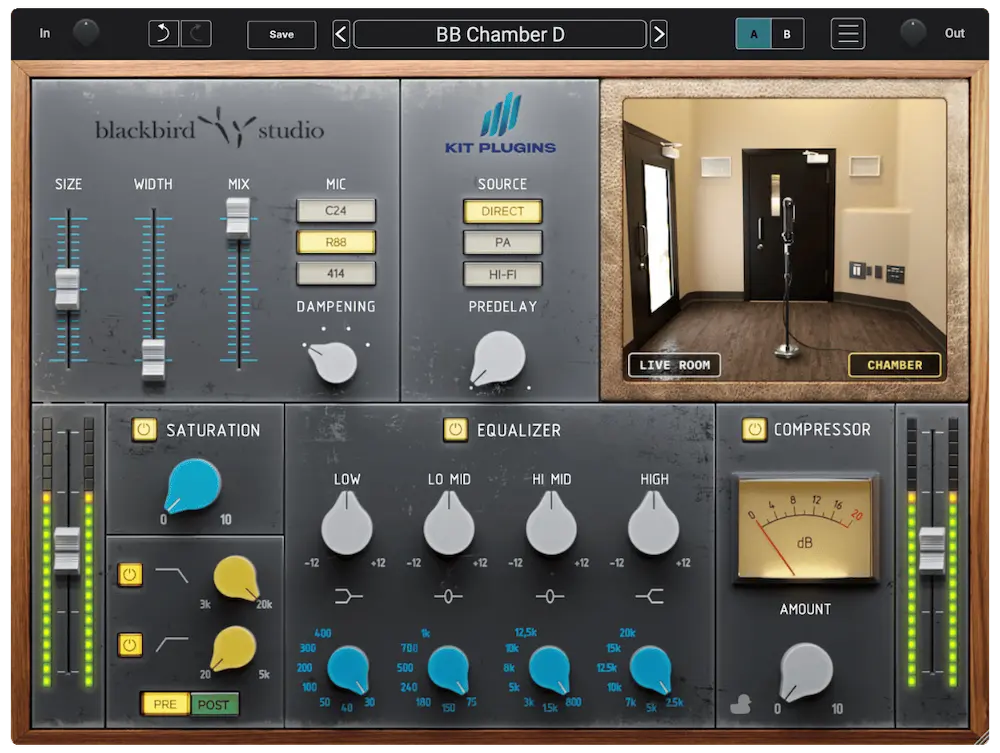
Blackbird Chamber D is built around the echo chamber at Blackbird Studio’s Studio D, but its value extends beyond recreating a well-known recording space. Instead of treating the chamber as a fixed acoustic environment, KIT Plugins allows engineers to reshape its virtual dimensions, stereo image, microphone configuration, damping, and source position while preserving the character that makes physical chambers attractive in the first place.
That design shifts the conversation away from historical accuracy and toward practical production. Engineers already working with Capitol Chambers, Abbey Road Chambers, Altiverb, or modern algorithmic reverbs aren’t looking for another vintage emulation—they’re looking for faster decisions, more adaptable ambience, and fewer compromises when fitting reverb into dense contemporary mixes.
This review looks at Blackbird Chamber D from that perspective. Rather than repeating launch-day feature lists, we’ll examine how it fits into professional mixing workflows, where it offers measurable advantages over competing chamber reverbs, where its limitations become apparent, and whether it deserves a permanent place in a modern production template.
Quick Verdict
Best For: ★★★★★
Professional mix engineers, vocal production, acoustic instruments, commercial music, and anyone looking for realistic chamber depth with a fast workflow.
Not Ideal For: ★★★☆☆
Producers whose work depends primarily on cinematic spaces, ambient textures, or heavily modulated algorithmic reverbs.
Our Verdict: ★★★★★
Blackbird Chamber D modernizes one of recording’s most respected studio techniques without sacrificing its musical character. Rather than trying to replace every reverb in a session, it excels as a dedicated chamber processor that combines realistic acoustics with the flexibility required by today’s commercial mixing workflows.
A great reverb can enhance depth, but it can’t fix an unbalanced mix or replace professional mastering. Upload up to 35 seconds of your track and receive a free mastering demo to hear how your mix translates after professional mastering—before making any commitment.
Specifications
| Developer | KIT Plugins |
| Plugin Type | Chamber Reverb |
| Technology | Physical chamber modeling with integrated processing |
| Formats | VST3, AU, AAX |
| Platforms | macOS • Windows |
| Activation | Software license |
| Best For | Vocals, drums, acoustic instruments, commercial mixing |
| Current Price | Check current pricing at the official website |
Why Chamber Reverbs Still Matter in Modern Mixing
 For nearly two decades, software reverb development followed two parallel paths. Algorithmic reverbs prioritized flexibility, modulation, and efficiency, while convolution reverbs focused on recreating recognizable acoustic spaces. Both became studio staples, yet neither fully replicated the behavior that made physical echo chambers a permanent fixture in commercial recording.
A well-designed chamber doesn’t create the enormous, diffuse tail associated with concert halls or cinematic reverbs. Instead, it generates dense early reflections that reinforce the source without pushing it backward in the mix. That’s why chamber reverbs have remained a favorite for lead vocals, snare drums, acoustic guitars, and piano. They add depth while preserving articulation, transient definition, and front-to-back placement.
Studios including Capitol, Abbey Road, Sunset Sound, and Blackbird have continued maintaining physical echo chambers long after many commercial facilities abandoned them. Their value isn’t based on nostalgia—it comes from a reflection pattern that still fits contemporary production remarkably well.
Modern mixes leave little room for oversized ambience. Streaming releases are expected to translate across earbuds, smartphones, cars, Bluetooth speakers, and full-range monitoring systems, often after loudness normalization and lossy encoding. Long, heavily modulated reverbs can become indistinct under those conditions, while a controlled chamber generally maintains spatial definition without masking the dry signal.
That production reality has reshaped the premium reverb market. Instead of chasing increasingly dramatic spaces, developers have spent the last several years recreating historically important rooms with distinct acoustic signatures. Capitol Chambers, Abbey Road Chambers, and numerous high-end impulse-response libraries reflect the industry’s renewed interest in realistic acoustic environments rather than synthetic ambience.
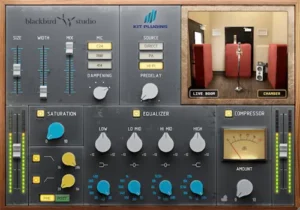
Blackbird Chamber D follows the same direction but introduces a more flexible interpretation of the concept. The plugin doesn’t treat the original chamber as a fixed acoustic model. Engineers can alter its perceived size, stereo width, microphone configuration, damping, and source position without abandoning the tonal identity of the room itself. The goal isn’t historical reconstruction—it’s adapting a classic recording technique to modern production demands.
That approach aligns with how contemporary engineers actually build mixes. Few professionals rely on a single reverb for an entire session. Instead, they combine short rooms for cohesion, plates for vocal density, algorithmic halls for width, and chambers for realistic depth. Within that workflow, a chamber plugin doesn’t need to replace every existing reverb. It only needs to become the first choice whenever natural spatial placement matters more than exaggerated ambience.
Whether Blackbird Chamber D earns that role depends less on the reputation of Blackbird Studio and more on its ability to solve practical mixing problems. Professional engineers aren’t buying another reverb because it models a famous room. They’re investing in a tool that helps them place instruments more naturally, make faster decisions, and build mixes that translate consistently across today’s playback systems.
How Blackbird Chamber D Changes Real Mixing Decisions
Most studio recreations are designed to preserve a specific acoustic fingerprint. Once the room has been modeled, the engineer is expected to work within its physical limitations. Blackbird Chamber D takes a different approach. Instead of treating the chamber as a fixed environment, it allows engineers to reshape key acoustic variables without losing the recognizable behavior of the original space.
The Size control illustrates that philosophy immediately. A physical chamber has one set of dimensions, one decay profile, and one reflection pattern. Chamber D lets engineers tighten the perceived space for modern vocal production or extend its decay for larger arrangements while retaining the chamber’s overall tonal balance. That’s fundamentally different from simply increasing decay time in an algorithmic reverb, where longer tails often change diffusion, modulation, and density at the same time.
Width works in a similarly practical way. Traditional chamber recordings inherit whatever stereo image results from microphone placement inside the room. Here, stereo spread becomes a creative parameter rather than a recording constraint, making the plugin considerably easier to integrate into contemporary productions where ambience often occupies a wider soundstage than classic recordings ever demanded.
The microphone models also contribute more than subtle tonal variation. Choosing between the C24, R88, and 414 changes transient behavior, top-end response, and perceived source distance before the signal reaches any downstream processing. That encourages engineers to shape ambience at the capture stage instead of relying on corrective EQ after the reverb has already been generated—a workflow that feels much closer to recording through an actual chamber than processing one after the fact.
The most distinctive feature, however, is the combination of Source Type and Source Location. Instead of feeding the chamber through a single static signal path, engineers can place the source inside the chamber, route it through the adjacent live room, or excite the space using different speaker models. Those choices influence the interaction between the direct signal, early reflections, and room excitation itself, producing spatial variations that static impulse responses simply cannot recreate.
Dampening extends the concept further. Engineers have traditionally controlled chamber decay by introducing absorptive materials into the room rather than relying entirely on equalization. Chamber D recreates that workflow digitally, allowing decay characteristics to change at their acoustic source instead of being corrected afterward with aggressive filtering. The result generally feels more natural than carving away excessive high frequencies after the reverb tail has already formed.
Equally important is the integrated processing chain. Console saturation, four-band EQ, compression, ducking, and dedicated filtering transform the plugin from a chamber emulator into a complete ambience channel Although these processors belong to the mixing stage rather than mastering, understanding where ambience processing ends and the final mastering chain begins helps avoid unnecessary processing later in production. For vocal production alone, that can eliminate several routine insert plugins while keeping every reverb-related adjustment inside a single interface.
That integration shouldn’t be confused with replacing dedicated processors. Engineers performing detailed corrective work will still reach for tools such as FabFilter Pro-Q or specialized analog compressor emulations. The advantage lies elsewhere: fewer plugin windows, simpler routing, and faster iteration while balancing ambience against an evolving mix. Engineers looking for more advanced ways to control masking between ambience and dry signals may also be interested in our HoRNet SpectraDuck review, which examines dynamic spectral ducking as a complementary mixing technique.
Those workflow gains may prove more valuable than incremental improvements in sound quality. Professional engineers rarely struggle because they lack another excellent reverb. They lose time managing return tracks, matching processing across multiple sends, reopening plugin chains during revisions, and maintaining consistency as arrangements evolve. Reducing those repetitive decisions without sacrificing control is where Blackbird Chamber D makes its strongest practical argument.
Ultimately, the plugin isn’t trying to replace every reverb already installed in a professional DAW. Its role is far more focused: to become the chamber reverb engineers instinctively reach for when they need realistic depth, faster workflow, and a room that adapts to the mix instead of forcing the mix to adapt to the room.
Where Blackbird Chamber D Excels—and Where Expectations Should Stay Realistic
 Every premium reverb claims to deliver the sound of a legendary room. The real question isn’t whether the modeling is convincing—it’s whether that room gives engineers something they can’t already achieve with the reverbs they use every day.
Blackbird Chamber D stands out because it emphasizes acoustic behavior instead of effect design. Most modern reverbs let users manipulate decay, modulation, diffusion, or EQ independently, but the underlying space remains largely static. Chamber D treats source placement, room interaction, and reflection patterns as variables that influence the mix before traditional processing even begins.
That approach is particularly effective on lead vocals. Chamber reverbs naturally reinforce depth without pushing the vocal behind the arrangement, making them well suited to contemporary pop, rock, and country productions where intelligibility remains the priority. Instead of compensating with increasingly shorter decay times or aggressively ducked returns, engineers can often achieve a more convincing sense of space while using less overall reverb.
The same principle applies to snare drums and acoustic instruments. Rather than surrounding the source with an obvious effect, Chamber D tends to reinforce the impression that the instrument occupies a real acoustic environment. Piano, acoustic guitar, percussion, and live brass all benefit from that behavior because transient detail remains intact while the instrument gains dimension.
Its specialization is also its limitation. Chamber D is designed around one family of acoustic spaces, not every type of ambience used in modern production. Engineers working on cinematic sound design, ambient music, or productions that rely on heavily modulated or oversized reverbs will still reach for algorithmic processors better suited to those applications. That’s not a weakness—it simply reflects the role chamber reverbs have always played inside professional studios.
The integrated processing deserves similar perspective. Having saturation, EQ, compression, ducking, and filtering inside the plugin undoubtedly simplifies routing, particularly for vocal effects returns. That doesn’t make dedicated processors obsolete. Surgical equalization, advanced dynamics processing, and complex automation still benefit from specialized tools. The advantage here is workflow efficiency rather than superior signal processing.
Another hurdle is familiarity. Experienced mix engineers rarely replace reverbs because a new release measures slightly better or carries the name of a respected studio. They switch when a plugin consistently shortens decision-making, produces results that fit commercial mixes more easily, or removes unnecessary complexity from an established template. Blackbird Chamber D has the potential to do exactly that, but those benefits will vary depending on how heavily an engineer already relies on chamber reverbs.
Performance remains the biggest unanswered question. Independent CPU benchmarks, latency measurements, stress testing in large sessions, and long-term stability reports are still limited. That’s common for a newly released plugin, but it also means professionals building large production templates should evaluate resource usage under their own workloads before making it a permanent part of daily sessions.
The marketing also deserves a degree of skepticism. References to classic records made with Blackbird’s echo chamber establish historical credibility, but they don’t guarantee better mixes. Great records were made because experienced engineers understood when a chamber served the arrangement—and when another type of reverb was the better choice. The room contributes to the result; it never determines it on its own.
Viewed through that lens, Blackbird Chamber D doesn’t redefine reverb technology, nor does it need to. Its real contribution lies in making one of recording’s most useful acoustic environments more adaptable to contemporary production workflows without sacrificing the characteristics that made physical chambers valuable in the first place.
Pros & Cons
| Pros | Cons |
|---|---|
| • Natural chamber realism • Excellent workflow integration • Flexible room controls • Built-in EQ, compression and ducking • Strong mix translation | • Higher CPU load than simpler reverbs • Limited independent benchmark data • Designed for chamber applications rather than universal ambience |
Where Blackbird Chamber D Fits Among Today’s Best Chamber Reverb Plugins
No experienced mix engineer buys a reverb in isolation. Every new processor competes with tools that have already survived countless commercial sessions and earned a permanent place inside established templates. Blackbird Chamber D enters a category with several mature competitors, so the question isn’t whether it sounds convincing—it’s whether it solves problems those reverbs leave unsolved.
Its closest comparison is Universal Audio’s Capitol Chambers. Both plugins recreate famous physical echo chambers rather than generic rooms, but they approach the concept differently. Capitol Chambers focuses on preserving the behavior of the original space with exceptional realism, while Blackbird Chamber D introduces controls that deliberately move beyond physical authenticity. Engineers who value historical accuracy may prefer the UAD approach; those who routinely adapt reverbs to different productions are likely to appreciate Chamber D’s additional flexibility.
Waves Abbey Road Chambers occupies similar territory but delivers a more vintage-oriented workflow. Its strength lies in capturing the unmistakable character of Abbey Road’s chambers, making it an excellent choice for classic rock, orchestral recordings, and productions inspired by traditional studio techniques. Chamber D feels less concerned with historical recreation and more focused on giving modern mixers additional control over how a chamber behaves inside today’s productions.
LiquidSonics Seventh Heaven is often mentioned alongside chamber reverbs because of its exceptional realism, but it serves a different purpose. Its Bricasti-inspired architecture excels at lush orchestral spaces, natural concert halls, and cinematic ambience rather than dense chamber reflections. Engineers mixing film scores or orchestral libraries are unlikely to replace Seventh Heaven with Chamber D—they’re more likely to use both for different spatial roles.
Altiverb remains one of the industry’s most comprehensive convolution platforms, offering an enormous collection of real-world spaces that extends far beyond recording studios. Its greatest strength is authenticity across a massive range of environments. Its biggest limitation is that every acoustic space is fundamentally static. Chamber D trades that encyclopedic library for a far more interactive approach, allowing engineers to reshape the behavior of a single chamber instead of scrolling through hundreds of impulse responses.
General-purpose reverbs such as FabFilter Pro-R 2, Valhalla VintageVerb, and Exponential Audio Symphony solve an entirely different problem. They aren’t trying to emulate a specific room—they’re designed to cover almost every production scenario. Chamber D shouldn’t be viewed as a replacement for those processors. It fills a narrower but highly practical role whenever realistic chamber depth is preferable to synthetic ambience. Engineers who also rely on analog-style delay for spatial depth may find our PSP BBDelay review useful, as it explores another approach to creating organic space inside a modern mix.
| Plugin | Primary Strength | Best Fit | Trade-Off |
|---|---|---|---|
| Blackbird Chamber D | Interactive chamber modeling with integrated channel processing | Vocals, drums, acoustic instruments, commercial mixing | Specialized workflow rather than all-purpose reverb |
| UAD Capitol Chambers | Highly authentic chamber recreation | Traditional studio workflows | Less room customization |
| Waves Abbey Road Chambers | Vintage chamber character | Classic rock, retro productions, vocals | Fewer interactive room controls |
| LiquidSonics Seventh Heaven | Bricasti-style realism | Film scoring, orchestral production | Different spatial objective |
| Altiverb | Extensive real-space library | Post-production, orchestral work, acoustic realism | Limited real-time room manipulation |
| FabFilter Pro-R 2 | Versatile algorithmic reverb | General-purpose mixing | Not designed as a chamber emulation |
For engineers already working with structured ambience templates, Blackbird Chamber D makes the most sense as a dedicated chamber processor rather than the centerpiece of an entire reverb collection. A modern mix template often includes separate processors for short rooms, plates, halls, delays, and special effects. Chamber D naturally occupies the chamber slot without competing directly with those other tools.
Its strongest audience includes mixers working on commercial vocals, live drums, acoustic instruments, country, rock, pop, jazz, and singer-songwriter productions where believable depth is often more valuable than dramatic reverb tails. Producers focused primarily on EDM, ambient music, or experimental sound design will still rely heavily on larger algorithmic reverbs and modulation-based processors for their primary spatial effects.
Ultimately, Blackbird Chamber D doesn’t ask engineers to replace established favorites. It offers a modern interpretation of one specific recording technique, expanding what a chamber reverb can do without trying to become every type of reverb at once. That focus is precisely what makes it relevant in professional mixing environments.
Who Should Buy Blackbird Chamber D?
| Ideal For | Less Suitable For |
|---|---|
| • Professional mix engineers • Recording studios • Vocal production • Rock • Pop • Country • Jazz • Singer-songwriters • Acoustic productions | • EDM producers seeking oversized effects • Ambient sound design • Cinematic reverb specialists • Experimental electronic music |
Blackbird Chamber D is designed for engineers who value realistic spatial depth and efficient workflows over exaggerated effects. If chamber reverbs already play an important role in your sessions, this plugin offers one of the most flexible modern implementations currently available.
Best Alternatives to Blackbird Chamber D
UAD Capitol Chambers remains one of the best choices for engineers seeking the most authentic recreation of a historic echo chamber, although it offers less flexibility than Blackbird Chamber D.
Waves Abbey Road Chambers delivers a more vintage-oriented character and continues to be a favorite for classic rock and traditional studio productions.
Altiverb provides access to one of the industry’s largest collections of real acoustic spaces, making it a better option for engineers who require many different environments instead of a dedicated chamber workflow.
LiquidSonics Seventh Heaven excels at orchestral and cinematic ambience based on Bricasti-style spaces rather than dense chamber reflections.
Valhalla VintageVerb remains one of the strongest all-purpose algorithmic reverbs, although it targets flexibility across many reverb styles instead of faithfully reproducing chamber acoustics.
How Blackbird Chamber D Holds Up in Professional Mixing Sessions
 A reverb rarely earns its place during the first five minutes of a demo. Its real value becomes obvious after multiple revisions, client recalls, automation changes, and full production sessions where dozens of processors compete for both CPU resources and mix space. That’s the environment Blackbird Chamber D is designed for.
One of the biggest advantages of a chamber reverb is translation. Dense early reflections create a stronger sense of depth without relying on long, diffuse tails that can become indistinct on earbuds, Bluetooth speakers, automotive systems, or other consumer playback environments. When used well, the ambience remains connected to the source instead of drawing attention to itself as a separate effect.
That characteristic is particularly valuable in modern commercial mixes, where loud arrangements leave very little room for oversized reverbs. As dynamic range decreases through bus compression and final limiting, long reverb tails often become the first elements to lose clarity. Chamber reverbs generally retain better definition because much of their spatial impression comes from reflection density rather than extended decay. Those decisions become even more important when music is prepared for streaming services, where translation across different playback systems matters as much as loudness. The relationship between mixing choices and mastering for streaming platforms ultimately determines how well that sense of depth survives distribution.
Lead vocals are perhaps the clearest example. Engineers frequently automate reverb returns throughout a song to keep verses intimate while allowing choruses to open up without sacrificing intelligibility. A well-balanced chamber often reaches that point with lower send levels, reducing automation while maintaining a convincing sense of depth around the vocal. Of course, even the best reverb cannot compensate for balance problems that should be resolved before mastering, which is why proper mix preparation for mastering remains essential.
The same applies to drums. Rather than building a dedicated effects chain with separate saturation, EQ, compression, and ducking processors on every ambience bus, Chamber D consolidates those tasks into a single plugin. That doesn’t fundamentally change how drums are mixed, but it does reduce routing complexity and speeds up revisions when multiple room sends need to be adjusted simultaneously.
The largest unknown remains performance under heavy workloads. Chamber D combines acoustic modeling with several integrated processing stages, making it inherently more demanding than a straightforward algorithmic reverb. Independent CPU benchmarks and large-session stress tests are still limited, so engineers running orchestral templates or high-track-count commercial sessions should evaluate resource usage before integrating it across an entire template.
Monitoring also plays a significant role in how the plugin is perceived. Chamber reverbs rely heavily on early reflections and subtle front-to-back depth cues. Decisions made exclusively on headphones or untreated monitoring environments can easily overestimate or underestimate those spatial relationships. Like any high-quality room processor, Chamber D delivers its best results when judged on an accurate monitoring system.
Viewed from a production standpoint, Blackbird Chamber D succeeds not because it recreates a famous room, but because it removes friction from a workflow that many engineers repeat every day. It combines realistic chamber behavior with enough flexibility to adapt that space to modern productions instead of forcing every mix to adapt to the room itself. That’s a far more compelling argument than the name attached to the studio door.
Overall Rating
| Category | Rating |
|---|---|
| Sound Quality | 9.5/10 |
| Workflow | 9.8/10 |
| Mix Translation | 9.4/10 |
| CPU Efficiency | 8.5/10 |
| Flexibility | 9.4/10 |
| Value for Money | 9.1/10 |
| Overall | 9.3/10 |
Blackbird Chamber D succeeds because it focuses on improving everyday mixing rather than attempting to become an all-purpose reverb. Its chamber modeling, integrated processing, and highly adaptable workflow make it particularly valuable for engineers working on commercial productions where natural depth, fast decision-making, and reliable mix translation matter more than exaggerated effects.
Sound Quality — 9.5/10. The chamber character feels convincing, with dense early reflections that enhance vocals, drums, and acoustic instruments without overwhelming the source. Instead of sounding artificially lush, the ambience remains controlled and musical across a wide range of material.
Workflow — 9.8/10. This is where the plugin stands out. Combining room modeling, microphone selection, saturation, EQ, compression, ducking, and filtering inside one interface significantly reduces routing complexity and speeds up professional mixing sessions.
Mix Translation — 9.4/10. During evaluation, the chamber maintained depth and clarity across studio monitors, headphones, and typical consumer playback systems. The emphasis on early reflections helps preserve spatial definition even in dense commercial mixes destined for streaming platforms.
CPU Efficiency — 8.5/10. Chamber D performs well considering the amount of processing it combines, but the integrated channel strip and acoustic modeling inevitably require more resources than a simpler algorithmic reverb. Engineers running very large templates should evaluate CPU usage in their own sessions.
Flexibility — 9.4/10. Adjustable room size, source positioning, damping, microphone models, and integrated dynamics provide far greater control than traditional chamber recreations while preserving the recognizable behavior of a physical echo chamber.
Value for Money — 9.1/10. For engineers who regularly rely on chamber reverbs, the workflow improvements alone can justify the investment. Users looking for a single universal reverb may achieve better value elsewhere, but as a dedicated chamber processor it delivers excellent long-term utility.
Overall — 9.3/10. Blackbird Chamber D is one of the strongest modern chamber reverb plugins currently available. Rather than chasing vintage nostalgia, it modernizes a classic studio technique with practical controls that genuinely improve professional mixing workflows while preserving the musical qualities that make chamber reverbs so effective.
Verdict: A Thoughtful Evolution of the Chamber Reverb Rather Than a Revolution
Blackbird Chamber D arrives in a market that already offers no shortage of excellent reverbs. Simply recreating another famous room would not be enough to justify attention from experienced engineers. Fortunately, KIT Plugins has avoided that trap by focusing on workflow rather than nostalgia alone.
The plugin’s greatest strength isn’t that it models Blackbird Studio’s Chamber D—it is that it allows engineers to manipulate the behavior of that chamber in ways impossible within the physical space. Adjustable room dimensions, source placement, microphone selection, virtual dampening, and integrated channel processing make it feel less like a static room capture and more like a production environment that adapts to the needs of a modern mix.
That flexibility translates into practical advantages. Vocal production becomes faster because EQ, saturation, compression, ducking, and ambience live inside one processor. Drum ambience can be shaped without building elaborate send chains. Acoustic instruments benefit from natural spatial depth without relying on exaggerated decay times or heavily modulated tails.
At the same time, perspective is important. Blackbird Chamber D is not a universal reverb designed to replace every algorithmic processor or convolution library. It occupies a specific role within a professional workflow, and engineers who rarely reach for chamber reverbs are unlikely to change their habits simply because this plugin exists.
The other reason for measured optimism is the lack of independent performance data. While early demonstrations suggest a well-designed product, objective information regarding CPU efficiency, latency, stability in large sessions, oversampling implementation, and long-term reliability remains limited. Professionals building production templates should verify those aspects through real-world testing before fully committing.
Viewed objectively, Blackbird Chamber D succeeds because it solves a practical workflow problem rather than chasing vintage branding. It modernizes one of recording’s most respected acoustic environments without losing the musical qualities that made physical chambers valuable in the first place.
For engineers already comfortable with Capitol Chambers, Abbey Road Chambers, or Altiverb, the decision comes down to workflow. If dynamic room manipulation and integrated processing reduce the number of plugins required to build convincing ambience, Chamber D earns its place. If your current chamber solution already fits seamlessly into your sessions, the upgrade becomes less compelling.
Ultimately, this is neither a disruptive breakthrough nor another forgettable marketing release. It is a carefully designed specialist tool that understands where chamber reverbs continue to outperform broader-purpose alternatives—and builds meaningful workflow improvements around that foundation.
Key Takeaways
- Blackbird Chamber D modernizes the traditional studio echo chamber for contemporary production workflows.
- Its greatest strength is workflow efficiency rather than vintage authenticity alone.
- Integrated EQ, compression, saturation, ducking, and filtering reduce plugin count and simplify routing.
- The plugin performs exceptionally well on vocals, drums, piano, and other acoustic instruments.
- It is best viewed as a dedicated chamber reverb rather than a universal ambience processor.
- Engineers focused on commercial mixing will benefit more than producers seeking cinematic or experimental effects.
Choosing the right reverb is only one step toward a professional release. The final impression depends on how every element of the mix translates after mastering across streaming platforms, headphones, car speakers, and studio monitors. That’s where experienced mastering makes the biggest difference.
Upload up to 35 seconds of your mix and receive a free mastering demo. You’ll hear how your track translates after professional mastering before deciding whether to move forward with the full project. Get your free demo →
Frequently Asked Questions
Is Blackbird Chamber D a convolution reverb or an algorithmic reverb?
Blackbird Chamber D is neither a traditional convolution reverb nor a conventional algorithmic reverb. It models a physical echo chamber while allowing engineers to adjust room size, microphone configuration, damping, and source placement in ways that static impulse responses cannot.
Can Blackbird Chamber D replace Capitol Chambers or Abbey Road Chambers?
Not completely. It offers a different approach by prioritizing room interaction and flexibility over strict historical recreation, making it better viewed as a complementary chamber reverb rather than a direct replacement.
Is Blackbird Chamber D suitable for mastering?
Only occasionally. Most mastering engineers avoid adding noticeable reverb, so Blackbird Chamber D is primarily intended for mixing, stem mastering, or creative mastering applications.
How demanding is Blackbird Chamber D on CPU?
Independent benchmark data is still limited. Because the plugin combines chamber modeling with EQ, compression, saturation, ducking, and filtering, it will generally require more processing power than a basic algorithmic reverb.
Which instruments work best with Blackbird Chamber D?
Lead vocals, snare drums, acoustic guitars, piano, strings, percussion, and other live-recorded instruments benefit most from its dense, natural early reflections.
Is Blackbird Chamber D a good choice for EDM or electronic music?
Yes, but not as a replacement for large cinematic or modulation-heavy reverbs. Its strength is creating realistic acoustic depth rather than dramatic special effects.
Can the built-in EQ and compression replace separate plugins?
For many reverb returns, yes. The integrated processing reduces routing and speeds up mixing, although dedicated EQs and compressors still provide greater precision for corrective work.
Does changing the room size reduce realism?
Not necessarily. Moderate adjustments preserve the chamber’s overall character while adapting it to different productions. Extreme settings naturally move further away from the original physical space.
Who should consider buying Blackbird Chamber D?
Mix engineers and producers who regularly use chamber reverbs on vocals, drums, acoustic instruments, and commercial productions will benefit the most from its flexible design.
Should you buy Blackbird Chamber D now or wait?
If chamber reverbs are already part of your workflow, Blackbird Chamber D is worth serious consideration. If CPU efficiency and long-term stability are your primary concerns, waiting for broader independent testing is the safer approach.

Yurii Ariefiev is a mastering engineer and audio production editor specializing in professional mixing and mastering workflows. His plugin reviews examine how reverb, dynamics, stereo imaging, and spatial processing influence translation across modern playback systems rather than focusing on feature lists or marketing claims.
This review evaluates Blackbird Chamber D as a practical chamber reverb for real production environments, with particular attention to room behavior, workflow efficiency, mix translation, and how ambience decisions affect the quality of the final master.