Acustica Pearl 3 — A High-End Analog Emulation Built for Modern Mixing and Mastering
The release of Acustica Pearl 3 marks a significant shift from a niche, limited-run plugin into a fully integrated professional tool designed for high-end mixing and mastering workflows. What began over a decade ago as a rare software recreation has now evolved into a permanent product within Acustica’s lineup, aimed squarely at engineers who prioritize tone, depth, and musicality over sterile precision.
Pearl 3 is based on one of the rarest Italian broadcast processors ever built — a piece of hardware designed during a time when audio engineering was driven by performance rather than cost efficiency. This philosophy carries directly into the plugin: it’s not about features for the sake of features, but about delivering a sonic signature that adds weight, density, and cohesion to a mix.
Architecture: A Modular Approach Instead of a One-Size Solution
Rather than combining everything into a single interface, Pearl 3 is delivered as a suite of three distinct plugins, each focused on a specific task:
- Pearl 3 EQ — a tone-shaping equalizer designed for broad, musical adjustments;
- Pearl 3 Comp — a vintage-style compressor focused on cohesion rather than aggression;
- Pearl 3 Strip — a full channel strip combining preamp, EQ, and compression.
This modular structure is deliberate. It allows engineers to deploy each component exactly where it adds value — whether on buses, groups, or the master chain — without unnecessary processing overhead. In practical terms, this leads to cleaner signal flow and more intentional decision-making.
Sound Philosophy: Shaping Tone Instead of Fixing Problems
Pearl 3 is not a corrective tool. Treating it like a surgical EQ is a mistake. Its purpose is tonal shaping — influencing how a track feels, not just how it measures.
The EQ is designed for wide, musical curves. It enhances low-end weight, clarifies midrange presence, and opens up the top end without introducing harshness. This makes it particularly effective on buses and full mixes, where subtle tonal shifts define the overall character.
The compressor operates with a different mindset compared to modern digital designs. Instead of aggressively controlling transients, it gently binds elements together. This “glue” effect is critical in professional mixing and mastering, where cohesion matters more than loudness alone.
The channel strip ties everything together into a unified analog-style signal path. Each stage interacts with the next, meaning results depend not only on parameter settings but also on gain staging and processing order. This behavior mirrors real hardware and rewards engineers who understand signal flow at a deeper level.
Hyper Modelling Technology: Beyond Static Emulation
At the core of Pearl 3 is Acustica’s Hyper modelling technology. Unlike traditional impulse-based approaches, this system captures non-linear behavior in detail — including how the processor reacts dynamically to different signal levels.
In real-world use, this translates into:
- level-dependent tonal changes rather than static frequency response;
- compression that adapts to the source material instead of applying uniform gain reduction;
- harmonic saturation that evolves naturally without sounding artificial.
This is what separates Pearl 3 from conventional plugins. It doesn’t just simulate a curve — it replicates behavior. The result is a more organic and dimensional sound that integrates seamlessly into a mix.
Where Pearl 3 Actually Works
This is not a utility plugin. It’s a finishing tool. Its strengths become obvious in the final stages of production:
- enhancing depth and cohesion on the master bus;
- processing drum, vocal, or instrument groups;
- adding analog weight to fully in-the-box productions;
- refining tonal balance during mastering.
Used incorrectly, it will feel underwhelming. Used with intent, it becomes a defining part of the sound.
Interface and Workflow
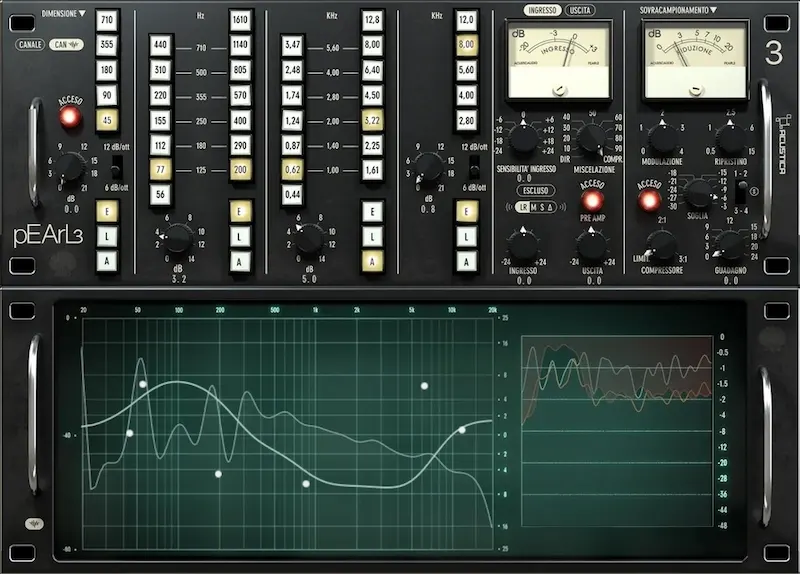
The interface mirrors the original hardware layout but integrates modern visual feedback tools. Engineers get access to real-time EQ curves, input monitoring, and gain reduction meters.
This hybrid approach — combining analog-style control with digital precision — allows for faster, more informed decisions without losing the tactile feel of hardware-inspired workflows.
What’s New in Pearl 3
The third version introduces more than incremental improvements. New preamp stages have been added to both the EQ and compressor, enhancing harmonic response and overall signal solidity.
Additionally, internal processing has been refined to improve clarity in dense mixes. Earlier versions could blur complex arrangements; Pearl 3 maintains separation while still delivering analog-style cohesion.
System Compatibility
Pearl 3 supports Windows 10 and above, as well as macOS 10.15 and later. It is available in VST3, AU, and AAX formats, ensuring compatibility with all major DAWs used in professional environments.
Market Positioning
Pearl 3 does not compete with clean digital EQs or transparent compressors. It sits in the category of character processors — tools designed to shape the emotional and sonic identity of a track.
This positions it alongside high-end analog emulations used in final-stage processing. In professional workflows, these tools are not optional — they are what separate a technically correct mix from a commercially competitive record.
Studio Perspective
From a production standpoint, tools like Pearl 3 are used selectively. They are not inserted by default — they are chosen when a mix requires additional depth, cohesion, and tonal richness.
Achieving a polished, release-ready sound involves more than technical balance. It requires controlled coloration and dynamic shaping. This is exactly where Pearl 3 becomes relevant.
Our studio provides professional online mixing and mastering services tailored to modern industry standards. Projects that demand depth, clarity, and competitive loudness are handled with a combination of precision tools and analog-style processing techniques.