Arturia Augmented Persia review: a fast cinematic engine that trades control for immediacy
Arturia Augmented Persia review — Arturia’s latest entry in the Augmented line doesn’t try to compete with deep sample libraries. It targets something else: speed. This is a hybrid instrument plugin built to generate finished, cinematic material in minutes, not to simulate instruments with nuance.
That distinction matters. Because if you approach Arturia Augmented Persia like a traditional instrument, it falls apart. If you treat it as a sound design engine, it becomes one of the fastest tools currently available for atmospheric production.
Context: why hybrid plugins like this are taking over
In modern audio production, the bottleneck is no longer access to sounds — it’s decision speed. Producers working in scoring, trailers, and content pipelines don’t have time to build tones from scratch. They need results that translate immediately in a mix.
This is where the Augmented series sits. Instead of offering depth, it compresses workflow. Arturia Augmented Persia narrows that idea further by focusing on Middle Eastern tonal material — not for authenticity, but for color.
It’s not competing with orchestral libraries. It’s competing with time.
Arturia Augmented Persia review: what’s actually under the hood
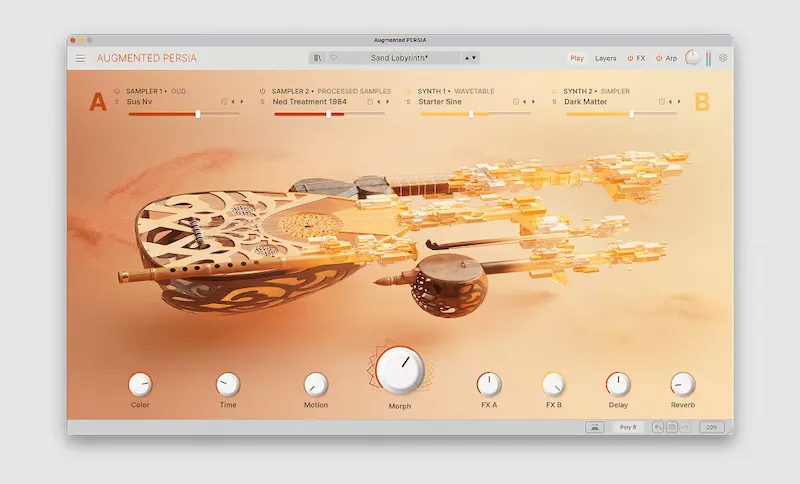
At its core, the plugin combines six sampled sources — oud, tar, saz, kamancheh variants, and ney — with four synthesis engines:
- granular (texture generation)
- wavetable (digital movement)
- virtual analog (body and warmth)
- additive/harmonic (upper structure shaping)
On paper, this isn’t new. What is different is how aggressively the signal is pre-shaped. These are not neutral samples. They’re captured and processed to behave like cinematic layers from the start.
Dynamic sampling (soft oud vs aggressive tar/saz) helps with movement, but it’s still curated toward a specific outcome: evolving, wide, emotionally loaded textures.
This is not an instrument you perform. It’s a system you steer.
What it does in a real mix (and why that matters)
The biggest gap between marketing and reality shows up in mixing.
In isolation, Arturia Augmented Persia sounds polished. In context:
- the ney layer pushes high-frequency noise into the same space as vocal air
- tar and saz generate dense upper-mid content (2–5 kHz), quickly masking presence elements
- bowed textures fill midrange in a way that collapses depth if left unchecked
Translation: the plugin arrives pre-mixed — and not necessarily for your mix.
This creates a specific workflow consequence. You’re not building tone from zero. You’re negotiating with a finished sound.
In mastering, this becomes more obvious. Saturated layers and baked-in compression respond unpredictably to limiting. You get perceived loudness early, but lose transient clarity and stereo definition under pressure.
If you’re aiming for competitive masters, especially in dense arrangements, these sources need to be controlled early. Otherwise, they’ll dictate headroom decisions later. This is exactly where hybrid material tends to fail — and why final-stage translation requires careful handling, often beyond what typical plugin chains solve, as seen in dedicated mastering workflows.
Where it actually delivers value
Arturia Augmented Persia is highly effective when speed matters more than control:
- trailer cues and cinematic beds
- game scoring requiring regional identity without live sessions
- ambient and hybrid electronic production
- intro/outro design and transitional layers
In these contexts, the plugin reduces hours of sound design into minutes. That’s not convenience — that’s production leverage.
Load a preset, move two macros, and you’re already in usable territory. Few tools in this category move that fast without sounding generic.
Where it breaks — and why that’s not a bug
The limitations are structural, not accidental:
- limited articulation control — this isn’t a performance instrument
- heavy tonal imprint — difficult to neutralize
- frequency dominance — easily overwhelms arrangements
- preset dependency — risk of repetition across projects
The key issue is agency. You don’t fully shape the sound — you adapt to it.
For some workflows, that’s efficient. For others, it’s restrictive.
Positioning: where it stands against the competition
Compared to adjacent tools:
- Kontakt libraries — unmatched depth and realism, but slower iteration
- UVI World Suite — broader coverage, less defined character
- EastWest RA — more traditional, less relevant sonically
- Output / Heavyocity — similar immediacy, but less culturally focused
Arturia Augmented Persia sits between realism and abstraction. It wins on speed and tonal identity, loses on control and versatility.
This makes it a layer tool, not a foundation instrument.
Verdict
Arturia Augmented Persia is a workflow accelerator disguised as an instrument.
If you need fast, cinematic results — it’s one of the most efficient plugins in its class.
If you need precision, articulation, and mix control — it will slow you down, not speed you up.
Use it to generate material. Don’t rely on it to carry your mix.