Stam Audio SA-4000+ Review: What the FX384 Mode Actually Fixes (and What It Doesn’t)
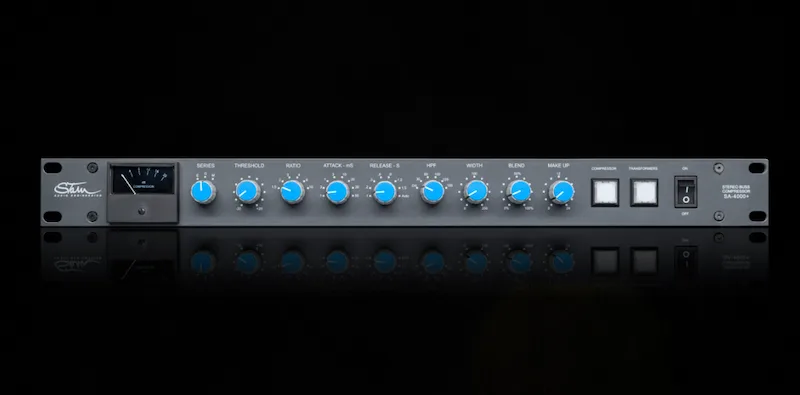
Stam Audio SA-4000+ isn’t a new compressor—it’s a correction. Instead of releasing another SSL-style unit, Stam reworked the SA-4000 to address a long-standing limitation: classic bus compression sounds great, but it doesn’t always translate cleanly in modern mixes.
The addition of a “Modern” mode, based on the late-’90s FX384, is aimed squarely at that problem. The question is whether this actually expands the unit’s role in mixing and mastering—or just adds another flavor that overlaps with what engineers already have.
What Changed in the SA-4000+ (and Why It Matters)
The headline feature is obvious: a third compression topology.
- E mode — fast, forward, aggressive
- G mode — classic SSL glue
- Modern (FX384) — cleaner, lower distortion
Under the hood, this isn’t a simple voicing switch. The Modern mode uses THAT VCAs for both gain reduction and sidechain, which shifts the behavior closer to late-era SSL hardware designed for transparency rather than character.
More importantly, Stam added 30 ms and 50 ms attack options. That single change dramatically alters how the unit handles transients—especially on drums and dense electronic material.
The new 6:1 ratio pushes it beyond subtle bus compression into more assertive control, while the Stereo Width control introduces a non-traditional variable that can either open up a mix—or destabilize it.
Real-World Test: How It Behaves at Different Gain Reduction Levels
This is where most reviews stop short. The SA-4000+ behaves very differently depending on how hard you hit it.
2 dB GR (Mix Bus / Master Bus)
Tightens the mix without audible pumping. In G mode, it behaves predictably—low-end stays intact, stereo image holds. In Modern mode, it’s cleaner, but slightly less cohesive.
4 dB GR (Mix Bus Sweet Spot)
This is where the unit does its job. G mode delivers glue without collapsing the image. E mode starts pushing midrange forward, which can help drums cut—but can also harden vocals if you’re not careful.
6–8 dB GR (Drum Bus / Aggressive Compression)
Now you’re in character territory. E mode becomes punchy but brittle. Low-end tightens, but loses weight. Stereo field starts narrowing. Modern mode holds together longer, but loses depth under heavy compression.
Low-End Behavior
— G mode: stable up to ~4 dB GR
— E mode: tighter, but can feel choked
— With transformer mods: low-end thickens, but headroom drops faster
Stereo Image
— up to 3 dB GR: solid
— beyond that: noticeable narrowing
— Stereo Width control: usable below ~120%, risky above
How It Fits in a Modern Mixing Workflow
The Stam Audio SA-4000+ makes the most sense in hybrid setups—not as a final mastering compressor, but as a control stage before limiting.
Typical chain:
DAW → EQ → SA-4000+ (2–4 dB GR) → limiter
In this position, it adds density and stabilizes dynamics before the final stage. The Modern mode is the only one that consistently works here without introducing unwanted color.
On drum bus, it’s more flexible:
- E mode for punch (4–6 dB GR)
- G mode for cohesion (2–4 dB GR)
It’s not subtle—but it doesn’t need to be.
Where It Breaks (and Why That Matters)
This unit has limits, and they show up quickly if you push it like a mastering compressor.
- Above 5 dB GR — depth collapses, especially in dense mixes
- Stereo Width >130% — phase instability becomes audible
- Transformer mods on mix bus — low-end builds up faster than it should
The core issue: this is still a bus compressor architecture. Trying to stretch it into a full mastering role exposes its weaknesses.
How It Compares to Real Alternatives
SSL G Bus Comp
More consistent, more predictable. Less flexible.
API 2500
Stronger transient control, more aggressive tone shaping. Less subtle glue.
TK Audio BC1
Cleaner, more mastering-friendly—but lacks character.
Plugin Options (UAD SSL, Cytomic The Glue, FabFilter Pro-C2)
Better recall, more precision, less dimensionality.
The SA-4000+ sits in between: more flexible than traditional hardware, less precise than plugins.
Who This Is Actually For
- Engineers running hybrid setups
- Producers who need one hardware unit covering multiple roles
- Studios working across genres (rock, electronic, hip-hop)
Who should skip it:
- Engineers looking for exact SSL behavior
- Mastering-focused workflows requiring absolute transparency
- ITB users expecting recall and surgical control
Price vs Reality
At $1190 (pre-order) and up to ~$2000 with mods, the SA-4000+ enters a competitive range where dedicated solutions become viable.
The value proposition only holds if you actually use all three modes. If you don’t, it’s an expensive way to get one sound.
Verdict
Stam Audio SA-4000+ solves a real problem: traditional SSL compression doesn’t always fit modern production.
The Modern mode makes it more usable across different contexts—but it doesn’t turn it into a mastering compressor, and it doesn’t replace specialized hardware.
It’s a flexible tool, not a definitive one.
If you need one box that can move between punch, glue, and control—it works.
If you’re chasing precision or authenticity, you’ll hit its limits fast.
And if you can’t clearly hear the difference between its modes, you don’t need it.