

Best 1073 Plugin 2026: Top 5 Ranked (UAD vs Waves vs Acustica vs Heritage)
The 1073 plugin category is one of the most crowded in audio production — and also one of the most misunderstood. Everyone knows the sound they’re chasing. Very few understand what these plugins actually do in a mix.
Quick answer: UAD for realism, Acustica for depth, Lindell for balance, Waves for speed, Heritage Audio for basic tone shaping.
If you just need one pick: UAD 1073 is the most reliable across different mixes.
- Best overall: UAD 1073
- Best for mastering: Acustica Gold
- Best balance: Lindell 80
- Best budget: Heritage Audio 80 Series
Most 1073-style EQs don’t “improve” your track. That’s where people get it wrong. They reshape tone, add harmonic density, and — if used incorrectly — blur detail and flatten transients. That’s why the real question isn’t which one is most “authentic,” but which one actually works under pressure.
This breakdown focuses on real-world behavior: transient response, top-end integrity, low-end control, and how these tools translate inside modern mixing and mastering workflows — including the recently released Heritage Audio 80 Series Collection plugin.
What a 1073 Plugin Actually Does (and Doesn’t)
A 1073 plugin is not a precision EQ. It’s a fixed-band, wide-Q tone shaper designed around analog circuit behavior. That means:
- limited frequency selection
- broad boosts and cuts
- harmonic coloration tied to gain staging
- inter-band interaction
It won’t fix problems — it just makes them more obvious. It won’t remove resonances or fix balance issues. What it does is shift perception — making elements feel closer, denser, or more forward.
That’s why it still shows up in mastering chains, despite offering far less control than modern parametric EQs.
Where 1073 Plugins Work — and Where They Break
In a controlled mix, a good analog EQ plugin can add weight and cohesion quickly. But the margin for error is narrow.
- Vocals: a 10–12 kHz boost can add presence without harshness — or smear articulation if the model lacks detail. In some cases, it actually feels better at first — until you put it back in the mix
- Bass: adds perceived size, but often sacrifices definition below 80 Hz
- Drum buses: can enhance punch, but also soften attack if the transient handling is weak
- Mix bus: subtle glue only works if the mix is already balanced — which is why proper mix preparation for mastering matters more than the EQ choice itself.
Common failure point: this is the same reason why tracks often fall apart during mastering — the issue was already built into the mix.
This is where differences between plugins become obvious.
This is where most people get misled: what sounds bigger often ends up less controlled in a full mix.
Top 1073 Plugins Ranked (2026)
- UAD 1073 — best overall (most consistent in real mixes)
- Acustica Gold — best for mastering (depth and harmonic detail)
- Lindell 80 Series — best balance (workflow + sound)
- Waves Scheps 73 — best for speed (low CPU, fast decisions)
- Heritage Audio 80 Series — entry-level tone shaping
Best 1073 Plugins Compared (Real Behavior, Not Marketing)
If you want the full breakdown, here’s how each plugin behaves under real mixing conditions:
| Plugin | Modeling Approach | CPU Load | Low-End Behavior | Top-End Behavior | Transients | Best Use Case |
|---|---|---|---|---|---|---|
| UAD 1073 | Component-level | Moderate (DSP/Native) | Tight, focused, controlled | Smooth, detailed, stable under boost | Maintained, adds punch | Mixing / Mastering |
| Acustica Gold | Dynamic sampling | High | Deep, heavy, extended | Highly detailed, natural texture | Very accurate | Mastering |
| Lindell 80 Series | Algorithmic | Low | Controlled, neutral | Clean, predictable | Stable | General mixing |
| Waves Scheps 73 | Algorithmic | Very low | Light, less defined | More aggressive, can feel brittle | Slightly softened | Fast workflow |
| Heritage Audio 80 Series | Algorithmic | Low | Soft, less focused | Rounded, reduced micro-detail | Slightly smoothed | Tone shaping |
Key takeaway: differences don’t show up in frequency curves — they show up in transient integrity and top-end behavior under gain.
Heritage Audio 80 Series Collection Plugin: Where It Fits
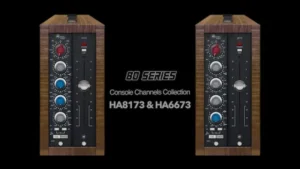 The Heritage Audio 80 Series Collection plugin bundles two EQs:
- HA6673 — wider, more forgiving curves
- HA8173 — tighter, more assertive response
This “dual-voicing” approach is the core idea. Instead of one model trying to do everything, you get two tonal directions inside the same ecosystem.
In practice, though, the differences are subtle compared to the gap between brands.
Real-world behavior:
- top-end boosts tend to widen the signal rather than bring it forward
- low-end feels larger, but not tighter
- transients soften under heavier gain
For example, boosting 12 kHz on a vocal adds air, but reduces focus compared to higher-end models where articulation stays intact.
This is a tone tool — not a finishing tool.
Marketing vs Reality
The idea that a pair of EQs can “cover virtually every EQ situation” doesn’t hold in modern production.
Today’s workflows rely on layered processing:
- surgical EQ for correction
- dynamic EQ for control
- color EQ for tone
Understanding how this fits into a full mastering chain is critical — otherwise this type of EQ gets used in the wrong place.
A 1073 plugin sits at the last stage — not the first.
Used early, it creates problems. Used late, it enhances what already works.
Which 1073 Plugin Should You Actually Use?
- Maximum realism: UAD or Acustica
- Balanced workflow: Lindell
- Speed and low CPU: Waves
- Entry-level tone shaping: Heritage Audio
The choice isn’t about brand — it’s about context. The wrong EQ in the right place will still fail.
Final Verdict
The best 1073 plugin isn’t the one that sounds “most analog” — it’s the one that holds together inside a dense mix.
The Heritage Audio 80 Series Collection doesn’t compete at the top end of modeling depth, but it offers a usable, fast workflow option for engineers who prioritize tone over precision.
If your mix collapses after EQ, the issue isn’t the plugin. It’s the stage you’re using it in. Sometimes it works. Sometimes it doesn’t. That’s the point.
FAQ: 1073 Plugin, Mixing and Real-World Use
What is a 1073 plugin actually used for?
A 1073 plugin is used for tone shaping, not correction. It adds harmonic density, changes perceived depth, and brings elements forward in a mix. It doesn’t fix resonances or balance issues.
What is the best 1073 plugin in 2026?
For maximum realism and depth, UAD and Acustica are still ahead. For balanced workflow, Lindell works well. Heritage Audio is usable, but not at the top in terms of detail or transient response.
Can a 1073 plugin be used in mastering?
Yes, but only for subtle tonal shaping. Strong boosts can easily destabilize the mix. These tools work best at the final stage, not as primary EQ.
Why does a 1073 plugin sometimes make a mix worse?
Because it amplifies existing problems. Wide curves and harmonic coloration can blur detail and reduce clarity if the mix isn’t already controlled.
Is a 1073 plugin good for vocals?
Yes, especially for adding presence and weight. But lower-quality models can smear articulation in the top end, particularly when boosting above 10 kHz.
What’s the difference between a 1073 plugin and a parametric EQ?
A parametric EQ is precise and surgical. A 1073 plugin is broad and musical. One fixes problems — the other shapes perception.
Is Heritage Audio 80 Series Collection worth it?
If you don’t already own a 1073-style plugin, it’s a solid entry point. If you already use UAD, Acustica, or similar tools, it doesn’t offer a clear upgrade.
Should you use a 1073 plugin on every track?
No. Overusing it leads to buildup of harmonics and loss of clarity. It’s more effective when used selectively.