
Front To Back Depth In Mixing: Why Great Mixes Feel Three-Dimensional
Front-to-back depth in mixing is what makes a recording feel three-dimensional instead of flat. Listeners usually recognize it without technical knowledge: lead elements feel closer, supporting instruments appear farther back, and the performance develops a natural sense of space instead of sounding like everything exists on one flat plane. Even when every instrument is clearly audible and the overall balance seems correct, a mix can still lack realism if every sound appears to exist at the same perceived distance from the listener.
That difference often comes down to front to back depth in mixing. Listeners don't experience every instrument as existing on a single line. They instinctively perceive some sounds as closer, others as supporting the performance from farther away, creating a musical perspective that feels effortless rather than crowded. When every element appears to occupy the same perceived distance, the mix can lose realism even if the individual tracks are recorded and balanced well.
Depth isn't about making a production louder, wider, or more dramatic. Instead, it allows listeners to perceive a convincing musical perspective where different sounds occupy different apparent distances.
What Front-To-Back Depth Really Means In A Mix
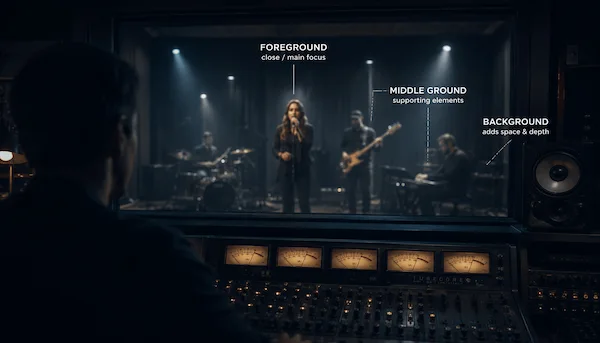 Every recording creates a mental picture. Long before listeners notice individual instruments, they instinctively build a sense of where the music is happening around them. Some sounds appear close enough to feel almost tangible, others seem to support the recording from farther away, while another group settles naturally between those two extremes. This perceived distance is what front-to-back depth is really about. It isn't a visual effect or an engineering trick—it is how the brain organizes a musical environment.
Think about attending a live performance. Your attention rarely lands on every musician equally. The lead vocal may feel only a few feet away, the rhythm section provides a solid foundation behind it, while supporting instruments occupy positions that make the entire performance feel believable. Even without looking at the stage, your brain continuously estimates those relationships. A successful mix creates a similar experience, allowing the listener to sense a foreground, a middle ground, and a background without consciously analyzing why.
Imagine standing in front of a band at a small venue. The vocalist naturally feels closest to you, the drummer feels farther back, while room reflections connect everything into one performance. A successful mix creates the same illusion—not because listeners consciously measure distance, but because those spatial relationships feel believable from the very first seconds.
The foreground contains the musical moments that immediately attract attention. The middle ground provides context, movement, and interaction, giving the arrangement shape without constantly demanding focus. The background completes the scene, adding support that expands the emotional space rather than competing with the song's primary ideas. These layers don't represent volume levels or track importance. Instead, they describe how comfortably each element settles into the overall perspective of the performance.
This explains why a technically clean mix can still feel surprisingly flat. Every instrument may be perfectly audible, yet if they all appear to originate from the same perceived distance, the listener experiences a single crowded plane instead of a convincing musical landscape. The performance becomes harder to interpret because the ear isn't guided intuitively through the arrangement—it simply encounters everything at once.
Distance and horizontal placement are also separate dimensions of spatial perception. A guitar can feel farther away while remaining clearly positioned to one side, just as a vocal can stay directly in the center while feeling very close to the listener. These relationships work together but describe different aspects of how space is perceived.
The Three Perceived Layers Of A Mix
The musical ideas that naturally capture the listener's attention first, such as lead vocals or primary melodies.
Supporting instruments that connect the arrangement, provide movement, and reinforce the main musical ideas without competing for attention.
Atmospheric and supporting elements that complete the listening environment and create a convincing sense of front-to-back depth.
A convincing mix doesn't place every instrument on the same apparent plane. Instead, listeners instinctively recognize these three perceived layers, allowing the performance to feel organized, natural, and three-dimensional.
Why Some Mixes Feel Flat Even When Everything Is Balanced
One of the most common situations we encounter in the studio is a mix that appears to be technically successful from the very first listen. Levels are under control. Nothing jumps out as distracting. Every instrument can be heard without effort, and there are no obvious signs of technical problems. On paper, everything looks ready for the next stage. Yet after thirty seconds, the same comment often comes up: "It still feels flat."
Interestingly, that reaction rarely comes from a lack of detail. In many cases, the arrangement itself is strong, the performances are expressive, and the production contains plenty of interesting textures. The issue is subtler. Every musical element seems to exist at roughly the same perceived distance from the listener. Instead of unfolding naturally, the entire performance presents itself as one continuous surface where every sound competes to occupy the same listening position.
We've encountered many mixes where every instrument could be heard perfectly, yet the performance still felt surprisingly two-dimensional. Nothing was technically broken. The missing ingredient was simply a convincing sense of front-to-back perspective that allowed different musical ideas to occupy different perceived distances.
Most listeners immediately recognize when every instrument feels equally close. Even without understanding why, the mix often feels less realistic and more difficult to stay engaged with.
This doesn't necessarily make the mix sound bad. In fact, many flat mixes initially impress listeners because everything feels present from the very first second. The problem usually appears later. As the song develops, nothing changes in the listener's perception of space. Choruses don't feel more immersive. Emotional moments don't seem to open up naturally. Even subtle arrangement changes become less satisfying because the performance lacks a convincing sense of perspective.
Over longer listening sessions, this can also contribute to fatigue. Not because the music is too loud or overly aggressive, but because the brain receives very few spatial cues to organize what it hears. Without natural differences in perceived distance, every section demands a similar level of attention. The result is a listening experience that feels surprisingly dense despite being technically clean.
Professional mix evaluation often begins with this observation rather than with processing decisions. Before changing anything, experienced engineers ask a simple question: Does the performance feel like it occupies a coherent space, or does everything appear equally close? That perspective shapes every decision that follows. Our article on How Professional Mixing Works explores this evaluation process in greater detail and explains why perception is assessed before technical adjustments are considered.
How Listeners Recognize Musical Distance
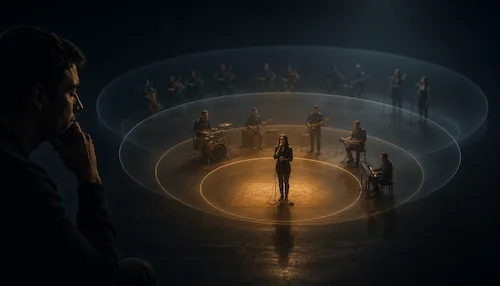 A listener never hears individual DAW tracks.
Within a fraction of a second, the brain combines every sound into one coherent acoustic scene and begins estimating which musical ideas feel closest, which provide support from farther away, and how those relationships shape the overall performance.
Distance perception is part of how people navigate the real world every day. We constantly estimate how near or far voices, footsteps, traffic, or other environmental sounds are without making a deliberate calculation. The same instinct carries over into recorded music. Even though a mix is built from separate recordings captured at different times, listeners expect it to behave like one coherent performance. When those spatial relationships feel believable, the brain accepts the illusion with remarkable ease.
An important detail is that perceived distance isn't simply about how loud something is. Two musical elements can be equally audible while creating very different impressions of proximity. One may feel immediate and engaging, encouraging the listener to connect with it first. Another may remain perfectly clear while naturally supporting the performance from a greater perceived distance. That balance allows attention to move through the song without becoming forced or exhausting.
This is why experienced engineers often describe a successful mix as being easy to follow. The listener isn't consciously searching for important musical ideas because the overall perspective already provides direction. Attention shifts naturally between the foreground, supporting layers, and the broader musical environment. Listeners experience one coherent performance instead of dozens of independent sounds.
Directness also plays a major role in this perception. Sounds that appear closer often feel more immediate and emotionally connected, while those that seem farther away contribute scale, atmosphere, or context without interrupting the primary musical narrative. Neither role is inherently more valuable than the other. Together they create the sense that the performance extends beyond a single flat listening plane.
This concept is often confused with other forms of auditory perception, particularly when discussing why certain instruments are difficult to notice. Those are related but fundamentally different observations. Our article on Masking in Mixing explores situations where musical elements compete for the listener's attention because they become difficult to distinguish from one another. Front-to-back depth addresses a different question altogether. Here, the listener can hear every important part clearly, yet the performance still succeeds or fails based on whether those parts occupy believable positions within a three-dimensional musical space.
Understanding that distinction changes the way an entire mix is evaluated. Rather than asking whether every instrument is simply audible, the more meaningful question becomes whether the listener instinctively understands where each musical idea belongs within the performance. When that happens, the recording feels less like a collection of individual tracks and more like a living musical event unfolding in front of the audience.
Evaluating Musical Perspective Before Making Mix Decisions
Experienced engineers rarely begin a session by reaching for processing. Their first objective is understanding how the recording already communicates spatial relationships. Before changing anything, they evaluate whether the listener naturally perceives a convincing foreground, midground, and background.
Every arrangement contains musical ideas that deserve different levels of intimacy. A lead vocal may be written to feel like a direct conversation. A piano might be intended to support that emotion without constantly pulling attention away. Background vocals, pads, percussion, or orchestral layers often serve a different purpose altogether—they help create a believable environment rather than becoming the center of every moment. None of these roles are accidental. They are part of the story the song is trying to tell.
When projects arrive at our studio, we rarely begin by thinking about individual processing choices. Instead, we listen for perspective. Does the chorus naturally open up? Does the verse invite the listener closer? Do supporting instruments reinforce the emotional direction of the arrangement without feeling disconnected from it? These observations often reveal more about a mix than examining technical details in isolation because they reflect how the audience will actually experience the record.
This evaluation also prevents a common mistake: treating every instrument as if it deserves the same level of presence. Modern productions can contain dozens of tracks, but listeners don't expect to connect with all of them equally. In fact, recordings usually feel more natural when different musical ideas occupy different perceived distances. The arrangement becomes easier to understand because attention moves through the performance instead of remaining fixed on a single crowded listening plane.
Professional perspective is therefore less about changing sounds and more about recognizing intent. Before asking whether something should become more noticeable, experienced engineers ask whether it already occupies the right place within the musical scene. Sometimes the strongest decision is allowing a supporting element to remain exactly where it contributes best, rather than pulling it unnecessarily toward the foreground.
This way of working also creates consistency throughout the entire production process. Instead of reacting to individual moments, engineers evaluate whether the spatial relationships remain believable from the first verse to the final chorus. Every listening pass reinforces the same objective: preserving a coherent musical perspective that supports the arrangement from beginning to end.
That philosophy naturally becomes part of the final review before a mix is approved. Once the overall perspective feels convincing, every remaining decision can be judged against that reference rather than in isolation. Our Mixing Checklist explains how professional engineers perform these final evaluations to ensure the finished mix communicates clearly as a complete musical performance, not simply as a technically polished collection of tracks.
| Perceived Layer | Listener Attention | Musical Function | Emotional Contribution |
|---|---|---|---|
| Foreground | Captures attention almost immediately and naturally becomes the listener's primary point of focus. | Communicates the song's central ideas, leading melodies, or the most emotionally significant musical moments. | Creates intimacy, immediacy, and a direct emotional connection with the performance. |
| Midground | Supports the main focus while allowing attention to move naturally throughout the arrangement. | Provides interaction, movement, and continuity between the primary musical elements and the surrounding arrangement. | Adds richness and keeps the musical story engaging without distracting from the foreground. |
| Background | Remains clearly present but rarely demands conscious attention. | Expands the musical environment, reinforces the arrangement, and completes the overall perspective. | Creates depth, atmosphere, and a convincing sense of space that makes the performance feel naturally three-dimensional. |
How Depth Changes The Listening Experience
Without front-to-back depth, every important musical element competes for the same listening position. The arrangement can feel dense, emotionally static, and surprisingly tiring despite remaining technically clean.
When realistic depth is present, listeners instinctively recognize where musical ideas belong. Lead elements feel more engaging, supporting instruments reinforce the performance without competing for attention, and the song becomes easier to follow from beginning to end.
Common Signs Of Missing Front-To-Back Depth
- Every instrument feels equally close.
- The chorus doesn't feel larger than the verse.
- Background parts compete with lead elements.
- The arrangement sounds dense despite remaining clean.
- Listening becomes tiring over longer sessions.
When every instrument feels equally close, the song loses its sense of space
Many mixes already contain excellent performances, thoughtful arrangements, and solid recordings, yet they still feel surprisingly flat. In our experience, the issue often isn't technical quality—it's musical perspective. Before considering any processing decisions, we evaluate how listeners naturally perceive distance throughout the performance, helping the song develop a convincing sense of depth instead of presenting every element from the same position.
Studio-focused evaluation. Practical recommendations. A listening perspective built around the music—not just the tracks.
Why Depth Is Different From Width, Size And Clarity
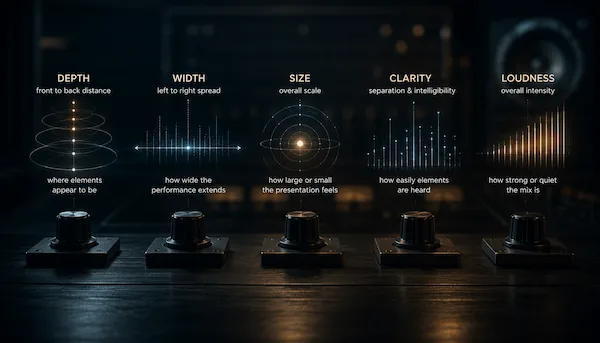 One reason front-to-back depth is often misunderstood is that listeners naturally associate an enjoyable mix with several positive qualities at once. When a recording feels immersive, it's easy to assume that width, clarity, size, and depth are all describing the same achievement. In reality, they answer completely different questions about how a performance is experienced.
Depth is concerned with distance. It answers a simple question: Where does each musical idea appear to exist in relation to the listener? A convincing mix doesn't present every element from the same position. Instead, it creates the impression that some parts feel immediate while others comfortably support from farther away, forming a believable musical perspective.
Width describes something entirely different. Rather than asking how close or distant a sound appears, width concerns how broadly the performance extends across the listening space. A recording may feel impressively wide while remaining completely flat from front to back, just as an intimate recording with relatively little horizontal spread can still produce a remarkably convincing sense of depth. If you're interested in how these two dimensions complement rather than replace one another, our guide to Stereo Width in Mixing explores that relationship in much greater detail.
Perceived size and perceived depth often work together, but they answer different questions. Size describes the overall scale of a presentation, while front-to-back depth describes how musical elements are distributed from near to far within that presentation.
Clarity is equally separate from depth. A recording may allow every important part to be heard distinctly while still feeling spatially compressed. Likewise, a convincing sense of perspective doesn't depend on making every musical element feel equally prominent. Clarity focuses on how easily listeners recognize what they're hearing, while depth focuses on how naturally those recognizable sounds occupy different perceived distances within the same performance.
Loudness should not be confused with depth either. Making an entire presentation feel more forward doesn't automatically create a stronger sense of perspective. In fact, listeners judge distance through relationships rather than overall intensity. If every musical event seems equally immediate, the performance often feels flatter regardless of how energetic or powerful it appears.
Depth and tonal balance influence different aspects of the listening experience. If you'd like to explore how engineers evaluate spectral balance independently from spatial perspective, see our guide to Frequency Balance In Mix.
Recognizing these distinctions makes depth much easier to evaluate. Instead of treating it as another word for width, size, clarity, or loudness, it becomes what it truly is: the listener's perception of musical distance and the invisible framework that allows a recording to feel naturally three-dimensional.
Why Musical Perspective Makes Songs Easier To Follow
One of the most valuable qualities of front-to-back depth is that listeners rarely notice it directly. Instead, they notice something much more important: the song feels easier to understand. They don't have to work to identify where their attention should go because the musical perspective effortlessly guides them through the performance. The experience becomes effortless rather than analytical.
This is one reason listeners often describe professional mixes as "easy to listen to" without being able to explain why. They are responding to musical organization rather than consciously analyzing production techniques.
People don't usually listen to music by examining individual sounds. They follow emotion, movement, and storytelling. As one section gives way to another, the brain continuously interprets how the performance unfolds, building a mental picture that extends beyond melody and rhythm alone. A convincing sense of depth supports that process by allowing different musical ideas to exist within a coherent environment instead of presenting every moment with equal immediacy.
This subtle organization has a powerful effect on engagement. When the performance feels spatially coherent, listeners remain connected to the music for longer periods without consciously understanding why. Their attention shifts naturally as the arrangement develops, making transitions feel intentional and emotional moments more satisfying. Rather than processing a dense collection of simultaneous events, the audience experiences a performance that seems to breathe and evolve on its own.
Perspective also strengthens recognition. Musical ideas become easier to remember because they occupy distinct places within the listener's mental image of the song. Even after the music has ended, people often recall the emotional journey rather than isolated technical details. That lasting impression depends as much on believable spatial relationships as it does on memorable melodies or compelling performances.
This is one reason experienced engineers often evaluate a mix with their eyes closed. The goal isn't to identify individual production choices but to experience the recording the same way a future listener will. Does the music gradually reveal itself? Does the performance invite attention without demanding constant effort? When those questions are answered positively, the recording usually feels more engaging regardless of genre or production style.
Importantly, this perspective doesn't replace musical relationships—it helps reveal them. Once the listener instinctively understands where ideas belong within the performance, it becomes much easier to judge how those ideas interact with one another. Decisions about the relationship between instruments become clearer because they are evaluated within a coherent musical scene instead of a flat presentation where every element appears equally close.
That is why perspective often becomes the foundation for broader mix evaluation. Before considering how individual parts relate to one another, it helps to establish a natural listening environment in which those relationships can be understood naturally. Our guide to How To Balance Instruments In A Mix continues that conversation by exploring how engineers evaluate the interaction between musical elements once the overall perspective of the performance is already making sense.
How Professional Mix Evaluation Identifies Missing Depth
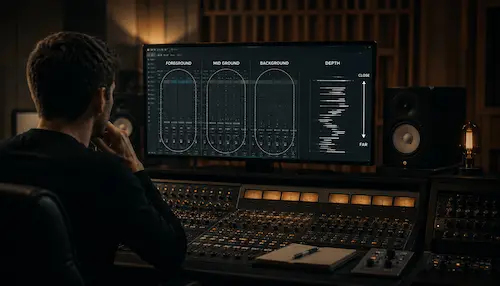 One of the biggest misconceptions about professional mixing is that engineers immediately begin making adjustments as soon as a session starts.
In reality, experienced evaluation begins with careful listening rather than action. Before deciding whether anything should change, engineers first ask whether the performance creates a convincing sense of musical space.
If that illusion is missing, the issue becomes apparent long before anyone considers possible solutions.
The first uninterrupted playback often reveals more than any visual inspection. Within seconds, experienced engineers can usually tell whether the performance gradually develops depth or whether every important musical idea remains locked to the same apparent distance.
A collapsed perspective is rarely identified through meters or visual analysis alone. Instead, it reveals itself through the listening experience. Everything appears to exist on the same plane, making the performance feel unusually compact even when individual sounds remain perfectly audible. Nothing necessarily feels incorrect by itself, yet the recording lacks the natural depth that allows a listener to become immersed in the music.
Another common observation is uniform distance. During evaluation, engineers pay attention to whether the performance naturally encourages the ear to move through different musical layers or whether every important idea arrives with the same apparent proximity. When every section of a song presents identical spatial relationships, emotional transitions often become less convincing because the performance never seems to expand, relax, or shift its perspective.
Professional listening also considers the presence of recognizable foreground and background relationships. This doesn't mean deciding which elements should dominate the mix. Instead, the goal is to determine whether the recording creates a believable listening environment where different musical ideas occupy distinct positions within the overall performance. If every sound appears equally immediate, listeners may struggle to experience the recording as a unified musical event rather than a collection of simultaneous parts.
Engineers also evaluate whether the arrangement develops a genuine sense of layering over time. A well-constructed song often introduces new ideas, changing textures, and evolving emotional moments. When those changes all seem to occur from the same perceived distance, the performance can feel visually static in the listener's imagination, even though the composition itself contains plenty of variation.
Importantly, these observations are not treated as isolated problems. Missing depth is usually considered alongside many other aspects of the listening experience because spatial perspective is only one characteristic of a successful mix. Professional evaluation focuses on understanding how multiple perceptions interact before determining which of them meaningfully affect the way the audience experiences the song.
For that reason, depth assessment naturally becomes part of a broader review rather than a standalone diagnosis. A recording that feels spatially compressed may also reveal other characteristics worth examining, while another project may exhibit strong depth yet benefit from attention elsewhere. Our Mixing Problems Guide explores how experienced engineers identify these observations as part of a complete listening evaluation, helping determine which issues genuinely influence musical communication before any corrective decisions are considered.
Depth Is About Musical Perspective, Not More Processing
It's tempting to assume that every flat mix needs additional processing. In practice, many recordings already contain expressive performances, strong arrangements, and carefully crafted productions. The challenge is often helping listeners experience those musical ideas within a convincing spatial perspective rather than changing the music itself.
Front-to-back depth is ultimately a matter of perception rather than accumulation. Listeners don't evaluate how much work has gone into a mix or how many creative decisions were made during production. They experience a single musical performance and instinctively judge whether it unfolds within a believable space. If that perspective feels natural, the recording becomes easier to connect with. If it doesn't, the performance can seem unexpectedly flat even when every individual element sounds polished on its own.
For that reason, experienced engineers don't automatically assume that additional processing is the answer. Many projects already contain expressive performances, thoughtful arrangements, and carefully recorded material. The emotional information is already present. What may be missing is a convincing sense of spatial organization that allows listeners to experience those musical ideas as parts of one coherent performance instead of a collection of equally immediate sounds.
This distinction is important because it changes the objective of mix evaluation. Professional evaluation begins with a different question: does the listener immediately understand the musical perspective? Does the performance feel like it exists within a coherent acoustic scene? Can the audience instinctively sense different layers of musical distance without consciously thinking about them? Those are perceptual questions before they are technical ones.
Ultimately, front-to-back depth is not defined by effects, complexity, or the number of production decisions behind a mix. It is defined by the listener's ability to experience music as a three-dimensional performance where different musical ideas occupy distinct positions in space. When those spatial relationships feel convincing, the recording becomes easier to follow, more emotionally engaging, and more naturally immersive. That is the essence of front-to-back depth in mixing—and the reason musical perspective remains one of the defining characteristics of a professional-sounding mix.
A mix doesn't need more processing—it needs a clearer sense of perspective
If your mix sounds technically clean but still feels flat, the issue may not be the recording itself. Before recommending any processing, we evaluate how listeners experience musical distance, depth, and perspective throughout the song. By understanding how the performance is perceived as a complete musical scene, we can identify whether the arrangement already contains everything needed for a more engaging and three-dimensional listening experience.
Professional listening. Honest recommendations. Every decision guided by how your audience experiences the music. Every recommendation begins with listening, not with assumptions about which processing should be applied.
About AREFYEV Studio
AREFYEV Studio approaches every mix from the listener's perspective before considering technical decisions. Every project is evaluated manually by experienced engineers without relying on templates or automated analysis. This perception-first approach has been applied across a wide range of genres and production styles, helping artists and producers understand not only how a mix sounds, but how it is experienced. That philosophy allows every project to be evaluated as a complete listening experience instead of a collection of isolated technical decisions.
Frequently Asked Questions
What is front-to-back depth in mixing?
Front-to-back depth is the listener's perception of distance within a mix. Instead of hearing every element from the same apparent position, the audience experiences a believable musical scene where different sounds seem to exist at different perceived distances, creating a more natural and immersive performance.
Can a mix be balanced but still feel flat?
Yes. A mix can have appropriate levels, clear individual elements, and no obvious technical problems while still lacking depth. When everything appears equally close to the listener, the performance often feels less engaging despite being technically well balanced.
Is depth the same as stereo width?
No. Stereo width describes how broadly sounds extend from left to right, while front-to-back depth describes how near or distant they appear. These are separate dimensions of spatial perception that work together but should not be confused.
Why do some instruments seem closer than others?
Listeners naturally organize music into a three-dimensional acoustic scene. Some musical ideas feel more immediate and emotionally connected, while others provide support from a greater perceived distance, making the performance easier to understand and follow.
Can depth be evaluated before processing begins?
Absolutely. Professional engineers typically assess musical perspective before making technical decisions. Evaluating how listeners experience spatial relationships helps determine whether a mix already communicates effectively or whether further refinement may be beneficial. In many cases, understanding the existing musical perspective is more valuable than immediately deciding what should be changed.
Can every genre benefit from front-to-back depth?
Yes. Every genre relies on perceived distance, although the amount of depth varies. Intimate acoustic recordings often emphasize realism, while dense electronic productions may intentionally reduce or exaggerate depth as part of their artistic character.