
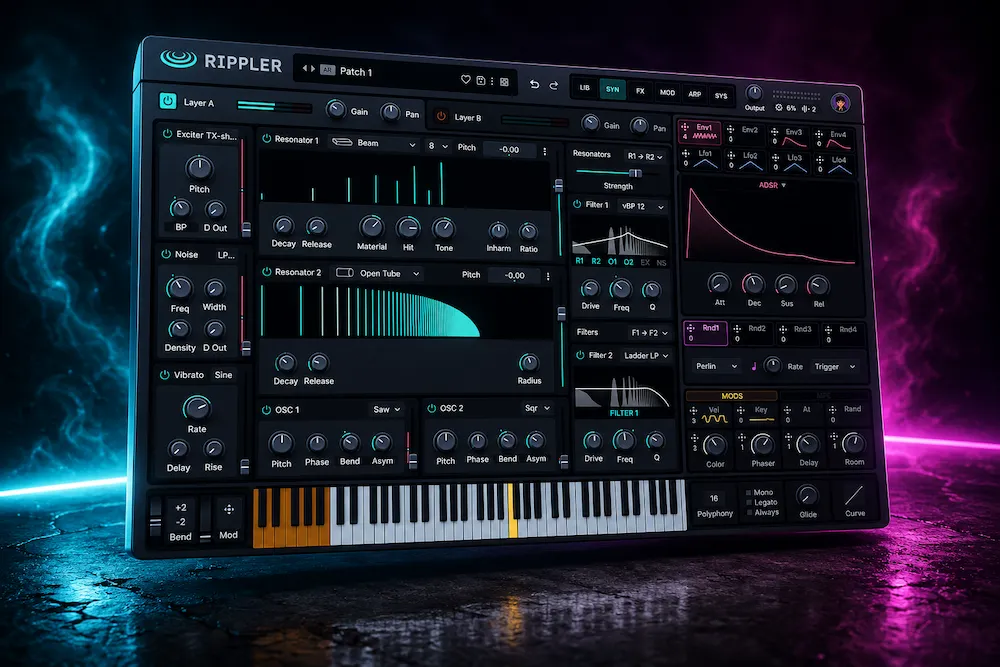
Physical modeling has never been a mainstream synthesis method, but it has quietly become one of the most effective ways to create instruments that respond with the nuance of acoustic sources while retaining the flexibility of software synthesis. As productions become increasingly saturated with familiar wavetable presets and sample libraries, many producers are looking for sounds that feel less static without sacrificing workflow.
reFX Rippler targets that space. Instead of building another virtual analog or wavetable synth, it combines physically modeled resonators with subtractive oscillators, filters, modulation, and onboard effects inside a single production environment. The concept isn’t new—physical modeling has existed for decades—but its integration into a modern, production-oriented workflow deserves closer examination.
The real question isn’t whether Rippler can generate impressive presets. Most flagship instruments can. What matters is whether its hybrid architecture delivers practical advantages during composition, sound design, and professional audio production, or whether it simply repackages an established synthesis approach with a modern interface. That’s the perspective taken throughout this review.
Contents
Great Sound Design Deserves Professional Mastering
Even the most expressive synth patch won’t reach its full potential without a properly finished master. If you’ve spent hours crafting your sound, hear how professional mastering can improve translation, depth, punch, and overall balance before release. Upload up to 35 seconds of your mix and receive a free mastering demo from a real mastering engineer.
Request your free mastering demo →
Why Physical Modeling Matters in Modern Music Production
 For years, physical modeling occupied a narrow corner of the software instrument market. It attracted sound designers, experimental composers, and engineers interested in synthesis, but rarely became part of everyday production workflows. Most commercial music relied on sample libraries, virtual analog synthesizers, or, more recently, wavetable engines that delivered polished results with minimal programming.
That balance has started to shift. Modern productions have access to virtually unlimited sonic resources, yet they often suffer from the opposite problem: too many tracks are built from the same factory presets, expansion packs, and heavily recycled sample libraries. Originality is no longer limited by processing power or storage capacity—it’s limited by how many producers begin with identical source material.
Physical modeling addresses a different challenge than traditional synthesis. Rather than generating harmonics from oscillators or replaying recorded samples, it simulates how energy behaves inside vibrating objects. A string, metal plate, membrane, or resonant tube responds dynamically to changes in excitation, damping, and resonance. The result isn’t simply a different timbre; it’s a sound whose harmonic structure continues to evolve throughout the performance instead of remaining largely fixed after the initial attack.
That behavior has become increasingly valuable as modern productions move toward more expressive and organic textures. Film composers, game audio designers, ambient producers, and electronic artists are no longer looking only for realistic acoustic instruments. They’re looking for sounds that retain the complexity and movement of real-world physics while extending well beyond the limitations of traditional instruments.
The industry has gradually followed that direction. Physical modeling is no longer confined to specialist software. Resonators, exciter modules, modal synthesis, and physically inspired processors have found their way into flagship synthesizers and modern DAWs because they solve a practical problem: they generate variation naturally instead of relying on automation or layered modulation to simulate it.
This distinction is easy to overlook until a production becomes densely layered. Conventional subtractive synthesis excels at precision and repeatability, but identical note attacks and static harmonic content can become predictable over time. Physical modeling introduces subtle instability—small variations in resonance, transient response, and overtone development—that help repeated phrases feel less mechanical without resorting to randomization or complex MIDI programming.
That doesn’t make physical modeling inherently superior to wavetable or virtual analog synthesis. Each approach solves a different problem. Wavetable instruments remain exceptionally efficient for aggressive basses, modern leads, and highly controlled electronic textures. Physical modeling is at its best when realism, motion, and interaction matter more than oscillator complexity alone.
Rippler arrives at a point where those two worlds are beginning to overlap. Rather than presenting physical modeling as a standalone synthesis discipline, it integrates modeled resonators into a workflow that will already feel familiar to producers accustomed to modern software instruments. That design decision may ultimately be more significant than the modeling engine itself, because accessibility—not sound quality—has historically been the biggest obstacle preventing physical modeling from becoming part of everyday music production.
Rippler’s architecture explains why it feels different from both traditional subtractive synthesizers and dedicated physical modeling instruments. Rather than treating modeling as a self-contained synthesis method, reFX builds the signal path around the interaction between acoustic behavior and conventional synthesis. The objective isn’t to recreate a specific instrument with scientific accuracy—it’s to give producers access to physically inspired sound generation without abandoning the workflow they’re already accustomed to.
The signal path begins with the Exciter, which functions as the energy source driving the entire instrument. In an acoustic instrument, that role belongs to a guitar pick, a piano hammer, a drumstick, or a column of moving air. Rippler applies the same principle digitally. Instead of feeding oscillators directly into filters, it injects energy into a resonant system, allowing the character of the sound to develop through interaction rather than simple waveform generation.
What makes the Exciter more flexible than many comparable implementations is the variety of available sources. Alongside factory excitation signals, users can import custom samples or feed external audio into the resonator engine via sidechain input. That capability expands Rippler well beyond conventional synthesizer programming. A percussion loop, transient hit, or even a vocal phrase can become the driving force behind entirely new harmonic textures that continuously react to incoming audio.
For sound designers, this eliminates a common production bottleneck. Instead of building elaborate routing chains with multiple plugins to achieve reactive resonant effects, much of that experimentation happens inside a single instrument. The workflow remains predictable while the resulting sounds retain the complexity normally associated with modular environments.
Once excited, the signal enters one or two physical Resonators. This stage defines Rippler’s sonic identity. Rather than replaying recorded samples, the resonators simulate how different physical objects respond to incoming energy. Strings, bells, plates, membranes, drumheads, vibraphones, marimbas, and resonant tubes all produce distinct overtone structures because each model distributes and dissipates energy differently over time.
The practical advantage isn’t simply realism. It is dynamic harmonic evolution. Small adjustments to excitation strength, damping, or resonance produce changes that extend across the entire decay rather than affecting only the initial transient. As a result, repeated notes rarely feel completely identical, even when triggered by identical MIDI performances. That subtle variation often translates into parts that sit more naturally within an arrangement without requiring additional modulation or randomized velocity programming.
Rippler extends this concept further through bidirectional resonator coupling, allowing two resonant bodies to exchange energy instead of operating independently. While the effect is often subtle, it contributes to the impression that sounds continue evolving after the initial attack rather than collapsing into static harmonic loops. It’s a sophisticated implementation that rewards careful programming instead of exaggerated parameter changes.
One of the most interesting additions is the manual resonator mode. Instead of selecting predefined acoustic models, users can shape individual partials directly, effectively blending physical modeling with additive synthesis. This opens creative territory that extends well beyond acoustic emulation. Producers are no longer limited to believable instruments—they can design resonant structures that obey the logic of physical interaction without resembling any instrument found in the real world.
reFX deliberately avoids making physical modeling the entire story. After the resonator stage, Rippler introduces dual Oscillators with phase control, wavefolding, asymmetry, and conventional filtering. Their purpose is less about replacing a dedicated subtractive synthesizer and more about reinforcing or reshaping the modeled signal. Additional low-end weight, harmonic density, or synthetic edge can be added without leaving the instrument or layering external plugins.
That hybrid design reflects how contemporary productions are actually built. Most professional sessions already combine sampled material, analog-style synthesis, physical modeling, and digital processing within the same arrangement. Rippler internalizes much of that layering strategy, allowing producers to construct complex hybrid patches inside a single instrument rather than distributing them across multiple tracks and plugin chains.
From an engineering perspective, that’s arguably the plugin’s most significant contribution. Physical modeling itself is not new. Integrating it into a production-oriented architecture that encourages hybrid sound design instead of treating it as a specialist discipline is where Rippler distinguishes itself from many earlier modeling instruments.
Architecture alone doesn’t determine whether an instrument earns a permanent place in a professional template. Workflow does. Many synthesizers demonstrate impressive technology during a product demo but become increasingly cumbersome once deadlines, client revisions, and large sessions enter the equation.
Rippler performs well because its architecture reduces the amount of routing required to build complex hybrid sounds. Instead of stacking multiple software instruments, assigning separate MIDI tracks, and managing individual effect chains, producers can develop evolving acoustic-electronic textures within a single patch. That doesn’t eliminate CPU usage, but it reduces project complexity—a much more valuable commodity in large productions.
The benefit becomes obvious in scoring and sound design workflows. A cinematic pulse that gradually evolves into a metallic pad or an organic drone would traditionally require layered synthesizers, resonators, modulation plugins, and automation spread across several channels. Rippler consolidates much of that signal flow into one instrument, making revisions significantly faster. When a director asks for “less metallic” or “more movement,” the adjustment often happens inside one preset instead of across half a dozen tracks.
The dual-layer design reinforces that efficiency. Each layer can operate independently before entering shared processing, allowing modeled and synthesized elements to be balanced at the source rather than during mixdown. In practice, this encourages better sound design decisions earlier in the production process instead of relying on corrective EQ, saturation, or additional processing after the fact.
Its modulation system follows the same philosophy. Four LFOs, four envelopes, macro controls, random generators, MIDI assignments, and MPE support provide more than enough flexibility for sophisticated patch design, but the important detail isn’t the number of modulation sources—it’s how quickly they can be deployed. Most assignments remain visible and logically organized, reducing the constant menu diving that slows programming in many deep synthesizers.
That efficiency matters more than specifications suggest. Programming speed directly affects creative momentum, especially during composition. The fewer interruptions required to assign modulation, rebalance layers, or reshape resonances, the more likely producers are to refine an idea instead of abandoning it halfway through.
The integrated effects section contributes to the same workflow advantage. Separate processing chains for each layer and the master output make it possible to shape modeled resonances independently from subtractive components before they reach the mix bus. While dedicated third-party effects may still outperform the built-in processors in specialized applications, the included toolkit is comprehensive enough to complete most sound design work without immediately reaching for additional plugins.
Rippler also benefits from a workflow decision that receives surprisingly little attention: its preset structure. A large factory library has limited value if navigating it interrupts the creative process. Here, categorization remains straightforward, favorites are easy to manage, and presets function as practical starting points rather than finished productions. Experienced programmers are unlikely to use them unchanged, but they provide efficient foundations for further development.
None of this makes Rippler a replacement for dedicated modular environments or flagship synthesis workstations. Producers who routinely build highly customized processing chains inside environments such as Falcon or Phase Plant will still find greater routing flexibility elsewhere. Rippler favors speed over unlimited configurability, and that tradeoff feels intentional rather than restrictive.
Perhaps the strongest indication that the workflow has been carefully considered is that the technology rarely calls attention to itself. After a few programming sessions, the focus shifts away from physical modeling as a synthesis method and toward the musical decisions being made. That’s a characteristic shared by mature production tools: the interface gradually disappears, leaving the instrument to support the creative process instead of becoming the center of it.
That practical workflow, however, shouldn’t be confused with technical disruption. Rippler introduces a well-executed interpretation of physical modeling, but it does not redefine the category.
Several of its headline features are built on established concepts. Physical modeling, modal synthesis, resonator coupling, additive partial editing, and sample-based excitation have existed in various forms for years. Products such as Chromaphone, Sculpture, Objekt, and Pianoteq demonstrated long ago that physically modeled instruments could move beyond research environments and into commercial production. Rippler’s contribution is not inventing a new synthesis method—it’s making several mature technologies work together inside a cohesive, production-oriented instrument.
That distinction is important because software synthesizers are often marketed around novelty rather than implementation. A genuinely useful instrument doesn’t have to introduce a new DSP algorithm if it removes friction from the creative process. In Rippler’s case, the engineering value lies in integration. Excitation, resonators, subtractive synthesis, modulation, and effects operate as parts of a single system instead of feeling like separate modules sharing the same interface.
The plugin also avoids another common industry trend: attaching artificial intelligence to features that don’t benefit from it. Rippler relies entirely on deterministic synthesis. Every change is the direct result of parameter adjustments rather than predictive algorithms or generative assistance. For experienced programmers, that level of control is arguably a strength rather than a limitation. Complex sounds remain repeatable, editable, and fully understood months later when a project returns for revision.
There are, however, practical limitations that shouldn’t be overlooked.
Physical modeling remains a deeper programming discipline than conventional subtractive synthesis. Although Rippler presents its architecture more clearly than many earlier modeling instruments, understanding how excitation, damping, resonance, and energy transfer interact still requires experimentation. Producers expecting immediate results from a handful of macro controls may never reach the instrument’s strongest capabilities.
Independent performance data is another area where conclusions should remain measured. Early demonstrations indicate stable operation, but comprehensive third-party testing covering CPU scaling, heavy polyphony, latency, and long-session reliability is still limited. Until broader adoption produces more benchmark data, performance claims should be viewed as promising rather than fully verified.
Even with those caveats, Rippler avoids the trap that has limited many physical modeling instruments in the past. It doesn’t ask producers to learn an entirely different production philosophy. Instead, it introduces physical modeling through familiar synthesis concepts and a workflow that feels immediately recognizable to anyone comfortable with modern software instruments.
Ultimately, that’s likely to determine its long-term relevance. The success of Rippler won’t depend on whether its resonators are mathematically more sophisticated than competing models. It will depend on whether producers continue reaching for it once the excitement surrounding a new release has faded. Judging by its architecture and workflow, it has a stronger chance of becoming a regular creative tool than many niche modeling synthesizers that came before it.
Hybrid Workflow: Why Rippler Feels Different in Practice
 Novel synthesis methods don’t become studio staples because they’re technically impressive. They survive because they remove friction from the creative process. That’s where Rippler makes its strongest case.
Its value isn’t the physical modeling engine alone. Plenty of instruments already model strings, plates, membranes, and resonant bodies with convincing results. What distinguishes Rippler is how those components are integrated with subtractive synthesis, modulation, and effects inside a single production environment.
That integration has practical consequences. Building an evolving hybrid patch in a conventional DAW often means stacking multiple instruments, routing modulation between tracks, inserting dedicated resonators, and balancing several independent effect chains. Every additional layer increases project complexity, revision time, and CPU overhead. Rippler consolidates much of that signal flow into one instrument without forcing producers to sacrifice flexibility.
A typical scoring session illustrates the advantage. An evolving metallic pulse that gradually develops into a harmonic texture can usually be built with multiple synthesizers, automation lanes, and auxiliary processing. Rippler achieves a comparable workflow inside a single patch, making revisions significantly faster. When the brief changes—as it inevitably does—adjustments remain localized instead of being distributed across half a dozen tracks.
The modulation architecture follows the same philosophy. Four LFOs, four envelopes, macro controls, random generators, MIDI assignments, and MPE support provide enough depth for sophisticated programming, but the more important detail is accessibility. Assignments remain visible, reducing the menu navigation that slows programming in many feature-rich synthesizers. During long programming sessions, that seemingly small design choice saves more time than an extra modulation source ever could.
The three-stage effects architecture extends that workflow advantage. Individual processing chains for each layer allow modeled resonances and subtractive elements to be shaped independently before entering global processing. That encourages producers to solve tonal and spatial problems at the sound-design stage instead of compensating later with corrective processing during mixing.
One of Rippler’s more distinctive capabilities is its manual resonator mode. Rather than selecting predefined acoustic models, users can edit individual partials directly, blending physical modeling with additive synthesis. The result isn’t greater realism—it’s greater freedom. Instead of reproducing existing instruments, producers can design resonant structures that behave according to physical principles without resembling any recognizable acoustic source.
Sidechain excitation expands that concept further. External audio can drive the resonator engine directly, allowing percussion, Foley, transient material, or even vocal recordings to generate evolving harmonic textures. Similar techniques have existed in modular environments for years, but integrating them into a conventional plugin dramatically lowers the barrier to experimentation.
These workflow decisions also clarify what Rippler is not. It isn’t intended to compete with Serum, Diva, Pigments, or Phase Plant as a general-purpose flagship synthesizer. Its oscillators support the resonator engine rather than replace it. Producers approaching Rippler as another virtual analog synth will likely miss its strongest capabilities. Those who treat it as a hybrid instrument built around interaction instead of oscillator design will extract considerably more from its architecture.
Professional Use Cases
Rippler is at its best when movement, harmonic evolution, and organic behavior matter more than perfectly repeatable oscillator-based synthesis. Rather than competing for every production task, it excels in a handful of workflows where physical modeling offers clear practical advantages.
Film and Trailer Scoring. Layered braams, metallic impacts, evolving drones, hybrid percussion, and cinematic transitions often require multiple instruments, resonators, and modulation processors. Rippler can consolidate much of that work into a single patch, making revisions considerably faster during tight scoring deadlines.
Game Audio. Interactive soundtracks benefit from textures that remain expressive across repeated playback. Rippler’s resonator engine naturally introduces subtle harmonic variation without relying on randomized modulation, making repeated events feel less mechanical.
Ambient and Experimental Production. Long-form pads, resonant atmospheres, prepared-instrument textures, and continuously evolving soundscapes are among the instrument’s strongest applications. These are areas where physical modeling often produces more convincing movement than traditional subtractive synthesis.
Hybrid Electronic Production. Producers combining acoustic elements with electronic arrangements can use Rippler to bridge both worlds. Instead of layering multiple plugins, modeled resonators and subtractive oscillators interact inside a single instrument, reducing routing complexity while maintaining a coherent sonic identity.
Engineering Analysis: Beyond the Marketing Claims
Software instruments are often marketed around broad promises rather than measurable engineering. Terms like organic, expressive, and next-generation synthesis sound compelling, but they reveal little about how an instrument actually behaves inside a production environment. Rippler’s launch campaign follows that familiar pattern, making it worth separating the technology from the marketing.
The first point worth clarifying is that physical modeling itself is not the innovation. Producers have had access to mature modeling instruments for years through platforms such as Chromaphone, Sculpture, Pianoteq, Collision, and Objekt. Rippler doesn’t introduce a new synthesis method, nor does it redefine the mathematical foundations of physical modeling.
Its engineering contribution lies elsewhere. Instead of presenting physical modeling as a specialist environment, Rippler combines excitation, resonators, subtractive synthesis, modulation, and integrated effects into a workflow that feels immediately familiar to modern producers. That architectural integration is arguably more valuable than introducing another isolated synthesis technique that few musicians would use in everyday sessions.
Several implementation details reinforce that approach. Bidirectional resonator coupling allows resonant bodies to exchange energy instead of behaving independently, producing harmonic movement that continues evolving after the initial transient. The manual resonator editor extends the engine beyond acoustic emulation by allowing direct manipulation of individual partials, effectively merging physical modeling with additive synthesis. Neither concept is entirely new, but their integration inside a commercial production instrument is thoughtful and well executed.
Equally notable is what Rippler does not attempt to do. There are no AI-assisted sound generators, adaptive algorithms, or automated programming tools designed to manufacture presets with a single click. Every result comes from deterministic synthesis and deliberate parameter changes. For experienced programmers, that level of predictability is often preferable because patches remain transparent, repeatable, and easy to revisit months later.
None of that means Rippler is without limitations. Physical modeling remains more demanding than traditional subtractive synthesis, and producers expecting instant results from factory presets may never reach the engine’s full potential. The interface reduces much of the historical complexity associated with modeled instruments, but it doesn’t eliminate the need to understand how excitation, resonance, damping, and harmonic interaction shape the final sound.
There are also questions that cannot yet be answered conclusively. Independent benchmarking covering CPU scaling, high-polyphony performance, oversampling behavior, latency, and long-session reliability remains limited. Early impressions suggest a stable release, but those observations are not a substitute for large-scale testing across diverse production environments.
Viewed objectively, Rippler’s value isn’t based on introducing revolutionary DSP. Its strength comes from refining established technologies into a workflow that feels practical rather than academic. That’s a more meaningful achievement than many product launches claiming to reinvent synthesis, and it’s likely to matter far longer than the marketing language surrounding the release.
What’s Still Missing?
Rippler already presents a mature production workflow, but several additions could make future versions considerably more compelling. Deeper performance analytics, broader visual feedback for resonator behavior, expanded modulation visualization, and comprehensive CPU benchmarking tools would give producers greater confidence when building large projects.
More importantly, long-term value will depend on continued preset development, workflow refinements, and regular engine updates rather than additional headline features. The core architecture already feels complete; future improvements should focus on making an efficient workflow even more efficient.
Rippler enters a market where technical capability is no longer the deciding factor. Today’s flagship synthesizers are all capable of producing commercial-quality results. The real question is whether an instrument offers a workflow or sonic perspective that existing tools don’t already cover.
Rippler doesn’t compete head-on with wavetable heavyweights such as Serum, Pigments, or Phase Plant. Those instruments were built around oscillator design, modulation flexibility, and electronic sound creation. Rippler approaches synthesis from the opposite direction. Its resonators generate movement first, while subtractive synthesis supports and shapes that behavior rather than defining it.
This shift also reflects a broader trend across software synthesis. Recent releases increasingly focus on solving specific production problems instead of trying to become universal “do-everything” instruments. Native Instruments’ Super*Saw, for example, explores modern supersaw generation and harmonic density from the opposite direction, making it an interesting comparison for producers deciding between oscillator-driven synthesis and physically modeled sound generation.
That difference makes direct comparisons somewhat misleading. Producers searching for aggressive EDM basses, supersaws, or highly controlled virtual analog sounds will likely work faster inside established wavetable platforms. Rippler is considerably more compelling when the goal is evolving percussion, resonant textures, hybrid acoustic instruments, cinematic transitions, or organic motion that would otherwise require several layered plugins.
| Instrument | Best For | Where Rippler Has the Advantage | Where the Alternative Remains Stronger |
|---|---|---|---|
| AAS Chromaphone 3 | Dedicated physical modeling | Hybrid architecture, subtractive layering, integrated workflow | Acoustic realism and years of refinement |
| Reason Objekt | Experimental resonator synthesis | More complete standalone production environment | Deep integration within the Reason ecosystem |
| Arturia Pigments | Hybrid electronic synthesis | More convincing physically driven harmonic behavior | Broader synthesis engines and visual modulation workflow |
| Phase Plant | Open modular sound design | Faster creation of acoustic-inspired textures | Unlimited routing and modular flexibility |
| Falcon | Complete production workstation | Cleaner workflow and lower programming overhead | Far broader synthesis and sampling capabilities |
Perhaps the most accurate way to view Rippler is as a complementary instrument rather than a replacement. It fills a gap that many flagship synthesizers leave untouched: physically evolving harmonic behavior that can be blended seamlessly with conventional synthesis inside a single patch.
That makes its strongest audience surprisingly specific. Composers working in film, television, and game audio will likely benefit more than mainstream EDM producers. The same applies to sound designers creating signature textures rather than preset-driven electronic sounds. In those workflows, the ability to generate believable movement at the source often reduces the amount of automation, layering, and post-processing required later.
For mixing and mastering engineers, the value is indirect. Rippler won’t improve gain staging, stereo imaging, or loudness management, but stronger source material frequently translates into simpler mixes. Instruments that develop naturally tend to require fewer corrective moves than heavily processed layered patches assembled from multiple synthesizers.
Best Alternatives to Rippler
AAS Chromaphone 3 remains the strongest option for producers prioritizing acoustic realism and mature physical modeling. Its engine has benefited from years of refinement and remains one of the benchmarks in the category.
Arturia Pigments is the better choice for producers who need one instrument capable of wavetable, granular, virtual analog, sampling, and advanced modulation. It offers broader synthesis coverage, although less emphasis on physically modeled behavior.
Phase Plant remains difficult to beat for modular sound designers who prefer building custom signal paths from scratch. Rippler reaches many hybrid textures faster, but Phase Plant offers substantially greater routing freedom.
Who Should Buy Rippler?
Rippler isn’t designed to be the only synthesizer in a studio. It makes the most sense as a complementary instrument for producers who regularly search for sounds that sit between acoustic realism and electronic synthesis.
Composers working in film, television, trailer music, and game audio will likely benefit the most. The instrument can generate evolving harmonic textures that would otherwise require considerably more routing and layering inside a DAW.
Electronic producers focused on ambient, downtempo, experimental, IDM, and hybrid genres will also find plenty of creative potential. Rippler rewards programming and exploration rather than preset browsing.
For producers who already own several flagship synthesizers, Rippler expands the palette instead of duplicating capabilities they already have.
Who May Want to Skip Rippler?
Rippler is a less compelling purchase for producers whose work depends primarily on commercial EDM, trance, festival bass music, or mainstream pop production. Those workflows continue to favor wavetable and virtual analog synthesizers optimized for aggressive oscillator design.
It’s also not the ideal choice for users looking for instant results through factory presets alone. Although the interface is approachable, the instrument reveals its strengths only after spending time with excitation, resonance, and physical interaction.
If your current setup already covers physical modeling and additive synthesis comprehensively, Rippler may feel more like a workflow refinement than a completely new creative platform.
How Rippler Performs in Real Mixes
 A synthesizer shouldn’t be judged by solo presets. Professional productions are built around context—how an instrument behaves once drums, vocals, guitars, orchestral layers, and bus processing compete for the same spectral space. That’s where Rippler becomes more interesting than its feature list suggests.
The modeled resonators generate harmonic movement continuously throughout the note rather than relying on static samples or fixed oscillator behavior. In practice, sustained textures often retain a greater sense of motion inside dense arrangements without requiring constant automation or stacked modulation sources. The result is less about added complexity and more about avoiding the repetitive character that can develop when identical transients and harmonic structures are triggered repeatedly.
That advantage is particularly noticeable with metallic percussion, mallet instruments, plucked textures, evolving pads, and cinematic transitions. Small variations introduced by the excitation stage make repeated phrases feel less mechanical while remaining fully repeatable—an important distinction from randomized performance tools.
Those same characteristics also introduce mixing considerations. Physical modeling naturally generates dense overtone structures, especially when multiple resonators interact or subtractive oscillators reinforce the modeled signal. Sounds that appear balanced in isolation can occupy considerably more upper-midrange space once layered into a full arrangement.
In practical terms, many patches benefit from selective high-midrange control and occasional low-frequency cleanup before reaching the mix bus. Fortunately, Rippler’s filter architecture allows much of that shaping to happen during sound design rather than later through corrective equalization. That’s generally the preferable workflow, since balancing harmonic content at the source tends to produce cleaner mixes than solving spectral conflicts after the arrangement is complete.
When additional control is still needed during mixing, spectral processing often produces cleaner results than broad equalization because it targets resonant buildup without reshaping the entire instrument. We explored that approach in our ToneVeil review, which examines how modern spectral resonance suppression differs from conventional EQ workflows.
From a mastering perspective, Rippler offers no inherent advantage over other software instruments. Loudness, codec behavior, and translation across streaming services are determined by the mix and the mastering process rather than the synthesis engine itself. Well-designed source material can certainly make a mix easier to finish, but it doesn’t eliminate the need for proper mastering. If you’re interested in what actually changes after release, see our guide to mastering for streaming platforms.
Monitoring quality plays an equally important role. Fine adjustments to damping, resonance, and overtone balance are difficult to evaluate accurately on consumer playback systems. Producers programming detailed physical models will achieve more consistent results using reliable nearfield monitors or reference headphones capable of resolving subtle high-frequency interactions.
Performance remains one area where long-term evaluation is still developing. Early user reports suggest CPU requirements comparable to other modern physical modeling instruments, but comprehensive third-party benchmarks covering large templates, high-polyphony sessions, and sustained production workloads are still limited. Producers planning to run dozens of simultaneous instances should evaluate performance within their own workflow rather than relying on isolated launch impressions.
Final Verdict
Rippler is one of the few recent software synthesizers that introduces a genuinely different production workflow rather than simply another oscillator architecture. Physical modeling isn’t new, and neither are resonators, additive editing, or hybrid synthesis. What reFX has done well is combine those technologies into an instrument that feels comfortable inside a modern production workflow instead of treating physical modeling as a specialist discipline.
That distinction makes Rippler considerably more relevant than many previous modeling synthesizers. It doesn’t ask producers to rethink how they build sounds—it simply gives them another way to generate movement, harmonic complexity, and acoustic behavior within a workflow they already understand.
At the same time, expectations should remain realistic. Rippler is unlikely to replace Serum, Pigments, Phase Plant, or Diva as a producer’s primary synthesizer. Its strengths lie elsewhere. It excels at hybrid textures, cinematic scoring, evolving percussion, organic transitions, and expressive sound design rather than mainstream electronic synthesis.
For composers, sound designers, and producers looking to expand their sonic palette beyond familiar wavetable and sample-based instruments, Rippler represents a worthwhile addition. For mixing and mastering engineers, its value is indirect. Better source material rarely eliminates the need for good engineering, but it often reduces the amount of corrective processing required later in the production chain. The same principle applies before mastering—strong mixes generally require fewer corrective decisions than problematic ones. If you’re preparing a project for final delivery, our guide on how to prepare a mix for mastering explains what matters most before export.
Ultimately, Rippler isn’t important because it introduces revolutionary DSP. It’s important because it lowers the barrier to using physical modeling in everyday music production. That may prove to be a far more meaningful contribution than another synthesizer competing on oscillator count, modulation depth, or factory preset libraries.
Pricing and Value in Today’s Synth Market
Rippler launched at an introductory price of $99, increasing to $129 MSRP after the promotional period. Within today’s software instrument market, that positions it below several flagship hybrid synthesizers while offering considerably more specialized functionality than many entry-level alternatives.
For producers specifically interested in physical modeling, cinematic sound design, and hybrid synthesis, the introductory pricing represents solid value. Producers focused primarily on conventional virtual analog or wavetable synthesis may achieve a better long-term return by investing in instruments designed around those workflows instead.
Overall Rating
| Category | Rating |
|---|---|
| Sound Quality | 9.3/10 |
| Workflow & Usability | 9.4/10 |
| Physical Modeling Implementation | 9.5/10 |
| Sound Design Flexibility | 9.2/10 |
| Production Efficiency | 9.1/10 |
| Value for Money | 8.8/10 |
| Overall | 9.2/10 |
Rippler isn’t attempting to outperform every flagship synthesizer in every category. Instead, it succeeds by making physical modeling practical for everyday production. Its hybrid architecture, efficient workflow, and expressive resonator engine give it a clear identity in a market crowded with oscillator-focused instruments.
Why These Scores?
Sound Quality — 9.3/10
Rippler produces rich, evolving harmonic content that feels more dynamic than conventional subtractive synthesis. While it isn’t intended to replace dedicated analog or wavetable instruments, its resonator engine consistently delivers textures that remain engaging inside dense arrangements.
Workflow & Usability — 9.4/10
The strongest aspect of the instrument. Hybrid sound design that normally requires multiple plugins can often be created inside a single preset. The interface exposes complex functionality without making programming feel overly technical.
Physical Modeling Implementation — 9.5/10
Rather than presenting physical modeling as a specialist environment, Rippler integrates resonators, excitation, modulation, and subtractive synthesis into a workflow that feels immediately familiar. That’s where the instrument stands out from many previous modeling synthesizers.
Sound Design Flexibility — 9.2/10
The combination of resonators, manual partial editing, sidechain excitation, modulation, and hybrid layering opens a wide creative range. Modular environments still offer greater freedom, but Rippler reaches complex results considerably faster.
Production Efficiency — 9.1/10
From an engineering perspective, Rippler reduces routing, layering, and project complexity. Better source sounds frequently translate into fewer corrective decisions during mixing, making it particularly valuable in large scoring and sound-design sessions.
Value for Money — 8.8/10
The introductory price represents solid value for producers interested in hybrid synthesis and cinematic sound design. Those looking exclusively for mainstream EDM, trance, or virtual analog sounds may see greater long-term value in more conventional flagship synthesizers.
Pros & Cons
| Pros | Cons |
|---|---|
| Excellent hybrid physical modeling workflow | Requires some understanding of physical modeling |
| Outstanding resonator implementation | Not designed as an EDM-first synthesizer |
| Creative sidechain excitation and additive editing | Limited independent benchmark data so far |
| Reduces routing and layering in complex projects | Some users may outgrow the included effects |
Hear What Your Mix Still Has Left to Give
The right synth can inspire a great production, but it can’t reveal what your mix is capable of after professional mastering. That’s where depth, punch, stereo balance, and translation are either preserved—or lost. A finished master isn’t about making a track louder; it’s about making every production decision hold together across real-world playback systems.
Before you release your music, hear the difference for yourself. Upload up to 35 seconds of your mix and receive a free mastering demo created by a professional mastering engineer. Compare your original mix with the mastered version and decide using your own ears.
Request your free mastering demo →
FAQ
How does Rippler differ from traditional physical modeling synthesizers?
Most physical modeling instruments focus almost exclusively on acoustic simulation. Rippler takes a hybrid approach by combining modeled resonators with subtractive oscillators, filters, modulation, and integrated effects, allowing producers to blend organic behavior with conventional synthesis inside a single patch.
Can Rippler replace Serum, Pigments, or Phase Plant?
Not realistically. Those synthesizers remain stronger choices for wavetable design, virtual analog synthesis, and complex modulation workflows. Rippler is better viewed as a complementary instrument that specializes in physically evolving textures rather than a replacement for flagship electronic synthesizers.
Does physical modeling improve a mix?
Not by itself. A physical modeling synthesizer doesn’t improve mix quality, but it can produce source material with more natural harmonic movement and fewer repetitive transients. That often reduces the need for excessive modulation, layering, or corrective processing later in production. If you’re unsure whether the remaining issues belong to the mix or the master, our article on mixing vs. mastering explains where those problems are actually introduced.
Is Rippler suitable for professional film and game composers?
Yes. Its resonator engine is particularly effective for evolving percussion, hybrid acoustic instruments, cinematic transitions, atmospheric textures, and sound design that benefits from continuous harmonic development instead of static sample playback.
How demanding is Rippler compared to other modern software synthesizers?
Early testing suggests CPU requirements comparable to other contemporary physical modeling instruments. While it is generally less memory-intensive than large sample libraries, producers working with high polyphony or orchestral templates should evaluate performance within their own sessions.
Does Rippler require previous experience with physical modeling?
No, but some understanding of resonance, excitation, and damping will help unlock its full potential. The interface is considerably more approachable than many earlier physical modeling instruments, although it still rewards careful programming.
Is Rippler a good investment for mixing or mastering engineers?
Only if sound design is part of the workflow. Rippler doesn’t replace processing plugins or improve mastering directly, but stronger source sounds often translate into simpler mixes with fewer corrective decisions.
What type of producer will benefit most from Rippler?
Composers, cinematic producers, ambient artists, electronic musicians, and professional sound designers are likely to gain the most value. Producers focused primarily on commercial EDM presets or traditional virtual analog synthesis may find existing flagship synthesizers a better fit.
Is Rippler likely to remain relevant as physical modeling evolves?
Its long-term value depends less on the underlying synthesis method than on its workflow. By integrating physical modeling into a familiar production environment, Rippler has a stronger chance of remaining useful than instruments that treat modeling as a specialist niche.

Yurii Ariefiev is a mastering engineer and audio production editor specializing in critical evaluations of music production software, studio workflows, and mastering practices. His reviews examine how new instruments perform in real-world sessions, with an emphasis on sound design, mix translation, workflow efficiency, and long-term production value rather than marketing claims.
This editorial review analyzes reFX Rippler as a practical production instrument, exploring where hybrid physical modeling offers measurable advantages, where conventional synthesizers remain the better choice, and how stronger source sounds influence mixing, mastering, and final release quality.