The Hohner Clavinet D6 occupies a unique place in recorded music. While it’s most closely associated with 1970s funk, its sharp transient response and percussive articulation continue to make it relevant in modern pop, neo-soul, rock, hip-hop, film scoring, and hybrid productions. Few keyboard instruments can deliver the same combination of rhythmic precision and harmonic presence without competing directly with guitars or percussion.
Software has never struggled to reproduce the Clavinet’s basic tone. Reproducing its behavior inside a finished mix has been the real challenge. Many virtual Clavinet instruments sound impressive on their own but lose definition once drums, bass, guitars, and vocals begin competing for the same frequency space. The issue is rarely frequency response alone—it is the relationship between dynamics, pickup voicing, transient shape, and amplifier coloration that makes an authentic Clavinet performance feel alive.
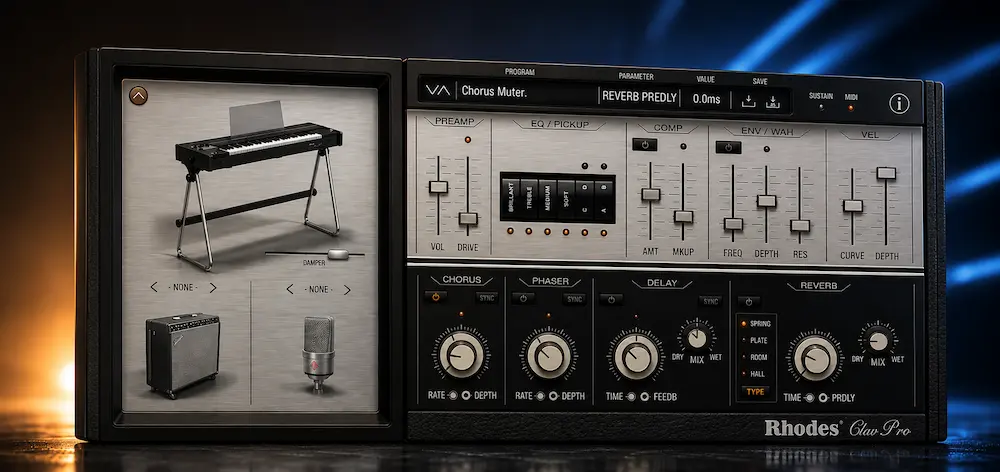
Rhodes Clav Pro approaches the problem from a different angle. Instead of treating the Clavinet as one preset within a broader keyboard collection, it focuses exclusively on recreating a single 1977 Hohner Clavinet D6 while extending the original instrument with production-oriented features that simplify recording, editing, and mixing inside a modern DAW.
That distinction matters more than another vintage instrument release. Professional users are not looking for convincing solo demonstrations—they need an instrument that responds naturally during performance, sits in dense arrangements with minimal corrective processing, and integrates efficiently into contemporary production workflows. This review examines whether Rhodes Clav Pro delivers practical advantages beyond historical authenticity.
This review evaluates Clav Pro from the perspective of commercial production rather than preset browsing. Particular attention was paid to transient response, mix translation, workflow efficiency, pickup interaction, and source quality inside dense arrangements.
Tested with Rhodes Clav Pro v1.0 on macOS and Windows compatibility information available at launch (August 2026). Performance observations are based on current public builds and real-world production workflows.
Contents
Technical Summary
| Instrument Type | Dedicated virtual Clavinet plugin |
| Source Instrument | 1977 Hohner Clavinet D6 Transition |
| Engine | Multi-sampled playback engine |
| Platforms | Windows 10+, macOS 11+ |
| Formats | VST3, AU, AAX |
| Best For | Professional production, funk, soul, pop, film scoring |
| CPU Load | Typical for a modern multi-sampled instrument. |
| Primary Strength | Production-ready workflow with authentic Hohner Clavinet D6 behavior |
Pros & Cons at a Glance
| Pros | Cons |
|---|---|
| • Outstanding Clavinet authenticity • Excellent workflow integration • Production-ready recording chain • Strong playability | • Focused on one instrument only • Limited appeal outside Clavinet users • Not designed for experimental synthesis |
Why Specialized Vintage Instruments Are Replacing Massive Keyboard Libraries
 For years, software developers competed by offering more instruments, larger sample libraries, and longer feature lists. That strategy is gradually giving way to something different. Instead of trying to cover every keyboard ever built, manufacturers are investing in highly detailed recreations of individual instruments that professionals actually reach for during production.
The shift reflects changing expectations inside modern studios. Most experienced producers already own comprehensive keyboard collections. What they increasingly value is authenticity of response rather than quantity of sounds. A convincing virtual instrument is no longer judged by the size of its library but by how naturally it performs under the fingers and how little corrective work it requires once the arrangement begins to fill out.
Rhodes has been moving in this direction for several years. Following dedicated software versions of its Rhodes electric piano and Wurlitzer, the Clavinet was the next logical addition. Rather than expanding into another broad workstation, the company continues building a focused ecosystem of classic electromechanical keyboards designed for professional production.
There is also a practical reason these instruments continue to gain relevance. Original Clavinets are becoming increasingly expensive to purchase, maintain, and transport. Pickup adjustment, mechanical wear, replacement parts, tuning stability, and routine servicing make vintage hardware difficult to justify unless a studio relies on it regularly. Software eliminates those variables while providing complete project recall and immediate session consistency.
At the same time, software instruments are held to a much higher standard than they were a decade ago. Producers expect more than accurate samples—they expect an instrument that already behaves like a finished recording chain. If a virtual keyboard still requires multiple amp simulations, compressors, EQs, and modulation plugins before it sits naturally in a mix, much of its authenticity becomes irrelevant in day-to-day production.
That changing expectation defines the market Clav Pro is entering. Its success depends less on recreating the sound of a vintage Clavinet than on reducing the amount of work required to turn that sound into a production-ready performance.
Hear What Your Mix Still Has Left to Give
Even the best virtual instruments can’t compensate for balance, dynamics, or translation issues in a mix. If you’re curious how your production would respond to professional mastering, upload up to 35 seconds of your mix and receive a free mastering demo. You’ll hear exactly what changes—and why—before deciding whether to master the full track.
Request your free mastering demo →
Inside Rhodes Clav Pro: Engineering Decisions That Matter in Real Sessions
Rhodes Clav Pro is built around a meticulously sampled 1977 Hohner Clavinet D6, positioning it as a dedicated virtual Clavinet plugin rather than a modeled instrument. The playback engine is shared with Rhodes Anthology, placing the emphasis on sample quality, performance scripting, and accurate reproduction of the original signal path instead of physical modeling. That approach is hardly revolutionary, but it is a proven one when the objective is preserving the behavior of a specific vintage instrument.
The most important part of the recreation isn’t the sample library itself—it’s the way Rhodes reproduces the pickup switching system and the original electronics. On a real Clavinet, pickup combinations change far more than tonal balance. They alter transient definition, midrange focus, and how the instrument locks into a rhythm section. Those differences become obvious once the keyboard starts competing with guitars, snare transients, percussion, and dense vocal arrangements.
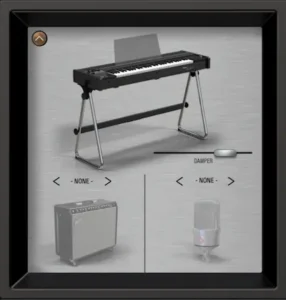
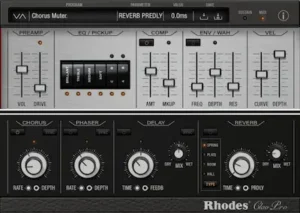
Rhodes also avoids presenting the instrument as a single finished recording. Instead, Clav Pro exposes several stages of the recording chain, including amplifier models, cabinet resonance, microphone selection, mechanical noise, and mute behavior. That gives producers more control over the source before reaching for EQ or dynamics processing later in the mix.
For experienced engineers, that approach is more valuable than simply having additional presets. Small decisions made at the instrument stage often eliminate corrective processing later, particularly when arranging rhythm-heavy productions where every source competes for space in the upper midrange.
The Timbre Shift control deserves attention because it goes beyond a conventional tone control. Rather than acting as a fixed EQ, it reshapes the overall character of the instrument, moving from cleaner studio-oriented textures toward the rougher response associated with well-used vintage hardware. It is a practical production tool that speeds up sound selection without forcing users to rebuild an effects chain from scratch.
Rhodes has also expanded the instrument beyond the limitations of the original hardware by adding sustain pedal and pitch-bend support. While neither feature is historically authentic, both make sense inside modern MIDI production. Film composers, contemporary pop producers, and hybrid writers routinely depend on performance techniques that were never possible on the original Clavinet.
The integrated Drive, Compressor, Envelope/Wah, modulation effects, and ambience processing follow the same philosophy. They are not intended to replace dedicated mixing plugins, nor should they. Their value lies in reducing setup time during writing sessions, allowing producers to move from an initial performance to a production-ready sound without assembling a separate processing chain every time a Clavinet track is added to a project.
That design philosophy ultimately defines Clav Pro. Its strongest feature is not a single effect or control, but the fact that it treats the Clavinet as a complete production instrument rather than a collection of isolated samples.
Why Source Quality Matters More Than Post-Processing
A convincing Clavinet sound is rarely the result of sampling alone. What determines whether it survives a dense arrangement is the relationship between articulation, transient response, pickup voicing, and amplifier coloration. If those elements feel disconnected, no amount of EQ or compression will make the performance behave like a well-recorded instrument.
Unlike many Clavinet VST instruments, Clav Pro approaches the Hohner Clavinet D6 as an entire recording chain rather than a collection of samples. Pickup selection, amplifier models, cabinet resonance, microphone options, and mechanical noise are all exposed as creative decisions instead of fixed characteristics printed into the library. That gives producers greater control over the source before the signal reaches the mix bus.
This distinction becomes noticeable during mixing rather than mastering. Much of the work normally associated with tonal balance is determined long before the mastering stage begins, which is one of the key differences between mixing and mastering.
The integrated amplifier section follows the same philosophy. Rather than recreating every historical recording setup, Rhodes provides several tonal directions that cover clean, modern textures as well as more saturated vintage responses. Combined with adjustable cabinet resonance, those options allow producers to shape the instrument before adding third-party processing.
Microphone selection adds another useful layer of control. Dynamic and condenser options encourage producers to think in terms of capture rather than post-processing, making it easier to match the instrument to different arrangements before reaching for additional EQ or transient shaping.
Even seemingly minor details, such as adjustable key noise and mute behavior, contribute to this production-first approach. Mechanical artifacts can enhance realism in exposed performances or be reduced for polished commercial mixes where excessive detail becomes distracting after compression.
None of these features fundamentally change what a Clavinet is. Their value comes from reducing the distance between selecting a preset and arriving at a sound that already fits the arrangement. For experienced producers, that usually saves more time than any single processing plugin added later in the mix.
What Rhodes Clav Pro Improves—and Where It Still Falls Short
 Clav Pro is easy to appreciate for what it is, provided expectations remain realistic. Rather than pursuing new synthesis techniques, Rhodes focuses on refining a mature multisampled workflow. Producers interested in the opposite design philosophy—where new synthesis technology takes priority over recreating vintage hardware—may also find our reFX Rippler review useful, as it explores a modern physically modeled instrument built around entirely different engineering principles.
The software is built around a familiar multisampled architecture, but Rhodes has invested considerable effort in recreating the parts of the instrument that influence performance rather than simply its frequency response. Pickup selection, mute behavior, amplifier voicing, cabinet interaction, and mechanical detail all contribute to how the instrument responds under the player’s hands. Those factors have a greater impact on musical phrasing than another layer of sample resolution alone.
That distinction is easy to overlook because it is less visible than a redesigned interface or an expanded preset library. In practice, however, responsive behavior usually has a greater effect on production than additional menu options. When an instrument reacts naturally, fewer performance corrections and fewer processing decisions are required later in the session.
Timbre Shift follows the same philosophy. It should not be confused with physical aging models or component-level simulation. Instead, it serves as a fast method of reshaping the instrument’s overall character without rebuilding an effects chain or switching presets. For working producers, that is a practical workflow improvement rather than a breakthrough in DSP.
The broader limitation is equally clear. Clav Pro remains a dedicated Clavinet plugin built around a single Hohner Clavinet D6 rather than a general-purpose keyboard collection. It will not replace comprehensive keyboard collections, nor is it intended to. Producers looking for electric pianos, organs, acoustic keyboards, and synthesizers within a single platform will still find greater value in larger ecosystems.
Viewed from that perspective, Rhodes has made a deliberate trade-off. Instead of maximizing versatility, the company has focused on making one instrument more convincing, more flexible, and faster to integrate into professional sessions. Whether that approach justifies another purchase depends almost entirely on how often a Clavinet appears in your productions.
How Clav Pro Compares to Today’s Leading Clavinet Instruments
Clav Pro enters a niche that already includes several highly respected virtual instruments, but most of its competitors were designed with broader goals in mind. Products such as Keyscape, Arturia V Collection, and UVI Vintage Vault treat the Clavinet as one instrument within a much larger keyboard ecosystem. Rhodes takes the opposite approach by building an instrument around a single source and expanding its production capabilities rather than its instrument count.
That distinction changes how the software should be evaluated. The question is not whether Clav Pro contains more sounds than competing libraries—it clearly does not. The more relevant question is whether a dedicated Clavinet provides enough practical advantages to justify replacing the versions many producers already own.
| Product | Primary Focus | Best Choice For | Potential Limitation |
|---|---|---|---|
| Rhodes Clav Pro | Dedicated Clavinet production instrument | Session keyboard players, funk, soul, and commercial production | Limited to a single instrument family |
| Spectrasonics Keyscape | Comprehensive premium keyboard collection | Studios needing maximum versatility | Less control over Clavinet-specific workflow |
| Native Instruments Scarbee Clavinet/Pianet | Kontakt-based vintage keyboard library | Kontakt users seeking strong value | Older workflow and fewer integrated production tools |
| Arturia V Collection | Complete vintage keyboard ecosystem | Producers covering multiple keyboard styles | Broader scope instead of deeper specialization |
| UVI Vintage Vault | Large multi-instrument vintage library | Composers and sound designers | General-purpose collection rather than dedicated Clavinet workflow |
For most producers, Keyscape remains the obvious point of comparison. Its Clavinet sounds are already capable of professional results, and many commercial studios have incorporated the platform into long-established templates. Switching to Clav Pro therefore becomes less a question of sound quality than one of workflow and specialization.
If a Clavinet appears only occasionally in your projects, Keyscape continues to offer better overall value simply because it covers a far wider range of instruments. Purchasing another dedicated library is unlikely to change your productions in any meaningful way.
The calculation changes in studios where the Clavinet is used regularly. Funk, soul, gospel, jazz fusion, vintage rock, and certain pop productions rely on subtle variations in pickup voicing, amplifier response, and performance dynamics that become difficult to recreate with more generalized keyboard libraries. In those situations, Clav Pro provides greater control before the signal reaches the mixing stage, reducing the need for external processing and alternate recording chains.
Scarbee Clavinet/Pianet remains one of the strongest lower-cost alternatives. It continues to deliver convincing performances and integrates well into Kontakt-based workflows. Its limitations are less about sound quality than age. Modern production expectations increasingly favor integrated processing, faster sound shaping, and streamlined session management—all areas where Clav Pro has a clear advantage.
Rhodes is not competing to build the largest keyboard collection. Its goal is to create one of the most complete dedicated Clavinet plugins currently available for professional production. It is competing to become the Clavinet that experienced producers load first when that instrument plays a meaningful role in the arrangement. For specialists, that focus may justify the investment. For everyone else, broader keyboard libraries remain the more practical long-term solution.
How Rhodes Clav Pro Performs in Professional Production Sessions
 Most virtual instruments are evaluated in isolation. Commercial productions rarely work that way. What ultimately determines whether a keyboard remains in a session is not how impressive it sounds on its own, but how quickly it finds its place once the arrangement becomes crowded.
That is where Clav Pro shows its strongest practical value. Because pickup selection, amplifier voicing, cabinet resonance, and microphone options are available before the instrument reaches the mixer, producers can shape the source around the arrangement instead of relying on corrective processing after the performance has already been recorded.
This approach is particularly useful in rhythm-driven productions. A Clavinet often occupies the same general frequency range as rhythm guitars, snare attack, percussion, and parts of the vocal presence region. Small changes in pickup selection or amplifier character frequently solve masking problems more naturally than additional EQ later in the mix.
The same production mindset applies to effects processing. Solving masking at the source is usually more effective than correcting it later with EQ, just as adaptive ambience tools attempt to preserve vocal clarity without constant manual adjustment. We explore that approach in our FRCTL Audio AURA review, which examines how modern reverb design can improve placement inside dense mixes.
Project recall is another advantage that should not be underestimated. Recreating vintage recording chains typically involves documenting amplifier settings, microphone placement, external processing, and routing decisions. Inside Clav Pro, those choices remain part of the project, allowing revisions without rebuilding an entire recording setup.
Current information also suggests sensible resource requirements for a modern multisampled instrument. While comprehensive independent CPU benchmarks are not yet available, there are no widespread reports of unusually heavy processor usage or stability issues during normal studio operation. Producers working with large orchestral templates should still evaluate performance within their own systems before committing to large-scale scoring sessions.
From a production standpoint, Clav Pro is best viewed as a source instrument rather than a processor. Establishing the instrument’s character before mixing generally leads to cleaner decisions later in the production chain. The same principle applies when you prepare a mix for mastering, where solving balance and tonal issues early usually produces better results than relying on corrective processing at the final stage.
Its limitations are equally straightforward. Producers looking for experimental sound design, granular processing, physical modeling, or unconventional keyboard synthesis will still need additional tools. Clav Pro remains focused on faithfully reproducing one classic electromechanical instrument while adapting it to contemporary production workflows.
That focus is also likely to give the software a longer lifespan than products built around short-lived production trends. The Clavinet has remained relevant across multiple decades of commercial music, and there is little evidence that demand for its distinctive rhythmic character is disappearing.
Overall Rating
| Category | Rating |
|---|---|
| Authenticity & Sound Quality | 9.5/10 |
| Performance & Playability | 9.5/10 |
| Production Workflow | 9.5/10 |
| Mix Integration | 9/10 |
| Creative Flexibility | 8.5/10 |
| Value for Money | 8.5/10 |
| Overall | 9.1/10 |
Authenticity & Sound Quality — 9.5/10
Rhodes has captured far more than the basic timbre of a vintage Clavinet. Pickup behavior, amplifier interaction, cabinet resonance, and performance dynamics work together to create an instrument that responds convincingly inside a finished arrangement rather than only in solo demonstrations.
Performance & Playability — 9.5/10
The instrument feels designed for modern production rather than historical re-creation alone. Fast access to pickup combinations, Timbre Shift, integrated effects, sustain support, and pitch bend make Clav Pro significantly easier to perform than many older software Clavinets.
Production Workflow — 9.5/10
One of Clav Pro’s strongest qualities is reducing the distance between loading the instrument and recording a production-ready performance. The integrated recording chain minimizes routine setup without forcing users into a fixed sound.
Mix Integration — 9/10
The library translates well into dense arrangements because tonal shaping begins before the mixing stage. Pickup selection and amplifier voicing solve many masking issues naturally, although final balance still depends on arrangement and engineering decisions.
Creative Flexibility — 8.5/10
Clav Pro deliberately focuses on one instrument instead of becoming an experimental sound-design platform. That specialization benefits producers seeking authenticity but naturally limits its range compared with larger keyboard collections.
Value for Money — 8.5/10
The value depends almost entirely on how often a Clavinet appears in your work. For regular users, the workflow improvements justify the investment. For producers who only need the occasional Clavinet part, comprehensive collections such as Keyscape may offer a stronger long-term return.
Overall — 9.1/10
Rhodes Clav Pro is one of the most complete dedicated Clavinet instruments currently available. It does not redefine virtual instrument technology, but it refines nearly every aspect of the recording and production workflow around a classic electromechanical keyboard. For producers who rely on Clavinet regularly, it stands among the strongest software options on the market.
Who Should Buy Rhodes Clav Pro—and Who Should Skip It?
Rhodes Clav Pro is aimed at keyboard players, producers, and composers who want a dedicated virtual Clavinet rather than another preset inside a general-purpose keyboard collection.
Clav Pro is an excellent fit if you regularly produce funk, soul, gospel, jazz fusion, vintage rock, modern pop, or cinematic music where the Hohner Clavinet D6 plays a noticeable role in the arrangement. Its workflow, pickup controls, amplifier modeling, and production-oriented features make it considerably more flexible than a typical Clavinet plugin bundled inside a larger keyboard collection.
You may not need Clav Pro if you already own Keyscape, Arturia V Collection, or another comprehensive keyboard library and only use a Clavinet occasionally. In those situations, the improvement is more about workflow than access to entirely new sounds.
It is also not intended for producers searching for experimental synthesis or advanced sound design. Clav Pro remains focused on faithfully recreating the behavior of a classic Hohner Clavinet D6 while making it easier to integrate into modern production sessions.
Verdict: One of the Most Focused Clavinet Instruments Available Today
Rhodes Clav Pro succeeds by resisting the temptation to become another all-in-one keyboard collection. Instead, it concentrates on a single instrument and refines the details that matter during real production: performance response, pickup behavior, amplifier integration, and fast sound shaping inside a modern DAW.
That focus inevitably limits its audience. Producers who only reach for a Clavinet a few times each year are unlikely to gain enough practical benefit to justify replacing broader platforms such as Keyscape or Arturia V Collection. Those libraries continue to deliver greater overall value when versatility is the priority.
For musicians and engineers who regularly build arrangements around the Clavinet, however, the calculation is different. The combination of integrated processing, flexible signal-chain options, reliable project recall, and production-oriented controls reduces preparation time while preserving the character that makes the original instrument so effective in rhythm-driven music.
Clav Pro is not a breakthrough in virtual instrument technology, nor does it attempt to redefine the category. Its value comes from thoughtful execution rather than technical novelty. Rhodes has focused on making one instrument easier to record, easier to mix, and easier to integrate into professional sessions without compromising the qualities that made the original Clavinet a studio classic.
If your productions rarely depend on a Clavinet, a comprehensive keyboard library remains the more practical investment. Clav Pro makes a strong case for becoming the dedicated Clavinet VST that remains permanently loaded in professional production templates. Once those production decisions are finished, the focus shifts away from instrument selection and toward the final stage of release preparation—audio mastering.
Your Mix Is Only as Strong as Its Final 5%
Great productions rarely fail because of the instrument or the plugin—they fall short when the final decisions don’t translate outside the studio. Professional mastering reveals subtle balance, dynamics, stereo, and tonal issues that often remain hidden until the track reaches streaming platforms or real-world playback systems.
If you want to hear what an experienced mastering engineer would improve before release, upload up to 35 seconds of your mix and receive a free mastering demo. Compare your original against the mastered version and decide based on what you hear—not on promises.
Request your free mastering demo →
FAQ
Is Rhodes Clav Pro worth buying if I already own Keyscape?
It depends on how often you use a Clavinet. If it appears only occasionally in your productions, Keyscape remains the more practical all-purpose solution. If the Clavinet is a regular part of your arrangements, Clav Pro offers a more focused workflow and deeper control over the instrument itself.
How does Rhodes Clav Pro compare to Native Instruments Scarbee Clavinet?
Scarbee remains a capable and cost-effective option, particularly for Kontakt users. Clav Pro offers a more modern interface, integrated signal-chain controls, and a production workflow designed around a dedicated Clavinet rather than a legacy sample library.
Is Rhodes Clav Pro the best Clavinet plugin available?
It is one of the strongest dedicated Clavinet instruments currently available. Whether it is the best choice depends on your workflow. Producers needing a complete keyboard collection may still prefer broader platforms such as Keyscape, while Clav Pro is aimed at users seeking a specialized Clavinet solution.
Can Rhodes Clav Pro replace a real Hohner Clavinet D6?
For most studio applications, it can eliminate many of the practical challenges associated with vintage hardware, including maintenance, project recall, and recording setup. Players seeking the exact feel of the original mechanical action may still prefer the hardware.
Is Rhodes Clav Pro better than Keyscape for Clavinet sounds?
Not universally. If the Clavinet is a central part of your productions, Clav Pro offers deeper pickup control, amplifier integration, and a more specialized workflow than Keyscape. If you need a broad collection of professional keyboard instruments, Keyscape remains the better long-term investment.
Are the built-in effects sufficient for professional productions?
They are designed to speed up sound creation rather than replace dedicated mixing plugins. Many users will find the integrated processing suitable during writing and tracking, while final mixes may still benefit from additional processing where appropriate.
Is Rhodes Clav Pro suitable for live performance?
Yes. Like most modern virtual instruments, live performance depends primarily on the host computer, audio interface, and buffer settings rather than the instrument itself.
Which music genres benefit most from Rhodes Clav Pro?
It is naturally suited to funk, soul, disco, jazz fusion, gospel, classic rock, neo-soul, and pop, but it also works well in film scoring and modern productions that benefit from rhythmic keyboard articulation.
What makes Timbre Shift different from a standard EQ?
Timbre Shift changes the overall character of the instrument rather than simply boosting or cutting frequencies. It provides a faster way to move between cleaner and more aggressive tonal personalities without rebuilding an entire processing chain.
Who should consider buying Rhodes Clav Pro?
Session keyboard players, composers, producers, and studios that regularly use Clavinet parts will benefit the most. If the instrument only appears occasionally in your work, a broader keyboard library may provide better overall value.

Yurii Ariefiev reviews virtual instruments from the perspective of real studio production, evaluating how they behave inside finished arrangements rather than how they sound in isolated demos. His analysis focuses on performance response, source quality, recording workflow, and the practical decisions that influence mixing and mastering.
This editorial review examines Rhodes Clav Pro as a dedicated Clavinet production tool, comparing its recording workflow, signal-chain flexibility, and integration into modern professional sessions instead of relying on launch claims or feature lists.