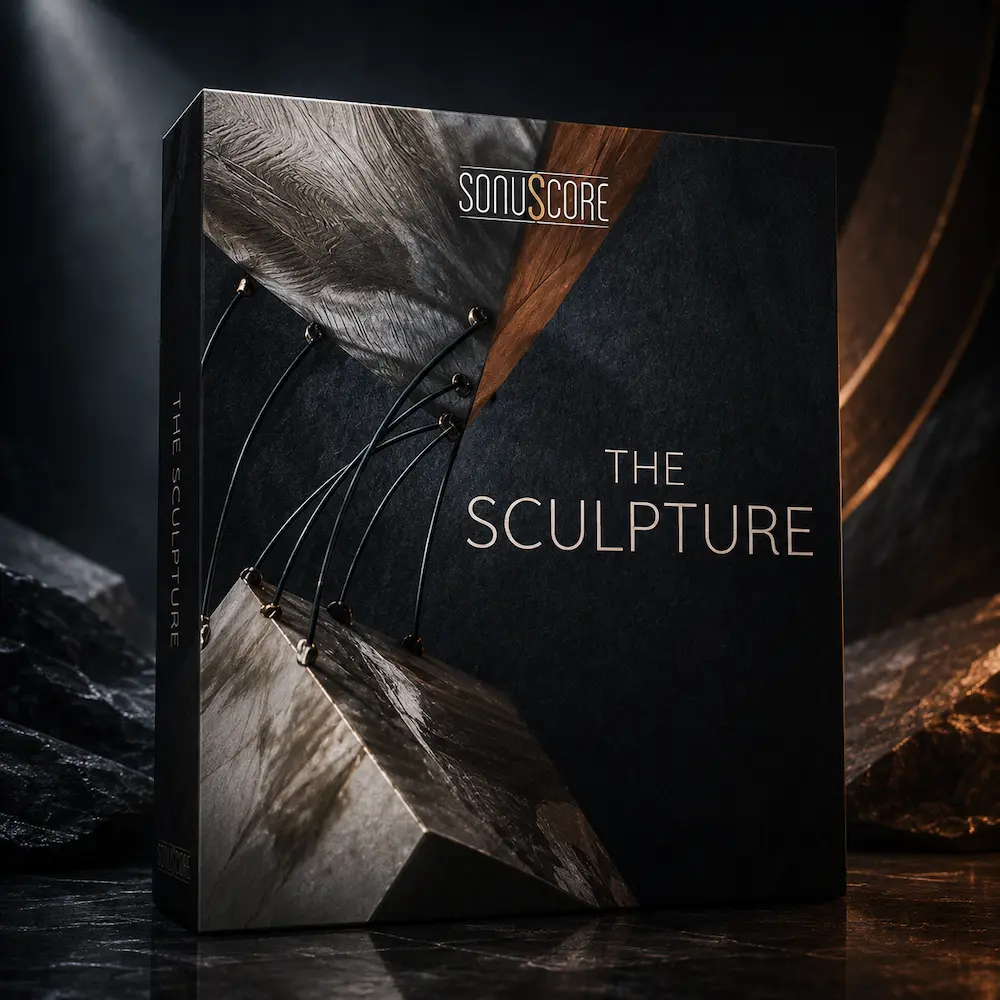
Sonuscore The Sculpture review comes down to one practical question: does its unusual source material offer something genuinely useful once it enters a real production, or is it simply another cinematic Kontakt library with a good story behind it? Built entirely from recordings of a single handmade metal sculpture, The Sculpture combines four microphone perspectives with two distinct instruments: the playable Single and a five-voice Engine built for layered, evolving sound design. The concept is unusual. The real test is whether that character remains useful when the sound has to compete with everything else in a mix.
Sonuscore The Sculpture at a Glance
| What It Is | Details |
|---|---|
| Instrument Type | Sample-based cinematic Kontakt instrument |
| Sound Source | One handcrafted metal sculpture by Klaus Gündchen |
| Microphone Perspectives | Close, Far, Contact, and Internal Blumlein |
| Instruments | Single and five-voice Engine |
| Engine Structure | Two playable voices, two arpeggiators, one granular voice |
| Playback | Free Kontakt Player 7.10.9 or later |
| Plugin Formats | VST3, AU, AAX Native, Standalone, NKS |
| Primary Use | Film scoring, game audio, sound design, ambient and experimental production |
| Price at Time of Review | $79 promotional price |
The important distinction is that The Sculpture is not trying to compete with large metallic sample libraries or cinematic percussion collections on quantity. Its proposition is narrower: one physical source, multiple recording perspectives, and enough playable and processed material to turn that source into a usable production instrument.
In This Review
- The Advantage of a Distinctive Source
- Single vs. Engine: Two Ways to Use the Same Source
- Four Microphone Perspectives Turn Recording Into Sound Design
- The Mixing Problem: Controlling Metallic Resonance Without Killing the Character
- Where The Sculpture Fits in a Real Production Workflow
- The Sculpture vs. Metallic Kontakt Libraries
- Kontakt Player, Plugin Formats and System Requirements
- Verdict: A Strong Specialty Instrument
The Advantage of a Distinctive Source
 Large sample libraries are useful when breadth is the priority. The problem is that sheer volume does not necessarily give a composer a distinctive sound. Metallic percussion is already a crowded category, with libraries covering everything from industrial impacts and found objects to bowed metal and cinematic effects.
The Sculpture takes a narrower approach. Its entire sound palette comes from a single handmade metal sculpture by German sculptor Klaus Gündchen. Sonuscore recorded the structure from four perspectives — close, far, contact and an internal Blumlein pair — covering its large plates, connecting rods and internal resonances. The result spans short impacts, sustained tones, bowed textures and granular material without relying on unrelated source recordings.
That consistency is more important than the “one-of-a-kind” label. The Sculpture is not unique because metal has never been sampled before; it is distinctive because the articulations share the same physical resonator. The timbral relationship between a struck plate, a bowed rod and the sculpture’s internal resonance can therefore feel coherent within the same cue.
For scoring, that gives the library a practical advantage. A short metallic accent can lead into a sustained resonance or evolving texture while retaining the same underlying sonic character. The source becomes part of the arrangement rather than simply another effect layered on top of it.
Hear What Professional Mastering Can Do
A distinctive production still needs to translate as a finished record. If you want to hear how professional mastering can improve the balance, punch, depth, and translation of your mix, upload up to 35 seconds and get a free mastering demo before committing to a full project.
Request your free mastering demo →
Single vs. Engine: Two Ways to Use the Same Source
The Sculpture splits its recorded material into two distinct workflows: the Single instrument for direct access to the source and the Engine for building more complex, evolving textures.
The Single instrument is the more useful starting point when the character of the sculpture needs to remain recognizable. It provides access to the recorded articulations and microphone perspectives, making it suitable for metallic accents, resonant hits, bowed tones and sustained textures that need to sit in an arrangement as identifiable acoustic elements.
The Engine takes the same recordings into sound-design territory. It combines five voices — two freely playable layers, two arpeggiators and one granular voice — with slot and master effects. That makes it faster to build rhythmic patterns, drones and evolving textures without constructing the entire signal path manually.
The distinction matters because processing can either extend the source or obscure it. The Single preserves the physical character that makes The Sculpture interesting in the first place. The Engine is more useful when movement and density matter more than maintaining a recognizable acoustic performance. Neither approach is inherently better; they serve different jobs in a production. Sonuscore has explored a similar balance between playable source material and faster cinematic workflows in our review of Elysion Elements, although The Sculpture takes a much more focused approach to its underlying acoustic source.
Four Microphone Perspectives Turn Recording Into Sound Design
The four microphone perspectives are one of The Sculpture’s most useful production features because they change the balance between attack, resonance and acoustic space before any processing is applied.
The close position emphasizes detail and transient definition. The far position adds room and spatial information. The contact microphone captures vibration directly from the metal, greatly reducing the influence of the surrounding acoustic space. The internal Blumlein pair captures resonance from inside the sculpture, giving the instrument a perspective that conventional room and close microphones cannot reproduce.
The internal pair is particularly valuable for sound design. It changes the proportion of direct impact to resonant body at the source, rather than trying to recreate that relationship later with EQ, reverb or additional processing.
In practical mixing terms, the four positions can function almost like four arrangement layers: close for foreground definition, contact for physical attack, far for environmental depth and Blumlein for internal resonance.
That makes the microphone system part of the instrument’s sound-design architecture. Instead of blending perspectives simply to make a patch sound larger, you can choose the recording perspective according to the role the sound needs to play in the mix.
What Matters After the Presets Stop Impressing You
The useful test for a library like The Sculpture is not how impressive the first few cinematic presets sound. It is what happens when the material is taken out of the demo context and placed into an actual arrangement.
That means listening for three things: whether the source remains recognizable after processing, whether the resonant information can be controlled without stripping away its character, and whether the instrument gives enough access to the raw material to remain useful after the initial preset exploration is over.
The Sculpture performs best when those decisions are made at the source. The Single instrument, microphone perspectives and articulations provide enough control to build a sound around the arrangement rather than forcing the arrangement to accommodate a finished cinematic preset.
From Metallic Hits to Sustained Textures
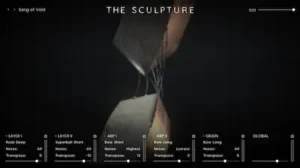 The Sculpture is more useful than a conventional metal percussion library because its source can cover both discrete impacts and sustained material. The large plates produce weighty strikes and resonances, while the thinner rods provide finer textures, including bowed tones and extended articulations.
That distinction changes how the instrument can function in an arrangement. A struck plate gives you a defined transient followed by a resonant tail. A bowed rod can sustain long enough to become part of the musical texture itself rather than simply marking an event.
That makes the library particularly well suited to scoring. A short metallic hit can establish an accent or transition, while a related bowed or resonant texture can continue underneath the following section. Because both sounds originate from the same physical structure, their timbral relationship remains coherent.
The rod material is also useful outside conventional scoring. Once rendered to audio, the finer metallic textures can be stretched, filtered, granulated or resampled into transitions, drones and atmospheric layers. The value is not in having another set of finished effects; it is in having a source that can be pushed into several different roles without losing its underlying character.
The Engine Speeds Up Sound Design — at a Cost
The Engine is the quickest way to turn The Sculpture’s recordings into more complex material. Its two playable voices, two arpeggiators and granular layer can produce pulses, drones, rhythmic patterns and evolving textures without building those layers manually in the DAW.
That is a legitimate workflow advantage, but it is not a new synthesis concept. Layering, arpeggiation, granular processing and effects are established sound-design techniques. The Engine’s contribution is the way those tools are organized around a single, highly specific acoustic source.
The trade-off is that processing can gradually erase the characteristic that makes the library worth having. Once several voices, granular processing and effects are stacked together, a patch can move toward the same generalized cinematic texture available from many other Kontakt instruments. The more processing becomes the focus, the less important the original sculpture becomes.
The Single instrument is therefore the better starting point when the source itself needs to remain recognizable. The Engine is the faster option when the production calls for movement, density and layered sound design.
The Mixing Problem: Controlling Metallic Resonance Without Killing the Character
The Sculpture’s strongest quality can also be its biggest mixing liability. Its metallic source produces dense harmonics and resonant tails, particularly through the upper mids and highs. In a busy arrangement, that energy can compete with cymbals, strings, vocal presence, synths or dialogue — the same kind of buildup that can become a harsh-highs problem at the mastering stage if it is left unresolved in the mix.
Static filtering is not always the best answer. If the problematic resonance appears only on specific notes or hits, dynamic EQ or multiband control can reduce those peaks while leaving the broader character of the instrument intact. The goal is to control the resonance rather than flatten the reason the sound was chosen in the first place.
The microphone perspectives provide another level of control before processing is even necessary. If the close position is too aggressive, the far or internal Blumlein perspective may deliver the same musical event with a different balance of attack, resonance and space. If room information is becoming a problem, the contact microphone offers a more isolated representation of the sculpture’s physical vibration.
That makes microphone selection part of the mixing process. Choosing the right perspective at the source can solve a spectral or spatial problem more cleanly than trying to repair it later with EQ and effects. When additional depth is needed, spatial processing can then be used to place the recorded material without losing the physical character of the source; our review of DEVPROAUDIO Reverside looks at that problem from the processing side, with a focus on algorithmic spatial design rather than source recording.
Where The Sculpture Fits in a Real Production Workflow
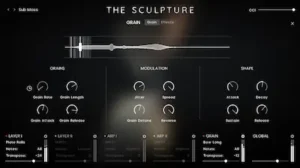 Film and TV scoring is the clearest use case. The combination of short metallic attacks, sustained bowed material and evolving textures gives a composer several functions from the same source: accents, transitions, tension beds and longer atmospheric layers. The sound is particularly well suited to horror, psychological drama, science fiction and contemporary scores where conventional orchestral colors can feel too familiar.
Game composition and sound design are also strong applications. The Single instrument can provide identifiable metallic events, while the Engine is better suited to environmental beds, transitions and evolving textures. It is not a dedicated game-audio system, but the source material can be rendered and further edited for use in a conventional game-audio workflow.
Sound design is arguably the second strongest application after scoring. The recordings are more useful when treated as raw material than as finished presets. A producer can print a performance, edit the timing, stretch or reverse sections, filter individual resonances, add distortion or modulation, and resample the result into a larger production. That approach preserves the unusual character of the source while avoiding the preset-heavy sound of a typical cinematic library.
Electronic music is a good fit when the production leaves room for distinctive acoustic textures. Industrial, ambient, IDM, experimental and cinematic electronic styles can all make productive use of the material. For conventional house, R&B or mainstream pop, the library is much harder to justify because its character is too specialized to function as a general-purpose instrument.
In rock and metal, The Sculpture is more useful for transitional effects, accents and textural layers than for core percussion. The same limitation applies to pop: it can add an unusual intro, fill or transition, but it is not a substitute for a conventional percussion or instrument library.
For mixing engineers, its value is upstream. The Sculpture provides material that can become part of the arrangement and then be treated like any other recorded element. For mastering engineers, there is no direct application; the instrument belongs to composition, production and sound design rather than the mastering chain.
The Sculpture vs. Metallic Kontakt Libraries: What Are You Actually Buying?
The relevant comparison is not which library has the most samples. These instruments take different approaches to the same production problem: creating convincing metallic material without building every sound from scratch.
| Instrument | Production Focus | Where It Has the Advantage | Where The Sculpture Has the Advantage |
|---|---|---|---|
| Sonuscore The Sculpture | Focused metallic source with playable and evolving textures | Broad metal coverage is not its goal | Coherent sonic identity, four recording perspectives and a distinctive physical source |
| Soundiron Rust Prime | Broad found-metal and industrial sound design | Much greater source variety and content depth | More focused palette and stronger continuity between articulations |
| Soundiron Iron Throne | Dark metallic percussion and cinematic effects | More directly oriented toward conventional cinematic metal material | More unusual recording perspective and greater emphasis on the sculpture as a single resonant instrument |
| Heavyocity Damage 2 | Large-scale cinematic percussion and sound design | Far broader coverage of impacts, rhythms, loops and processed material | Smaller, more focused instrument built around one recognizable acoustic source |
Rust Prime is probably the most useful comparison if you want a dedicated metallic sound-design library. Its broader collection gives you more ways to approach industrial and found-metal material, while The Sculpture deliberately limits the palette to one physical source. Damage 2 sits further toward an all-purpose cinematic percussion system, with a much larger production scope.
That makes the purchasing decision fairly straightforward. If the job is to cover as many metallic sounds as possible, a broader library makes more sense. If the goal is to add a specific metallic character that can move between impact, resonance and texture while retaining a consistent acoustic identity, The Sculpture’s narrower approach is the advantage.
Where The Sculpture Is Actually Different
The Sculpture’s strongest point of differentiation is the recording concept, not a new piece of DSP. Its granular processing, arpeggiators, layering and effects use established sound-design techniques. The unusual part is what those tools are being applied to.
The instrument is built around one resonant physical object, recorded through four substantially different perspectives and played with techniques that range from conventional impacts to sustained and bowed textures. That gives the library a consistent acoustic fingerprint that is difficult to reproduce by combining unrelated samples from a larger collection.
There is a meaningful distinction here between sonic innovation and technological innovation. The Sculpture does not introduce a new synthesis method or sampling technology. Its value comes from the source material, the recording approach and the way that material is exposed through the Kontakt interface.
Sonuscore also features endorsements from professional composers including Simon Franglen, Ramin Djawadi and John Enroth. Those comments indicate that experienced composers have worked with the instrument, but they are not substitutes for independent testing. They provide no meaningful evidence about CPU efficiency, aliasing, long-session stability or whether The Sculpture outperforms competing libraries in a controlled comparison.
The more useful test is whether the source still sounds distinctive after it has been layered, processed and placed in a dense arrangement. That is where The Sculpture has to justify its design rather than relying on the novelty of the recording story.
Kontakt Player, Plugin Formats and System Requirements
The Sculpture runs in the free Kontakt Player, so a separate full Kontakt license is not required. It is also available as a VST3, AU, AAX Native, standalone and NKS instrument, giving it a broader place in modern DAW workflows than the “Kontakt instrument” label suggests.
Best Service lists support for macOS 11–13 on Intel and Apple Silicon systems and Windows 10/11, with 4GB of RAM required and 6GB recommended. Because software requirements can change with installer and host updates, these specifications should be checked against the current product listing before installation.
The more relevant production question is resource usage. The basic Single instrument should place a relatively modest load on a modern system, while complex Engine patches can involve several active voices, arpeggiators, granular processing and effects. There is still no reliable independent CPU benchmark that would justify assigning a precise performance figure.
The same caution applies to latency, aliasing, oversampling and phase behavior. Without controlled independent measurements, those characteristics should remain unverified rather than being presented as either advantages or weaknesses.
Price and Value: Is The Sculpture Worth the Investment?
Sonuscore positions The Sculpture as a specialty instrument rather than a comprehensive cinematic percussion library. That distinction is important when evaluating its price. You are paying for a specific acoustic source, four recording perspectives and a playable sound-design environment, not for the sheer sample volume offered by larger cinematic collections.
Rust Prime, for example, provides substantially broader metallic coverage and a much larger collection of raw material. Damage 2 operates at an even larger scale, covering cinematic percussion and processed sound design far beyond the scope of The Sculpture. Comparing them by sample count therefore misses the point.
The Sculpture makes the most financial sense when its particular sound is likely to appear in real projects. A composer working regularly with tension, horror, science fiction, experimental scoring or metallic sound design can justify a specialized library more easily than a producer who already owns several broad cinematic collections.
At its promotional price, the barrier to entry is relatively low for a professional specialty tool. The value drops quickly, though, if the library spends most of its time unused. The right question is not whether The Sculpture contains enough material to replace a larger library; it is whether its particular sonic character solves a problem your existing instruments do not.
What The Sculpture Does Not Replace
The Sculpture is easy to overestimate if it is judged by the range of sounds in its Engine presets. It does not replace a comprehensive cinematic percussion library, a dedicated granular synthesizer, a general-purpose synthesizer or a large found-sound effects collection.
Its role is narrower. It gives the producer a distinctive physical source that can cover impact, resonance, sustained texture and processed sound design while retaining a common acoustic identity. If that specific character is not needed, a broader instrument will usually provide better value.
Who Gets the Most From The Sculpture?
Film and TV composers are the clearest target. If metallic resonance, unusual impacts or sustained mechanical textures appear regularly in your scores, the Single instrument provides enough distinctive material to justify the library on its own. The Engine becomes useful when those same sources need to turn into moving beds, pulses or transitions.
Game composers and sound designers are also a strong fit, particularly for horror, science fiction and atmospheric work. The ability to start with a recognizable physical source and then resample or process it gives the material more flexibility than treating the factory presets as finished effects.
Experimental electronic producers can get substantial mileage from the library, especially in industrial, ambient, IDM and other styles where unusual acoustic textures are part of the production language. For these users, the raw recordings may be more valuable than the cinematic Engine presets.
For a home studio or general-purpose producer, the purchase is more conditional. The Sculpture makes sense as a specialty instrument after the basic production toolkit is already covered. It is not a replacement for a broad percussion library, synth or effects collection.
Beatmakers working in conventional genres have a lower return on investment. The same applies to mixing and mastering engineers who do not produce music themselves. The instrument lives upstream of the mix, so its professional value is primarily in composition, arrangement and sound design rather than mixing or mastering.
For a professional scoring studio, The Sculpture is best viewed as a specialty color. It can fill a specific gap in a larger template, but it should not be treated as a replacement for a comprehensive cinematic percussion library.
The Limits of a Highly Specialized Sound Source
The Sculpture’s strongest design decision is also its main limitation: the sonic palette is deliberately narrow. The same physical character that makes the instrument recognizable also limits how often it will be the right choice.
It is therefore better viewed as a specialty layer than as a replacement for a broad percussion library, synthesizer or dedicated granular instrument. The Engine can produce a wide range of processed textures, but that flexibility does not change the underlying character of the source. In conventional production styles, there may simply be better tools for the job.
There is also a risk of preset dependence. If The Sculpture is used primarily through its finished Engine patches, its most distinctive quality can become less apparent. The deeper value is in working from the Single instrument, changing microphone perspectives, combining articulations and processing the recordings yourself. That keeps the physical character of the source audible instead of turning it into another generic cinematic texture.
The other limitation is the current lack of independent technical testing. There is not yet enough reliable data to make strong claims about CPU efficiency, large-template behavior, render performance or detailed DSP characteristics. That limits what can responsibly be concluded about performance, even if the underlying instrument is otherwise well designed.
From Source to Mix: Putting The Sculpture Through a Real Production Chain
The Sculpture works best when treated as an arrangement element rather than a finished effect. The useful workflow starts before processing: choose the articulation for the musical role, then use the microphone perspective to establish the balance of attack, resonance and space.
The Single instrument is particularly well suited to this approach. A close perspective can establish a defined foreground event, while the far or internal Blumlein positions can push the same material deeper into the soundstage. Contact recordings can provide a more isolated physical layer when room information is getting in the way.
Once the sound is in the DAW, the usual mix constraints become more important than how impressive the patch sounded in isolation. Long resonant tails can mask the next musical event. Upper-mid energy can compete with percussion, vocals or dialogue. Wide stereo material can lose its usefulness when the mix is summed toward mono. Those are arrangement and mix decisions, not problems that another preset will solve.
The same applies at mastering. If a metallic layer becomes brittle or overly dense after compression and limiting, the better fix is usually upstream: shorten the tail, reduce the offending resonance, change the microphone perspective or rebalance the layer in the mix. Preparing a mix for mastering means dealing with those problems before the final processing stage rather than expecting mastering to repair a source that was already occupying too much spectral or dynamic space.
That is ultimately the professional test for The Sculpture. The source is distinctive, but it still has to earn its space in the arrangement. Its value comes from giving the producer unusual material to work with, not from eliminating the mixing decisions that follow.
Verdict: A Strong Specialty Instrument, Not a General-Purpose Library
Sonuscore The Sculpture succeeds for a fairly specific reason: it gives producers access to a coherent metallic sound source with a character that is difficult to reproduce by combining conventional percussion samples. The four microphone perspectives add useful control over attack, resonance and space, while the Single and Engine instruments cover two distinct workflows — direct performance and faster sound design.
The limitation is the same. The Sculpture is deliberately specialized, so it does not make sense as a replacement for a broad percussion library, a full cinematic sound-design collection or a dedicated synthesis and granular toolkit. The Engine can expand the palette considerably, but heavy processing can also move the material toward generic cinematic territory and reduce the character that makes the source interesting.
For composers working in film, television, games and experimental electronic music, that specialization is a strength. The library can fill a specific sonic role that larger collections often approach through sheer volume rather than a single recognizable acoustic source.
For mixing and mastering engineers, the value is further upstream. The Sculpture is useful when creating and arranging the material that will eventually reach the mix, but it has no meaningful role as a core mixing or mastering processor.
The Sculpture is worth considering if you need a distinctive metallic source that can move between impacts, resonance and evolving textures. If your existing library already covers that territory and you rarely work with experimental or cinematic material, there is little reason to add another specialty instrument.
Overall Rating
| Category | Rating |
|---|---|
| Sound Quality | 9/10 |
| Workflow | 9/10 |
| Mix Usability | 9/10 |
| Source & Sonic Identity | 9.5/10 |
| Sound Design Flexibility | 8/10 |
| Value for Money | 8.5/10 |
| Overall | 8.8/10 |
Sound Quality — 9/10: The strongest part of The Sculpture is the character of the recorded source. The combination of plates, rods, bowed material and resonances gives the instrument a coherent acoustic fingerprint rather than a collection of unrelated metallic samples. The score stops short of 10 because the material is intentionally specialized and can become dense or abrasive in the upper mids and highs if it is not placed carefully in a mix.
Workflow — 9/10: The split between Single and Engine is genuinely useful. Single provides direct control over the recorded material, while Engine handles layered, evolving textures without requiring the producer to construct every layer manually. The workflow is fast without pretending that the underlying sound-design techniques are revolutionary.
Mix Usability — 9/10: The four microphone perspectives give the producer meaningful control before EQ, compression or spatial processing enters the chain. Close, contact, far and internal Blumlein perspectives can serve different arrangement roles, which makes source selection part of the mix rather than an afterthought. The main limitation is the amount of resonant upper-mid and high-frequency energy some material can introduce.
Source & Sonic Identity — 9.5/10: This is where The Sculpture earns its place. The consistent physical origin gives its articulations a relationship that broader metallic libraries cannot necessarily reproduce through sheer sample volume. It is not technically innovative in the synthesis sense, but the recording concept produces a genuinely recognizable palette.
Sound Design Flexibility — 8/10: The Engine adds arpeggiation, granular processing, layering and effects, while the raw recordings can be edited, stretched, filtered and resampled outside Kontakt. That is enough for substantial sound-design work, but it remains a focused source rather than a replacement for a dedicated granular or synthesis environment. Heavy processing can also push the material toward more generic cinematic territory.
Value for Money — 8.5/10: The Sculpture makes sense as a specialty purchase rather than a replacement for a large percussion collection. Its value is high for composers and sound designers who regularly need unusual metallic textures, but considerably lower for producers whose existing libraries already cover this territory. The narrower application prevents a higher score.
Overall — 8.8/10: The Sculpture is a well-focused specialty instrument with a clear sonic reason to exist. It does not win through sample count or groundbreaking DSP; it wins by giving a distinctive physical source enough control and workflow flexibility to remain useful in real productions.
Make Sure Your Mix Holds Up Outside the Studio
A distinctive sound is only useful if it survives the final stage. Professional mastering is where balance, dynamics, low-end control, and stereo depth are evaluated as a complete record—not just as isolated tracks or impressive sounds in a studio session.
Before paying for a full mastering session, hear what an experienced mastering engineer can actually change in your mix. Upload up to 35 seconds and receive a free mastering demo with real-world processing applied to your track.
Hear your free mastering demo →
Frequently Asked Questions
What plugin formats does Sonuscore The Sculpture support?
The Sculpture is available for VST3, AU and AAX Native, as well as standalone and NKS workflows. It also runs in the free Kontakt Player, so the full version of Kontakt is not required.
How much storage does The Sculpture require?
Sonuscore’s published figures are inconsistent: the system requirements list 4GB of disk space, while another section describes the sample content as 5–6GB. Either way, its footprint is modest compared with many large orchestral and cinematic libraries.
Is The Sculpture suitable for a large DAW template?
It should be practical on a modern production system, but there is not enough independent testing to quantify its CPU or memory behavior in large templates. Complex Engine patches can require more resources than the simpler Single instrument because they combine multiple voices, arpeggiators, granular processing and effects.
Should I use The Sculpture’s Single or Engine instrument?
Use Single when the character of the recorded sculpture needs to remain clear and controllable. Use Engine when you need layered movement, rhythmic patterns, granular textures or a faster route to a more complex sound.
Can The Sculpture be useful without heavy processing?
Yes. The Single instrument is specifically valuable as a source of playable metallic impacts, resonances and bowed textures. In many mixes, choosing the right microphone perspective and articulation will be more effective than adding another layer of processing.
Is The Sculpture a replacement for a cinematic percussion library?
No. It is a focused instrument rather than a comprehensive percussion collection. Larger libraries such as Heavyocity Damage 2 cover substantially more impacts, rhythms and cinematic material, while The Sculpture focuses on a narrower but more distinctive acoustic source.
Does The Sculpture replace a dedicated granular synthesizer?
No. Its Engine includes a granular voice designed to process the library’s own recordings, but a dedicated granular instrument offers a much broader synthesis, modulation and sample-processing environment.
Is The Sculpture useful for electronic music?
It can be particularly effective in ambient, industrial, IDM, experimental and cinematic electronic production. Its value decreases in genres where metallic acoustic textures rarely play a significant role.
Is The Sculpture useful for mixing or mastering?
Its value is upstream of both. A mixing engineer can use its recordings as production material and process them in the mix, but The Sculpture itself is not a mixing processor. It has essentially no direct role in mastering.
Is The Sculpture a good choice for professional film scoring?
Yes, particularly when a score needs metallic accents, sustained resonances or evolving textures with a consistent acoustic identity. Its strongest advantage for scoring is the ability to move between those roles without switching to unrelated sound sources.

Yurii Ariefiev is a mastering engineer and audio production editor focused on how instruments, sample libraries, and production tools behave once they enter a real arrangement, mix, and mastering workflow.
This review evaluates The Sculpture as a production and sound-design instrument, with particular attention to source character, microphone perspective, arrangement, spectral balance, and how distinctive material holds up through the final mix and master.