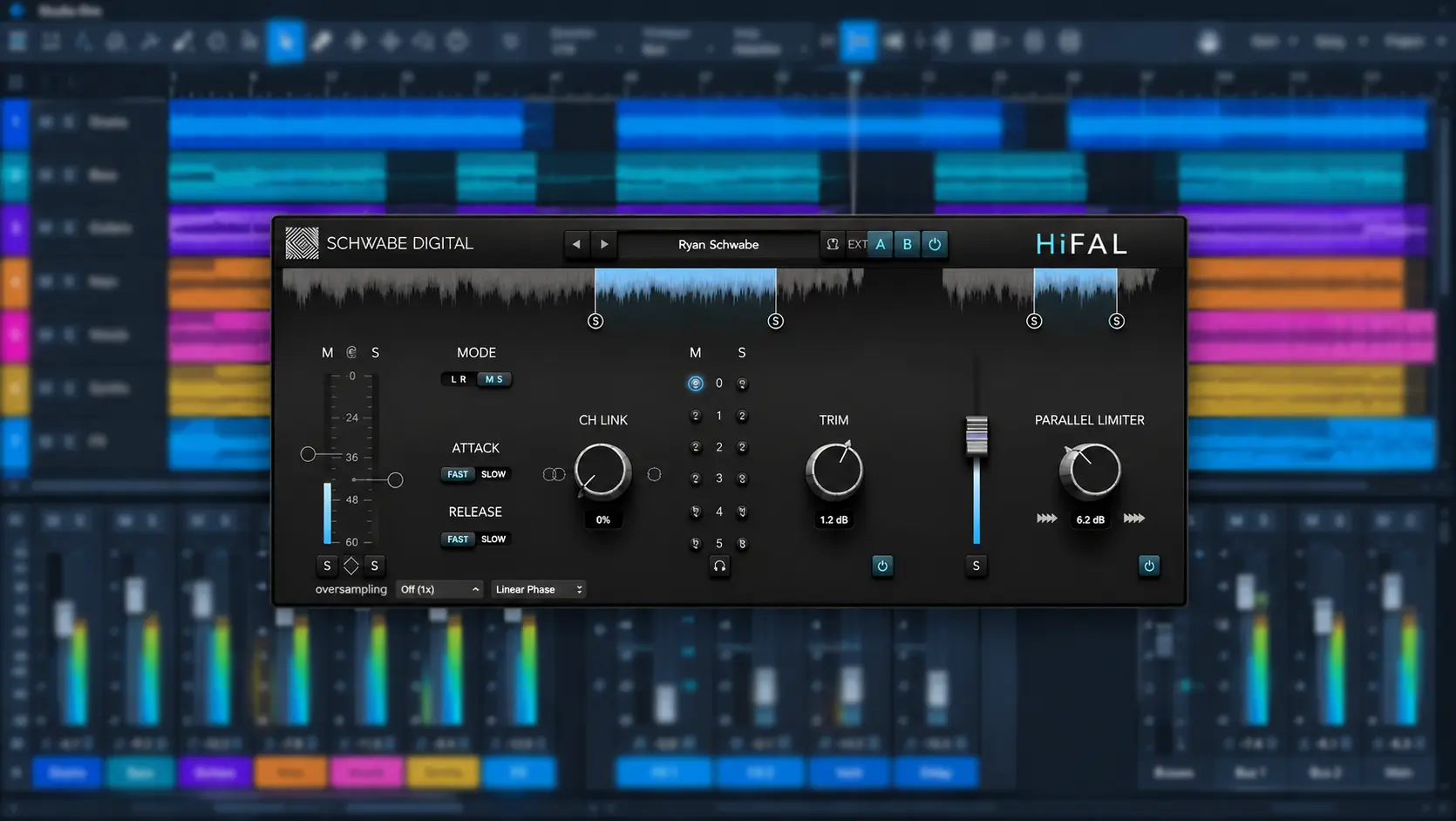
Schwabe Digital HiFAL 2 is a specialized high-frequency acceleration limiter designed to control aggressive transients without relying solely on broad treble reduction. It targets a specific problem in mixing and mastering: upper-frequency peaks that become distracting after compression, limiting, or dense layering, even when the overall tonal balance is otherwise acceptable.
The version 2 update combines a redesigned filter architecture with Linear, Dynamic, and Live modes, oversampling up to 32x, and PARALIMIT for parallel high-frequency processing with stereo targeting. These features make the plugin relevant to engineers working with bright vocals, cymbals, percussion, and dense electronic mixes.
HiFAL 2 is not a universal harshness remover. A de-esser remains more direct for isolated vocal sibilance, dynamic EQ is useful for frequency-specific problems, and resonance suppression addresses a different type of harshness. The key question is whether acceleration limiting provides useful control over the material without sacrificing the presence and transient detail the mix needs.
Why High-Frequency Control Requires More Than EQ
 High-frequency harshness is not always a tonal imbalance. A vocal can sound balanced throughout most of a phrase yet become piercing on a few consonants. Cymbals may sit correctly in the overhead balance but produce sharp transients that become more distracting after bus compression or limiting. Bright synths can provide useful presence in isolation and turn abrasive when layered into a dense arrangement.
A static high-shelf cut reduces the entire selected range, including frequencies that contribute to clarity. Dynamic EQ offers more selective control, while a de-esser targets sibilance. These tools remain effective, but they address different problems from a dedicated high-frequency acceleration limiter, which is designed to control the behavior of high-frequency transients over time.
When harshness remains a problem after basic tonal correction, understanding how to fix harsh highs in mastering can help distinguish persistent tonal imbalance from aggressive transients that require a different approach.
This distinction is relevant in pop, hip-hop, and electronic music, where bright percussion, layered vocals, and dense arrangements can make the upper frequencies difficult to manage without compromising definition. Rather than reducing treble across the board, an engineer can evaluate whether controlling transient behavior will preserve more of the original tonal balance.
That is the specific case for HiFAL 2. Its value depends on whether acceleration limiting produces a more controlled result than the available alternatives on the material being processed. Level-matched comparisons are essential: a change in loudness or perceived brightness can easily be mistaken for an improvement in clarity.
HiFAL 2: A New Filter Architecture and Parallel Processing
HiFAL 2 is a major rebuild of the original high-frequency acceleration limiter, not a new product category. Schwabe Digital has introduced its SchwabeCore processing foundation, redesigned the filter bank, expanded oversampling to 32x, and added new stereo-processing and workflow options. The most consequential addition is PARALIMIT, which extends the plugin beyond its original high-frequency dynamics function.
The core processor is designed to control high-frequency transients through acceleration limiting rather than conventional band compression. Its adaptive timing behavior changes with the amount of gain reduction, offering a different way to manage the relationship between sharp attacks and sustained high-frequency content. The objective is to restrain aggressive peaks without applying a fixed reduction to the entire upper-frequency range.
This approach serves a different purpose from a conventional multiband compressor, where the engineer sets the dynamics behavior for a defined frequency band. Neither method is inherently superior. A multiband compressor offers familiar, predictable controls; HiFAL 2 is worth evaluating when its specialized transient response produces a more suitable result on the source or mix bus.
Understanding how a mastering chain works also helps put a specialized processor in context: its position and purpose should follow the problem being addressed, rather than a fixed order of plugins.
The major additions in version 2 are:
- PARALIMIT: Parallel high-frequency limiting with dedicated level and threshold controls.
- Mid, Side, and Left/Right processing: Options for targeting different parts of the stereo signal within the processed frequency range.
- Linear, Dynamic, and Live filter modes: Different trade-offs in phase response, transient behavior, and latency.
- Oversampling up to 32x: Higher internal processing rates for evaluating nonlinear processing quality, with potentially greater CPU demand.
- Match Volume: Output-level matching for more reliable comparisons between processing settings.
- Band and blend controls: Low- and high-frequency crossover flags define the processed range, while Process Band Trim and the main processor’s Dry/Wet control help adjust the level and blend of the affected band.
- Monitoring and routing: Momentary band solo, the tonal-balance display, gain-reduction metering, and external sidechain support provide additional ways to monitor or control the processing.
The practical decision is whether the problem calls for transient control, parallel high-frequency shaping, or a more conventional corrective process. The main acceleration limiter addresses the first task, while PARALIMIT adds a separate option for shaping density and stereo placement. The filter modes introduce different phase and latency trade-offs, so the appropriate choice depends on the source and signal path rather than a fixed preset or processing order.
Refine High-Frequency Detail Without Losing Musical Balance
Aggressive high-frequency transients can make a finished mix feel harsh, while excessive correction may reduce presence, definition, and the sense of space. Professional mastering helps assess how these elements interact with overall dynamics, tonal balance, and stereo image across playback systems. Submit up to 40 seconds of your mix for a free mastering demo to hear how your track translates through a dedicated mastering process, with no assumption that a particular change is always necessary. Request Your Free Mastering Demo →
PARALIMIT: Parallel High-Frequency Processing and Stereo Width
PARALIMIT is one of the most significant additions to HiFAL 2 because it combines parallel high-frequency limiting with control over the stereo signal. Rather than relying solely on the main processor, the engineer can blend a separately processed high-frequency layer into the original signal.
This approach is useful when a mix needs more upper-frequency density without making every transient behave as though it has passed through the same processing stage. On vocals, the parallel path can help shape presence; on a mix bus, it offers another way to adjust high-frequency energy without applying broad compression to the entire signal.
PARALIMIT also supports Mid, Side, and Left/Right processing. Mid processing targets the center component, Side processing targets the stereo difference signal, and Left/Right processing allows the two channels to be treated independently. These options provide different ways to shape high-frequency density and perceived width.
Consider a mix with a stable center but a relatively narrow upper-frequency image. Processing the Side signal may increase the prominence of high-frequency information toward the edges without relying solely on a conventional width control. Mid processing offers a different balance, allowing the engineer to focus on the center rather than the stereo difference signal.
Neither approach guarantees better stereo translation. Excessive Side processing can make cymbals and reverberant detail disproportionately prominent, while independent Left/Right processing can alter the balance between channels. A result that sounds wider on headphones may be less convincing on loudspeakers or after mono fold-down.
PARALIMIT is best understood as a specialized combination of parallel dynamics processing and stereo shaping. Its advantage is the ability to explore both within one workflow; whether that is preferable to a dedicated stereo imager or separate parallel-processing chain depends on the material and the intended result.
HiFAL 2 Filter Modes: Linear vs. Dynamic vs. Live
HiFAL 2 offers three filter modes with different phase and latency characteristics. The choice affects transient behavior as well as whether the plugin is practical for real-time monitoring or best suited to offline mixing and mastering.
Linear is designed for linear-phase filtering, which can be useful when phase relationships across the processed frequency range need to be preserved. The trade-off is potential pre-ringing around sharp transients. Its audibility depends on the filter design, cutoff settings, and source material.
Dynamic provides an alternative filter architecture intended to retain transient detail without relying on the same linear-phase behavior. It is worth comparing against Linear on material with sharp attacks, but neither mode should be assumed to sound better across every source or setting.
Live is designed for zero-latency operation, making it the logical starting point when monitoring through the plugin or working in a latency-sensitive signal path. Actual performance still depends on the DAW, audio buffer, sample rate, and overall session load.
Schwabe Digital says its custom filter architecture concentrates pre-ringing into a shorter window around transients. That is a specific design objective, not proof that pre-ringing has been eliminated. Independent impulse-response measurements and controlled listening tests would be needed to establish the extent of the improvement.
For mastering, compare the modes at matched output levels using material with sharp transients and sustained high-frequency content. For real-time monitoring, prioritize latency and system stability. For offline processing, choose the mode that delivers the most convincing transient response and tonal balance on the actual material.
HiFAL 2 Oversampling: Is 32x Worth Using?
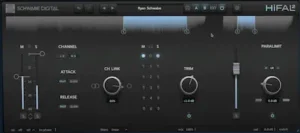 HiFAL 2 supports oversampling up to 32x, with separate settings for real-time processing and offline rendering. This allows engineers to balance processing quality against CPU load during playback and final export.
Oversampling raises the internal processing rate and can reduce aliasing generated by nonlinear operations. The benefit depends on the algorithm and signal conditions; it is not a universal improvement switch. Higher settings also increase computational demand and may affect real-time performance.
For mixing and mastering, use a setting that remains stable during playback, then compare higher oversampling levels during final evaluation. Check for audible differences in high-frequency texture, transient character, and distortion, while keeping output levels matched. If a higher setting produces no meaningful improvement, using the maximum multiplier offers little practical advantage.
HiFAL 2’s support for 32x oversampling provides additional processing options, but the maximum value alone does not establish superior sound quality. Quantifying the difference would require controlled listening tests and aliasing measurements across relevant settings and source material.
HiFAL 2 in Mixing and Mastering: Five Practical Use Cases
Controlling Harshness in a Bright Pop Mix
A pop mix can sound balanced at moderate levels but become fatiguing after bus compression or limiting increases its perceived density. Before choosing another processor, determine whether the problem is a persistent tonal imbalance or a small number of aggressive high-frequency transients. A broad high-shelf cut may remove too much air, while dynamic EQ can target a narrower problem range.
HiFAL 2 offers another option when the problem is concentrated in high-frequency transients rather than a persistent tonal imbalance. Its main processor can be compared with conventional dynamic processing, while PARALIMIT provides additional control over high-frequency density and stereo placement.
The objective is not to make the master brighter. It is to control harsh events without unnecessarily reducing the upper-frequency detail that supports clarity and presence.
Managing Vocal Presence and Sibilance
On vocals, HiFAL 2 is worth evaluating when sharp upper-frequency transients make a performance feel aggressive. Its behavior should be compared with a de-esser or dynamic EQ to determine which tool controls the problem with the fewest unwanted changes to the vocal’s tone.
If the issue is concentrated in sibilant consonants, a dedicated de-esser is usually the more direct starting point. Persistent harshness caused by resonances, distortion, or recording choices may require corrective EQ or source-level repair before additional dynamics processing. PARALIMIT can be explored when the goal also involves high-frequency density, but it is not a substitute for targeted sibilance control.
Controlling Cymbal and Percussion Transients
Cymbals and bright percussion combine sharp attacks with sustained high-frequency decay. A static EQ cut can soften the initial impact, but it may also reduce the shimmer and definition that help these elements sit in the mix.
HiFAL 2 is worth testing when the transient-to-sustain relationship is the main concern. Listen for changes in attack definition, decay, and perceived brightness rather than relying on the gain-reduction meter alone. Compare the processed and unprocessed signals at matched levels to avoid mistaking a loudness change for better transient control.
Balancing High-Frequency Energy in Dense Electronic Mixes
Layered synthesizers, bright percussion, and distorted textures can make the upper frequencies feel crowded in a dense electronic mix. With HiFAL 2, start by identifying the frequency range that needs control, then use the band-solo function to check what the processor is affecting. Evaluate the main processor for transient control and assess PARALIMIT separately if high-frequency density or stereo placement is also part of the problem.
However, processing the bus will not necessarily resolve spectral masking or arrangement conflicts. If several synth layers compete for the same frequency range, adjusting their levels, envelopes, or arrangement may produce a more reliable result than applying additional processing to the combined signal.
Shaping High-Frequency Stereo Width with PARALIMIT
PARALIMIT adds a way to explore high-frequency density and stereo placement through parallel processing, with Mid, Side, and Left/Right targeting. This provides more specific control than simply raising the level of the Side signal across the entire frequency spectrum.
Evaluate the result in stereo and mono, at different listening levels, and against a level-matched bypass signal. Excessive Side processing can make cymbals or reverberant detail disproportionately prominent, while changes to the center-to-side balance may affect how stable the mix feels. A wider image is useful only when it preserves the intended balance and translates across playback systems.
HiFAL 2 Limitations: What the Technology Does Not Guarantee
HiFAL 2 offers a specialized approach to high-frequency dynamics, but its features should be evaluated in the context of the problem being solved. No single processor is the best choice for every form of harshness, tonal imbalance, or transient control.
It does not replace conventional corrective tools. Dynamic EQ is often more suitable when a specific resonance needs frequency-selective control. A de-esser is the more direct starting point for vocal sibilance, while a multiband compressor offers familiar controls for managing dynamics across defined frequency bands. HiFAL 2 is worth comparing when high-frequency transient behavior is the primary concern.
Manufacturer claims are not independent verification. Schwabe Digital describes changes to the filter architecture intended to manage pre-ringing, along with oversampling up to 32x. These are relevant design features, but they do not establish the magnitude of any audible improvement. Independent measurements and controlled listening tests would be needed to assess the results across different settings and source material.
CPU performance depends on the session. Processing demand can vary with oversampling settings, filter modes, sample rate, buffer size, and the number of active instances. Without independently verified benchmarks across these conditions, performance should be assessed on the actual production system rather than inferred from the feature list.
It cannot fix problems outside its intended role. Excessive distortion, poor source balance, recording artifacts, and arrangement conflicts may require corrective work earlier in the signal chain. Applying high-frequency dynamics processing to a mix with fundamental tonal or arrangement problems can mask symptoms without resolving their cause.
For a broader diagnostic framework, this guide to common mastering problems covers why a finished track can sound worse after processing and why identifying the cause matters before choosing a fix.
The practical conclusion is straightforward: HiFAL 2 should be judged by whether it solves a specific high-frequency dynamics problem more effectively than the available alternatives. Its feature set creates options for evaluation, not a guarantee of better results.
HiFAL 2 vs. soothe2, Dynamic EQ, and De-Essers
The most useful comparison is based on the type of problem each processor is designed to address, not on a universal ranking. HiFAL 2 focuses on high-frequency acceleration limiting and parallel processing, while other tools offer more direct solutions for resonance control, equalization, sibilance, or band-specific dynamics.
| Processor | Primary strength | Best use case | Main limitation |
|---|---|---|---|
| Schwabe Digital HiFAL 2 | High-frequency acceleration limiting and parallel stereo processing | Managing aggressive high-frequency transients while exploring density and stereo placement | Specialized approach that requires comparison with established alternatives |
| oeksound soothe2 | Dynamic resonance suppression | Reducing multiple harsh or resonant areas across a configurable frequency range | Over-processing can reduce presence and detail |
| FabFilter Pro-Q 4 | Static and dynamic equalization | Correcting tonal imbalances and targeting specific frequencies | Requires deliberate band selection and parameter adjustment |
| FabFilter Pro-DS | Dedicated de-essing | Controlling vocal sibilance and similar high-frequency peaks | Not intended for general-purpose high-frequency dynamics control |
| Multiband compressor | Dynamics control across defined frequency bands | Managing broader changes in band-level energy with conventional compressor controls | Crossover behavior and attack and release settings can affect the result |
HiFAL 2 is most relevant when high-frequency transient control is the primary objective and PARALIMIT’s parallel processing or stereo options are useful to the task. soothe2 is a more direct choice for suppressing multiple resonances, Pro-Q 4 for precise tonal correction, and Pro-DS for vocal sibilance. A multiband compressor remains a practical option when the goal is to control the dynamics of a defined frequency band.
The deciding factor is workflow efficiency and the quality of the result. Compare HiFAL 2 with the tools already available in the session, using matched output levels and the same source material. If it solves the problem more cleanly or offers useful control that is difficult to achieve with the existing chain, it may justify its place in the workflow. If the current tools already deliver the required result, another processor may add complexity without a meaningful benefit.
HiFAL 2 Compatibility, CPU Usage, and Session Reliability
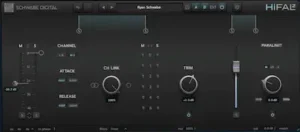 Schwabe Digital lists VST3, AU, and AAX support, along with native Apple Silicon compatibility. Its published system requirements include macOS 10.13 or later and Windows 10, with Windows 11 also supported. The published compatibility information lists sample rates of 44.1, 48, 88.2, and 96 kHz. Support for 192 kHz sessions is not confirmed in the available documentation, so studios working at that rate should verify compatibility with Schwabe Digital before purchase.
These limitations are relevant to mastering studios that work at higher sample rates or maintain older DAW systems. Meeting the minimum system requirements does not guarantee smooth performance with demanding oversampling settings, multiple plugin instances, or large sessions.
HiFAL 2 is available as a free update for existing HiFAL owners and uses the same iLok license, according to Schwabe Digital. The installer replaces the previous HiFAL assets, so the original and updated versions cannot be maintained as separate installations. Although the developer states that existing sessions should recall correctly, engineers working on active client projects should back up their sessions and save reference renders before updating.
CPU usage and session stability should be evaluated in the actual production environment. Test the intended DAW, sample rate, buffer size, filter mode, oversampling level, and number of active instances. HiFAL 2’s Live mode is intended for zero-latency operation, but that does not guarantee low CPU usage or eliminate performance issues in demanding sessions.
HiFAL 2 Pricing and Value: Is It Worth the Investment?
At the time of writing, Schwabe Digital lists HiFAL 2 at a promotional perpetual-license price of $139.30, alongside a rent-to-own option advertised at $13.93 per month for ten months. A 30-day trial is also available. These prices and terms may change, so verify the current offer before purchasing.
For existing HiFAL owners, the update is free and uses the existing iLok license, according to the developer. That makes the upgrade easier to justify, provided the new features fit the engineer’s workflow.
For new buyers, the value depends on how frequently high-frequency transient control presents a genuine problem. Mastering engineers working with bright, dense mixes may find a dedicated acceleration limiter useful across multiple projects. Mixing engineers dealing with aggressive vocals, cymbals, and bright instrument buses may also benefit from PARALIMIT’s parallel processing and stereo-targeting options.
The investment is harder to justify if harshness occurs only occasionally. Dynamic EQ, a dedicated de-esser, or an existing multiband compressor may already handle the relevant tasks without adding another specialized processor to the workflow.
The most reliable way to assess the purchase is to use the trial on challenging material from actual sessions. Compare HiFAL 2 with your existing processing chain at matched output levels, using the same source material and monitoring conditions. The key question is whether it delivers a repeatable, useful improvement—not simply a different tonal character or a result that initially sounds more impressive because of a level change.
Overall Rating
| Category | Rating |
|---|---|
| High-Frequency Transient Control | 8.5/10 |
| Filter Mode Flexibility | 8.2/10 |
| Parallel Processing & Stereo Targeting | 8.6/10 |
| Oversampling & Processing Options | 7.8/10 |
| Evaluation & Gain-Control Tools | 8.1/10 |
| Compatibility & Session Practicality | 7.2/10 |
| Overall | 8.1/10 |
HiFAL 2 earns 8.5/10 for high-frequency transient control because its acceleration-limiting approach addresses aggressive peaks without relying solely on broad treble reduction, although comparative measurements are not provided.
The three filter modes offer meaningful choices across phase behavior, transient handling, and latency, but their relative performance still needs to be judged against the source material and the demands of the session.
PARALIMIT scores 8.6/10 because its parallel path combines high-frequency density control with Mid, Side, and Left/Right targeting, giving engineers more focused stereo options than a global width adjustment.
The oversampling range up to 32x provides useful processing choices, but the page does not establish the audible advantage of the highest settings through independent aliasing measurements or controlled comparisons.
Match Volume and the updated gain-reduction metering support more reliable comparisons, helping engineers separate actual processing changes from differences in output level.
Practical workflow reliability scores lower because performance depends on session conditions, 192 kHz support is not listed, and the installer replaces the previous version rather than allowing separate installations; independent CPU benchmarks are also unavailable.
HiFAL 2 Review Verdict: Is It Worth Using for Mixing and Mastering?
Schwabe Digital HiFAL 2 is best considered when aggressive high-frequency transients remain a problem after basic tonal correction. Its acceleration-limiting approach and PARALIMIT section address a narrower task than general-purpose EQ or resonance suppression, with additional options for shaping high-frequency density and stereo placement.
The strongest reason to consider HiFAL 2 is a recurring need to manage bright vocals, cymbals, percussion, or dense electronic mixes without automatically reducing the entire upper-frequency range. The main compromise is that its specialized processing must be evaluated against simpler tools that may already solve the problem, and the available feature descriptions do not independently establish the magnitude of its sonic advantages.
For existing HiFAL owners, the free update makes the new processing and workflow options worth evaluating. For new buyers, the trial is the most sensible way to determine whether the plugin adds a useful capability to an existing chain.
Final verdict: HiFAL 2 is a focused option for engineers who regularly encounter aggressive high-frequency transients and need more than broad EQ correction. Its value depends on the result it delivers on the material being processed, not on the number of modes or the maximum oversampling setting.
Hear What Your Mix Reveals Beyond Plugin Processing
Controlling harsh transients is only one part of preparing a track for release. A mix can sound smoother after processing yet still need careful evaluation of tonal balance, transient impact, stereo stability, and how its details translate across playback systems. Adding another plugin will not necessarily resolve every issue, and mastering is not a substitute for correcting problems in the mix itself. Upload up to 40 seconds of your mix for a free mastering demo prepared by a real mastering engineer. Compare the original with the mastered excerpt to assess the changes in context and decide whether the approach serves your track.
HiFAL 2 FAQ: Compatibility, Oversampling, and Practical Use
Can HiFAL 2 replace a de-esser on vocals?
Not in every situation. HiFAL 2 targets high-frequency dynamics, while a dedicated de-esser is usually more direct when the problem is limited to vocal sibilance. Compare both processors at matched output levels to determine which controls the unwanted peaks with fewer changes to the vocal’s tone.
Does HiFAL 2 support 192 kHz sessions?
The available compatibility information lists 44.1, 48, 88.2, and 96 kHz sample rates, but does not confirm support for 192 kHz sessions. If your studio works at 192 kHz, verify compatibility with Schwabe Digital before purchasing.
Can HiFAL 2 be used on individual tracks as well as the master bus?
HiFAL 2 can be evaluated on individual sources, including vocals, cymbals, guitars, and synthesizers, when aggressive high-frequency transients are the main concern. Mix-bus use is another option, but the decision should depend on the material and the result rather than a fixed processing template.
Does 32x oversampling always sound better?
No. Oversampling can reduce aliasing in nonlinear processing, but the audible benefit depends on the algorithm and signal. Compare settings under controlled conditions and consider the additional CPU demand before choosing the highest multiplier.
Can PARALIMIT widen a mix without compromising mono compatibility?
Not automatically. PARALIMIT can be used to shape high-frequency stereo width, but the result depends on the settings and source material. Check the processed signal in mono and listen for changes in the center, cymbals, and reverberant detail before approving the processing.
How much CPU does HiFAL 2 use?
CPU consumption depends on the computer, DAW, sample rate, filter mode, oversampling setting, and number of active instances. Without benchmarks under defined conditions, a single figure would be misleading. Test the plugin in your intended session, including both real-time playback and offline rendering.

Yurii Ariefiev writes about audio processing from an engineering perspective, with particular attention to high-frequency transient control, filter behavior, and stereo imaging. When evaluating a specialized processor such as HiFAL 2, he considers how its approach differs from dynamic EQ and conventional limiting, and whether its effect can be assessed reliably through level-matched comparisons.
Enjoyed this review?
If you found it useful, you can support independent audio research with a coffee.
☕ Buy me a coffee