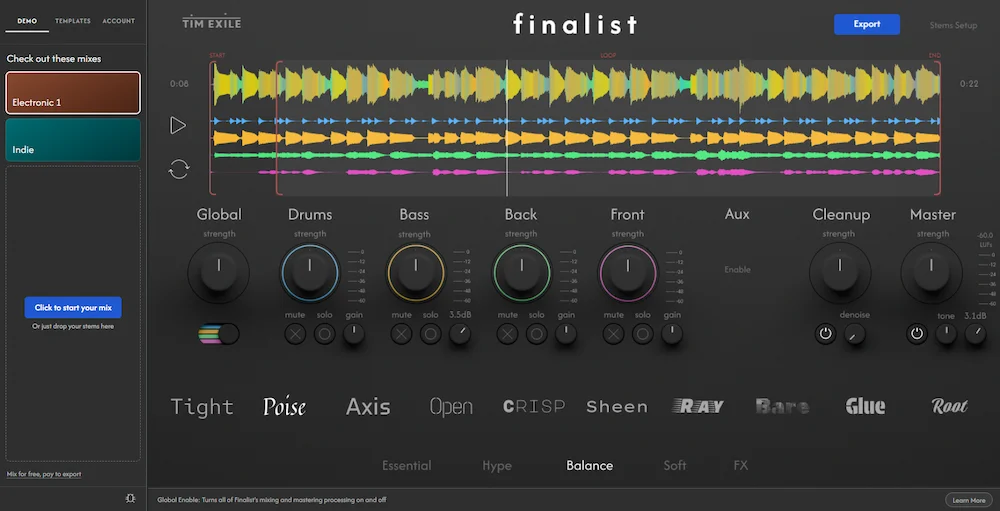
Finalist 2 takes a different approach to automated mixing: instead of trying to reconstruct a finished mix with AI, it works from the actual stems and builds a mix around them. Tim Exile’s system analyzes the incoming audio and applies a hand-designed DSP architecture that combines dynamics processing, transient shaping, Mid/Side processing, saturation, clipping, and limiting. Genre-based presets determine the overall direction, while the user controls how aggressively the system applies it.
That makes Finalist 2 less of a conventional plugin and more of a dedicated stem-mixing environment. Its strongest advantage is speed. A properly prepared stem set can be turned into a coherent mix without building the routing, processing chains, and initial balance manually in a DAW. The result is not a substitute for detailed human mixing, but it can eliminate a substantial amount of the repetitive work involved in getting a production from raw stems to a credible first mix.
Version 2 also addresses several practical limitations of the original Finalist. The Reaktor dependency is gone, the stem capacity has increased from 32 to 64, stems can be added or replaced inside an existing project, and mixes can be saved, versioned, templated, and exported directly. The browser version also processes audio locally rather than sending the source material to a remote mixing service. These changes matter more to day-to-day production than a cosmetic redesign: they make Finalist 2 a substantially more practical automated mixing environment for repeated work.
Finalist 1 vs. Finalist 2: What Actually Changed
Finalist 2 is more than a new interface for the original Finalist. Most of the important changes affect how the system fits into a production workflow: the Reaktor dependency has been removed, the stem limit has doubled, projects are editable after import, and export and version management are now built into the application.
| Feature | Finalist 1 | Finalist 2 |
|---|---|---|
| Runtime | Reaktor-based | Browser and standalone application |
| Stem capacity | Up to 32 stems | Up to 64 stems |
| Stem placement | More manual preparation | Automatic placement from filenames |
| Project editing | More limited workflow | Stems can be added, replaced, deleted, or updated |
| Versions & templates | More limited | Built-in Versions and Templates |
| Export | Reaktor-dependent workflow | One-click offline export |
| Grouped outputs | More limited | Drums, Bass, Back, and Front groups |
The practical difference is therefore less about adding another collection of processors and more about removing friction around the automated mixing process. Finalist 1 introduced the concept; Finalist 2 makes it easier to use, revise, organize, and export across a continuing production workflow.
What Finalist 2 Actually Does Inside a Mix
 Finalist 2 is not a stack of genre-specific EQ curves wrapped in an automatic interface. Its core is an analysis-driven mixing architecture: the incoming stems are measured, those measurements are interpreted by a set of hand-designed algorithms, and the resulting control data drives multiple processing stages across the mix.
The processing covers the areas that normally require a mix engineer to make dozens of interdependent decisions. Finalist 2 uses multiband dynamics, transient shaping, Mid/Side processing, analog-style coloration, clipper-limiters, and a limiter network. The engine also analyzes hundreds of data points from the incoming audio and maps those measurements to its hand-designed processing architecture through genre-based starting points. These stages are not presented as isolated effects for the user to configure individually; they form a larger system designed to alter level relationships, density, transients, spectral balance, and stereo behavior as the mix develops.
The developer also describes the Version 2 engine as recalibrated for greater dynamic range and transparency, with the Strength controls allowing a denser result when required. Those statements describe the design goals and development process rather than independently measured sonic performance, so they should not be treated as proof that Version 2 will produce a universally more transparent or musical result.
The system is deliberately algorithmic rather than machine-learning based. Finalist 2 does not use a trained model to generate its processing decisions. Analysis data determines how a predefined DSP architecture responds to the material. That distinction is useful, but it should not be confused with an audio-quality advantage. “No AI” describes how the system is built; it does not prove that its results are more accurate, more musical, or better than those produced by a different approach.
From an engineering perspective, the more relevant question is how much useful mix work the architecture can automate without losing control of the musical hierarchy. Finalist 2 is designed to establish those relationships automatically: controlling density, shaping transients, managing dynamics, and keeping the individual stems working as part of a single mix rather than as unrelated tracks.
That makes Finalist 2 closer to an automated mix architecture than an autonomous creative producer. It can make a large number of technical decisions quickly, but it does not remove the need to judge whether those decisions serve the arrangement, performance, and intent of the record.
The Finalist 2 Workflow: Where the Time Savings Actually Come From
Finalist 2’s main advantage is not the individual processors inside it. A modern DAW already gives an engineer access to EQ, dynamics, saturation, transient shaping, stereo processing, clipping, and limiting, including specialized tools for more specific tonal decisions. The difference is that Finalist coordinates multiple processing stages around the incoming stems as a single mixing system, removing much of the setup and initial decision-making normally required to build a mix from scratch.
The workflow starts with exported stems rather than an empty DAW session. Finalist 2 can identify and place stems from their filenames, which becomes increasingly useful as the number of sources grows. Once the material is loaded, the system analyzes the stems and establishes an initial mix according to the selected genre-oriented starting point. The engineer is then working from an existing balance instead of spending the opening stage of the session constructing one manually.
That distinction matters because the early stage of a mix is often dominated by low-level decisions: gain structure, routing, rough balances, drum-to-bass relationships, vocal placement, bus organization, and the first round of corrective processing. None of those tasks is technically difficult for an experienced engineer, but together they consume time before the more consequential creative decisions can begin. Finalist 2 compresses that setup and exploration phase into a single automated pass.
The result is most useful when the goal is to reach a credible mix direction quickly. A producer who has finished the arrangement can evaluate the production without turning mixing into another full production cycle. A composer can generate a working cue mix across a large session. A mix engineer can use the automated result as a reference point, then rebuild, refine, or selectively replace the processing where the material requires more deliberate control.
That is the real efficiency gain: Finalist 2 reduces decision time more than it reduces processing time. The computer is not doing something a modern DAW could not technically do. It is making a large number of interconnected starting decisions without requiring the engineer to construct the entire system manually.
Hear What Your Mix Reveals Beyond the Automated Balance
An automated mix can establish useful relationships between stems, but the final test is how the finished production translates in terms of clarity, depth, dynamics, stereo image, punch, and detail across different listening systems. A professional mastering pass provides an independent engineering perspective on those relationships without assuming that automation has already solved every mix decision. Upload up to 40 seconds for a free mastering demo →
Why Finalist 2’s 64-Stem Capacity Matters
Doubling the stem capacity from 32 to 64 looks like a specification change, but it has a direct effect on how much of a production can enter the automated mixing process intact. The original 32-stem ceiling forced larger sessions to be consolidated before they could be processed, adding another preparation stage between the DAW and the mixer.
That becomes a practical issue in arrangements built from separate pads, leads, backing parts, risers, effects, noise layers, percussion, and other supporting elements. Consolidating those sources into fewer stems may solve the technical limit, but it also removes independent control before Finalist begins making its mix decisions. The more material that has to be combined in advance, the less granular the input becomes.
At 64 stems, Finalist 2 can accommodate a substantially wider range of production exports without requiring that consolidation step. It still is not an unrestricted DAW session, and complex orchestral or heavily layered electronic projects can exceed the limit, but 64 stems is much closer to the structure of a typical modern production.
The important improvement is therefore not the number itself. It is the reduction in preparation required before automation starts. Keeping more elements separate gives Finalist 2 more useful source-level information to work with and preserves more of the original arrangement structure throughout the automated mixing process.
From One-Off Experiment to Repeatable Mixing Workflow
 The more significant difference between Finalist 1 and Finalist 2 is not another processing feature. It is the ability to treat an automated mix as an editable project rather than a one-off pass.
Finalist 2 allows stems to be added, replaced, deleted, or updated without rebuilding the entire project. Mixes can be kept in a project library, different versions can be saved and revisited, and templates can preserve a useful starting configuration for future sessions.
That matters once the system is used across multiple songs. An automated mixer becomes considerably more useful when the engineer can return to an earlier project, change individual source material, compare versions, and maintain a consistent starting point without recreating the session from scratch.
An EP is a straightforward example. A producer may want the six tracks to share a broadly compatible tonal and dynamic direction while still allowing each arrangement to retain its own balance. A reusable Finalist 2 template can provide that common starting framework without forcing every song through an identical processing chain.
It still does not create consistency automatically. Different arrangements, performances, stem balances, and production densities will produce different results. The value is that Finalist 2 makes repeatable starting conditions practical, while leaving room for each track to be evaluated on its own terms.
Finalist 2 and the Limits of Automated Gain Structure
This is where the quality of the source material becomes more important than the processing architecture.
Finalist 2 has to infer the relative importance of its inputs from the audio it receives. That works well when the stems arrive with sensible gain relationships and clear production intent. It becomes less predictable when a supporting element is unusually loud, a source has already been heavily processed, or the musical hierarchy depends on context that is not obvious from the audio alone.
A human mix engineer can make those distinctions deliberately. A synth may be intentionally pushed forward for one section and pulled back for another. A room microphone may sit low for most of a track but become an important part of the final chorus. A background vocal can be technically prominent while remaining perceptually secondary. Those decisions depend on arrangement, performance, section changes, and the role of the sound within the record, not simply on its measured level or spectral content.
That is why Finalist 2 is better treated as a mixing system operating on prepared material than as a repair tool for an unfinished production. It can establish relationships between the available sources, but it cannot reliably correct problems that originate before the mix stage.
It is not a substitute for fixing:
- poor recordings or unusable source material;
- incorrect edits and timing problems;
- arrangement decisions that do not work musically;
- phase relationships between microphones or layered sources;
- unwanted bleed and excessive source noise;
- sounds that are fundamentally wrong for the arrangement;
- large and unintended level inconsistencies between stems.
The distinction is important: automation can optimize a set of sources, but it cannot determine that the sources themselves are wrong for the record. If the production enters the system with a flawed musical or technical hierarchy, a more polished balance does not necessarily make the underlying decision correct.
Where Finalist 2 Stops Short of Human Mix Judgment
A professional mix is not simply an optimization problem. The technically balanced solution is not always the musically correct one.
A mix engineer can decide that a vocal should move forward for a single phrase and sit deeper in the arrangement immediately afterward. A guitar may need a different tonal and dynamic treatment when the second chorus introduces additional layers.
Those decisions depend on context. They are tied to lyrics, performance, arrangement changes, section transitions, genre conventions, and the intended emotional hierarchy of the record. The same measured level or spectral profile can therefore require completely different treatment depending on where the sound appears in the song.
Finalist 2 can establish useful relationships between sources, but it does not eliminate the need for human judgment when those relationships are intentionally unconventional. This is also where the distinction between automated mixing and mix engineering becomes clearest: automation can solve many technical relationships quickly, while an engineer decides which relationships should exist in the first place.
That makes rapid mix development a more realistic professional use case than treating Finalist 2 as a one-click replacement for an experienced mixer. Generate a coherent starting point, listen critically, identify what translates and what does not, then decide whether the automated result is worth refining or whether the session should return to the DAW for a more deliberate mix.
The value is not that the system removes the engineer from the process. It is that it can move the production past the initial balancing stage quickly enough for the engineer to spend more time on the decisions that actually require context and taste.
Finalist 2 for Mixing vs. Mastering
Finalist 2 is fundamentally a mixing system, even though parts of its processing architecture overlap with techniques commonly found in mastering.
Clipping, limiting, dynamics control, saturation, and a final output stage can make the signal path look similar to a mastering chain at first glance. The critical difference is where the processing operates and what problem it is solving. Finalist 2 receives separated stems and makes decisions about their relationships before they are combined into a finished mix. Mixing and mastering solve different problems: mastering starts with the completed mix and works on the stereo or multichannel presentation as a whole.
That difference changes the available options. During mixing, a vocal can be moved relative to the guitars, the kick can be balanced against the bass, or a supporting layer can be reduced without affecting unrelated elements. Once those sources have been summed into a stereo mix, that degree of separation is largely gone. Mastering can reshape the overall presentation, but it is not a substitute for correcting every source-level balance decision made upstream.
For a mastering engineer, Finalist 2 is therefore more interesting as a pre-mastering reference than as a mastering replacement. Running the stems through an automated mix system can provide another reference for how the production behaves when its internal relationships are reorganized. That can help expose problems in vocal balance, low-mid density, transient control, or overall dynamic behavior before the material reaches the final mastering stage. Once the mix is ready to leave the DAW, proper mix preparation for mastering becomes the next practical step.
It does not, however, turn mastering into mixing. If the underlying production contains a source-level balance problem, the most appropriate solution is usually to address that problem at the mix stage rather than expecting the mastering chain to reconstruct decisions that were made before the mix was finalized.
Where Finalist 2 Makes the Most Sense in Real Production
Finalist 2 is most useful when the production has a clear stem structure, a reasonably defined musical hierarchy, and a need to reach a workable mix quickly. The less a project depends on highly contextual automation and unconventional source relationships, the more useful an automated starting point becomes.
Electronic and dance music are natural applications. These productions often have clearly separated drums, bass, synths, vocals, effects, and supporting layers, while kick-to-bass balance and overall density play a major role in the finished sound. Finalist 2 can establish that foundation quickly, leaving the producer to refine drops, transitions, automation moves, and other arrangement-specific moments manually.
Hip-hop and pop can also benefit from the initial balancing stage. Getting drums, bass, samples, instruments, and vocals into a coherent relationship is a useful first pass, particularly in dense productions. The limitations appear later, where detailed vocal rides, effect throws, ad-libs, sectional changes, and highly deliberate low-end decisions become part of the record’s identity.
Rock is more dependent on source preparation and arrangement complexity. Multiple guitar layers, room microphones, bleed, cymbal energy, and different drum perspectives can create relationships that are difficult to judge from level and spectral information alone. Finalist 2 can still provide a useful starting balance, but the amount of manual correction is likely to increase as the production becomes more dependent on microphone interaction and performance dynamics.
Film and game scoring presents a different opportunity. Here the advantage is less about replacing detailed mix engineering and more about producing credible cue mixes quickly and maintaining a repeatable baseline across a large number of sessions. For deadline-driven work, that reduction in setup and balancing time can be more valuable than absolute automation depth.
Dialogue-first work such as podcasts and broadcast production is a less natural fit. Finalist 2 is built around musical stem relationships, whereas dialogue workflows often prioritize speech intelligibility, loudness specifications, noise control, editorial cleanup, and delivery standards. Those requirements call for a different processing strategy.
The common thread is therefore not genre. It is workflow structure. Finalist 2 has the most to offer when there are many separated sources, a repeatable production format, and a need for a competent starting mix without spending the opening stage of every session building one manually.
Finalist 2 vs. Manual Mixing, AI Mixing, and Conventional Plugin Workflows
| Approach | How It Works | Primary Trade-Off | Typical Role |
|---|---|---|---|
| Finalist 2 | Analyzes separated stems and applies a coordinated automated mix architecture | Fast setup with less source-level and contextual control than manual mixing | Rapid mix development, references, and repeatable starting points |
| Manual DAW mixing | Engineer designs routing, processing, automation, and balances directly | Maximum control requires more time and more individual decisions | Detailed production mixing and final mix decisions |
| AI mixing services | Machine-learning systems analyze supplied material and generate automated processing decisions | Workflow, processing logic, and user control vary considerably between platforms | Fast automated results with minimal manual setup |
| Conventional plugin workflow | Engineer assembles and controls individual processors and signal paths | Fine control comes with greater routing and decision overhead | Specialized processing, detailed correction, and precision work |
The useful comparison is not whether Finalist 2 has a better EQ, compressor, or limiter than the processors already available in a professional DAW. Those individual tools are not its differentiator. Its value comes from coordinating multiple mix decisions around a set of separated stems without requiring the engineer to design the entire routing and processing structure manually.
That puts Finalist 2 in a different position from a conventional plugin chain. A plugin gives the engineer a processing tool; Finalist attempts to provide a complete set of initial mix decisions. Compared with manual mixing, the trade-off is equally clear: less setup and decision overhead in exchange for less direct control over the individual decisions being made.
For that reason, Finalist 2 makes more sense as part of a broader production workflow than as a replacement for the DAW. It can provide a fast automated reference, a starting balance, or a repeatable mix direction, while the DAW remains the environment for detailed editing, automation, source-level correction, and final mix decisions.
Audio Translation, Loudness, and Delivery Checks
A convincing automated mix is not automatically a finished release master. Finalist 2 can establish the internal balance of a production, but the resulting mix still has to be evaluated independently for translation, dynamics, stereo behavior, and delivery.
Translation remains a separate engineering task. A balance that works on the main monitoring system can expose excessive sub-bass, aggressive upper-mid energy, weak center information, or unstable stereo content on headphones, nearfields, consumer speakers, or mono playback. Those problems are properties of the finished mix and its interaction with the monitoring chain; automation does not remove the need to check them.
The same applies to dynamics. Finalist 2 includes clipping and limiting stages that can increase density and control peaks, but the presence of a limiter does not determine the appropriate final dynamic range. The engineer still has to decide whether the resulting density serves the arrangement or has started to flatten transients and reduce musical contrast.
Lossy encoding adds another useful verification stage. Clipped transients, dense high-frequency material, and complex stereo content can produce artifacts or increased harshness after codec processing. Checking the encoded result is therefore part of delivery quality control rather than something that can be assumed from the automated mix itself.
For a mastering engineer, this reinforces the correct position of Finalist 2 in the signal chain: it can be a useful mix-stage system and reference, but translation, loudness decisions, codec checks, and final delivery remain separate engineering tasks. When the production still benefits from source-level control after mixing, stem mastering can provide more flexibility than working from a finished stereo file alone.
Finalist 2 Browser vs. Standalone: Access, Privacy, and Workflow
 Finalist 2 can run directly in Chrome or Microsoft Edge on desktop systems, or as a standalone application for macOS and Windows. The browser version removes the need to install a conventional plugin or host environment, while the standalone build is better suited to a dedicated desktop production setup.
The browser workflow is also different from a conventional cloud-based AI mixing service. The current Finalist 2 information states that audio is processed locally on the user’s machine rather than being uploaded to a remote server. That makes the browser version primarily an access and deployment change, not a change to the underlying mixing architecture.
The removal of the Reaktor dependency is the more important production change compared with Finalist 1. Users no longer need a separate Reaktor environment simply to run the automated mixer, which makes Finalist 2 easier to introduce into a normal production workflow.
There is currently not enough independent benchmarking to claim that the browser and standalone versions differ materially in CPU usage, memory consumption, processing speed, stability, or sound quality. Without controlled testing on the same material and hardware, those differences should not be inferred from the runtime alone.
For practical purposes, the distinction is therefore about access, deployment, and workflow, rather than a documented sonic advantage between the two versions.
Finalist 2 Pricing: Credits, Subscription, and Perpetual License
Finalist 2 uses a hybrid pricing model that separates the mixing environment from final export. Mixing, analysis, presets, Versions, and Templates are available without paying for each individual mix; exporting the finished result requires either a credit, a subscription, or the perpetual desktop license.
| Option | Price | Best fit |
|---|---|---|
| Credits | From £2.50 per export | Occasional projects |
| Subscription | From £8/month | Regular export and repeated use |
| Perpetual desktop license | £149 | Frequent long-term use |
| Finalist 1 upgrade | £25 launch price | Existing Finalist 1 owners |
The perpetual license is currently listed at £149, with a launch price of £99 through October 9, 2026. Finalist 1 owners can upgrade for £25 during the same launch period, compared with the standard £49 upgrade price. Prices include VAT.
The relevant ROI question is therefore not whether Finalist 2 is cheaper than another mixing plugin. Its value depends on how often the system produces a useful starting mix quickly enough to replace repetitive setup and balancing work. Occasional users may have little reason to buy a perpetual license, while producers or studios using it repeatedly have a clearer opportunity to amortize the cost across multiple projects.
Pricing checked September 26, 2026. Launch pricing is time-sensitive and may change after October 9, 2026.
Who Should Actually Use Finalist 2?
Finalist 2 makes the most sense for producers and engineers whose bottleneck is the initial mix rather than detailed final-stage decision-making. The common factor is not experience level or genre. It is the need to turn a structured set of stems into a workable mix quickly and repeatably.
Producers and bedroom producers can use it to get past the technical setup that often separates a finished arrangement from a usable mix. Instead of building routing and processing from an empty session, they can start from an automated balance and decide what still needs attention.
Electronic producers are a natural fit when projects contain clearly separated drums, bass, synths, vocals, and effects and need to be auditioned quickly. The system is particularly relevant when speed of iteration matters more than preserving complete manual control over every processing decision.
Composers and scoring workflows present another practical case. When many cues need a consistent baseline mix under deadline pressure, reducing repetitive balancing work can be more valuable than having another collection of individual processors.
Mix engineers can treat Finalist 2 as an additional mix engine, reference, or prototyping stage. Its value is highest when the automated result provides a useful alternative perspective on the balance; if the engineer has to rebuild every major decision afterward, the time advantage becomes much smaller.
Mastering engineers have a narrower use case. Finalist 2 can be useful for evaluating whether a problem originates in the mix and for generating an alternative pre-mastering reference, but the mastering stage remains a separate process.
High-volume studios may also find the workflow relevant for demos, pre-production, internal references, and projects where turnaround time matters. The key question is operational rather than theoretical: how often does the system produce a starting point that is useful enough to retain?
For engineers with highly developed manual workflows, that question becomes especially important. If templates, routing, automation, and decision-making are already optimized, Finalist 2 needs to remove a meaningful amount of repetitive work to justify another stage in the production chain.
How This Finalist 2 Review Was Assessed
This review focuses on Finalist 2’s documented architecture, workflow changes from Finalist 1, stem handling, project management, export system, production use cases, and stated processing design. Claims about dynamic range, transparency, and sonic behavior are identified as developer-reported characteristics where independent measurements or direct hands-on testing are not available.
Editorial Assessment
| Area | Assessment |
|---|---|
| Automated Mix Development | Strong — fast creation of a workable starting mix from organized stems. |
| Stem Handling | Strong — 64-stem capacity and filename-based placement reduce preparation work. |
| Processing Architecture | Strong on paper — broad coordinated DSP architecture, but independent sonic benchmarking is not available. |
| Project Workflow | Strong — editable projects, Versions, Templates, and individual stem updates make repeated work more practical. |
| Contextual Control | Limited — source relationships can be automated, but arrangement-specific and creative decisions remain outside the system. |
| Export & Integration | Strong — offline WAV, AIFF, and FLAC export plus grouped production stems. |
Its strongest practical advantage is the ability to turn a structured set of stems into a coherent starting mix while reducing the manual setup and balancing decisions normally required at the beginning of a session.
The increase to 64 stems, automatic filename-based placement, and support for separate production elements make the system suitable for substantially more complex sessions than the original 32-stem workflow could accommodate.
The hand-designed DSP architecture covers dynamics, transient shaping, Mid/Side processing, saturation, clipping, and limiting as a coordinated system, giving the automated process meaningful depth without relying on machine-learning decisions.
Editable projects, saved versions, templates, and the ability to update individual stems make Finalist 2 considerably more practical for repeated work across multiple songs rather than isolated automated passes.
The main limitation is dependence on well-prepared source material and relationships that can be inferred from the stems; arrangement-specific decisions, deliberate exceptions, performance context, and unconventional creative choices still require human intervention.
Offline export to WAV, AIFF, and FLAC, together with master and grouped Drums, Bass, Back, and Front outputs, gives the system a useful position inside a larger production chain rather than making it a closed one-click destination.
Finalist 2 is particularly well suited to producers, composers, and mix engineers who need a fast and repeatable starting point from organized stems. Its value decreases when the mix depends heavily on detailed automation, unusual source relationships, corrective editing, or highly contextual creative decisions that cannot be reduced to consistent technical relationships.
Finalist 2 Review Verdict: A Practical Automated Mixing System with Clear Limits
Finalist 2 is most convincing when the problem is getting from a well-prepared set of stems to a workable mix quickly. Its second-generation workflow removes much of the friction associated with the original version, while 64-stem support, editable projects, Versions, Templates, and direct export make the system substantially easier to use across repeated production work.
The important limitation has not disappeared: Finalist 2 can automate relationships between sources, but it cannot reliably interpret every arrangement, performance, or creative decision behind those relationships. For producers and engineers, its strongest role is therefore as a rapid starting point, reference, or prototyping system rather than a universal replacement for manual mixing.
Find Out What Your Mix Still Needs After Automated Mixing
Finalist 2 can establish a fast, coherent starting balance from organized stems, but the review also shows where automated decisions stop: arrangement-specific balance, transient control, dynamics, stereo behavior, and translation still need to be judged as a finished production. Instead of adding another processing stage without knowing what the mix actually needs, compare your current mix with a real mastering treatment and hear the difference for yourself. Upload up to 40 seconds of your mix and receive a free mastering demo prepared by a real mastering engineer. Upload your mix and get your free mastering demo →
Finalist 2 FAQ
How much does Finalist 2 cost?
Finalist 2 is free to use for mixing, analysis, presets, Versions, and Templates, while exports are paid through credits or a subscription. The perpetual desktop license is listed at £149, with a £99 launch price through October 9, 2026. Finalist 1 owners can upgrade for £25 during the launch period.
Is Finalist 2 an AI mixing tool?
No. Finalist 2 uses hand-designed audio analysis and DSP rather than a machine-learning mixing model. Its architecture analyzes the incoming stems and uses that information to control predefined processing stages including dynamics, transient shaping, Mid/Side processing, saturation, clipping, and limiting.
Can Finalist 2 replace a professional mixing engineer?
Not when a project requires detailed automation, corrective editing, arrangement-specific decisions or creative production work. Finalist 2 is better suited to rapid mix development: it can establish a workable starting balance, while the engineer remains responsible for decisions that depend on musical context and intent.
Does Finalist 2 work without a DAW?
Yes. Finalist 2 is available as a standalone application for macOS and Windows and can also run in supported desktop browsers. The workflow is based on imported stems rather than inserting the system as a conventional DAW plugin.
How many stems can Finalist 2 handle?
Finalist 2 supports up to 64 stems, compared with 32 in the original version. Automatic placement based on filenames also reduces manual setup when importing larger stem sets.
Can Finalist 2 export stems?
Yes. Finalist 2 can export the main mix along with Drums, Bass, Back and Front group stems. These groups are designed to sum to the master, making them usable as downstream production stems rather than relying on reconstructed source separation.
Is Finalist 2 faster than manual mixing?
For establishing an initial balance across a structured stem set, Finalist 2 can reduce setup and decision time. Manual mixing remains necessary when the work depends on detailed automation, arrangement context, performance changes or creative intent. The two workflows can therefore serve different stages of the same production.
Is Finalist 2 useful for an album or EP?
Yes. Saved projects, templates and version management make it easier to develop repeatable starting points across multiple tracks. A consistent album sound still requires track-by-track decisions because different arrangements and performances rarely respond identically to the same mix approach.
Is Finalist 2 worth upgrading to if I already own Finalist 1?
The upgrade is most relevant if the original workflow was limited by Reaktor, the 32-stem ceiling, project-management constraints or the earlier export process. Finalist 2 addresses those workflow limitations with a standalone environment, higher stem capacity, editable projects, version management and more practical export options.

Yurii Ariefiev approaches automated mixing from an engineering perspective, focusing on how algorithmic processing handles real source relationships rather than treating automation as a substitute for musical judgment. For systems such as Finalist 2, the important variables are stem integrity, gain structure, spectral balance, transient behavior, and how reliably the resulting balance holds together as a complete production.
Enjoyed this review? If you found it useful, you can support independent audio research with a coffee.
☕ Buy me a coffee