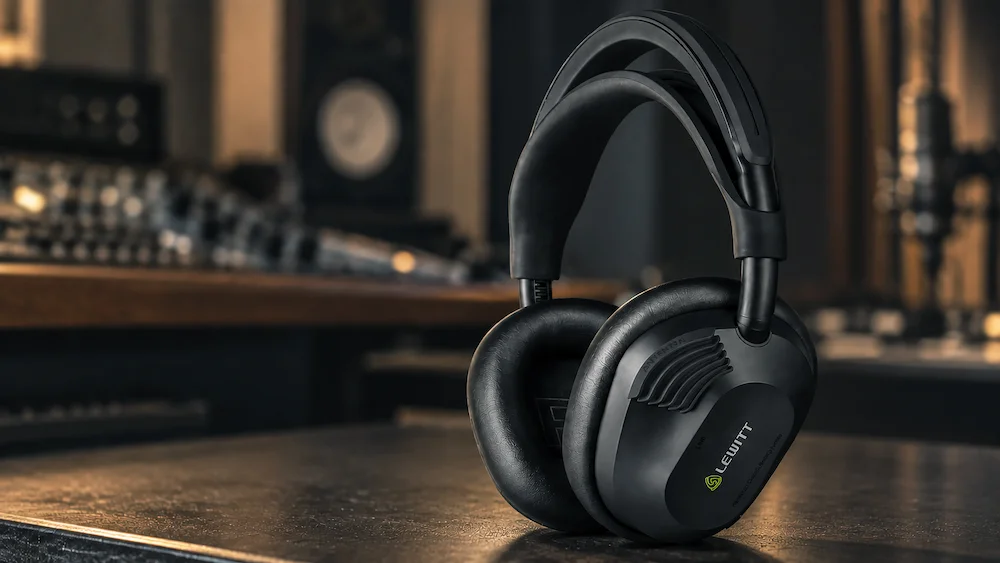
Wireless headphones have traditionally asked studio engineers to accept compromises in exchange for freedom from the cable: added latency, lossy transmission, or less predictable monitoring. The LEWITT LW6 Wireless Studio Headphones take a more serious approach, using LEWITT’s RealSound UWB system for a claimed 5.8 ms wireless latency and uncompressed audio transmission. The headphones also carry their own DSP, including a five-band parametric EQ and monitoring functions that can be stored directly on the unit.
That makes the LW6 more than a Bluetooth headphone aimed at producers. The real question is whether its wireless architecture, acoustic tuning, and monitoring tools hold up in mixing, mastering, recording, and professional audio production — and whether those advantages justify the $699 price. Early independent reviews now provide useful evidence on sound, latency, recording, and day-to-day usability; the remaining question is how consistently those results hold up under broader standardized measurement and long-term use.
Why Wireless Studio Monitoring Is Becoming a Serious Production Option
 Wireless monitoring has traditionally been a poor fit for critical production. Bluetooth can introduce too much latency for tracking, while earlier dedicated wireless systems often forced a choice between responsiveness and transmission quality. That equation has started to change. In its review of the AIAIAI TMA-2 Studio Wireless, Sound On Sound measured approximately 9.5 ms latency from the W+ Link system and found the setup particularly useful for tracking, hardware-based production, and listening away from the main workstation.
AIAIAI has since expanded the concept with the TMA-2 Studio Wireless+, which uses an uncompressed W+ Link connection with latency specified below 16 ms. The less expensive TMA-2 Studio Wireless remains a compressed 320 kbps implementation with latency below 10 ms. The distinction is important: low latency alone does not make a wireless monitoring system equivalent to a direct digital or analog connection.
The LEWITT LW6 takes a more aggressive approach. Its RealSound system uses a dedicated UWB connection with a claimed 5.8 ms latency and uncompressed PCM transmission. The included transmitter accepts digital audio over USB-C or an analog feed from a headphone output, while the headphones can also operate through Bluetooth or a conventional wired connection.
That changes the role wireless can play in a studio. The useful question is no longer whether headphones can be made wireless, but whether a dedicated wireless link can become a reliable part of the monitoring chain without introducing compromises that matter during recording, mixing, or critical listening.
LEWITT LW6 Wireless Architecture: What Actually Matters for Studio Monitoring
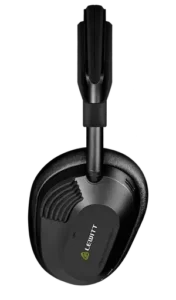
The LW6 combines a closed-back design with 40 mm bio-cellulose drivers and a dedicated wireless transmitter. LEWITT specifies a 20 Hz–20 kHz frequency range, 32-ohm impedance, maximum output of 121 dB SPL, up to 21 hours of battery life, and a weight of approximately 358 g. Those figures establish the basic hardware, but they do not tell us much about how the headphones perform as a reference.
The more consequential part of the design is the wireless link.
LEWITT’s RealSound system uses Ultra-Wideband (UWB) rather than Bluetooth for its dedicated studio connection. The transmitter handles the professional monitoring feed separately from the headphones’ Bluetooth connection, allowing LEWITT to optimize the RealSound link around latency and uncompressed transmission rather than the broader compatibility requirements of Bluetooth.
LEWITT specifies 5.8 ms latency for RealSound. That is a meaningful figure for tracking and is lower than the approximately 9.5 ms latency Sound On Sound measured with AIAIAI’s W+ Link system. But the comparison needs context: the figure represents the wireless transmission path, not the complete round-trip latency of a recording system.
For a vocalist or instrumentalist, the actual monitoring delay is the sum of several stages: interface conversion, DAW buffering, plugin processing, output conversion, and the wireless link. A low-latency headphone system cannot compensate for a large buffer or a plugin chain that already adds significant delay.
Independent testing adds useful context to LEWITT’s specification. In one published measurement, delamar compared the same interface output through a direct cable and through RealSound and found an additional wireless delay of approximately 2.2 ms in its test setup, including measurements repeated at distances up to about five metres. That is not a standardized measurement of the headphone’s total latency, but it is useful evidence that the wireless stage itself can remain a relatively small part of the complete monitoring path.
That makes the 5.8 ms specification more meaningful in practice: the important engineering advantage is not that the entire recording chain becomes 5.8 ms, but that the dedicated wireless stage does not appear to add a large additional delay under the tested conditions.
Hear How Your Mix Holds Up Under Critical Mastering
Wireless monitoring can change how you work, but the final test is still how reliably your mix translates across different listening environments. A mastering pass examines the balance, dynamics, stereo image, low-end control, and overall detail of the finished mix as a complete signal path. AREFYEV STUDIO offers a free mastering demo so you can hear how your own production responds to professional mastering decisions. Upload up to 40 seconds of your mix for a focused evaluation. Upload Your Mix for a Free Mastering Demo →
Why Uncompressed Wireless Audio Matters for Critical Monitoring
Latency gets most of the attention when wireless headphones are discussed in a studio context, but transmission quality matters too. A low-latency connection that relies on lossy compression still introduces another variable into a monitoring chain used to make detailed production decisions.
AIAIAI’s TMA-2 Studio Wireless provides a useful comparison. Its W+ Link connection is specified below 10 ms, but the Studio Wireless transmits at 320 kbps. AIAIAI’s higher-end Studio Wireless+ uses uncompressed transmission, with latency specified below 16 ms. The two models illustrate the tradeoff that has shaped professional wireless monitoring: lower latency, uncompressed audio, and price have not always appeared together.
The LW6 is designed to combine the first two. LEWITT specifies 5.8 ms latency and uncompressed PCM transmission over its dedicated RealSound connection. That removes a lossy codec stage from the professional wireless path, which is a sensible design choice when the headphones are being used for critical monitoring rather than casual playback.
But an uncompressed transmission path does not make the headphones inherently more accurate. It only means the wireless link is not intentionally reducing the source signal through lossy encoding. The final monitoring result still depends on the transducers, acoustic tuning, enclosure behavior, channel matching, distortion, and any DSP applied inside the headphones.
That distinction is important at the LW6’s price. Uncompressed wireless transmission is a meaningful technical advantage, but it is not evidence of reference-grade sound by itself. The value of the architecture has to be judged together with the acoustic performance of the headphone.
LEWITT LW6 Sound Quality: Tuning, Balance and Spatial Presentation
Early independent listening reports converge on a controlled, relatively balanced presentation rather than a strongly colored studio sound. The low end is described as defined rather than oversized, the midrange remains prominent enough for vocal and instrument balance decisions, and the treble avoids the deliberately bright presentation found on some monitoring headphones. The more useful question is therefore not whether the LW6 sounds impressive, but whether its tonal balance stays predictable enough to make repeated production decisions.
The closed-back design also shapes the presentation. The LW6 aims for a more open and spacious character than is typical of sealed studio headphones, but it does not completely remove the acoustic limitations of a closed enclosure. Independent listening reports describe good instrument separation and usable spatial information, while also noting that a conventional open-back reference can still provide a more naturally open presentation for critical evaluation of depth and width.
LEWITT’s tuning methodology is also more relevant than the nominal 20 Hz–20 kHz specification. The company says the LW6 was developed around the Harman target and then refined using MIRE measurements taken from real listeners, followed by expert listening evaluation. That is specifically aimed at the problem of closed-back headphones: the seal, ear geometry and cup acoustics can produce larger differences between a standardized measurement and what a listener actually hears. The methodology gives the acoustic design a defensible rationale, but it remains manufacturer-derived evidence rather than a substitute for independent standardized measurements.
That does not make the LW6 automatically neutral for every listener. Headphone seal, ear shape and individual perception still affect the result, which is one reason the onboard parametric EQ is more significant than a conventional consumer tuning control. The useful conclusion at this stage is that the LW6 has credible evidence behind its acoustic concept, while standardized independent measurements and longer-term comparative testing are still valuable for establishing how consistently that tuning translates across users and reference systems.
LW6 DSP: Built-In Monitoring Correction and Reference Tools
The LW6’s more unusual studio feature is not the wireless link itself, but the amount of monitoring control that can remain inside the headphones.
LEWITT provides a five-band parametric EQ, user sound profiles, virtual room processing, mono monitoring, side-stereo, side-mono, and left/right channel swapping. These functions can be configured in LEWITT’s software and stored on the headphones, so the selected processing remains available without keeping the companion application open.
That changes the workflow in a meaningful way. A conventional headphone-correction setup usually depends on a DAW plugin or system-level software running somewhere in the signal path. With the LW6, the monitoring configuration can travel with the headphones and remain available when they are connected to another computer or playback system.
For engineers working between multiple rooms, workstations, or mobile rigs, that portability can be useful. It also makes the LW6 a more self-contained monitoring platform than a conventional passive headphone. The tradeoff is that the usefulness of the DSP depends on the quality of the correction and virtual-room implementation. Without independent measurements, it is difficult to treat those functions as a substitute for a properly calibrated reference environment.
For an engineer already working inside a single DAW with an established headphone-correction workflow, the advantage is smaller. The LW6’s DSP is therefore best understood as a workflow and monitoring-management feature, not automatically as evidence of greater acoustic accuracy.
Mono, Side Monitoring and L/R Swap: Practical Mix-Checking Tools
 The LW6’s monitoring utilities are more useful than several items in a conventional feature list because they address specific mix decisions rather than adding another layer of sound processing.
Mono monitoring provides a quick check of center balance, vocal position, kick and bass relationships, and phase-dependent elements. Side-only monitoring isolates the information outside the phantom center, making excessive stereo width, wide reverbs, modulation, and peripheral synth layers easier to identify. L/R swapping offers a simple way to change the spatial perspective and can expose channel-dependent balance decisions that become less obvious through repeated listening from the same orientation.
None of these functions is technically novel. They are established monitoring techniques used in mixing and mastering.
The practical advantage is their implementation. Because these tools are available within the LW6’s onboard DSP, an engineer can perform the checks without opening a DAW session, inserting monitoring plugins, or changing the underlying mix signal path.
That reduces workflow friction, particularly when the headphones are being used as a portable monitoring system. It does not make the mix better by itself; it simply makes several established diagnostic checks faster to access. These checks are also useful as part of a broader mastering checklist before a final master is approved.
Can You Mix With the LEWITT LW6?
Yes. The more important question is whether it should be treated as a primary mix reference or as a secondary monitoring system.
The LW6 uses a closed-back design, which gives it a practical advantage for recording: better isolation and less headphone bleed into microphones. Open-back headphones remain common in critical mixing and mastering because their acoustic presentation can provide a more natural sense of space. That does not make a closed-back headphone unsuitable for mixing, but it changes the conditions under which it is most useful.
LEWITT’s acoustic tuning and DSP are intended to make the LW6’s presentation more suitable for production work, but neither changes the basic acoustic behavior of a closed enclosure. The relevant test is therefore not whether the headphone can produce a convincing stereo image, but whether its tonal balance, transient response and spatial presentation remain predictable enough to support repeated mix decisions.
The onboard DSP makes this question more interesting. A properly configured correction profile or virtual monitoring environment could make the LW6 more consistent across different playback situations. But that depends on the accuracy of the underlying implementation.
Early hands-on reviews now provide useful evidence that the LW6 can support real recording and mixing sessions rather than functioning only as a technically impressive wireless headphone. Reviewers have reported usable latency during instrument recording, low headphone spill in acoustic-guitar tracking, and a balanced presentation that remains practical for mix decisions. These are listening and production tests rather than standardized laboratory measurements, so they should be treated as evidence of usability rather than proof of universal reference accuracy.
The distinction is therefore more precise: the LW6 has now demonstrated credible real-world production use, while its status as a fully established reference still depends on broader independent acoustic measurements, comparative testing and longer-term use.
Where the LW6 Fits Best in a Real Production Workflow
The strongest case for the LW6 is not sitting at a desk for hours of critical spectral analysis. It is removing the cable when the production workflow requires the engineer or performer to move.
Consider vocal tracking. With conventional headphones, the monitoring cable runs from the interface or headphone amplifier to the performer and becomes part of the physical workspace. The LW6’s dedicated transmitter removes that cable from the performer’s immediate area while using a purpose-built low-latency wireless connection.
The wireless freedom does have a defined boundary. LEWITT specifies a RealSound range of approximately 5 metres, which is enough for most nearfield recording setups but should not be interpreted as unrestricted movement through a large studio. Early real-world testing supports that limitation: operation remained stable within a roughly five-metre room, while moving into an adjacent room through a wall produced dropouts. Transmitter placement therefore matters when the monitoring position extends beyond the immediate recording area.
The wireless advantage has to be weighed against the physical design. At roughly 358 g, with a closed-back enclosure and memory-foam pads, the LW6 is not a lightweight headphone. Independent testing has found the fit generally comfortable but also noted heat buildup and the weight becoming more noticeable during longer sessions. That matters for a product positioned not only for tracking but also for extended mixing work.
The same advantage applies when the listener needs to move between instruments, controllers, or different positions in the room.
There is also a less obvious benefit: distance from the workstation can become part of the monitoring process. Walking around the room while listening to an arrangement, checking a production from another position, or discussing changes with a performer is easier when the monitoring system is not physically tethered to the interface.
This aligns with the practical use case described in Sound On Sound‘s review of AIAIAI’s W+ Link system, where wireless monitoring proved useful for tracking, hardware-based production, and listening away from the main workstation. The value was primarily workflow flexibility rather than replacing the engineer’s main critical-listening setup.
Mixing, Mastering and Translation: Where the LW6 Fits
For mixing, the LW6 can make sense as a primary headphone system when a conventional monitoring setup is impractical, or as a secondary reference alongside speakers and an established wired headphone system. Its wireless architecture is particularly useful when the workflow requires movement, while the onboard DSP adds monitoring options that are not available on a conventional passive headphone.
Mastering demands a different level of confidence. Final decisions depend on predictable frequency response, stereo behavior, low-frequency reproduction, distortion, channel matching, and reliable translation to other playback systems. The LW6’s onboard EQ and virtual-room processing provide additional monitoring tools, but they do not by themselves establish that the underlying headphone response is sufficiently neutral for final mastering decisions. The same principle applies to professional reference monitoring systems, where room behavior, calibration and listening geometry remain part of the evidence behind critical decisions.
Loudness needs the same distinction. The LW6’s loudness-protection features can help manage listening level and reduce the risk of excessive exposure, but they are not a substitute for dedicated program metering. A mastering workflow still requires reliable measurement of integrated, short-term, and momentary loudness, as well as true-peak behavior where relevant. For a deeper explanation of how those measurements fit into mastering decisions, see the LUFS mastering guide.
The virtual-room functionality is more useful as a translation check. It can present the same mix through a different monitoring perspective without physically moving to another speaker system. That can reveal issues that remain less obvious in a single monitoring environment, but it should be treated as an additional reference rather than a replacement for a properly calibrated control room.
For the LW6, the sensible boundary is therefore clear: it has a strong case as a flexible mixing and production monitor, while its role in critical mastering depends on independent evidence of the headphone’s acoustic accuracy and translation behavior.
Wireless Transmission Quality Is Not the Same as Streaming Translation
The LW6’s dedicated RealSound connection is designed to avoid lossy codec compression in the wireless monitoring path. That is useful because the engineer is hearing the production feed without deliberately adding another lossy encoding stage before it reaches the headphones.
But that has no direct relationship to how the finished master will behave after distribution. Spotify, Apple Music, YouTube, and other services apply their own encoding, loudness management, playback processing, and delivery conditions. Those variables occur after the production and mastering decisions have already been made.
Streaming translation therefore needs to be evaluated separately. The appropriate workflow is to use the LW6 for production and monitoring decisions, then check the actual exported master through controlled playback and, where relevant, representative streaming encodes. The broader mastering implications are covered in our guide to mastering for streaming platforms.
A low-latency, uncompressed wireless link can preserve the monitoring signal; it cannot predict how a finished master will behave after a streaming platform processes it.
LEWITT LW6 vs. Wireless Studio Headphone Alternatives
| Model | Wireless system | Latency | Transmission | Relevant studio advantage |
|---|---|---|---|---|
| LEWITT LW6 | RealSound UWB | 5.8 ms claimed | Uncompressed PCM | Low-latency monitoring with onboard DSP |
| AIAIAI TMA-2 Studio Wireless | W+ Link | <10 ms specified | 320 kbps | Lower-cost wireless production and tracking |
| AIAIAI TMA-2 Studio Wireless+ | W+ Link | <16 ms specified | Uncompressed | Uncompressed wireless monitoring |
| Traditional wired reference headphones | Wired | Negligible transmission latency | Direct | Established critical-monitoring workflow |
The comparison shows where the LW6 is positioned. AIAIAI’s two W+ Link models address wireless production at different price and transmission levels, while a conventional wired headphone removes the dedicated wireless link from the monitoring chain altogether.
At a $699 US launch price, the LW6 therefore needs to justify a substantial premium over less expensive wireless alternatives. Its proposition is the combination of UWB transmission, claimed 5.8 ms latency, uncompressed audio, onboard DSP, and integrated monitoring utilities rather than wireless connectivity alone.
The key question is whether those features solve a real workflow problem. For an engineer who needs cable-free tracking, portable monitoring, and onboard diagnostic tools, the additional hardware may have clear practical value. For a stationary mix engineer who already has reliable wired headphones and established correction software, much of that premium may address problems that do not exist in the first place.
Who Should Consider the LEWITT LW6?
Recording engineers: The clearest use case. Closed-back isolation, cable-free monitoring and low additional wireless latency directly address the practical problems of tracking.
Electronic and hardware-based producers: The value increases when the production setup requires moving between instruments, controllers and different listening positions.
Mixing engineers: The LW6 makes the most sense when wireless flexibility and onboard monitoring tools solve a real workflow problem. It can function as a serious mix reference, but the evidence does not yet justify treating it as a universal replacement for established wired references.
Mastering engineers: The additional monitoring perspectives are useful, but the case for replacing a trusted wired reference remains unproven until broader independent acoustic and comparative testing is available.
Is the LEWITT LW6 Worth $699?
 At $699, the LW6 needs to be evaluated as a workflow purchase rather than simply as another studio headphone.
It sits above conventional wired reference headphones and many dedicated wireless production systems. The premium therefore comes primarily from the combination of RealSound wireless transmission, low claimed latency, uncompressed audio, onboard DSP, and integrated monitoring functions.
If the only requirement is accurate monitoring from a fixed workstation, much of that architecture provides limited practical benefit. A wired headphone avoids the wireless link, battery management, and RF considerations while remaining straightforward to integrate into an established monitoring chain.
The equation changes when wireless freedom is used repeatedly. Vocal tracking, hardware-heavy production, mobile setups, producer feedback sessions, and moving between monitoring positions can all make the cable-free workflow materially more useful.
The relevant question is therefore not whether $699 is expensive for a pair of headphones. It is whether the time saved and workflow flexibility provided by wireless monitoring are valuable enough to justify the premium over an established wired reference.
For a stationary mixing or mastering workflow, that premium is harder to rationalize. For a production environment where the engineer or performer regularly moves, the LW6’s additional hardware addresses a much more tangible problem.
What Independent Testing Still Needs to Establish About the LW6
Several important questions are now supported by independent hands-on evidence, including recording latency, practical range, isolation, comfort, and general tonal balance. The remaining gaps are less about whether the LW6 works in a studio and more about how consistently its acoustic performance and DSP behavior hold up under controlled measurement and long-term comparative use.
- How closely does the measured frequency response align with established reference targets across standardized fixtures and real-ear measurements?
- How consistent is left/right channel matching across the audible range?
- What distortion levels does the 40 mm driver produce at realistic monitoring levels?
- How closely does wired playback match RealSound playback at the same source level?
- Does the onboard DSP introduce measurable changes to phase, transients or frequency response that affect critical monitoring?
- How accurately do the Virtual Studio Monitor and Space Replicator systems reproduce their intended monitoring perspectives?
- How does RealSound latency and stability behave in more demanding RF environments and over longer sessions?
- How does the acoustic response change with the onboard EQ bypassed, engaged or configured with correction profiles?
That distinction matters because the LW6 is no longer an untested concept. Early reviews have demonstrated practical recording and mixing use, while standardized acoustic measurements, comparative reference testing and long-term wireless reliability remain the areas where stronger independent evidence would add the most value.
LEWITT LW6 Verdict: A Serious Wireless Production Tool, With Reference Status Still Unproven
The LEWITT LW6 is not simply a Bluetooth headphone with studio-oriented tuning. Its RealSound UWB system, claimed 5.8 ms wireless latency, and uncompressed transmission address two of the practical limitations that have historically made wireless monitoring difficult to integrate into professional production. The onboard DSP adds another layer of functionality, including correction, mono and side monitoring, and virtual-room tools that can reduce friction during recording and mix checking.
The strongest case for the LW6 is specific rather than universal: it removes the headphone cable without reverting to conventional Bluetooth latency or lossy monitoring. That matters most during tracking, hardware-based production, and workflows where the listener needs to move away from the interface.
The argument for replacing an established wired mixing or mastering reference remains more nuanced. Early independent reviews now support the LW6 as a practical recording and mixing headphone, with usable latency, controlled sound and effective isolation. What remains less established is how consistently its acoustic response, DSP behavior and spatial presentation perform against standardized reference measurements and long-term comparative testing.
The LW6 has moved wireless studio monitoring beyond a purely theoretical proposition. Its RealSound system is demonstrably useful for recording and production, while its acoustic tuning and onboard DSP give it a credible role in critical monitoring. At $699, however, the strongest case is still for engineers who can make practical use of the wireless architecture; whether it should replace an established wired reference remains a question of comparative evidence rather than connectivity alone.
Put Your Mix Through a Real Mastering Test
The LW6 shows how much monitoring depends on predictable balance, spatial information, dynamics, and translation — and the same principle applies to the mix itself. A different headphone, DSP profile, or monitoring perspective can reveal issues, but it cannot tell you by itself whether the finished mix is ready for release. The most useful next step is a direct before-and-after comparison: get a free mastering demo of your own mix, prepared by a real mastering engineer. Upload up to 40 seconds and hear how the mix responds to professional mastering decisions before committing to a full master. Upload 40 Seconds and Get Your Free Mastering Demo →
LEWITT LW6 FAQ
Is the LEWITT LW6 good for mixing?
Early hands-on reviews indicate that the LW6 is usable for real mixing sessions, with a controlled tonal balance, low-latency RealSound connection and useful monitoring tools. That does not automatically make it a universal reference replacement: acoustic measurements, individual fit and long-term comparative listening still matter when making critical decisions.
Can you record vocals with the LEWITT LW6?
Yes. Vocal tracking is one of the clearest use cases for the LW6 because its closed-back design helps reduce headphone bleed and the dedicated RealSound connection is specified at 5.8 ms latency. Actual monitoring latency will still depend on the interface, DAW buffer, plugins, and the rest of the signal path.
Is the LEWITT LW6 Bluetooth?
It supports Bluetooth 5.3, but Bluetooth is separate from the dedicated professional monitoring connection. RealSound UWB is the low-latency wireless system intended for production use.
Does the LEWITT LW6 use a codec?
LEWITT specifies uncompressed audio over the RealSound wireless connection. Bluetooth is a separate connection for conventional wireless playback.
How does the LEWITT LW6 compare with the AIAIAI TMA-2 Studio Wireless?
The LW6 uses RealSound UWB with a claimed 5.8 ms latency and uncompressed transmission. The TMA-2 Studio Wireless uses W+ Link with latency specified below 10 ms and 320 kbps transmission, while AIAIAI’s Studio Wireless+ uses uncompressed wireless audio with latency specified below 16 ms.
Does the LEWITT LW6 need software running during mixing?
No. The headphone’s monitoring profiles and DSP settings can be stored onboard, so the configuration software does not need to remain open during a session.
Does the LEWITT LW6 use host CPU for its DSP?
The headphone’s EQ and monitoring functions are handled by onboard DSP rather than conventional DAW plugins. As a result, those processing functions do not add the same host-CPU load as a software monitoring chain.
Is the LEWITT LW6 suitable for mastering?
It can be useful as a secondary mastering reference, but current independent evidence is not sufficient to establish it as a replacement for a trusted wired mastering headphone or monitor system. Its wireless architecture does not remove the need for verified acoustic accuracy.
Is $699 expensive for wireless studio headphones?
The LW6 sits at the premium end of wireless production headphones. The price is easier to rationalize for engineers who will regularly use its UWB connection, onboard DSP, and cable-free workflow. For a stationary mixing setup, a wired reference may offer a more direct route to the required monitoring performance.
Can the LEWITT LW6 replace wired studio headphones?
For some production workflows, potentially. For critical mixing and mastering, keeping an established wired reference available remains sensible until independent testing establishes the LW6’s acoustic accuracy, DSP behavior, and long-term reliability.

Yurii Ariefiev is a mastering engineer and audio production editor focused on monitoring accuracy, latency, signal-path behavior, and translation. His reviews examine how studio hardware fits into real production and critical-listening workflows rather than evaluating specifications in isolation.
Enjoyed this review?
If you found it useful, you can support independent audio research with a coffee.
☕ Buy me a coffee