Minimoog Model D Tribute Edition Isn’t About Innovation — It’s About Legacy (And That Matters)
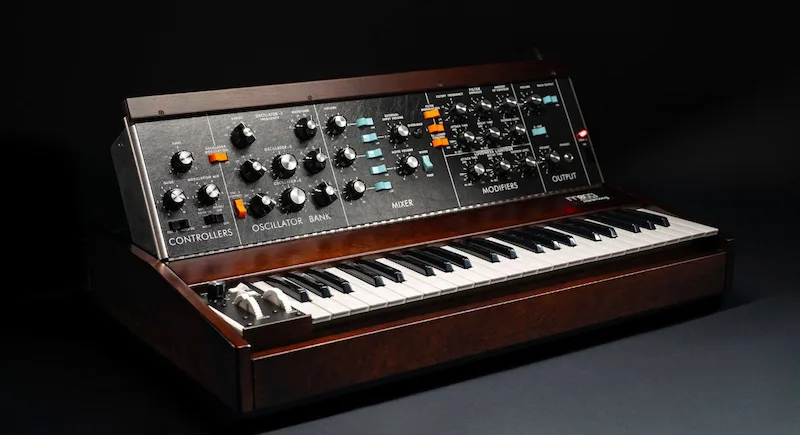
Minimoog Model D Tribute Edition is officially here. Moog Music has announced a limited run of 500 units, each contributing $500 to the Bob Moog Foundation — a move that positions this release as both a product and a statement.
This isn’t a new synth. It’s a reissue of the 2022 Minimoog Model D, wrapped in symbolism, scarcity, and brand heritage.
Why This Release Matters Right Now
The timing is not accidental. The hardware market has been losing ground to plugins and hybrid workflows for years. In 2026, most producers rely on recall, automation, and speed — not analog ritual.
The Minimoog Model D Tribute Edition pushes directly against that trend. It’s not trying to compete with modern synths. It’s reinforcing something else: identity.
This release exists to remind the market what “analog authority” looks like — even if most workflows no longer require it.
What You Actually Get (Beyond the Marketing)
Technically, nothing here is new.
— 3 analog VCOs
— classic 24 dB/oct ladder filter
— improved stability (from 2022 reissue)
— full MIDI integration
— dedicated LFO
The only real changes:
— white oak cabinet
— Bob Moog silhouette branding
— limited production (500 units)
Sound? Identical to the 2022 version.
This is critical. You are not buying new sonic capabilities — you are buying context.
What It Means in a Modern Mixing and Mastering Workflow
The Minimoog Model D Tribute Edition still delivers one thing exceptionally well: controlled, harmonically rich low-end.
In practical terms:
— bass sits more predictably in mono
— filter saturation translates well after compression
— transients feel less “digitally shaped”
But here’s the part most articles ignore:
none of that guarantees a better mix.
Once the signal hits a modern chain — EQ, compression, limiting — differences between analog and high-end plugins shrink dramatically. The advantage becomes situational, not absolute.
That’s why engineers working at a high level still rely on the final stage to define the result. If the source is strong, it helps — but the outcome is determined in mastering. This is exactly where decisions like tonal balance and perceived loudness actually translate, whether the source is analog or digital. For context, see how professional-grade processing is handled in dedicated mastering environments.
Where the Tribute Edition Actually Works
This is not a general-purpose synth. It’s a specialized tool.
It performs best in:
— hip-hop and trap bass design
— techno sequences with minimal layering
— lead lines that rely on filter movement
— sessions where tactile control matters
It also serves a non-technical role:
studio perception.
A Minimoog on the desk changes how clients perceive your setup — whether that matters depends on your business model.
Limitations Nobody Wants to Emphasize
The Minimoog Model D Tribute Edition is fundamentally constrained:
— monophonic architecture
— minimal modulation routing
— no onboard effects
— zero recall in analog state
In a DAW-centric environment, this translates to friction:
— slower iteration
— dependency on external processing
— workflow fragmentation
“It sounds great — until you need to move fast.”
Competition: Hardware vs Plugins Isn’t Even Close Anymore
The real competition isn’t other synths. It’s software.
— Arturia Mini V
— u-he Diva
— Softube Model 72
Plugins win in:
— instant recall
— automation
— scalability
— price
The Minimoog wins in:
— tactile interaction
— analog non-linearity
— psychological impact
From a production standpoint, the gap has narrowed to the point where it’s rarely decisive.
Who This Is Actually For
The Minimoog Model D Tribute Edition is not for most producers.
It makes sense if:
— you value hardware identity
— you run a client-facing studio
— you collect iconic instruments
It doesn’t make sense if:
— you prioritize workflow speed
— you work fully in-the-box
— you expect functional innovation
Verdict
The Minimoog Model D Tribute Edition is not a better synth. It’s a more meaningful one.
It doesn’t push technology forward. It reinforces legacy — and monetizes it effectively.
If you approach it as a tool, it’s limited.
If you approach it as a symbol, it’s unmatched.