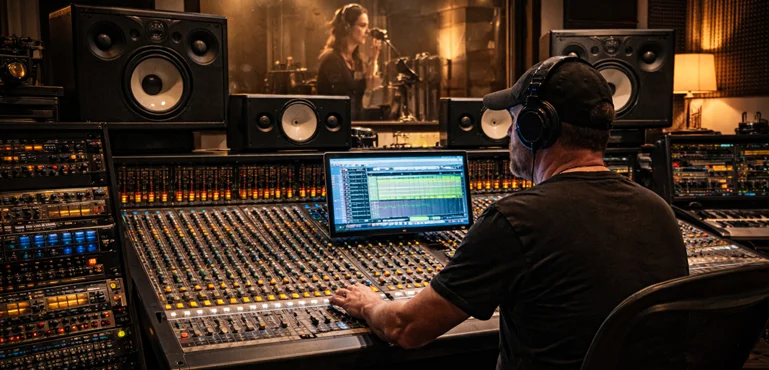
Chicago artists record music in many different ways. Some tracks come straight from live club performances and rehearsal rooms. Others are built in home studios between sessions. Many hip-hop and pop releases start with a purchased beat and a vocal recorded in a bedroom setup.
Despite these different workflows, most Chicago musicians face the same confusion before release: should they order mixing or just mastering?
The most common mistake is paying for mastering too early, when the track is still unbalanced and unfinished. This guide gives you a fast way to know exactly what your song needs before spending money — and how to avoid paying twice. Run this quick test before paying for mastering.
Mixing vs mastering explained in plain language
 Mixing is the stage where all individual tracks are balanced together. Vocals are placed properly, bass is controlled, drums are tightened, space is created, and everything is shaped so the song feels clear, powerful, and professional. This is where most sound problems are solved.
Mastering happens after the mix is finished. It works on a single stereo file to polish tone, set loudness for streaming platforms, and ensure consistency across releases. Mastering improves an already good mix, but it cannot fix poor balance, muddy low-end, buried vocals, or frequency conflicts.
Think of mixing as building the house and mastering as painting and lighting it.
The 60-second test: does your track need mixing first?
Play your song on headphones, then on your phone speaker or laptop. If the vocal disappears, the bass feels uncontrolled, or parts of the song fight each other for space, the track needs mixing.
If certain frequencies feel harsh or muddy, if some instruments jump out randomly, or if the song feels unbalanced compared to professional references, mixing is required before mastering will help.
When even one of these issues is present, mastering alone will not solve it.
When mastering alone is actually enough
 There are times when mastering makes sense without mixing first. This usually happens when a track already has a clean, balanced stereo mix created by an experienced engineer or producer.
If the vocals sit naturally, the bass is tight, the dynamics feel controlled, and the song already sounds professional across systems, mastering can add loudness polish and tonal refinement.
This situation is far less common for DIY and live-recorded Chicago projects than many artists expect.
Chicago real-world recording scenarios
Live club recordings and rehearsal room sessions almost always require mixing first. Multiple microphones create bleed, phase interactions, uneven levels, and raw dynamics that mastering cannot correct.
Home-studio singer-songwriter tracks usually need mixing because vocals often sit inconsistently, room acoustics affect tone, and frequency buildup masks clarity.
Beat-plus-vocal singles depend heavily on mixing for vocal presence, low-end control, and spatial balance. Mastering without mixing rarely delivers professional results here.
Across Chicago’s DIY scene, mixing is the step that transforms raw recordings into release-ready music.
Why skipping mixing hurts your release
 When mastering is applied to an unbalanced track, the problems simply become louder. Harsh frequencies get sharper, muddy bass gets boomier, distortion becomes more noticeable, and vocal clarity often worsens.
Instead of sounding polished, the song feels congested and fatiguing. Many artists then pay again for mixing afterward — turning a cheaper shortcut into a more expensive process.
How mixing improves mastering results
A proper mix creates headroom, tonal balance, and dynamic control. This allows mastering to enhance loudness smoothly, improve clarity, and achieve streaming-platform consistency without damaging the sound.
When mixing is done correctly, mastering becomes a powerful final step rather than a rescue attempt.
Preparing your track for the right stage
For mixing, engineers need clean multitracks or stems with proper levels and organization. This gives full control over balance and tone.
For mastering, a finished stereo mix with headroom and no heavy limiting is required. Sending the right files for the right stage dramatically speeds up workflow and improves results.
A professional workflow: mix first, then master
In professional production, the process always follows the same structure. Files are reviewed first, mixing shapes the song, revisions refine it, and mastering finalizes the release sound. This approach saves time, protects your budget, and delivers consistently stronger results.
Many Chicago artists now send their tracks to AREFYEV Studio for professional online mixing and mastering, starting with an honest evaluation to determine whether mixing, mastering, or both are needed — instead of guessing and overspending. Get a quick file review and clear recommendation before starting your release process.
Conclusion
 For most Chicago recordings — especially live sessions, home studio projects, and beat-driven singles — mixing is the essential first step. Mastering is the final polish, not a fix for unfinished balance. Understanding this difference saves money, improves sound quality, and leads to stronger releases.
If you want professional online mixing and mastering for your Chicago release with clear workflow and real results, AREFYEV Studio is ready to help bring your track to release level.
Mini-FAQ
What is the difference between mixing and mastering?
– Mixing balances individual tracks into a complete song, while mastering polishes the finished stereo mix for release.
Do I need mixing before mastering?
– In most cases, yes — especially for home recordings and live sessions.
Can mastering fix a bad mix?
– No. Mastering enhances a good mix but cannot correct balance problems.
How do I know if my track is ready for mastering?
– If it sounds clear, balanced, and professional across different speakers, it may be ready.
Is mixing necessary for home recordings?
– Almost always, since room acoustics and raw vocal balance usually need correction.
Should I hire the same engineer for both?
– Often yes, as it ensures consistency across the entire release.