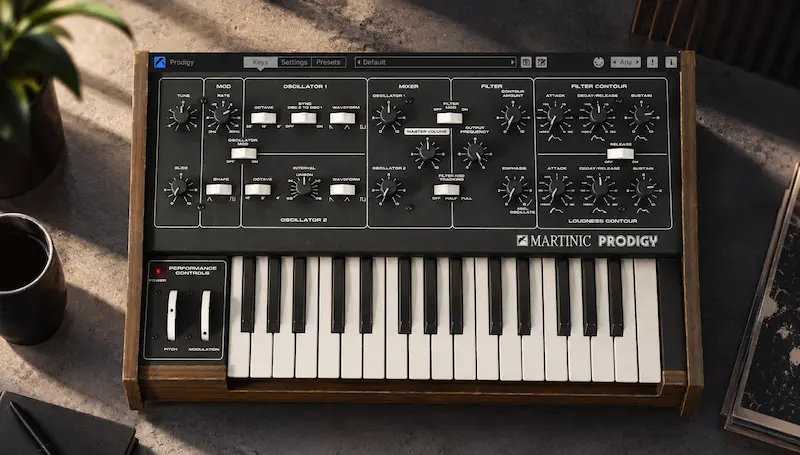
Martinic Prodigy is a software recreation of the 1979 Moog Prodigy, using Martinic’s ACE circuit-modeling technology to reproduce the original two-oscillator architecture, hard sync, glide and 24 dB/octave ladder filter. It also expands the original monosynth with 8-voice polyphony, 6-voice unison, pulse-width control, a sub-oscillator, noise generation, Multidrive, spring reverb, expanded modulation, sequencing, MPE and more than 300 presets.
The short version: this Martinic Prodigy review finds a convincing Prodigy-style instrument, but not enough independent evidence to call it a one-to-one hardware emulation. It gets much closer to the original production concept than a generic analog-style synth, while its modern features make it substantially more practical inside a DAW.
In this review, I focus on the parts that actually matter when evaluating a Prodigy emulation: oscillator behavior, hard sync, ladder-filter response, modulation, the expanded voice architecture, sequencing, interface, workflow and how convincing the instrument is when pushed beyond static factory presets. That also makes the plugin relevant to a few practical questions beyond emulation accuracy: whether Martinic Prodigy is good for bass, whether its hard sync behaves convincingly, how useful the polyphonic and unison modes are, and whether it is worth buying at the current price.
Martinic Prodigy Review: Quick Verdict
Best for: Prodigy-style basses, aggressive leads, hard-sync sounds and vintage-inspired sequences.
Biggest strength: It preserves the focused two-oscillator/sync/filter concept while adding modern DAW features.
Biggest weakness: The vintage-style interface is less efficient than the underlying synth design, while low-resolution MIDI controllers can expose stepping during hard-sync sweeps.
Emulation verdict: Convincing in overall character, but the available public evidence does not prove one-to-one hardware equivalence.
Overall: 8.5/10
Martinic Prodigy Review Highlights
| Area | Verdict |
|---|---|
| Sound | Strong Prodigy-style bass, lead and hard-sync character |
| Emulation | Convincing overall direction, but not independently proven as electrically identical to hardware |
| Oscillators | Two oscillators, hard sync, expanded waveforms and adjustable/modulatable pulse width |
| Filter | 24 dB/octave ladder filter with keyboard tracking, drive and boost options |
| Voice architecture | Mono, 6-voice unison and 8-voice polyphony |
| Sequencer | 16-step sequencer with parallel or serial chain modes and multiple modulation destinations |
| Workflow | Excellent DAW recall, preset management, MIDI Learn and MPE support |
| Weak point | UI scaling and some controller-resolution behavior reduce the sense of hardware-like immediacy |
In This Martinic Prodigy Review
ACE Modeling & Emulation
Hard Sync Test
Authenticity vs. Modern Features
Production Features
Interface
Alternatives
Overall Verdict
Martinic Prodigy ACE Modeling: How Close Is It to the Original Moog?
 Martinic says Prodigy was recreated using its Advanced Circuitry Emulation (ACE) technology rather than being built simply as a conventional subtractive synthesizer with a similar front panel. The modeled architecture includes the two oscillators, hard sync, glide, ladder filter, filter and loudness contours, and the characteristic pitch and modulation controls of the original instrument.
That is the right architecture to model because the Prodigy’s identity comes from the interaction between those stages rather than from its relatively small feature count. The oscillator relationship, sync behavior and ladder filter are more important to the result than reproducing the appearance of the hardware.
However, ACE is a modeling methodology, not independent proof of hardware equivalence. There are currently no published independent hardware-versus-plugin measurements demonstrating one-to-one hardware equivalence with an original Moog Prodigy.
The available listening evidence is more encouraging. KVR users familiar with the original hardware have described the plugin as broadly convincing, while one owner specifically criticized its pitch-bend behavior in hard-sync mode as more stepped and less aggressive than the hardware. Martinic explained that this can occur with 7-bit MIDI pitch-bend data and noted that host parameter automation uses higher-resolution values.
That makes the most useful conclusion more nuanced than either “perfect emulation” or “not authentic”: Martinic Prodigy appears to capture the overall Prodigy sound and architecture convincingly, but some performance behavior can differ depending on how the instrument is controlled.
Hands-On: What Becomes Obvious After Using It
In actual use, the difference between the original-style section and the expanded controls becomes apparent very quickly. The basic Prodigy signal path is easy to work with: two oscillators, sync, filter and envelope shaping get you into the instrument’s characteristic territory without much setup. The additional controls become useful once the sound needs to move beyond that starting point.
The hard-sync section is the first place I would spend time rather than judging the synth from factory presets. With the oscillators close to a simple interval, the sound can remain relatively stable; push the second oscillator further and the harmonic movement becomes much more obvious. This is also where the difference between moving a parameter with the mouse, using MIDI control and drawing automation matters.
That kind of test tells me more about the instrument than the preset count. A synth can reproduce the right static tone and still feel wrong when its controls are moved. Martinic Prodigy’s strongest evidence is therefore found in the way its core controls respond under continuous adjustment, not in a screenshot or a specification list.
Hear What Your Prodigy-Style Synth Sounds Like in a Finished Master
A synth can have the right bass weight, harmonic movement and aggressive character in isolation and still behave differently once it reaches a complete mix. Our free mastering demo lets you hear how your own production translates after professional mastering. Upload up to 35 seconds of your mix and compare the result for yourself. Get your free mastering demo →
The Oscillators Are Still the Point
The core oscillator architecture is where Martinic Prodigy either succeeds or fails as an emulation. Two oscillators feed the mixer and ladder filter, with hard sync providing the nonlinear harmonic movement that gives the original instrument much of its character. That behavior is more important than the number of waveforms or modulation destinations added around it.
Martinic expands the original oscillator section with additional waveform options, pulse-width control, independent oscillator modulation and tempo-synchronized modulation. Velocity can also influence the instrument’s response, while the expanded modulation system provides destinations that were never available on the original hardware.
These additions are not major synthesis innovations, and they are not supposed to be. Their value is that they make a deliberately limited vintage architecture more practical inside a modern DAW. A producer can keep the Prodigy’s basic oscillator/filter character while introducing movement that would otherwise require additional MIDI or automation tracks.
The Ladder Filter Determines How the Sound Sits in a Mix
The ladder filter is where the Prodigy architecture becomes much more obvious in practice. Cutoff, emphasis and envelope movement change not only the brightness but also how much of the oscillator energy remains audible as the patch moves through its range.
This is especially noticeable on bass patches: a setting that sounds full when played alone can become much less useful once the filter is opened, resonance is increased or the envelope is made more aggressive. The extra filter controls therefore matter less as a list of specifications than as ways of keeping the Prodigy-style response usable in a modern arrangement.
That matters particularly with bass patches. Resonance and cutoff do not simply change the apparent brightness of a synthesizer; they can redistribute energy around the cutoff frequency and alter how much low-end weight survives as the sound moves through the filter. A useful emulation therefore has to be judged by its behavior under changing cutoff, resonance and envelope modulation, not just by how the filter sounds on a static patch.
The added controls also make the instrument easier to adapt to a mix without abandoning its basic character. That is a practical advantage over the original hardware, but it should not be confused with a guarantee of better low-end translation. Once the synth is in a finished production, kick, bass, clipping and bus processing will still determine how much of that low-frequency energy is actually useful.
Martinic Prodigy Hard Sync Test: The Most Important Emulation Detail
Hard sync is the most revealing part of the Martinic Prodigy emulation. The original Moog Prodigy became particularly distinctive when oscillator 2 was synchronized to oscillator 1 and its pitch was moved, producing the aggressive harmonic sweeps associated with the instrument.
With hard sync engaged, the pitch relationship between the oscillators changes the harmonic structure of the sound rather than simply shifting its fundamental frequency. Sweep that relationship with a pitch wheel or automation and the result can move from relatively stable to aggressively vocal, metallic or dissonant. On the original Prodigy, those sync sweeps are part of the instrument’s appeal.
The most useful independent criticism so far comes from a KVR user who owned an original Prodigy. He reported that Martinic’s pitch-wheel sync sweeps sounded more stepped and less aggressive than the hardware, describing the original as considerably more raucous. This is a much more meaningful criticism than a generic claim that the plugin “doesn’t sound analog,” because it identifies a specific performance behavior under modulation.
Martinic responded that the stepping can result from 7-bit MIDI pitch-bend data. A later follow-up in the same KVR discussion is important here: the original user tested the plugin again and found that the on-screen pitch wheel and DAW automation were smooth, while the stepping occurred with a particular low-resolution MIDI controller. That makes the result more nuanced: the reported stepping is clearly affected by MIDI resolution, but this does not by itself prove that the plugin’s hard-sync behavior is identical to the original hardware.
The important distinction is therefore not simply “the plugin steps” versus “the hardware does not.” The controller itself can become part of the test result. MIDI pitch-bend resolution can affect how smoothly a rapid pitch sweep is represented, particularly when the movement is generated from a controller rather than drawn as continuous DAW automation. Martinic has pointed to this as one possible explanation for perceived stepping. That does not establish that MIDI resolution is the whole story, but it means the comparison should not be treated as a pure test of the synthesis model.
For an emulation, this distinction matters because the same patch can behave differently depending on how the parameter is controlled. A plugin can match the broad tonal balance of vintage hardware and still behave differently when its controls are pushed. For Martinic Prodigy, hard-sync sweeps are therefore a better stress test than simply comparing sustained notes or factory presets.
If sync-driven leads are a significant part of your workflow, audition the instrument with both controller-based pitch bends and DAW automation. The result of that test is more relevant to a working producer than another preset-count comparison.
What Feels Authentic—and What Does Not?
The most useful way to judge Martinic Prodigy is to separate the parts that define the instrument’s sonic identity from the features Martinic added for modern production.
| Area | Original Moog Prodigy | Martinic Prodigy | Review Assessment |
|---|---|---|---|
| Oscillator architecture | Two VCOs | Two modeled oscillators plus expanded options | Core architecture preserved |
| Hard sync | Characteristic aggressive sync behavior | Modeled sync with modern automation support | Convincing overall, but pitch-wheel stepping can matter |
| Ladder filter | 24 dB/octave low-pass | 24 dB/octave modeled ladder filter with additional controls | Core character retained, workflow expanded |
| Pulse width | Fixed on the original | Adjustable and modulatable | Useful modern extension |
| Voice count | Monophonic | Mono, 6-voice unison and 8-voice polyphony | Major departure from hardware |
| Sequencer | Not present | 16-step sequencer with parallel or serial chain modes | Significant production advantage |
| MPE | Not available | Supported | Modern performance advantage |
| Preset system | Physical/manual settings | 300+ presets and collections | Major DAW workflow advantage |
Which Martinic Prodigy Features Actually Matter in a DAW?
The useful additions are the ones that remove limitations without forcing the synth away from its Prodigy identity. In practice, that means the sub-oscillator, drive, polyphony, unison and sequencer are more important than the raw number of extra controls. The question is whether those additions change the way the instrument works in a session, rather than simply making the specification sheet longer.
Sub-Oscillator and Noise Add Useful Sound-Design Options
The additional sub-oscillator adds another low-frequency source without requiring another instrument, while the pink and white noise generators can be used independently for attack, texture and high-frequency density.
That is useful when building bass patches. The fundamental, harmonic content and noise component can be shaped at the source instead of being assembled from several instruments. It does not remove the need for EQ, compression or other mix processing, but it gives the producer more control before the signal reaches the rest of the chain.
Multidrive Moves Saturation Into the Synth
Martinic’s extended Multidrive section addresses a different part of the signal path: harmonic density. Drive can change how a synth cuts through an arrangement by adding upper harmonics and altering the apparent weight of the original oscillator signal.
Putting that stage inside the instrument is useful because the saturation becomes part of the patch rather than an obligatory post-synth processor. A bass patch, for example, can be designed around the driven oscillator or filter response and then recalled with that character intact.
It is not a replacement for a dedicated saturation plugin. External processors still provide more control over placement, filtering, parallel processing and signal-chain interaction. That becomes particularly relevant later in the production process, where the final mix may pass through several stages of processing; the mastering chain is one example of that broader workflow. The advantage here is speed and repeatability: if the desired distortion is part of the synth sound, there is little reason to build a separate processing chain for it.
Polyphony and Unison Are Deliberate Departures From the Hardware
Polyphony and unison are the clearest examples of Martinic treating the Prodigy as a synthesis foundation rather than a strict historical reproduction. The plugin can operate as a monophonic instrument, an eight-voice polyphonic synth or a six-voice unison instrument, with additional controls for voice detuning, panning, keyboard width and note priority.
None of this is authentic to the original Prodigy, and authenticity is not the useful criterion here. These modes expand the instrument into territory the hardware could not cover, from widened lead sounds to compact chord parts and thicker electronic textures.
The trade-off is equally clear: once multiple voices, unison and additional modulation enter the design, Martinic Prodigy becomes less useful as a strict reference for the original instrument’s behavior. For producers buying it as a practical synth rather than a historical reconstruction, that is a reasonable trade.
The Built-In Sequencer Has the Clearest Workflow Benefit
The onboard sequencer is arguably the most consequential modern addition because it moves repeated parameter automation inside the instrument. It can operate as a 16-step sequence with parallel or serial chain modes, with control over oscillator pitch, filter level, pulse width, sound-source levels, volume and panning. Tempo synchronization, quantization and multiple trigger modes are also available.
For repeating patterns, that can eliminate several DAW automation lanes. A bass patch can contain its own oscillator, filter and level movement, so the musical behavior travels with the preset instead of being split between the instrument and the project.
That is a real workflow improvement, but it has a boundary. Sequencing inside the synth is most useful when the modulation is part of the patch itself and repeats predictably. For arrangement-specific automation, evolving transitions or changes that need to follow the structure of a song, DAW automation remains more flexible.
That makes the sequencer a convenience feature with a genuine production advantage, rather than a major synthesis innovation. It reduces session clutter and makes certain animated patches faster to build and recall.
Vintage Workflow vs. Modern Production Mode
That matters because a strict recreation and a practical production instrument solve different problems. If the goal is to recreate the experience of programming a vintage Prodigy, the reduced control set is part of the appeal. If the goal is to finish a modern track, adjustable pulse width, additional modulation, polyphony, unison, sequencing and preset management are considerably more useful.
The result is less historically pure but more useful. That is arguably the most defensible design decision in the entire plugin.
Where Martinic Prodigy Fits in an Actual Mix
Martinic Prodigy is a sound-generation instrument, so its professional value is ultimately determined by what the resulting audio does once it enters a mix. The useful question is not whether it can produce impressive sounds in isolation, but whether those sounds retain enough definition and control when competing with the rest of the arrangement.
Leads: Where Hard Sync Earns Its Keep
Lead sounds are the other obvious strength. Hard sync, oscillator-interval changes, glide and drive provide a more aggressive palette than a basic subtractive synth, particularly when the oscillator relationship is being moved during performance or automation.
That makes the instrument well suited to electro, synth-pop, techno, industrial and related styles where a lead has to carry a recognizable timbral identity rather than simply fill a harmonic role. The important advantage is not that these sounds are inherently louder or brighter; it is that their changing harmonic structure can give a part enough definition to remain recognizable without relying entirely on extreme EQ or level.
Martinic Prodigy Interface: Authentic Look, Weak Modern Workflow
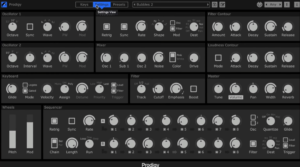
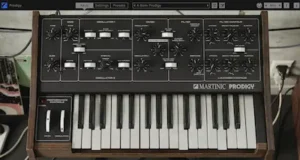
The Martinic Prodigy interface is one of the clearest compromises in the plugin. The vintage panel is visually faithful to the original instrument, but that authenticity comes at a cost: screen space, scaling and access to the expanded controls are not as efficient as in many modern software synthesizers.
Independent early feedback has specifically criticized the interface for looking washed out and being difficult to scale comfortably, with one KVR reviewer describing the 100% view as too small and the 200% view as excessively large. The interface also gives you relatively limited flexibility in how much screen space the instrument occupies, which can make the expanded control set less convenient on smaller displays.
The practical problem is screen efficiency. The original-style panel works as a visual recreation, but the software version has to accommodate controls that never existed on the hardware. Once the secondary functions, modulation, sequencing and voice options are added, the amount of information competing for screen space becomes more noticeable than it would on the original instrument.
This is where the plugin feels less modern than its synthesis architecture. The underlying instrument has been substantially expanded for DAW production, but the interface still carries some of the limitations of a hardware recreation.
Martinic Prodigy Features and Specifications
| Feature | Martinic Prodigy |
|---|---|
| Original instrument | Moog Prodigy, 1979–1984 |
| Modeling | ACE Advanced Circuitry Emulation |
| Oscillators | 2 modeled oscillators |
| Hard sync | Yes |
| Filter | 24 dB/octave ladder low-pass |
| Waveforms | 4 oscillator waveforms |
| Pulse width | Adjustable and modulatable |
| Sub-oscillator | Yes |
| Noise | Pink and white noise |
| Drive | Multidrive and filter drive |
| Voice modes | Monophonic, 6-voice unison, 8-voice polyphonic |
| Sequencer | Up to 16 steps, with parallel or serial chain modes |
| Reverb | Vintage spring reverb |
| MPE | Yes |
| Preset library | 300+ factory presets |
| Formats | AAX, AU, CLAP, VST2, VST3 |
| Apple Silicon | Native support |
| Windows | Windows 7+; Arm64EC version for Windows 11+ |
| macOS | macOS 10.9+ |
| License | Key file; no dongle or permanent online activation |
Martinic Prodigy Alternatives: What Should You Buy Instead?
Martinic Prodigy makes the most sense when the Prodigy sound itself is the reason for the purchase. If the goal is broader analog synthesis rather than this specific architecture, the comparison changes.
| Choose Martinic Prodigy if… | Choose another synth if… |
|---|---|
| You specifically want the Moog Prodigy oscillator, sync and ladder-filter character. | You mainly want a general-purpose analog-style synthesizer. |
| You want vintage-inspired basses and aggressive hard-sync leads. | You need a much deeper modulation architecture. |
| You want modern DAW recall without giving up the Prodigy concept. | You already own several analog-modeling synths covering the same territory. |
| You want the option of mono, unison and polyphonic operation. | You care more about historical hardware accuracy than modern production features. |
The key buying question is therefore not “Is Martinic Prodigy the best analog synth?” It is “Do I specifically want the Prodigy sound and workflow?” If the answer is yes, its focused architecture is an advantage. If the answer is no, a broader synthesizer may provide more value from the same plugin slot.
Compatibility and Recall: Where Software Beats the Original Hardware
 Martinic Prodigy’s compatibility is not particularly unusual for a current software instrument, but it matters when the alternative is a vintage hardware synthesizer. Version 1.0.0 supports VST2, VST3, AU, AAX and CLAP on Windows and macOS, with native Apple Silicon support.
The practical advantage is recall. A hardware Prodigy has to be physically available, manually configured and documented if its settings need to be reproduced later. The plugin stores its state with the DAW session, making the instrument immediately recallable alongside the rest of the production.
Martinic’s license system also does not depend on a hardware dongle or permanent online activation, using a generated license-key file instead. That is a small detail, but it removes one potential point of failure when working across studio machines or on a system that is not continuously connected to the internet.
For a working producer or mix engineer, instant recall, session portability and the ability to open a project without locating a piece of vintage hardware are legitimate workflow advantages.
The preset browser extends the same principle. With more than 300 factory presets, favorites and collections, Martinic Prodigy can function as a fast source-selection tool when a project needs a bass, lead or sequence starting point. Presets are not a substitute for programming, but they can shorten the path from an empty MIDI track to a workable sound.
The value is not owning 300 sounds; it is being able to recall a usable starting point without rebuilding the patch or searching for the hardware that created it.
Who Should Buy Martinic Prodigy—and Who Should Skip It?
Martinic Prodigy makes the most sense for producers who already know the kind of sound they want from a subtractive synth. Its strongest use cases are basses, aggressive leads, hard-sync sounds and sequenced parts where the instrument’s specific character matters more than having the deepest possible synthesis architecture.
Electronic producers and serious home-studio users are the clearest audience. They get a focused vintage-derived sound source without the maintenance, physical space and recall problems associated with aging analog hardware. The expanded feature set also makes the instrument considerably more practical for contemporary production than a strict software recreation would be.
Composers working with electronic, retro, industrial or period-inspired material can also get useful mileage from it, particularly when a track calls for a distinctive monophonic-style lead or bass rather than another interchangeable general-purpose synth.
Mixing engineers who also produce can justify it as part of a source-generation toolkit. A mixing engineer who never creates MIDI instruments has little reason to own it, and the same is true for a mastering engineer working exclusively from completed mixes. The plugin generates audio; it does not address the problems those engineers normally solve at the mix or mastering stage.
Beatmakers and beginners can use it successfully, but neither group has a compelling reason to treat it as essential. Beatmakers have a large selection of inexpensive synths that can cover similar territory, while beginners may benefit more from a broader instrument that exposes a wider range of synthesis concepts.
The strongest buyer profile is therefore fairly narrow: a producer or producer-engineer who wants the Prodigy’s particular oscillator/filter vocabulary, but does not want to give up modern DAW recall, sequencing and expanded voice options.
Price and Value: Is Martinic Prodigy Worth the Money?
 At launch, Martinic Prodigy is available for €33 instead of the regular €66, with the introductory 50% discount scheduled to end on September 16, 2026. Check Martinic’s current price before buying.
At the introductory price, the financial risk is low enough that the instrument does not need to replace another synthesizer to earn its place. If its particular oscillator, filter and hard-sync behavior gives you sounds you actually use, the cost of entry is easy to justify.
The regular price requires a more selective decision. At €66, Martinic Prodigy is no longer competing primarily on affordability; it is competing against established analog-modeling instruments that may offer deeper synthesis, more effects or a broader range of sounds.
That makes the value proposition highly dependent on intent. Someone looking specifically for the Prodigy’s character gets a focused instrument with modern production features. Someone who simply wants another analog-style synth has less reason to choose it over a broader instrument already in the studio.
For professional users, the relevant calculation is not the number of features per dollar. It is whether the instrument produces sounds distinctive enough to survive repeated use in real projects. A $30–$70 synth that remains permanently unused is expensive; a specialized instrument that repeatedly supplies the right bass or lead can be cheap at several times the price.
Martinic Prodigy: Pros and Cons
| Pros | Cons |
|---|---|
| Strong Prodigy-style oscillator and filter character | Hardware equivalence is not independently proven |
| Convincing hard-sync concept | Low-resolution MIDI controllers can expose pitch-bend stepping |
| 8-voice polyphony | Vintage-style interface is not especially efficient |
| 6-voice unison | Expanded features make it less historically pure |
| Adjustable/modulatable pulse width | Not the best choice for broad, deep synthesis |
| Built-in sequencer | Some modern workflow decisions still feel constrained by the skeuomorphic UI |
| 300+ presets | Its value depends heavily on actually wanting the Prodigy sound |
| MPE and modern plugin formats | No reason for mastering-only users to own it |
Overall Verdict
| Category | Rating |
|---|---|
| Sonic Character | 9/10 |
| Emulation Credibility | 8/10 |
| Sound Design | 8.5/10 |
| Workflow | 9/10 |
| Interface | 7/10 |
| Value | 9/10 at launch price |
| Overall | 8.5/10 |
Sonic Character — 9/10: The Prodigy architecture gives Martinic a clearly defined sonic identity rather than making it another generic analog-style synthesizer. The combination of two oscillators, hard sync, glide and ladder filtering is particularly effective for basses and aggressive leads. The score is high because the instrument has a recognizable production role, not because it attempts to cover every synthesis style.
Workflow — 9.0/10: This is one of Martinic Prodigy’s strongest areas. Polyphony, unison, sequencing, expanded modulation, preset recall, MPE and modern plugin formats remove many of the practical limitations of the original hardware. The built-in sequencer is especially useful when modulation belongs to the patch itself. The workflow score is therefore higher than the emulation score: the software is arguably more useful in a modern production environment than a strict hardware recreation would be.
Emulation Credibility — 8/10: The circuit-modeling approach is technically credible, and Martinic has retained the parts of the original architecture that matter most to its identity. However, the available public evidence does not establish one-to-one hardware equivalence. The specific criticism of smoother or more stepped hard-sync pitch-bend behavior is also a reminder that behavioral differences can matter more than matching the front-panel layout. This score reflects a strong emulation proposition with an evidence gap, rather than assuming that a circuit-modeling claim proves hardware accuracy.
Sound Design Flexibility — 8.5/10: Martinic expands the original Prodigy’s relatively narrow architecture with a sub-oscillator, noise sources, Multidrive, additional modulation, polyphony, unison and sequencing. That makes the instrument considerably more versatile than the hardware without turning it into an unnecessarily complicated modular-style synth. The score stops short of the top tier because broader modern synthesizers still offer substantially deeper modulation and sound-design architectures.
Interface — 7/10: The interface is the clearest weakness in an otherwise practical production instrument. Early independent feedback has specifically raised concerns about visual presentation, scaling and usability. That matters because the parameters that define the Prodigy’s character—oscillator tuning, sync, filter cutoff, resonance and envelopes—are exactly the controls users are likely to adjust repeatedly. A more modern, resizable and efficiently scaled interface would improve the instrument without changing its sonic identity.
Overall — 8.5/10: Martinic Prodigy is a strong specialized instrument rather than a universally superior analog synthesizer. Its biggest strengths are the recognizable Prodigy-derived sound, excellent DAW workflow and practical usefulness for basses, leads and sync-based sounds. The main limitations are the less convincing evidence for exact hardware equivalence and an interface that feels less polished than the underlying production concept. At the introductory price, the value proposition is particularly strong for producers who specifically want this sound; at full price, the purchase becomes more dependent on whether the Prodigy character fills a real gap in the existing synth collection.
Martinic Prodigy Verdict: Is It Worth Buying?
Martinic Prodigy is a convincing way to bring the distinctive Moog Prodigy concept into a modern DAW without accepting the maintenance and recall limitations of vintage hardware.
The two-oscillator architecture, hard sync, glide and ladder filter preserve the parts of the original instrument that actually define its sound, while pulse-width control, additional modulation, sub-oscillator, Multidrive, sequencing, unison and polyphony make the software version considerably more versatile.
The main reservation is emulation accuracy. The available public evidence supports the claim that Martinic captured the overall Prodigy character, but it does not establish one-to-one hardware equivalence. The most interesting independent criticism so far concerns pitch-bend stepping during hard-sync performance, while other experienced users have described the overall sound as very close to the hardware.
For producers who specifically want Prodigy-style basses, aggressive leads and hard-sync sounds, Martinic Prodigy is an easy recommendation. For someone simply looking for another analog-style synthesizer, the case is weaker because broader instruments can offer substantially deeper synthesis.
Overall: 8.5/10. Martinic Prodigy succeeds because it preserves a very specific vintage sound while removing many of the reasons a modern producer might not want the original hardware.
Does Your Synth Mix Still Translate Outside the Studio?
A well-designed synth can give a track the right character, but the final result still depends on how its bass weight, harmonic density, dynamics and stereo balance interact with the complete mix. Not every issue that appears at the mastering stage can be solved by adding another processor to the chain. A direct before-and-after comparison is often a more useful way to judge what the finished mix can actually support.
Upload up to 35 seconds of your mix and get a free mastering demo prepared by a real mastering engineer. Compare your original against the mastered version and hear how the mix responds to professional mastering before making a larger decision. Upload your mix for a free mastering demo →
Martinic Prodigy FAQ
Is Martinic Prodigy a Moog Prodigy emulation?
Yes. Martinic Prodigy is explicitly designed as an emulation of the 1979–1984 Moog Prodigy, using Martinic’s ACE circuit-modeling approach. It reproduces the original’s two-oscillator architecture, hard sync, glide and ladder filter, while adding polyphony, unison, sequencing and other modern features.
How close is Martinic Prodigy to the original Moog Prodigy?
It captures the overall Prodigy architecture and sonic character convincingly, but there is not enough independent measurement data to claim one-to-one hardware equivalence. The most specific criticism from an original Prodigy owner concerns stepped pitch-bend behavior in hard-sync mode.
Does Martinic Prodigy have hard sync?
Yes. Hard sync between the two oscillators is one of the central features of the instrument and one of the most important parts of its Prodigy character.
Is Martinic Prodigy polyphonic?
Yes. Unlike the original monophonic Prodigy, the Martinic version provides 8-voice polyphony as well as 6-voice unison.
Does Martinic Prodigy work in Logic Pro and Pro Tools?
Yes. The plugin supports AU for Logic Pro and AAX for Pro Tools, alongside VST2, VST3 and CLAP. macOS versions also support native Apple Silicon.
Is Martinic Prodigy worth buying?
Yes, if you specifically want the Prodigy’s sound and hard-sync behavior. It is less compelling as a generic analog-style synthesizer because broader instruments can offer more synthesis depth.

Yurii Ariefiev is a mastering engineer and audio production editor who evaluates music-production plugins and virtual instruments from a working studio perspective. His reviews focus on how instruments behave in production rather than treating feature lists or manufacturer claims as a substitute for practical evaluation.
☕ Buy me a coffee