
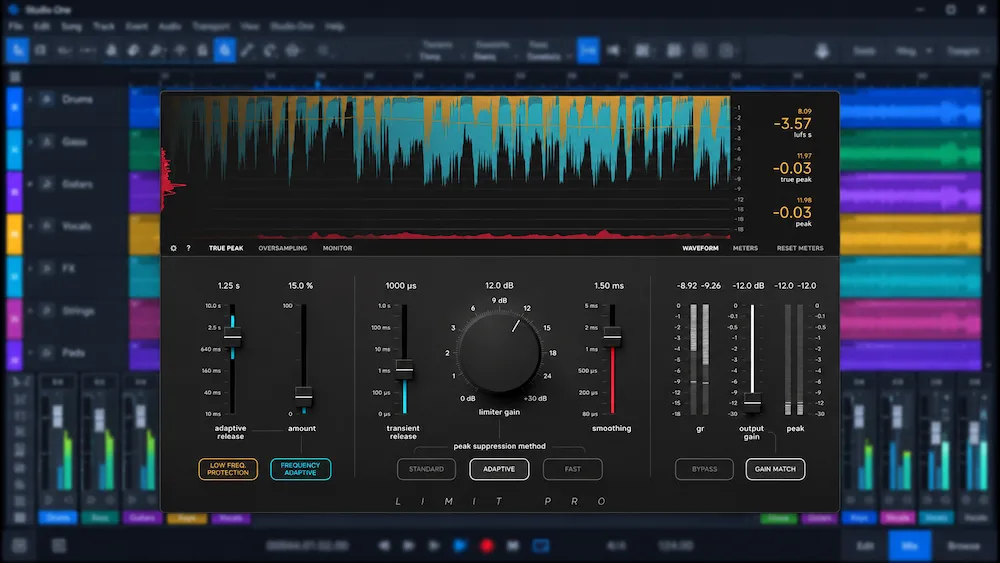
Softube Limit Pro is built around a familiar mastering problem: how far can you push level before the limiter starts changing the character of the mix? The difficult part is rarely the first few decibels of gain reduction. It is what happens at the edge of the loudness target, where kick drums, bass, and sharp transients begin to dictate the limiter’s behavior.
Limit Pro approaches that problem with three peak-suppression modes, frequency-adaptive release behavior, Low Frequency Protection, True Peak processing, and detailed metering for gain reduction, loudness, and distortion. The architecture is clearly aimed at giving the engineer more control over how the limiter reacts to different types of program material rather than relying on a single fixed response.
That does not make it automatically better than established mastering limiters. Modern processors such as FabFilter Pro-L 2, Ozone Maximizer, Limitless, and other high-end designs already offer sophisticated loudness control, oversampling, True Peak handling, transient management, and program-dependent dynamics. The more useful question is narrower: does Limit Pro make difficult material easier to limit cleanly, and does its adaptive approach provide a practical advantage over the limiter already in your mastering chain?
That is the real test. The interesting part of Limit Pro is not the number of features on the interface, but how its peak suppression and release behavior interact with real mixes when the final few decibels of level matter.
Why Mastering Limiters Become Difficult at the Loudness Ceiling
 Digital limiting is straightforward in principle: reduce peak level, raise the average level, and keep the output within the required ceiling. The difficulty begins when the limiter has to remove several decibels from a dense mix without changing the way that mix moves.
A kick transient can trigger gain reduction that also affects the bass underneath it. An aggressive release can recover level quickly, but repeated low-frequency events may turn that recovery into audible modulation or distortion. A slower release can sound more controlled, yet keep the entire mix attenuated after the original peak has already passed.
The problem becomes even more material-dependent as the program gets denser. A response that works well on a controlled pop mix can behave very differently on an 808-heavy hip-hop master, a transient-rich rock production, or electronic material with sustained low-frequency energy. There is no single release behavior that is equally effective across all of these cases.
That is why the meaningful distinction between mastering limiters is not simply how much gain reduction they can apply. It is how intelligently they distribute that gain reduction over time and across different types of peaks.
Limit Pro is built around that part of the problem. Its three peak-suppression modes change the way the limiter responds to incoming peaks, while its adaptive release behavior allows recovery to respond to the program rather than relying on one fixed timing relationship.
For masters that are already comfortable at conservative levels, those differences may be difficult to justify. Once the limiter is working hard, however, peak detection, release behavior, low-frequency interaction, and transient recovery become audible parts of the master itself. That is the point at which the limiter’s architecture matters.
How Limit Pro’s Peak-Suppression Modes Change the Limiting Behavior
Limit Pro’s main point of differentiation is not its metering or interface. It is the way the limiter changes its response to incoming peaks through three distinct peak-suppression modes, combined with adaptive release behavior.
Standard is the straightforward starting point: a predictable limiting response for general mastering work. Adaptive is designed to vary its behavior with the incoming program, aiming to maintain strong peak control without keeping the signal attenuated longer than necessary. Fast prioritizes a more aggressive approach to peak suppression and is intended for situations where density and level are more important than conservative transient handling.
The practical advantage is not that one mode is universally better than the others. It is that the engineer can choose how the limiter should behave before deciding how hard to drive it. A controlled acoustic or pop master may benefit from a different response than a dense electronic production, an 808-heavy hip-hop track, or a transient-rich rock mix.
Smoothing adds another layer to that decision by influencing how quickly peak suppression reacts. Lower settings favor faster, more aggressive peak control, while higher settings can reduce unwanted distortion at the cost of a softer response. In practice, this makes Smoothing part of the limiter’s core peak-control behavior rather than a secondary fine-tuning parameter.
As a starting point, denser material generally benefits from controlled peak suppression without excessive recovery movement, while bass-heavy material is where the adaptive release behavior becomes more important. These are not fixed recipes: the useful setting depends on how much gain reduction the source actually requires and which elements are driving it.
The more interesting part of the design is what happens underneath those modes. Limit Pro uses frequency-adaptive release behavior, allowing the recovery characteristics to respond differently to low-frequency energy and higher-frequency transients.
That matters because low-frequency events can dominate a limiter’s gain-reduction envelope. A sustained 808, synth bass note, or large kick can keep conventional limiting engaged well beyond the initial peak. Recover too quickly and the repeated movement of the gain envelope can become audible as modulation or distortion. Recover too slowly and the limiter can continue suppressing the rest of the mix after the transient that triggered it has already passed.
There is also a less obvious control that matters when the limiter is pushed hard: Sidechain Link. It does not link the peak-suppression stage itself; instead, it controls how much the slower release behavior is shared between the left and right channels. That distinction matters because increasing gain reduction can otherwise allow channel-dependent recovery to make the stereo image move. Sidechain Link gives the engineer a separate way to manage that behavior without changing the limiter’s peak-detection stage.
Limit Pro’s Low Frequency Protection is aimed at this specific interaction. It does not correct an unbalanced low end, and it cannot substitute for fixing excessive sub-bass or poorly controlled kick-and-bass relationships in the mix. Its role is narrower: to reduce the extent to which low-frequency peaks dictate the limiter’s overall gain-reduction behavior.
That distinction is important. The value of this architecture should ultimately be judged by what happens under real gain-reduction pressure: whether bass-heavy material can be pushed further without unwanted movement, distortion, or loss of transient definition compared with the limiter already in the chain.
Hear What Your Master Needs Beyond the Limiter
A limiter can control peaks and loudness, but the final master still depends on how well the mix preserves punch, low-end stability, detail, stereo balance, and translation across playback systems. If you want an independent engineering reference for your track, try our free mastering demo and upload up to 40 seconds of your mix. Upload your mix for a free mastering demo →
Using Limit Pro on the Mix Bus
Limit Pro is primarily a mastering limiter, but it can also be useful on the mix bus when the goal is to evaluate how a production responds to final-stage peak control.
Used this way, the limiter is less about making the mix permanently loud and more about exposing weaknesses before the master reaches the mastering stage. If the kick consistently drives several decibels of gain reduction, the bass loses definition, or the vocal level moves noticeably whenever the limiter engages, those are mix decisions worth addressing upstream.
This can be particularly useful in electronic music, hip-hop, pop, and other productions built around high density and controlled peaks. A moderate amount of limiting can show whether the arrangement retains its impact when the available headroom becomes limited, without requiring the producer to commit to the final loudness of the master.
The important distinction is between monitoring through a limiter and mixing into a limiter. The first uses the processor as a diagnostic tool; the second can gradually make the mix dependent on its gain-reduction behavior. If the kick, bass, vocal, or other dominant element only works because the limiter is constantly reshaping it, the problem belongs in the mix rather than in the limiter.
Limit Pro is therefore most useful on the mix bus when the underlying balance is already sound and the limiter is being used to evaluate peak behavior, transient impact, and density—not to compensate for unresolved arrangement or level problems.
Low-Frequency Limiting: The Hardest Test for Limit Pro
 Low-frequency-heavy material is one of the more revealing tests for any mastering limiter. A kick, 808, or sustained synth bass can contain enough energy to dominate the gain-reduction envelope, even when the rest of the mix has substantial headroom.
Consider a modern hip-hop master with a large 808, a kick occupying overlapping frequency and timing territory, bright percussion, and a vocal that needs to remain stable. If the limiter responds primarily to the low-frequency peaks, the resulting gain reduction can affect the entire mix. Faster recovery may restore level sooner, but excessive movement can introduce audible modulation or distortion; slower recovery can keep the mix attenuated after the triggering event has passed.
Limit Pro attacks the low-frequency problem in two different ways. Frequency Adaptive changes the release behavior according to the frequency content, allowing longer recovery for low-frequency material while keeping faster transients from unnecessarily holding down the mix. Low Frequency Protection is a separate layer: it rapidly reduces level when sub-bass energy becomes problematic, helping prevent the fast peak-suppression stage from generating excessive low-frequency distortion.
That does not make the limiter a substitute for low-end correction. Kick-and-bass balance, phase relationships, subsonic content, resonant notes, and inconsistent bass performance still have to be resolved in the mix. If the low end is already forcing excessive gain reduction, no limiter architecture can turn a fundamentally unstable bass relationship into a clean one.
The more useful test is therefore not whether Limit Pro can handle bass-heavy material at all. Most modern mastering limiters can. The question is whether it can maintain transient impact and overall stability when the low end is responsible for a significant share of the required gain reduction.
That makes 808-heavy hip-hop, electronic music, and sustained low-frequency material particularly useful sources for evaluating Limit Pro against the limiter already in your mastering chain.
Limit Pro Metering: Measuring What the Limiter Is Actually Changing
Limit Pro’s metering is useful because it shows more than the final output level. The scrolling display separates total gain reduction from the contribution of Adaptive Release and Low Frequency Protection, while also showing Loudness Loss and distortion. That makes it possible to see not only how hard the limiter is working, but which part of its processing is responsible for the result.
Loudness Loss is particularly relevant when pushing the limiter toward its ceiling. Softube defines it as a measure of when additional input gain stops producing a proportional increase in perceived loudness. In practical terms, rising Loudness Loss is a warning that more level is increasingly being traded for compression and distortion rather than useful loudness.
Limiter evaluation is particularly vulnerable to level bias. A master that is 1 or 2 dB louder can sound more exciting even when the additional level comes with reduced transient impact, increased distortion, or less stable dynamics. Comparing limiter settings at matched loudness is therefore more useful than simply choosing the setting that produces the highest output level, particularly when you understand what LUFS actually tells you about perceived loudness.
Gain Match is especially useful in this context. Once the level difference is removed, the comparison becomes much more revealing: does the limited version retain more punch, preserve the balance of the mix, or produce fewer unwanted changes than the bypassed or less aggressively limited version?
Delta monitoring approaches the same problem from the opposite direction. Instead of concentrating on the finished signal, it draws attention to what the limiter has removed or altered. That can make changes in transient structure, low-frequency behavior, and other audible side effects easier to identify.
The Distogram adds another diagnostic view by showing distortion behavior as the limiter is driven harder. It can help locate increases in harmonic content that may otherwise be difficult to identify at normal listening levels. It is not, however, a universal measure of quality. Harmonic generation that is undesirable on an acoustic or vocal master may be entirely acceptable—or even intentional—in an electronic production.
The practical workflow is straightforward: level-match the comparison, watch what changes as gain reduction increases, then decide whether those changes are musically acceptable. The meters provide evidence; the final judgment still comes from the behavior of the master in context.
Limit Pro: Separating the DSP Design From the Marketing Claims
Claims such as “maximum loudness” and “ultimate transparency” are useful as product positioning, but they are not meaningful technical conclusions without context. Loudness, transparency, transient preservation, and distortion are competing variables whose relationship depends on the source material, target level, spectral balance, and amount of gain reduction.
A more defensible technical distinction is that Limit Pro separates several stages of the limiting decision that are often treated as one control problem: the peak-suppression method, transient release, program-dependent release, frequency-dependent release, and dedicated low-frequency protection. That gives the engineer more ways to change the limiter’s behavior without simply increasing or decreasing the amount of gain reduction.
None of the individual techniques is revolutionary in isolation. Program-dependent release, adaptive dynamics, True Peak processing, loudness metering, and specialized low-frequency handling are all established ideas in professional dynamics processing. The potentially interesting aspect of Limit Pro is the particular way those elements are combined around peak suppression and low-frequency behavior.
That distinction also sets a useful boundary for evaluating the plugin. At launch, there is not enough independent comparative data to establish that Limit Pro is objectively more transparent, produces less distortion, or delivers more usable loudness than every established mastering limiter.
For an experienced mastering engineer, the relevant question is therefore not whether Limit Pro introduces a new category of limiter. It is whether its particular implementation produces a better-controlled master on material that is difficult to limit with the tools already in the chain.
Limit Pro vs Established Mastering Limiters
Limit Pro enters a mature limiter market. Engineers already have access to processors such as FabFilter Pro-L 2, iZotope Ozone Maximizer, DMG Audio Limitless, Sonnox Oxford Limiter, and Weiss processors, all of which cover the core requirements of modern mastering in different ways.
| Limiter | Core Approach | Where It Makes Sense | Why You Might Keep It |
|---|---|---|---|
| Softube Limit Pro | Multiple peak-suppression modes with adaptive release and low-frequency-focused processing | Material where low-frequency peaks and aggressive limiting are difficult to manage | A useful alternative when a familiar limiter does not produce the desired response |
| FabFilter Pro-L 2 | Flexible mastering limiter with extensive control and metering | General mastering, mix bus work, and engineers who want detailed control over limiting behavior | A mature workflow with a broad range of applications |
| iZotope Ozone Maximizer | Limiter integrated into a broader mastering environment | Engineers building masters inside the Ozone ecosystem | Convenience and integration with the rest of the mastering chain |
| DMG Audio Limitless | Deep control over advanced mastering dynamics | Engineers who want extensive control over complex limiting behavior | A highly configurable approach for demanding mastering work |
| Sonnox Oxford Limiter | Established mastering-focused limiting workflow | Engineers who prefer a straightforward, dedicated limiter | A familiar tool that already fits an existing mastering workflow |
| Weiss limiting processors | Precision-oriented dynamics processing | High-end mastering and engineers already working within the Weiss ecosystem | A proven option for engineers who value established processing workflows |
The point is not that Limit Pro replaces these processors. Its more credible position is as an additional option for situations where the behavior of a familiar limiter is not giving the engineer enough control over the interaction between peak level, low-frequency energy, and recovery. The useful comparison is therefore not a feature checklist, but matched-loudness behavior at the same amount of gain reduction, particularly once low-frequency peaks begin to dominate the gain-reduction envelope.
An engineer who already has a reliable Pro-L 2, Limitless, Ozone, Sonnox, or Weiss workflow has little reason to switch simply because Limit Pro is newer. The useful comparison is practical: run the same difficult mixes through both processors, level-match the results, and listen specifically for changes in low-frequency stability, transient recovery, distortion, and overall density.
If Limit Pro consistently produces a more useful result on that material, it has earned a place in the chain. If it does not, its newer architecture is largely academic.
Limit Pro vs Limit Go: Control vs Speed
Limit Go uses the same core limiting approach as Limit Pro, but presents it through a much smaller control set. Its purpose is different: reduce the number of decisions required when a limiter needs to be inserted quickly into a production or mix-bus workflow.
It offers three simplified styles: Raw, Clean, and Safe, reducing the number of decisions required when speed matters more than detailed control. Raw is aimed at more aggressive processing, Clean provides a general-purpose starting point, and Safe is intended for situations where preserving the character of the source takes priority.
That simplified structure makes more sense in production than a full mastering control surface. When the job is to put a limiter on a mix bus, monitor the result, and keep working, the ability to choose a broad behavior quickly can be more useful than access to every available parameter.
Limit Go is also positioned for low-latency use, which makes it better suited to tracking, production, and monitoring situations where detailed mastering controls are unnecessary. Limit Pro, by contrast, is designed for more deliberate decisions about peak suppression, release behavior, low-frequency interaction, and final loudness.
With Limit Go included with Limit Pro, the two processors serve complementary roles. Limit Pro is built for controlling the details; Limit Go is built for getting to a useful result quickly.
Real-World Mastering: Loudness, Translation, and Streaming
The useful test of a mastering limiter is not the loudness number by itself. It is whether the master remains controlled when the level, playback system, and delivery format change.
A master can sound impressive at the studio monitors while losing kick definition, vocal clarity, low-end separation, or stereo-image balance when the listening level changes. Excessive limiting can also make those problems harder to diagnose because the limiter becomes part of the tonal and dynamic behavior of the finished master.
Limit Pro’s metering provides useful information for this stage of the process, including LUFS, True Peak, gain reduction, and distortion. Those measurements can show how hard the limiter is being driven, but they cannot predict every playback environment or encoding outcome.
Streaming normalization also changes the value of chasing additional level. If a heavily limited master is subsequently turned down during playback, the engineer may retain the reduced crest factor and increased distortion without retaining the level advantage that motivated the extra limiting in the first place.
That does not make loudness irrelevant. Genre, arrangement density, competitive context, and the intended playback environment still influence the appropriate target. The more useful approach is to decide how much level the production actually benefits from, then use the limiter to reach that target without compromising the characteristics that make the mix work. A final mastering checklist can then be used to verify the result before delivery.
True Peak becomes particularly important at the delivery stage because the peak behavior of an encoded signal can differ from the sample peaks visible in the DAW. Leaving appropriate headroom for downstream encoding is therefore more meaningful than treating 0 dBFS as a target that should always be approached as closely as possible.
Limit Pro can provide the measurements needed to make those decisions. It cannot determine the correct loudness target or guarantee translation; those remain engineering decisions based on the material and the delivery requirements.
CPU, Latency, and Production Workflow
A limiter on the master bus is used continuously enough that CPU load and latency can affect the way a session is built and monitored.
Limit Pro is positioned as a low-CPU processor, while Limit Go is designed for low-latency operation. That makes the two products relevant at different stages: Limit Pro is better suited to deliberate mastering decisions, while Limit Go is more practical when immediate response matters during production or monitoring.
There is also a practical latency trade-off. Softube states that True Peak processing adds around 3 ms of latency, with oversampling adding roughly another 1 ms. That is unlikely to matter during final mastering, but it becomes more relevant when a limiter remains active during tracking or low-latency monitoring.
The workflow benefit is straightforward. A producer can monitor a mix through a limiter without necessarily committing to the detailed controls required for final mastering. The processor can remain part of the monitoring path while the actual mastering decisions are made later, when the mix is ready for critical evaluation.
CPU efficiency is a different question. There is currently not enough independent benchmark data to establish that Limit Pro uses substantially fewer resources than competing mastering limiters. Its real-world performance should be evaluated at the sample rate, buffer size, and oversampling settings used in the session, since those variables can materially change CPU load and latency.
In other words, the relevant question is not whether Limit Pro carries a “low CPU” label. It is whether its performance remains practical in the sessions where you actually intend to use it.
Who Should Buy Softube Limit Pro?
 Limit Pro makes the most sense for engineers who already understand what they want a limiter to do and are looking for another way to handle difficult peak behavior. Mastering engineers should be among the first to evaluate it, particularly on dense material where low-frequency energy regularly drives significant gain reduction.
It is also relevant to mixing engineers and producers working in electronic music, hip-hop, trap, and modern pop. These genres can put unusual demands on a limiter: substantial low-frequency energy, dense arrangements, strong transient peaks, and relatively high loudness targets. The question is not whether Limit Pro can make those mixes loud, but whether its particular response produces a more useful result than the limiter already being used.
For home-studio producers, the inclusion of Limit Go makes the package more versatile. Limit Pro provides the deeper control needed for mastering, while Limit Go offers a simpler option for production and mix-bus work. That combination makes the product easier to justify than a limiter intended only for final mastering.
Beginners may get more practical value from Limit Go at first. Limit Pro becomes more useful once an engineer can hear the difference between transient preservation, sustained gain reduction, low-frequency modulation, and simple changes in loudness.
Professional studios should treat Limit Pro as an addition to the evaluation pool rather than a replacement for an established limiter. A trusted Pro-L 2, Limitless, Ozone Maximizer, Sonnox, or Weiss workflow should only be displaced if comparative testing shows a repeatable advantage on the material being mastered.
Overall Rating
| Category | Rating |
|---|---|
| Peak Control | 8.8/10 |
| Adaptive Release Behavior | 8.7/10 |
| Low-Frequency Handling | 8.6/10 |
| Control & Limiting Flexibility | 8.5/10 |
| Metering & Diagnostic Feedback | 8.8/10 |
| Practical Mastering Versatility | 8.2/10 |
| Overall | 8.6/10 |
The three peak-suppression modes give Limit Pro a strong range of responses for material where conventional limiting behavior becomes difficult to manage, particularly as gain reduction increases.
Frequency-adaptive release is one of the more meaningful aspects of the design because low-frequency events can otherwise dominate the gain-reduction envelope and affect the rest of the program.
Low Frequency Protection addresses a specific and important limiting problem, although it does not replace correction of excessive sub-bass, unstable kick-and-bass relationships, or problems already present in the source.
The combination of Standard, Adaptive, and Fast modes provides useful control over how aggressively peaks are handled, but the plugin remains less compelling when only modest gain reduction is required.
Peak, True Peak, LUFS, gain reduction, loudness loss, distortion, Gain Match, Delta, and Distogram provide unusually useful diagnostic context for judging what changes as the limiter is driven harder.
Its strongest application is demanding music with dense arrangements, substantial low-frequency energy, and relatively high loudness targets; the absence of extensive independent comparative testing also limits how confidently its practical advantage can be established against mature alternatives.
Limit Pro’s strongest case is its focused approach to difficult peak-control situations, particularly where low-frequency energy makes conventional limiting harder to manage. Its main limitation is that the technical premise is more convincing than the currently available comparative evidence, so its value depends on whether it produces a repeatable advantage on the engineer’s own demanding material.
Verdict: A Serious Limiter for Difficult Peak-Control Work
Softube Limit Pro has a credible technical premise because its design focuses on the part of limiting where differences between processors become easiest to hear: aggressive peak control, recovery behavior, and the interaction between low-frequency energy and overall gain reduction.
What remains unproven is whether that architecture consistently outperforms mature alternatives such as Pro-L 2, Limitless, Ozone Maximizer, Sonnox, or Weiss processors on demanding material. There is not yet enough independent comparative evidence to make that claim objectively.
For engineers working regularly with dense, bass-heavy music, Limit Pro is therefore a credible processor to evaluate rather than an automatic replacement for an established limiter. At the current introductory $99 price through November 7, 2026, the package is easier to justify as an additional mastering option; after the introductory period, the regular $149 price makes its value more dependent on whether it solves a specific limiting problem better than the tools already in the chain.
Limit Pro does not need to reinvent mastering limiting to be useful. Its case depends on whether its particular approach gives the engineer more controlled, predictable results when conventional limiting starts to become the problem.
Find Out What Your Limiter Is Actually Leaving Behind
More limiting is not always a better master. As this review shows, the difficult part is knowing whether extra level is costing transient impact, low-frequency stability, dynamics, detail, or translation. The most useful next step is a real before-and-after comparison: send up to 40 seconds of your mix and get a free mastering demo prepared by a real mastering engineer, so you can judge the difference by ear rather than by loudness numbers alone. Upload up to 40 seconds and get your free mastering demo →
Softube Limit Pro FAQ
Is Softube Limit Pro a mastering limiter?
Yes. Limit Pro is primarily designed for mastering, but its peak-control architecture also makes it suitable for mix buses and other applications where controlled peak reduction is required.
Is Softube Limit Pro better than FabFilter Pro-L 2?
There is no universal winner. Pro-L 2 is a mature, highly flexible limiter with an established workflow, while Limit Pro takes a different approach to peak suppression and release behavior. The meaningful comparison is how both processors handle the same demanding material at matched loudness.
Is Softube Limit Pro good for 808-heavy music?
It is a relevant limiter to test on 808-heavy hip-hop, trap, and electronic material because sustained low-frequency energy can strongly influence gain reduction. The result will still depend on the kick-and-bass balance, subsonic content, and how hard the limiter is being driven.
Does Limit Pro’s Low Frequency Protection eliminate bass distortion?
No. Low Frequency Protection is intended to manage the limiter’s response to low-frequency peaks; it does not correct excessive sub-bass, poor kick-and-bass balance, or distortion already present in the mix. Those problems need to be addressed upstream.
Is Limit Go included with Limit Pro?
Yes. Limit Go is included with Limit Pro and provides a simpler limiting workflow with Raw, Clean, and Safe styles.
Should I use Limit Pro or Limit Go on a mix bus?
Limit Go makes more sense when speed and simplicity are the priority. Limit Pro is better suited to situations where you need more control over peak suppression, release behavior, and the final limiting process.
Does Softube Limit Pro have True Peak processing?
Yes. Limit Pro includes True Peak processing along with peak, LUFS, gain-reduction, and distortion monitoring.
What does Smoothing do in Softube Limit Pro?
Smoothing controls the speed of the limiter’s peak suppression. Lower settings favor faster, more aggressive peak control, while higher settings can reduce unwanted distortion at the cost of a softer and potentially less dynamic response.
Is Softube Limit Pro CPU efficient?
Softube positions Limit Pro as a low-CPU processor, but there is not enough independent benchmark data to establish a definitive advantage over competing mastering limiters. Actual CPU load will depend on the project, sample rate, buffer settings, and processing configuration.
Is Softube Limit Pro worth $99?
At the introductory $99 price, it is easier to justify as an additional mastering option, especially for engineers working regularly with dense or low-frequency-heavy material. If an existing limiter already handles those sources well, a side-by-side demo is more useful than switching on price alone.
Can Softube Limit Pro replace a mastering engineer?
No. A limiter can control peaks, dynamics, and output level, but it cannot make decisions about mix balance, tonal problems, translation, arrangement, sequencing, or the appropriate overall mastering approach.

Yurii Ariefiev approaches limiter evaluation from an engineering perspective, with particular attention to how peak control behaves when a processor is pushed beyond conservative gain reduction. For a mastering limiter such as Softube Limit Pro, the important questions are how release behavior, low-frequency energy, transient recovery, and distortion interact as the loudness ceiling becomes increasingly demanding.
Enjoyed this review?
If you found it useful, you can support independent audio research with a coffee.
☕ Buy me a coffee