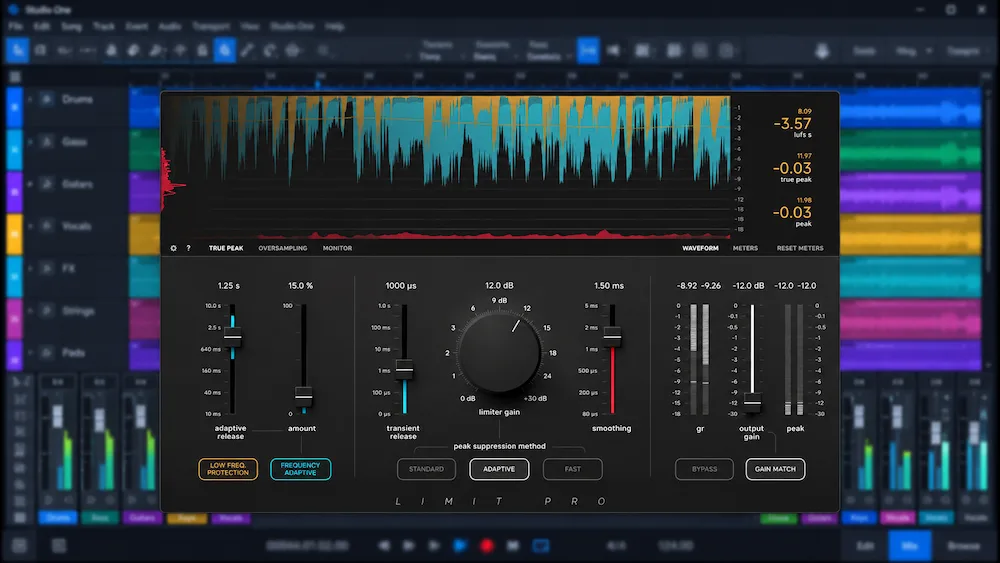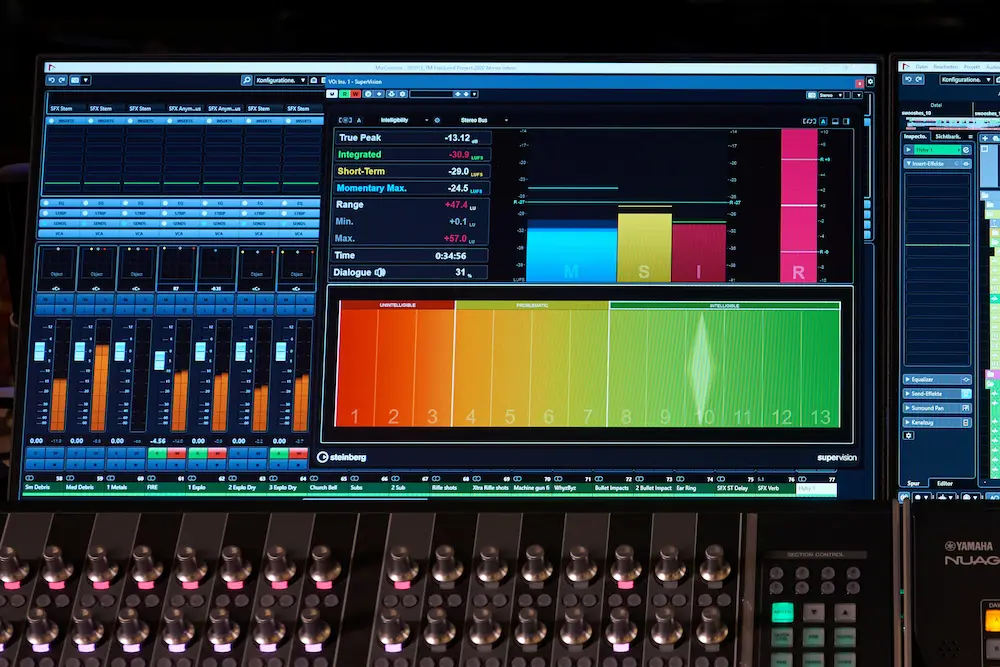
A loudness reading is meaningful only when the measurement method matches the delivery requirements. Under ATSC A/85:2026, audio engineers need to distinguish dialogue-gated loudness from full-program loudness, configure their meters correctly, and evaluate True Peak separately.
The July 2026 revision updates the guidance for television audio and adds recommendations for streaming workflows, including metadata-based and non-metadata-based delivery. The practical challenge is to determine which measurement method applies, establish the correct target, and verify that the delivered audio meets the relevant requirements.
This guide explains the measurement principles, target levels, meter settings, metadata considerations, and quality-control procedures relevant to ATSC A/85:2026.
What Is ATSC A/85?
ATSC A/85, Techniques for Establishing and Maintaining Audio Loudness for Digital Television, is a Recommended Practice published by the Advanced Television Systems Committee. It provides guidance for managing loudness throughout television production, post-production, distribution, and transmission.
The underlying problem is that peak amplitude alone does not describe perceived loudness. Two programs with similar peak levels can sound substantially different because of their dialogue levels, dynamics, spectral balance, and the relationship between speech, music, and effects.
A/85 applies standardized loudness measurement principles to television workflows and addresses related issues such as dynamic-range control, audio metadata, and consistency between programs and commercials. Its measurement framework draws on ITU-R BS.1770, which defines algorithms for measuring program loudness and True Peak.
The current edition, ATSC A/85:2026-07, was approved on July 8, 2026, updating the previous 2013 edition. The revision clarifies measurement practices and includes guidance for streaming services, along with a Loudness and True Peak Quick Reference.
A/85 is an ATSC Recommended Practice, not a standalone statute. Its recommendations can be relevant to regulatory obligations and contractual delivery requirements, but the requirements applicable to a particular submission depend on the relevant law, distribution workflow, and recipient’s specification.
What Changed in ATSC A/85:2026?
The 2026 revision retains the established principles of television loudness management while clarifying how they should be applied. It addresses recurring problems with measurement configuration, the distinction between dialogue and full-program loudness, and the handling of streaming delivery.
One important addition is a dedicated Quick Reference that summarizes the recommended measurement methods and key loudness values. It makes the distinction between long-form and short-form content explicit and provides guidance for choosing a target loudness in streaming workflows.
The revision also addresses metadata-based and non-metadata-based audio delivery. This matters because the measured source level, the metadata carried with the program, and the behavior of the receiving system can all affect the final listening experience.
For engineers, the main task is not simply to update a loudness preset. It is to identify the content category, apply the appropriate measurement method, establish the agreed target, and confirm that the final deliverable is suitable for its intended distribution path.
The Anchor Element: Choosing the Right Loudness Reference
The anchor element is the primary perceptual reference around which a program’s loudness is evaluated. In dialogue-driven television, speech is generally the anchor. In music-led content, the music may serve that role.
Consider a drama with restrained dialogue, a quiet music bed, and a loud action sequence. A full-program measurement includes the contribution of all these elements. Depending on their relative levels and duration, the action and music may substantially affect the integrated result even when the dialogue remains comparatively quiet.
Dialogue-gated measurement addresses a different question: what is the measured loudness of the portions identified as containing speech? This distinction matters because viewers often set their playback level according to dialogue and expect speech to remain reasonably consistent as the program moves between scenes.
The anchor element does not require every line or musical passage to have the same level. Creative dynamics remain important. The purpose is to measure the appropriate reference without allowing unrelated high-energy passages to dictate the result for dialogue-driven content.
Dialogue-gated loudness is not a direct measurement of intelligibility. Masking, reverberation, spectral balance, and playback conditions can still make speech difficult to understand even when the measured dialogue level meets its target.
Make Sure Your Mix Translates Beyond the Meter
Meeting an LKFS target and controlling True Peak are essential for technical delivery, but they do not tell the whole story about tonal balance, dialogue clarity, or how a mix translates across playback systems. A professional mastering review can help assess the finished stereo mix while preserving its intended dynamics and balance. Submit up to 40 seconds of audio for a free mastering demo and hear how the material holds up to a dedicated mastering pass. Request Your Free Mastering Demo →
Dialogue-Gated vs. Full-Program Loudness
Dialogue-gated and full-program loudness are different measurement methods. They should not be treated as interchangeable readings or converted using a fixed offset.
Dialogue-Gated Measurement
 Dialogue-gated measurement uses speech detection to identify portions of a program that contain dialogue. The integrated result is calculated from eligible speech portions rather than treating the entire soundtrack as the measurement reference.
This method is important for long-form, dialogue-driven content, where music and effects may be considerably louder than the speech. A full-program reading can be higher than the dialogue-gated reading, but the difference depends on the program’s content, dynamics, and measurement configuration.
Speech detection is not infallible. Whispered dialogue, overlapping voices, crowd scenes, heavily processed speech, and speech-like sound design can complicate detection. Meter configuration and critical listening therefore remain important.
Full-Program Measurement
Full-program measurement evaluates the complete soundtrack over the selected measurement interval. Dialogue, music, ambience, effects, and other audible elements contribute to the integrated result according to the selected algorithm and gating rules.
This method is used for applicable short-form content, including commercials, public service announcements, interstitials, and music videos. It is particularly relevant when the entire mix, rather than speech alone, is the intended loudness reference.
Full-program measurement is not inherently more or less accurate than dialogue-gated measurement. Each method answers a different question. The result becomes misleading when a reading from one method is interpreted as though it represented the other.
Which Measurement Method Should You Use?
Under the A/85:2026 Quick Reference, applicable long-form content is measured using dialogue-gated loudness. Full-program mix loudness should not normally be used as the loudness measurement for long-form content containing dialogue. Short-form content is measured using full-program loudness.
For long-form material with little or no dialogue, the appropriate approach requires closer examination of the applicable A/85 guidance. Do not assume that a production’s running time or the mere presence of speech is enough to determine the correct method.
Always establish the content category and recipient’s requirements before configuring the meter. If a distributor specifies a different target or measurement arrangement, clarify how that requirement relates to the applicable A/85 recommendations before approving the deliverable.
ITU-R BS.1770 and ATSC A/85: Measurement vs. Delivery Practice
ITU-R BS.1770 defines algorithms for measuring program loudness and True Peak. ATSC A/85 applies loudness measurement principles to television production and distribution, including recommendations for measurement methods, target levels, and delivery workflows.
The distinction is important: using a BS.1770-based meter does not automatically mean that it is configured correctly for a particular A/85 workflow. The selected algorithm version and gate settings affect which parts of the audio contribute to the integrated loudness result.
How BS.1770 Measures Loudness
The BS.1770 algorithm applies K-weighting to the audio signal and combines the contributions of the applicable channels using defined channel-weighting factors. The result is a standardized estimate of program loudness, not a measurement of acoustic sound pressure level in a listening room.
Integrated loudness measurement uses gating to limit the influence of sufficiently quiet material. The details depend on the applicable algorithm version and configuration. True Peak measures a separate property: the estimated maximum level of the reconstructed waveform, including peaks that may occur between digital samples.
Integrated loudness and True Peak must therefore be evaluated independently. One describes the program’s measured loudness; the other helps identify peaks that may exceed the permitted signal level.
BS.1770 Versions and Gate Settings
The A/85:2026 Quick Reference specifies different meter configurations for long-form and short-form content.
- Long-form content: Use dialogue-gated measurement. With BS.1770-1, enable the Speech Gate. With BS.1770-2 or later versions covered by the reference, disable the Relative Gate and enable the Speech Gate.
- Short-form content: Use full-program measurement with BS.1770-3 or a later version. Enable the Relative Gate and disable the Speech Gate.
These settings are not interchangeable. An incorrect configuration can produce a reading that does not represent the required measurement method. A preset labelled “Broadcast” or “ATSC” is not sufficient evidence that the settings are correct.
Before measuring a deliverable, verify the meter’s actual algorithm and gate configuration against the current A/85 guidance. When comparing readings from different products, make sure that their measurement methods, channel layouts, and integration intervals are equivalent.
LUFS vs. LKFS: What Is the Difference?
LUFS means loudness units relative to full scale, while LKFS means loudness, K-weighted, relative to full scale. In standard BS.1770-based practice, they express equivalent numerical loudness values when the same algorithm and measurement method are used.
A reading of -24 LUFS is therefore numerically equivalent to -24 LKFS under equivalent measurement conditions. The unit label does not tell you whether the meter used dialogue gating or full-program measurement.
When comparing loudness readings, check the algorithm version, gate configuration, channel layout, and measurement interval rather than focusing on the unit label alone.
ATSC A/85 Loudness Targets and True Peak
 For delivery or exchange without loudness metadata, and where the parties have not agreed on another target, A/85 recommends a target loudness of -24 LKFS. The Quick Reference anticipates measurement variation of approximately ±2 dB around this value. That tolerance should not be treated as a reason to deliberately aim above or below the target.
The measurement method depends on the content category. For applicable long-form content, the reference is integrated dialogue loudness. For short-form content, it is full-program mix loudness.
| Content or parameter | A/85:2026 guidance | Measurement context |
|---|---|---|
| Long-form content without loudness metadata | -24 LKFS target | Dialogue-gated loudness |
| Short-form content without loudness metadata | -24 LKFS target | Full-program loudness |
| Streaming delivery | -27 to -23 LKFS recommended target range | Choose one consistent target for the service unless the parties agree otherwise |
| Maximum True Peak | -2 dBTP | Approximately ±0.5 dB of measurement variation is anticipated |
The streaming range is not a requirement to use a different target for every program. A/85 recommends a single, consistent target loudness for the service where practicable. The appropriate value depends on the delivery arrangement and any prior agreement between the parties.
Understanding the Loudness Tolerance
A tolerance describes the measurement variation that may occur around a nominal target. For the -24 LKFS reference, the Quick Reference anticipates variation of approximately ±2 dB because of measurement differences.
This tolerance should not be interpreted as a new target range for creative decisions. The nominal target remains the reference point, and content should not deliberately be aimed at the high or low edge of the tolerance.
What the True Peak Limit Controls
True Peak estimates the maximum amplitude of the reconstructed waveform, including inter-sample peaks that may exceed the highest stored digital sample. Such peaks can become relevant during digital-to-analog reconstruction, sample-rate conversion, and lossy encoding.
A/85 lists -2 dBTP as the maximum True Peak reference. The approximately ±0.5 dB allowance in the Quick Reference accounts for measurement variation between meters; it should not be treated as a general instruction to target a higher peak level.
Integrated loudness and True Peak describe different properties. A program can meet its loudness target and still exceed its True Peak limit. Conversely, keeping peaks below the limit does not establish that the program meets its loudness target.
When the delivery workflow requires checking an encoded or transcoded file, measure the actual deliverable rather than relying only on readings from the unencoded mix or master.
How to Configure a Loudness Meter for ATSC A/85
Correct meter configuration is essential before evaluating compliance. A loudness reading may be misleading if the selected algorithm, gate settings, or measurement interval do not match the required workflow.
Step 1: Identify the Content Type
Determine whether the deliverable falls under the applicable long-form or short-form guidance. Long-form content containing dialogue generally uses dialogue-gated measurement; short-form content uses full-program measurement under the corresponding A/85 recommendations.
Step 2: Select the Applicable BS.1770 Version
Choose a supported algorithm version that matches the current A/85 recommendation. For the applicable short-form workflow, the Quick Reference specifies BS.1770-3 or a later version. The long-form workflow has its own requirements for the algorithm and dialogue gating.
Step 3: Verify Gate Configuration
For long-form content, configure the meter for dialogue-gated measurement. With BS.1770-1, enable the Speech Gate. With BS.1770-2 or later versions covered by the guidance, disable the Relative Gate and enable the Speech Gate.
For short-form content, enable the Relative Gate and disable the Speech Gate. Do not enable both gates on the assumption that more gating will produce a more accurate result.
Step 4: Measure the Entire Program
Reset the integrated loudness measurement and run the complete program from beginning to end. Include the opening, closing, fades, and any other audio that forms part of the actual deliverable.
For long-form content, the Quick Reference specifies measurement over the entire duration of the composite mix, not act by act. Make sure the measurement interval excludes unrelated material and represents the program being delivered.
Step 5: Evaluate Loudness and True Peak Separately
Record integrated loudness and True Peak as separate measurements. Check the result against the correct target and limit for the content category and delivery arrangement.
If a reading differs unexpectedly from another meter, check the algorithm version, gate settings, channel layout, and measurement interval before changing the mix.
Loudness Management for Streaming Services
Streaming delivery introduces variables that cannot be resolved by checking a single loudness value. A service may use metadata, measure the submitted audio, or apply its own playback-level management. The result depends on the delivery format and the receiving system.
ATSC A/85:2026 includes guidance for streaming services using metadata-based and non-metadata-based codecs. For streaming delivery, it recommends a single target loudness between -23 and -27 LKFS unless the parties have made another arrangement.
A service should aim for a consistent target loudness across long-form and short-form content where practicable. At a minimum, the loudness of short-form content should not exceed that of the long-form content it accompanies. This helps maintain consistent perceived levels during transitions between programs and commercials.
The recommended range is not a universal target for every consumer music platform. Individual providers may have their own technical requirements, normalization policies, and metadata rules. Before delivery, confirm the applicable specification rather than assuming that compliance with A/85 automatically guarantees a particular playback level on every service.
Normalization and Content Transitions
Loudness normalization adjusts playback level according to the system’s measurement and gain-control rules. The effect depends on what the system measures, which target it uses, and how it applies the adjustment.
A/85 emphasizes consistency between long-form and short-form content. A service should not select targets that cause accompanying commercials to be louder than the programs they interrupt. Where a service operates at one agreed target, the measurement method still needs to match the relevant content type.
A single loudness target cannot guarantee identical playback across services, codecs, devices, and user settings. The objective is to meet the specified delivery requirements and preserve consistent loudness management through the intended distribution chain.
Metadata-Based and Non-Metadata Audio Workflows
Loudness metadata carries information that a compatible downstream system can use when managing playback level. Its exact function depends on the format, codec, and receiving implementation.
For delivery without loudness metadata, A/85 recommends -24 LKFS when the parties have not agreed on another target. For metadata-based delivery, the Quick Reference describes the use of dialnorm or equivalent loudness metadata. Engineers should follow the relevant delivery specification and ensure that the metadata accurately represents the intended program and workflow.
What Loudness Metadata Can and Cannot Do
Supported metadata can provide information for downstream level management. A compatible decoder or distribution system may use that information when adjusting playback gain or applying format-specific processing.
Metadata does not repair an unbalanced mix, restore clipped transients, resolve dialogue masking, or guarantee consistent playback across all platforms. Incorrect values, missing fields, or unsupported metadata may also cause the receiving system to handle the program differently than intended.
What to Verify Before Delivery
- Whether the recipient requires loudness metadata or a non-metadata workflow.
- Whether the required metadata fields are supported by the selected format and codec.
- Whether the values correspond to the correct program and measurement method.
- Whether encoding, transcoding, and packaging preserve the required metadata.
- Whether the receiving workflow applies additional loudness normalization or dynamic-range processing.
Do not rely on a preset name to establish that metadata is correct. Validate the required fields and confirm that the final deliverable follows the recipient’s specification.
ATSC A/85 vs. EBU R128
ATSC A/85 and EBU R128 address consistent program loudness, but they serve different broadcast environments and should not be treated as interchangeable delivery specifications. Both use ITU-R BS.1770-based loudness measurement, but their reference levels and implementation requirements differ.
| Aspect | ATSC A/85 | EBU R128 |
|---|---|---|
| Primary context | North American television and relevant streaming workflows | European broadcasting and associated production workflows |
| Measurement foundation | ITU-R BS.1770 | ITU-R BS.1770 |
| Common program-loudness reference | -24 LKFS for applicable delivery without metadata or another agreed target | -23 LUFS under the standard EBU R128 recommendation |
| Implementation | Follow the applicable A/85 guidance and recipient’s specification | Follow the current EBU R128 framework and recipient’s specification |
The commonly cited -23 LUFS reference under EBU R128 is not a universal target for every European streaming service. Likewise, the -24 LKFS reference associated with A/85 should not automatically be applied to every audio delivery in the United States.
For projects intended for both North American and European distribution, establish the requirements before finalizing the master. If separate deliverables are needed, document the target, measurement method, gating configuration, and True Peak limit for each version.
What ATSC A/85 Means for Mixing and Mastering
Loudness compliance is part of technical delivery, not a substitute for creative judgment. The purpose of measurement is to verify the applicable requirements while preserving the balance, dynamics, and intended impact of the mix.
Loudness Is Not the Same as Dialogue Intelligibility
A program can meet its integrated loudness target and still have poor dialogue intelligibility. Masking from music and effects, excessive reverberation, inconsistent dialogue levels, unsuitable equalization, and limited playback bandwidth can all make speech difficult to follow.
Increasing the overall level does not necessarily solve these problems. Improving the balance between dialogue and competing elements may be more effective than adding gain or compression. Dialogue-gated loudness is a measurement method, not a direct assessment of intelligibility.
Preserve Dynamic Contrast
A loudness target does not require a soundtrack to have uniform dynamics. Film and television mixes often depend on the contrast between restrained dialogue, quiet passages, music, and high-impact effects. Excessive compression can reduce transient impact and alter the perceived distance between elements.
Evaluate dynamics in the context of the intended playback environment and delivery requirements. Correct dialogue balance and peak management where necessary, but do not flatten the entire program simply to make its loudness readings look uniform.
Verify the Final Deliverable
Encoding, sample-rate conversion, channel mapping, and metadata handling can affect the delivered signal or the way a receiving system processes it. When the workflow requires it, measure and audition the final exported or encoded file rather than relying solely on the mix-session reading.
Confirm the file format, sample rate, bit depth, channel layout, metadata, and measurement results against the recipient’s requirements. A session measurement is useful during production, but the submitted deliverable is the file that ultimately needs to pass the relevant checks.
ATSC A/85 Pre-Delivery Quality-Control Checklist
Use this checklist to catch common technical problems before submitting a television or streaming audio deliverable. It supplements, rather than replaces, the recipient’s formal acceptance criteria.
Content and Specification
- Identify the applicable content category and loudness measurement method.
- Confirm the nominal target and permitted measurement tolerance.
- Determine whether dialogue-gated or full-program measurement is required.
- Establish whether loudness metadata is required and how it must be handled.
- Check the recipient’s requirements alongside the current A/85 guidance.
Meter Configuration
- Select the applicable BS.1770 version.
- Verify the Speech Gate and Relative Gate settings.
- Measure the complete program using the correct measurement method.
- Confirm the channel layout and measurement interval.
- Record integrated loudness and True Peak separately.
Listening and Audio Quality
- Listen for dialogue masked by music, ambience, or effects.
- Check transitions between quiet passages and high-energy scenes.
- Investigate True Peak excursions and signs of clipping or distortion.
- Confirm that dynamic-range processing preserves the intended impact.
- Check channel balance, downmix behavior, and required alternate mixes.
Final Files and Documentation
- Verify the required sample rate, bit depth, channel layout, and file format.
- Confirm that required loudness metadata is present and valid.
- Recheck the exported file after final encoding or processing when required.
- Verify filenames, version labels, and delivery notes.
- Retain the measurement results and identify the specification used for approval.
Common ATSC A/85 Compliance Mistakes
Using full-program measurement for every content type. Full-program and dialogue-gated measurements answer different questions. Using the wrong method can produce a reading that does not represent the required loudness reference.
Enabling every available gate. More gating does not automatically make a measurement more accurate. The algorithm and gate configuration must match the prescribed workflow.
Trusting a meter preset without checking its settings. A preset labelled “Broadcast” or “ATSC” may use settings intended for another workflow or an earlier recommendation. Check the actual algorithm and gate configuration.
Confusing True Peak with integrated loudness. Integrated loudness and True Peak measure different properties. Passing one check does not establish compliance with the other.
Applying one television target to every streaming platform. A/85 provides guidance for television and relevant streaming workflows, but individual services may have their own requirements. Confirm the intended recipient’s specification.
Changing the mix before verifying the measurement. An unexpected reading may result from an incorrect meter configuration rather than a mixing problem. Verify the method and settings before applying additional gain or compression.
Go Beyond Loudness Compliance — Hear What Your Mix Can Deliver
Meeting the correct LKFS target and staying below the True Peak limit are essential, but passing the meter check does not guarantee clear dialogue, controlled low frequencies, balanced dynamics, or reliable translation across playback systems. Before making more mix adjustments based on numbers alone, hear how your stereo mix responds to a professional mastering pass. Upload up to 40 seconds and receive a free mastering demo prepared by a real mastering engineer, so you can compare the original and mastered versions and judge the differences for yourself. Upload Your Mix for a Free Mastering Demo →
Frequently Asked Questions About ATSC A/85
What Is the Current Version of ATSC A/85?
The current published edition is ATSC A/85:2026-07, approved on July 8, 2026. It updates the previous 2013 edition and includes guidance for streaming workflows and a Loudness and True Peak Quick Reference.
What Is the ATSC A/85 Loudness Target?
For delivery or exchange without loudness metadata, and where no other target has been agreed, A/85 recommends -24 LKFS. The applicable measurement method depends on the content category. For streaming services, the Quick Reference recommends selecting a consistent target between -23 and -27 LKFS unless the parties agree otherwise.
What True Peak Limit Does ATSC A/85 Recommend?
The Quick Reference lists -2 dBTP as the maximum True Peak reference. It anticipates approximately ±0.5 dB of measurement variation between meters. This variation should not be interpreted as a general permission to target above the limit.
Should I Use Dialogue-Gated or Full-Program Loudness?
Applicable long-form content uses dialogue-gated measurement, while short-form content such as commercials, interstitials, and music videos uses full-program measurement. Check the current A/85 guidance for unusual content categories and edge cases.
Why Do Two Loudness Meters Show Different Readings?
Differences can result from the algorithm version, gate settings, measurement interval, channel configuration, or measurement mode. Compare these settings before concluding that either meter is inaccurate.
Are LUFS and LKFS the Same?
In standard BS.1770-based practice, LUFS and LKFS express equivalent numerical loudness values when the same algorithm and measurement method are used. The configuration determines what the reading represents.
Does ATSC A/85 Apply to All Streaming Services?
A/85 includes guidance for streaming-media workflows, but individual providers may have additional or different delivery requirements. Confirm the applicable loudness, metadata, format, and peak-level specifications.
Does Meeting the Loudness Target Guarantee Clear Dialogue?
No. Dialogue intelligibility also depends on masking, spectral balance, reverberation, playback conditions, and the relationship between speech and competing sounds.
Is ATSC A/85 a Legal Requirement?
A/85 is an ATSC Recommended Practice rather than a standalone statute. Its recommendations may be relevant to regulatory or contractual obligations, depending on the applicable law and delivery arrangement.
Conclusion: Measure the Right Thing Before Changing the Mix
ATSC A/85:2026 makes the distinction between dialogue-gated and full-program loudness central to the measurement process. The correct method depends on the content category, while the target and metadata requirements depend on the delivery arrangement.
For engineers, the reliable approach is to configure the meter correctly, measure the intended program, evaluate integrated loudness and True Peak separately, and verify the final deliverable. The goal is to meet the applicable requirements without sacrificing the dialogue balance, dynamics, and creative intent of the mix.

Yurii Ariefiev is an audio production editor focused on the technical standards that shape reliable broadcast delivery. His perspective on ATSC A/85 centers on measurement accuracy, dialogue-gated loudness, LKFS readings, and True Peak verification, with particular attention to how meter configuration and delivery specifications affect the interpretation of audio measurements.
Enjoyed this review?
If you found it useful, you can support independent audio research with a coffee.
☕ Buy me a coffee