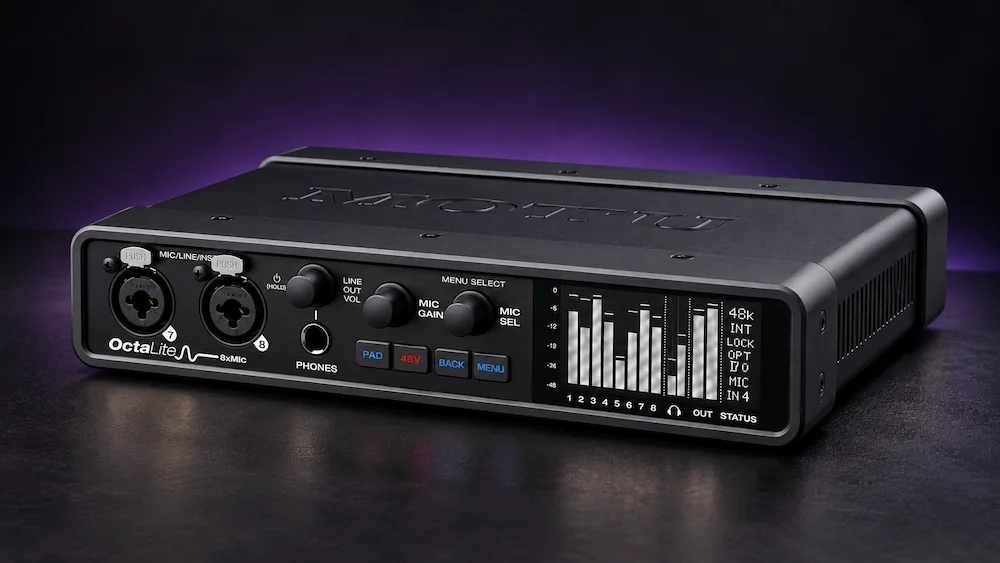
The MOTU OctaLite is designed for studios that need eight microphone preamps, onboard DSP monitoring, and ADAT connectivity in a compact half-rack unit. It combines multichannel recording with flexible digital routing without requiring a full-size rack interface. Whether it offers good value depends on the current price and how much you need its eight preamps, DSP monitoring, and ADAT connectivity. That configuration makes it relevant for drum tracking, live sessions, and recording multiple performers. For producers who work almost entirely in the box, however, the additional inputs may not justify the cost.
Input count alone says little about an interface’s value for mixing or mastering. Eight preamps can simplify recording, while DSP effects can provide useful control over headphone mixes. Neither feature inherently improves the sound of a finished track. The key question is whether the OctaLite’s input capacity, monitoring options, and routing flexibility offer a meaningful advantage over a conventional audio interface paired with an ADAT expander.
This review examines the OctaLite from an engineer’s perspective, focusing on its preamps, ADAT expansion, DSP monitoring, analog I/O limitations, and practical role in a modern recording and mixing setup.
Why Eight Microphone Preamps Matter in a Compact Interface
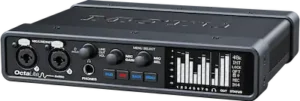 For multichannel recording, the number of available microphone preamps can matter more than an interface’s physical size. A two-preamp desktop unit works well for overdubs and solo recording, but it falls short when a session requires multiple microphones at once. Drum kits, acoustic ensembles, live rehearsals, and bands recording together can easily require eight or more inputs.
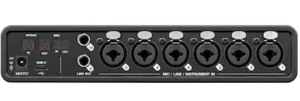
The MOTU OctaLite provides eight mic/line inputs for simultaneous recording. The two front-panel inputs are especially convenient for temporary instrument connections, while the rear-panel inputs suit sources that remain connected between sessions. Two inputs are accessible from the front panel for convenient instrument connections; the remaining inputs are positioned on the rear for fixed studio wiring. This layout suits setups where some sources remain connected between sessions while others are patched in as needed.
In a space-limited project studio, that arrangement can reduce repatching and keep a multichannel recording setup ready to use. It also supports hybrid workflows in which virtual instruments and in-the-box production are combined with recorded vocals, guitars, synthesizers, drum machines, or other external sources.
The trade-off is straightforward: input capacity has value only if the session requires it. For an engineer recording one vocalist or instrument at a time, eight preamps may add cost without improving the workflow. The OctaLite makes the strongest case in studios that regularly record several sources simultaneously and need that capacity in a compact enclosure.
MOTU OctaLite Specifications: What Matters in Practice
The MOTU OctaLite combines eight analog mic/line/instrument inputs, USB audio, optical ADAT connectivity, and onboard DSP. Its published specifications help establish whether it fits a recording setup, but figures such as EIN, gain range, and converter bit depth need to be interpreted in context. Manufacturer specifications describe stated capabilities; they are not a substitute for independent performance measurements.
| Specification | Practical significance |
|---|---|
| 16 inputs / 12 outputs at 44.1–48 kHz | Provides the full advertised channel configuration at standard sample rates. Available USB and digital I/O channels vary at higher sample rates. |
| 12 inputs / 12 outputs at 88.2–96 kHz | Higher-rate operation reduces the available input count. Verify the channel configuration before planning a multichannel session. |
| 8 inputs / 4 outputs at 176.4–192 kHz | High sample rates impose a substantial I/O trade-off, which matters when recording multiple sources or routing signals to external equipment. |
| Eight mic/line/instrument inputs | Allows simultaneous recording of multiple microphones, instruments, and line-level sources. |
| Up to 74 dB of preamp gain | Offers substantial gain for low-output microphones. Actual suitability also depends on noise performance and the microphone’s output level. |
| −129 dBu EIN | Indicates the published equivalent input noise. Meaningful comparisons require consistent measurement conditions. |
| 24-bit A/D conversion and ESS Sabre32 DAC technology | Identifies the published conversion specifications. Bit depth and DAC chipset alone do not establish the interface’s overall measured performance or audible superiority. |
| DSP reverb, four-band EQ, compression, and gating | Supports hardware-based monitor processing, reducing the need to build every cue mix from DAW plugins. |
| Per-input phantom power, pad, and polarity controls | Individual 48V phantom power, a -20 dB pad, and polarity inversion provide input-level control for different microphones and sources. |
| Pre/post-FX routing | Allows the input signal to be routed to the computer dry or with DSP processing, depending on the selected configuration. |
| Loopback and independent headphone monitoring | Supports computer-audio capture for streaming and a separate headphone mix for monitoring workflows. |
| Optical ADAT connectivity | Supports digital integration with compatible interfaces and external converters, subject to channel-count limits at higher sample rates. |
| USB 2.0 | Defines the USB data standard. A USB-C connector does not imply USB 3 or USB 4 throughput. |
| Price varies by retailer | Check the current price against the interface’s input capacity, DSP monitoring, and routing options. |
For recording and mixing, the most useful specifications are those that affect noise, headroom, connectivity, and monitoring. An EIN figure, for example, cannot be compared reliably without knowing the measurement bandwidth, source impedance, gain setting, and test method. Converter performance likewise depends on measured dynamic range, distortion, and noise—not bit depth alone. Round-trip latency also varies with sample rate, buffer size, driver performance, and system configuration.
These figures should therefore be treated as selection criteria rather than proof of sound quality. The practical question is whether the OctaLite provides the required input count, usable digital expansion, and monitoring workflow for the intended sessions.
MOTU OctaLite Workflow: Eight Preamps, DSP Monitoring, and ADAT Expansion
Eight Inputs for Multichannel Recording
The OctaLite’s main advantage is the ability to record up to eight analog sources simultaneously without adding a separate bank of microphone preamps. For drum tracking, the available inputs can accommodate kick, snare, toms, overheads, and room microphones, depending on the recording setup. The same capacity suits small live sessions, acoustic ensembles, and electronic producers capturing several hardware instruments in one pass.
The benefit is primarily operational. Integrating eight preamps into one unit reduces the need for additional hardware, interconnecting cables, and rack space. It also simplifies setup when multiple sources must be recorded together. These conveniences do not automatically translate into lower noise or better conversion; those depend on the performance of the complete signal path.
Input placement also affects day-to-day usability. Two front-panel inputs make temporary instrument connections convenient, while the rear-panel inputs suit sources that remain wired between sessions. Engineers who frequently patch different microphones across all eight channels may prefer an interface with more accessible front-panel connections.
DSP Monitoring for Recording Sessions
The onboard DSP mixer includes reverb, four-band EQ, compression, and gating. These tools allow engineers to shape monitor feeds during recording without building the entire cue mix from DAW plugins. That can be useful when performers need a more finished-sounding headphone mix to work comfortably.
A vocalist, for example, can monitor with reverb while the recorded signal remains dry, provided the routing is configured accordingly. During drum tracking, EQ and gating in the monitor path can help make individual microphones easier to hear. Hardware-based monitoring can also reduce dependence on the DAW’s buffer settings for those monitor effects.
DSP processing should not be mistaken for an improvement to the recorded signal by default. The practical advantage is a more self-contained monitoring workflow, not proof that the onboard effects outperform native plugins or that the computer’s processing load disappears entirely. This differs from a USB microphone such as the Shure MV6 Gen 2, where DSP is part of the capture path and can shape the signal before it reaches the DAW.
Before relying on the OctaLite for a specific session, confirm the available signal-routing options, including whether the recording feed is taken before or after DSP processing and how cue mixes behave in standalone operation. Those details determine whether the monitoring setup can meet the session’s requirements.
ADAT Expansion for an Existing Interface
ADAT connectivity can make the OctaLite useful as an input expander as well as a standalone USB interface. When connected to a compatible interface with optical ADAT input, it can add analog inputs without requiring the studio to replace its existing system. This is particularly relevant when the current interface still meets monitoring and output requirements but lacks enough microphone preamps for larger sessions.
This modular approach lets an engineer retain an established computer connection and monitoring setup while expanding the available input count. Compatibility depends on the host interface, optical I/O configuration, digital clocking, and supported sample rates, so the intended connection should be checked before purchase.
ADAT channel capacity also decreases at higher sample rates when S/MUX is used to carry higher-rate audio. The number of available channels therefore depends on the sample rate and the devices at both ends of the connection. A studio planning to record many sources at 88.2 or 96 kHz should verify the supported channel count rather than assume that all base-rate ADAT channels remain available.
For studios that already own an ADAT-equipped interface, this expansion role may be a stronger reason to consider the OctaLite than replacing the existing interface altogether. The decision depends on whether its preamps, routing, and monitoring functions justify the cost compared with a dedicated ADAT converter.
Hear How Your Mix Translates Beyond the Studio
A multichannel recording setup gives you control over how sources are captured, but the finished mix still depends on clarity, low-end definition, stereo balance, and dynamics working together. Submit up to 40 seconds of your mix for a free mastering demo to hear how your existing mix translates through a dedicated mastering process, without assuming that any particular change is guaranteed. Request Your Free Mastering Demo →
MOTU OctaLite Audio Quality: Understanding the Published Specifications
MOTU lists up to 74 dB of preamp gain and an equivalent input noise (EIN) figure of −129 dBu for the OctaLite. These specifications indicate the intended gain range and published noise performance under the manufacturer’s measurement conditions. Both matter when recording low-output microphones or quiet sources, where preamp noise can become a limiting factor.
EIN alone does not determine the noise level of a finished recording. Microphone self-noise, source impedance, gain settings, acoustic conditions, and overall gain staging all affect the result. Consistent levels throughout the signal path are also important when evaluating headroom and avoiding unnecessary noise or clipping; this is where gain staging in mixing becomes relevant. The published EIN figure is useful for technical comparison, but meaningful conclusions require consistent test conditions across competing interfaces.
The same principle applies to the ESS Sabre converter technology identified in the OctaLite’s specifications. The converter chipset is only one part of the signal path. Analog input and output circuitry, power supply design, implementation, and system performance all influence the measured results. The chipset name or nominal bit depth alone cannot establish audible superiority.
Independent measurements and controlled listening comparisons are not available for this review, so the published specifications cannot establish whether the OctaLite sounds better than similarly priced interfaces. The most useful future comparisons would measure input noise, converter dynamic range, distortion, and output performance under consistent conditions.
For mixing and mastering, the practical priorities are accurate monitoring, stable operation, predictable routing, and sufficiently low noise and distortion. An interface with impressive published specifications does not automatically produce a more accurate mix or a better master. Room acoustics, loudspeaker performance, and reference headphone behavior, along with monitoring level and engineering decisions, remain critical to the final result.
MOTU OctaLite Latency, Drivers, and DAW Reliability
 MOTU advertises round-trip latency as low as 2 ms under specified operating conditions, including a 32-sample buffer at a 96 kHz sample rate with optimized drivers. This is a manufacturer specification, not a result that should be expected across every computer, DAW, sample rate, or buffer setting. Actual performance depends on the driver, buffer configuration, safety buffers, and the system’s ability to process audio in real time.
Smaller buffers reduce monitoring latency, which matters when playing virtual instruments or monitoring through DAW effects. The trade-off is reduced processing headroom: demanding sessions may develop clicks, dropouts, or audio interruptions if the CPU cannot complete each processing cycle in time. Increasing the buffer can improve stability, but adds latency to software-based monitoring.
The OctaLite’s onboard DSP monitoring offers another option for recording. When the cue mix is handled by the interface rather than routed entirely through the DAW, performers can monitor with less dependence on the host buffer setting. This is particularly useful when tracking vocals or instruments in projects with demanding plugin chains, although the exact monitoring behavior depends on the available routing configuration.
Published specifications alone cannot establish driver stability, CPU overhead, project-loading performance, or long-term reliability. These factors need to be evaluated on the intended operating system, DAW, and session configuration. Before using the OctaLite for critical recording work, test it at the sample rates and buffer sizes the studio actually uses, including sessions with realistic track counts and plugin loads.
Compatibility also requires more than checking whether the interface can pass audio over USB. Basic class-compliant operation does not necessarily provide access to every advanced routing or DSP control. Engineers who depend on CueMix features, custom monitor mixes, or specific driver functions should confirm operating-system support and software requirements before committing to the device.
MOTU OctaLite vs. Focusrite, Audient, and Other Alternatives
The right alternative to the MOTU OctaLite depends on what the studio needs most: eight microphone preamps, flexible analog I/O, desktop convenience, or affordable ADAT expansion. These products overlap in some areas, but they are designed around different recording and routing priorities.
| Interface | Choose it when… | Key advantage | Main trade-off |
|---|---|---|---|
| MOTU OctaLite | You need eight preamps in a compact unit that can also work as an ADAT expander. | Combines eight analog inputs, DSP monitoring, standalone operation, and digital expansion. | Only two balanced analog line outputs are available for conventional external hardware routing. |
| Focusrite Scarlett 18i20 4th Gen | You want a rack-format interface for a more permanent studio installation. | Provides eight mic preamps in a conventional rack-based recording system. | Its larger format and different routing architecture may be less convenient for a compact or portable setup. |
| Audient EVO 16 | You want eight preamps in a desktop-oriented multichannel interface. | Combines eight mic preamps with assisted gain-setting features. | Its connectivity, control layout, and workflow differ from the OctaLite; compare the required I/O before buying. |
| MOTU UltraLite-mk5 | You need a compact interface for a hybrid setup with external processors. | Offers a more extensive analog output configuration for routing hardware. | It has fewer built-in microphone preamps, so a large multichannel recording session may require additional preamps. |
| Behringer ADA8200 | You already own an interface with compatible ADAT input and only need more analog channels. | Provides eight additional analog input channels without replacing the host interface. | It is an expander, not a standalone USB interface with the OctaLite’s DSP monitoring workflow. |
The most important distinction is whether you need a new USB interface or additional inputs for an existing one. If your current interface already provides the monitor outputs, headphone routing, and computer connection your studio needs, an ADAT expander may be the more economical way to add microphone inputs. The OctaLite is a stronger fit when you also need its own USB interface functionality, DSP monitoring, and compact standalone mixer operation. For a hybrid studio, compare the number of simultaneous analog outputs and hardware insert paths before comparing preamp counts.
For hybrid mixing with several external processors, the UltraLite-mk5’s analog output flexibility may be more useful than the OctaLite’s higher preamp count. If your existing interface already provides ADAT input, the ADA8200 may be the more economical expansion route. It adds channels to the existing system rather than replacing it.
Before comparing prices, count the analog inputs and outputs you actually need, including hardware inserts, monitor feeds, and headphone mixes. An interface with more preamps is not automatically the better purchase if your limiting factor is output routing.
MOTU OctaLite for Mixing, Mastering, and Hybrid Studios
The MOTU OctaLite is primarily a recording interface and monitoring system. Its value in mixing and mastering comes from the connectivity and monitoring path it provides, not from any direct effect on the processing decisions that shape a finished track.
For an in-the-box mixing engineer, eight preamps may be useful when recording clients or tracking multiple instruments, but they offer little advantage during a mix that relies almost entirely on existing audio files and software processing. Engineers who use external compressors, equalizers, or other hardware should assess the analog output configuration carefully: eight analog inputs do not provide eight analog outputs for hardware inserts. This matters when integrating external processors into a mix bus processing setup.
In mastering, the key question is whether the interface supports the studio’s monitoring accuracy and routing requirements. A compact unit can work well in a stereo mastering setup if its measured performance and connections are appropriate. A system built around multiple analog processors or several independent monitor paths may be better served by an interface with more analog outputs.
The OctaLite can also be useful for podcasting and streaming when loopback or virtual routing is part of the workflow. These functions can simplify combining microphone signals with computer playback, but they do not inherently improve the sound of the final stream. Results still depend on microphone technique, processing, gain structure, and the streaming platform’s signal path.
MOTU OctaLite Limitations: Output Count, Form Factor, and Verification
The OctaLite prioritizes input capacity over analog output flexibility. Its stereo pair of balanced monitor outputs is sufficient for a conventional two-channel setup, but offers limited connectivity for studios that rely on multiple hardware inserts, external processors, or independent analog monitor feeds. Before buying, map the required inputs and outputs across the entire signal chain rather than judging the interface by its eight preamps alone.
The half-rack enclosure saves space, but its physical layout may be less convenient in studios that frequently repatch equipment. With most connections on the rear panel, changing sources can require access behind the unit. A permanent rack installation may also require mounting accessories, adding to the total system cost.
USB-C describes the connector, not the data protocol. The OctaLite uses USB 2.0, so buyers should focus on supported channel counts, driver compatibility, and routing capabilities rather than assume the connector indicates a newer or faster USB standard.
MOTU OctaLite Verdict: Who Should Buy It?
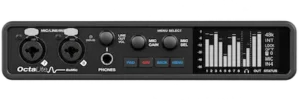 The MOTU OctaLite is best suited to recording studios that regularly need eight analog inputs, compact hardware, DSP monitoring, and optical expansion. Its combination of built-in preamps and standalone mixing can simplify a multichannel recording setup without requiring a full-size rack interface.
It is a less compelling purchase for producers who rarely record more than one or two sources at a time, or for hybrid studios that depend on several simultaneous analog hardware connections. In those cases, the available input count may be excessive while the two balanced line outputs may be restrictive.
Before buying, compare the OctaLite with the interface you already own and calculate the actual cost of meeting your I/O requirements. If you mainly need additional preamps, an ADAT expander may be sufficient. If you need a standalone USB interface with eight preamps and DSP monitoring in a compact enclosure, the OctaLite makes a stronger case.
The deciding factor is not the converter chipset or the number of specifications on the product sheet. It is whether the OctaLite’s input capacity, digital connectivity, monitoring workflow, and limited analog output configuration fit the way your studio actually works.
MOTU OctaLite FAQ
Can the MOTU OctaLite record eight microphones simultaneously?
Yes. Its eight analog mic/line/instrument inputs support simultaneous multichannel recording. The total number of available channels depends on the DAW configuration, sample rate, and any connected digital devices.
Can the MOTU OctaLite operate without a computer?
It supports standalone mixer operation. Check the current CueMix documentation to confirm which routing options, DSP functions, and saved settings remain available when the interface is disconnected from a host computer.
Can I use the OctaLite with another audio interface?
Yes, it can serve as an ADAT expander with a compatible interface that has optical ADAT input. Confirm channel capacity at the intended sample rate, optical routing, and digital clocking before connecting the devices.
Is the MOTU OctaLite compatible with macOS and Windows?
Compatibility depends on the operating-system version and the required driver and control software. Check MOTU’s current compatibility information before purchase, particularly if your workflow relies on advanced DSP mixing or routing rather than basic audio input and output.
Is the MOTU OctaLite suitable for a hybrid studio with external hardware?
It can work in a hybrid studio, but its two balanced analog line outputs limit conventional hardware-insert and independent monitor-routing options. The optical connections provide additional digital I/O, but they do not replace the need for enough analog outputs when routing signals through external processors. Check the complete signal path before buying.
Is the MOTU OctaLite better than the Focusrite Scarlett 18i20?
Neither is universally better. The OctaLite combines eight preamps with a compact half-rack design and DSP monitoring. The Scarlett 18i20 4th Gen offers a conventional rack format and a different set of studio connectivity options. Compare analog I/O, routing, installation requirements, and monitoring workflow before choosing.
Is the MOTU OctaLite worth the price?
It may justify the price if eight preamps, DSP monitoring, and ADAT expansion solve a recurring recording or routing problem. If you usually record one or two sources at a time, a less expensive interface may offer better value. Confirm the current selling price before purchasing.
Can I use the MOTU OctaLite for streaming and podcasting?
Yes. Its loopback functionality and DSP monitoring can support workflows that combine microphone signals with computer audio. The practical benefit is routing flexibility, not an automatic improvement in sound quality. Confirm that the available inputs, mixes, and loopback configuration meet the requirements of your streaming software.
Your Interface Captures the Mix. Hear What Happens at the Mastering Stage.
The MOTU OctaLite gives you the inputs and monitoring tools to build a recording workflow, but the final result still depends on how the mix balances low-end definition, stereo image, dynamics, and detail. Instead of relying on specifications or another round of adjustments alone, compare your own mix with a version processed by a real mastering engineer. Upload up to 40 seconds of your track for a free mastering demo and hear the before-and-after difference for yourself. The comparison gives you a practical reference for evaluating your mix, without promising that every issue can be solved at the mastering stage. Upload Your Mix for a Free Mastering Demo →

Yurii Ariefiev is a mastering engineer and audio-production editor covering recording interfaces, monitoring systems, and studio signal flow. This review focuses on the OctaLite’s eight-input architecture, ADAT expansion, DSP monitoring, and analog output limitations. Performance claims are distinguished from published specifications where independent verification is unavailable.
Enjoyed this review?
If you found it useful, you can support independent audio research with a coffee.
☕ Buy me a coffee