REFERENCE 3 Review: Is This the Smartest Mix Referencing Plugin or Just Another Crutch?
Mix referencing has always been a discipline, not a feature. You compare, interpret, adjust, and repeat. That loop requires experience, not just tools.
REFERENCE 3 by Mastering The Mix attempts to compress that entire process into a guided system. Instead of asking “what’s wrong with my mix?”, it starts telling you exactly what to change.
This is where things get interesting—and problematic.
What REFERENCE 3 Actually Does
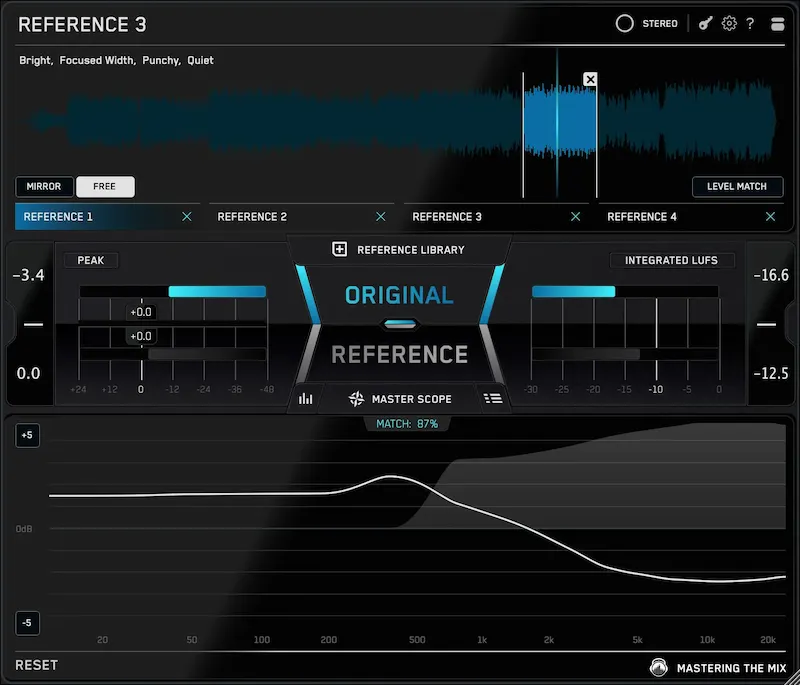
At its core, REFERENCE 3 is a mix referencing plugin designed to compare your track against professionally released material. It sits on your master bus and evaluates how close your mix is to a chosen reference.
That concept isn’t new. What’s new is how aggressively the plugin translates analysis into decisions.
Instead of showing raw data, it builds actionable output:
— EQ correction targets based on perceptual weighting
— stereo width comparison across frequency bands
— dynamic range and compression analysis
— loudness-matched A/B referencing
— phase coherence checks
The keyword here is guidance. REFERENCE 3 doesn’t just show differences—it interprets them for you.
Key Features That Redefine Mix Referencing
Smart Reference Tracks
Automatically selects reference tracks from your library that best match your mix profile. This eliminates one of the most common mistakes in mix referencing—choosing the wrong references.
Level Line
Provides exact EQ suggestions. Not “more low end,” but “boost by X dB at this range.” This crosses into decision-making territory.
Stereo Width Display
Breaks down stereo imaging per frequency zone, making width issues visible instead of subjective.
Overcompression Detection
Flags areas where transient impact is reduced compared to the reference.
Mix Instructor
Converts analysis into plain-text commands. This is where mix referencing stops being analytical and becomes procedural.
Match Percentage
A real-time score showing how close your mix is to the reference across multiple dimensions.
This feature alone can distort judgment if misunderstood.
How It Works Under the Hood
REFERENCE 3 relies heavily on loudness normalization. Every comparison is level-matched automatically, removing the most common bias in audio perception.
It also uses perceptual frequency analysis instead of linear spectrum comparison. That means its EQ suggestions are based on how humans hear, not just measured amplitude.
The plugin combines multiple analysis layers into a unified decision model:
— tonal balance profiling
— stereo distribution mapping
— transient density tracking
— phase alignment evaluation
This multi-dimensional approach is what allows REFERENCE 3 to generate instructions instead of just metrics.
REFERENCE 3 vs Other Mix Referencing Tools
The mix referencing space is already crowded, but most tools fall into clear categories.
iZotope Ozone leans into automation. Its Master Assistant creates a starting point, but often lacks transparency in decision logic.
Metric AB is the opposite. It provides precision comparison tools but leaves all interpretation to the engineer.
Sonible smart:EQ and Gullfoss go further by directly reshaping the signal in real time.
REFERENCE 3 sits between these approaches. It doesn’t process audio directly, but it strongly influences what you do next.
That positioning is both its strength and its biggest flaw.
Real-World Use Cases
In professional workflows, REFERENCE 3 fits into specific, limited roles.
Quick Mix Validation
When you need to check if your tonal balance is in the right ballpark, the plugin provides immediate feedback.
Non-Ideal Monitoring Environments
For producers working in untreated rooms or headphones, visual referencing compensates for unreliable acoustics.
Learning and Ear Training
Beginners can use it to understand how professional mixes are structured.
But here’s the critical boundary: once you rely on instructions instead of judgment, your mixes start losing identity.
In real production environments, referencing tools are used for verification—not decision-making. That distinction matters. When projects require consistent translation across systems and platforms, relying solely on plugin guidance becomes a liability.
That’s why many artists choose to work through professional online mixing and mastering instead of trying to reverse-engineer commercial sound with automated tools.
Strengths
REFERENCE 3 excels at speed. It reduces the time needed to evaluate a mix dramatically.
The interface is optimized for clarity. Instead of multiple plugins, you get a consolidated analysis environment.
It lowers the entry barrier for mix referencing, making the process accessible to less experienced users.
And in unstable monitoring conditions, it provides a useful layer of objectivity.
Weaknesses and Limitations
The biggest issue is false precision.
Matching a reference does not equal a good mix. It only means similarity in measurable parameters.
The plugin ignores musical context. Arrangement, genre intent, and artistic direction are not part of its logic.
It also encourages visual mixing. Users start trusting graphs more than their ears.
Another critical flaw is dependency. Over time, decision-making shifts from the engineer to the tool.
And finally, it promotes homogenization. If everyone follows the same references and instructions, mixes start sounding identical.
Final Verdict
REFERENCE 3 is not a breakthrough in sound quality. It’s a breakthrough in workflow acceleration.
It makes mix referencing faster, more structured, and easier to understand. But it doesn’t replace expertise.
Used correctly, it’s a diagnostic layer. Used blindly, it becomes a shortcut that limits growth.
In the end, it’s not about how closely your mix matches a reference. It’s about whether it actually works.